





26 Five-Minute Exercises for Seniors
A head-to-toe menu of 5-minute exercises for seniors using a sturdy chair, a kitchen counter, and, if you want one, a soft ball.
By Dr. Alan Pierce, PT, DPT, Health Reviewer
Updated · 19 min read
The short answer: Start with a sturdy chair or counter and one supported move, like a chair stand or a standing march. Wall push-ups add upper-body work; seated arm circles move the shoulders. Pick what fits into five minutes, then stop. Short bouts count toward weekly activity totals, so the next session doesn't have to happen all at once.
- Written by our health reviewer
- Cited 12 sources
- How we review
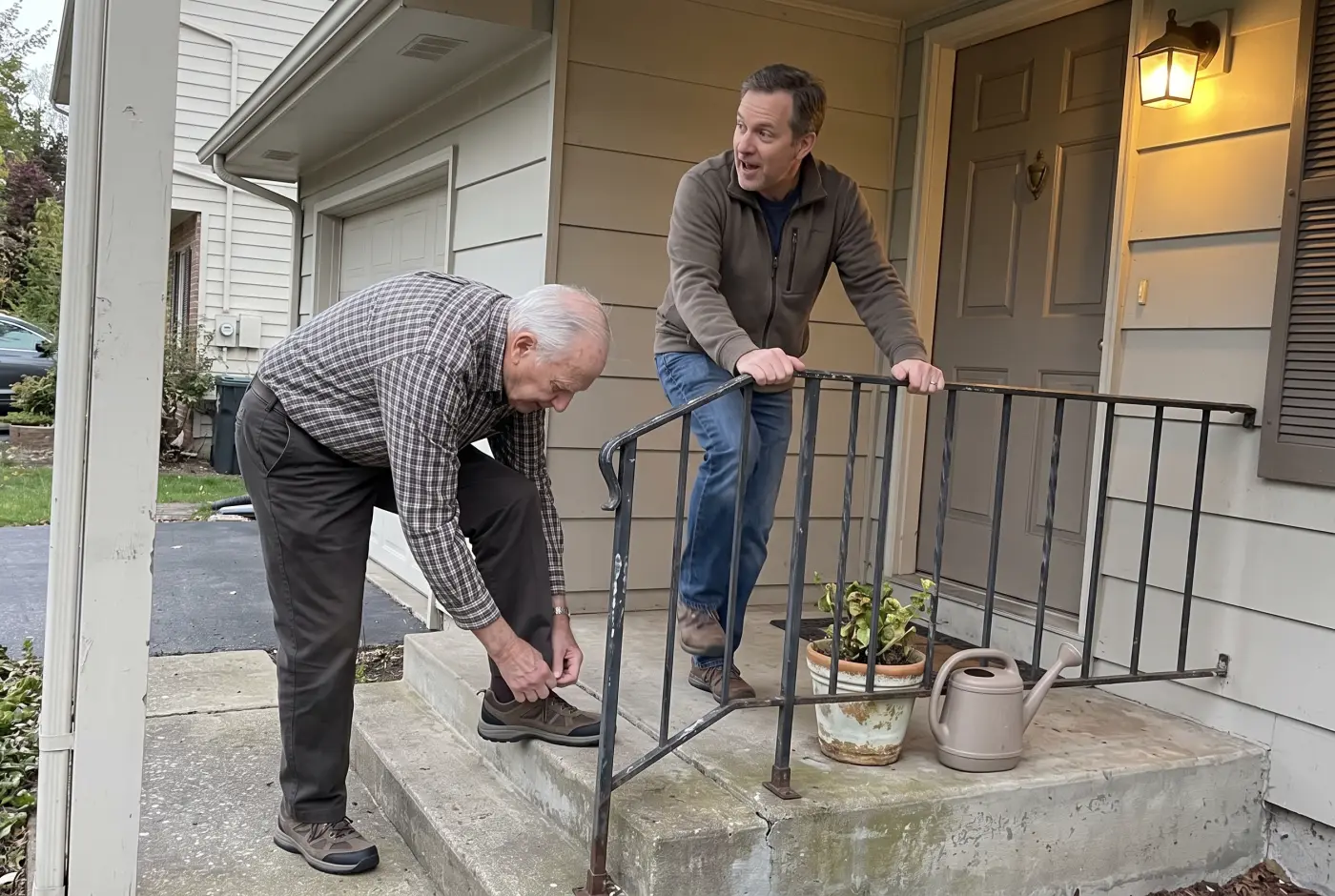
The chair is already beside you. Your shoes are on, but you aren't sure whether five minutes is worth starting, or whether standing without support is worth the risk.
Keep the chair close. U.S. physical activity guidance counts bouts of any length, so a short session is still activity.
Choose one move rather than rushing through the whole list. If standing feels unsteady, use the counter or stay seated. You get to decide when the session ends.
26Chair stands for leg and core strength

Start with a sturdy, armless chair. Sit with your feet planted and lean forward. Stand, then lower yourself back to the seat with control. Stay close enough to know where the chair is as you come down.
The National Institute on Aging's *Workout to Go* guide includes chair stands. Its exercise guide calls for 10 to 15 repetitions, a rest, then another set of 10 to 15. Chair stands work the thighs and abdomen.
That's a guide, not a demand to finish both sets today.
Check the chair before you begin. If it moves when you stand, change the setup. If the seat feels too low for a controlled return, choose another move for now.
You want to pay attention to your legs, not wonder whether the furniture will stay put. Sit for a moment when you're done and notice how they feel.
See more: 25 Small Changes That Let You Stay in Your Home Ten More Years →
25Standing marches holding a chair back
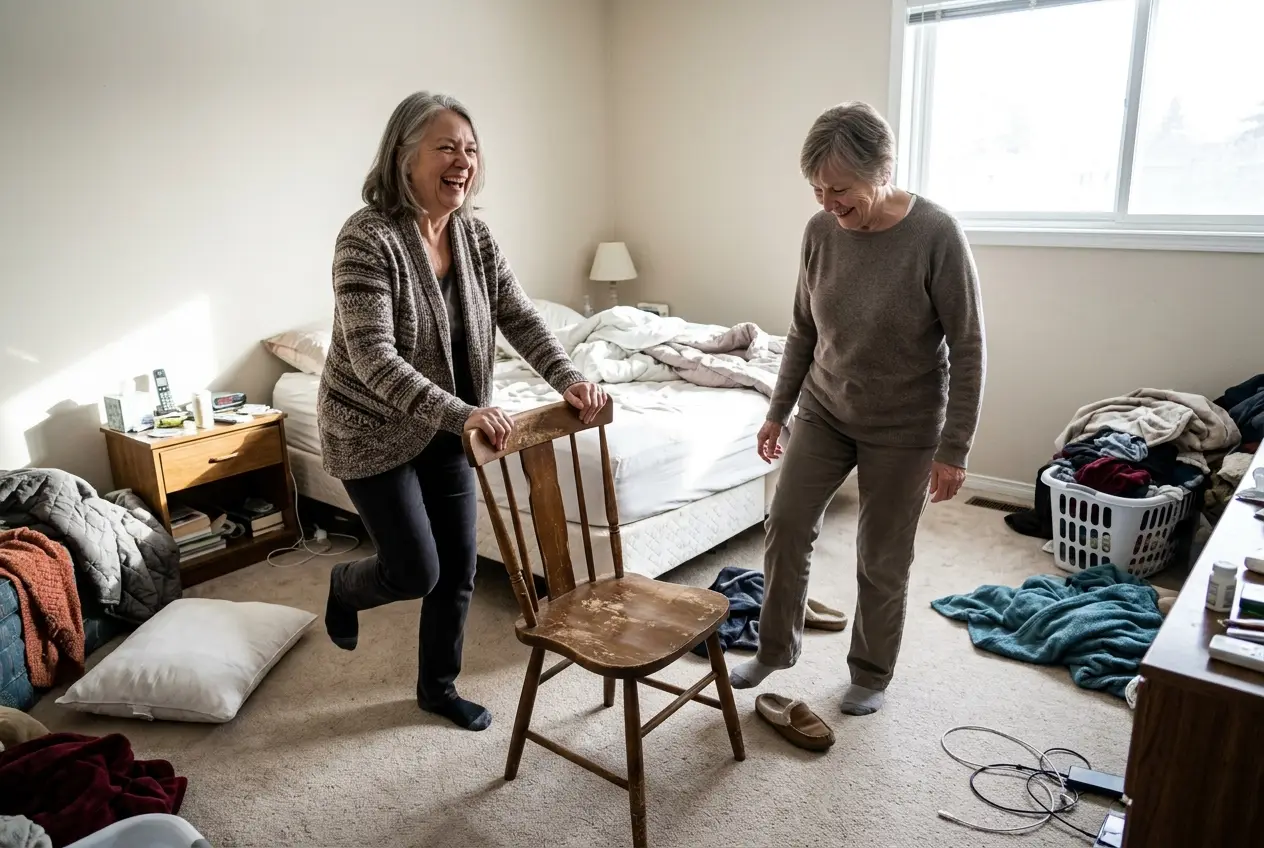
Some days, deciding to stand is the hard part. Put a sturdy chair where you can hold its back, then stand behind it. Lift one foot and set it down. Switch feet, as if you're marching without going anywhere.
Cleveland Clinic describes standing marches with a chair back for support. A CDC participant guide gives 3 to 5 minutes for marching in place while holding a stable object.
Keep your hand where it helps you feel secure. There's no pace to catch up with, and you can stop before the guide's full time. If standing doesn't feel right today, sit and march from the chair instead. The point is to choose a version you control from start to finish.
24Wall push-ups for upper-body strength
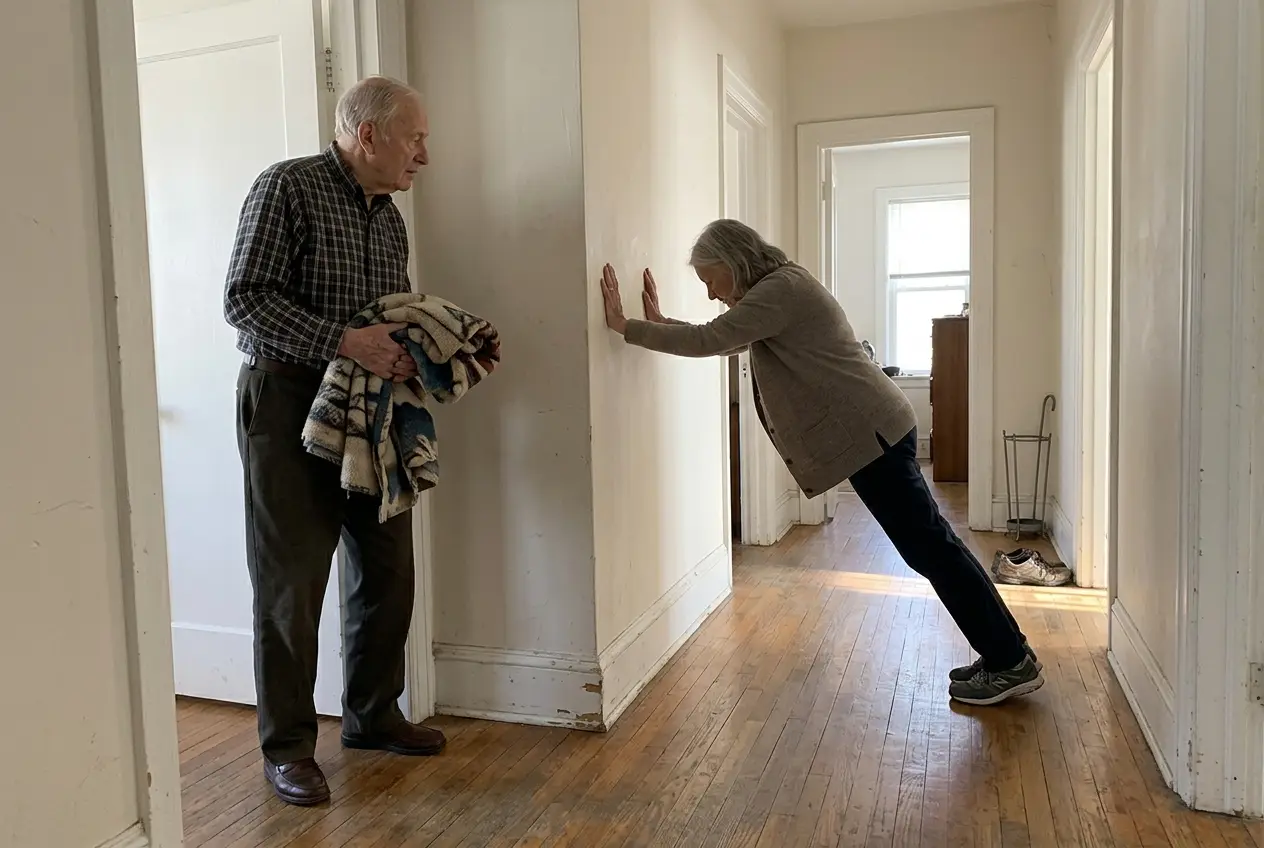
Find a clear stretch of wall, rather than a door someone could open. Put your palms on it and step back to a comfortable distance. Bend your elbows, then press away until your arms straighten again.
Mayo Clinic's modified push-up guide includes wall push-ups as an option for working the chest. Your feet stay on the floor, and there's no trip down to a mat.
Move closer to the wall if the press feels too demanding. Give yourself enough space that you won't dodge a picture frame halfway through. After a few presses, pause and check your footing. Do you still feel steady? If so, decide whether to continue. If not, you've already found your stopping point.
23Standing arm circles for shoulder mobility

Shoulders don't need a grand gesture. Stand beside a chair, or sit in it. Raise your arms only as far as feels comfortable, trace small circles, then change direction.
Harvard Health describes seated or standing arm circles for the rotator cuff. Its instructions suggest varying the circle size and direction. That gives you room to start small rather than copying somebody else's range.
Compare the directions. Does one feel easier to control? Lower your arms and rest whenever you want. A circle doesn't have to grow bigger to count as movement.
22Step-back toe taps at a low step

The step-back part happens after the tap. Stand near sturdy support, facing a low step. Tap the top with one foot, bring that foot back to its starting place, then switch sides. Don't climb onto the step.
The University of Nebraska-Lincoln balance workout describes alternating toe taps on a step. Keep your support close enough to hold, rather than reaching for it after you lose your place.
Look at the step before starting. If it's too high, don't improvise with a loose book or sliding box. Save this drill for a fixed step with a dependable handhold. On level ground today, another supported move is the better choice. Five minutes gives you enough time to choose carefully.
21Counter exercises for seniors: calf raises
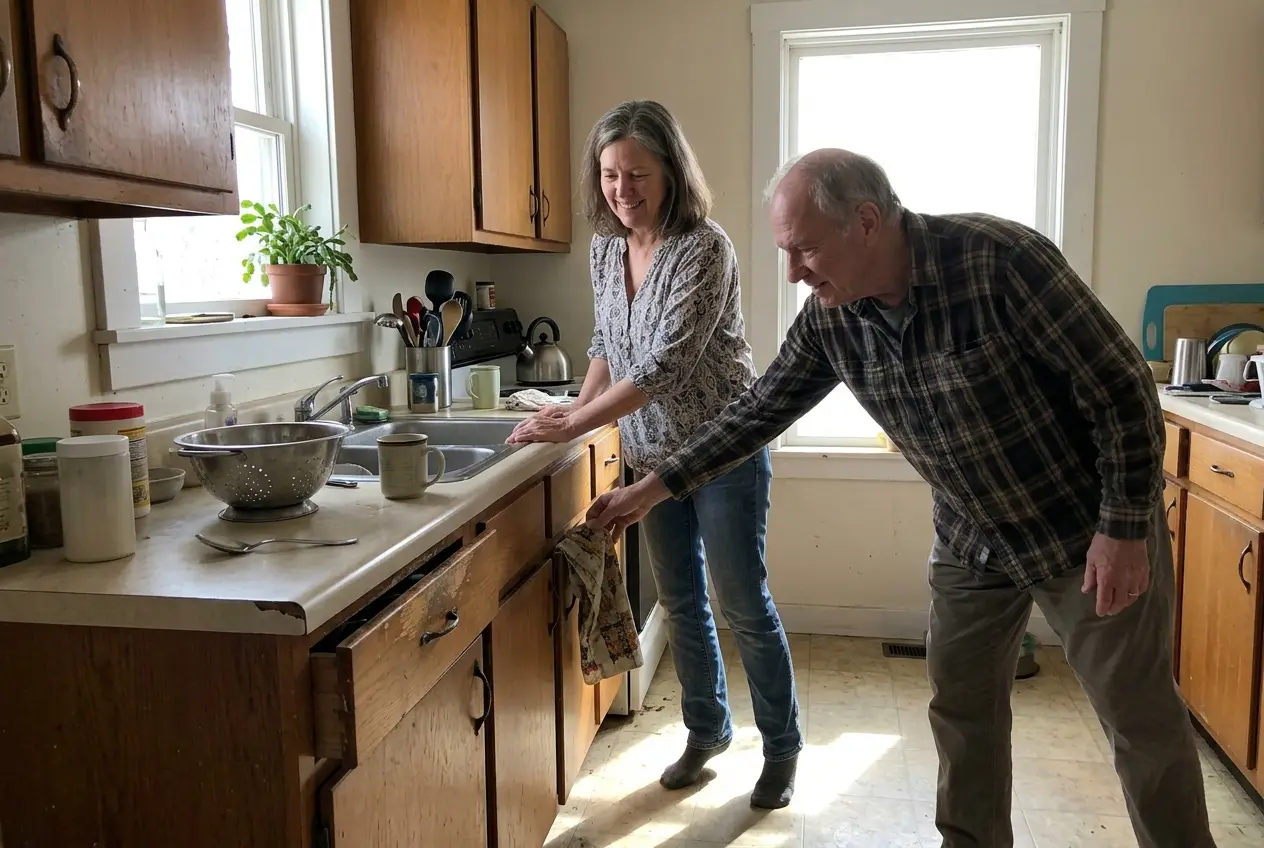
Here's a counter move that doesn't require clearing the whole kitchen. Face a sturdy counter and rest your hands on it. Rise onto the balls of both feet, then lower your heels without bouncing.
The National Institute on Aging calls this a toe stand. Its exercise guide gives 10 to 15 repetitions per set and describes progressing to one leg as you're able. There's no need to try that harder version today.
Look down first. A curled mat or something slippery underfoot changes the exercise before you've started.
If you catch yourself pulling hard with your arms to rise higher, lower your heels and reset. The lift can stay small. You should feel able to pause at the bottom, check where both feet landed, and decide whether another rise feels worthwhile.
20Counter exercises for seniors: side leg lifts
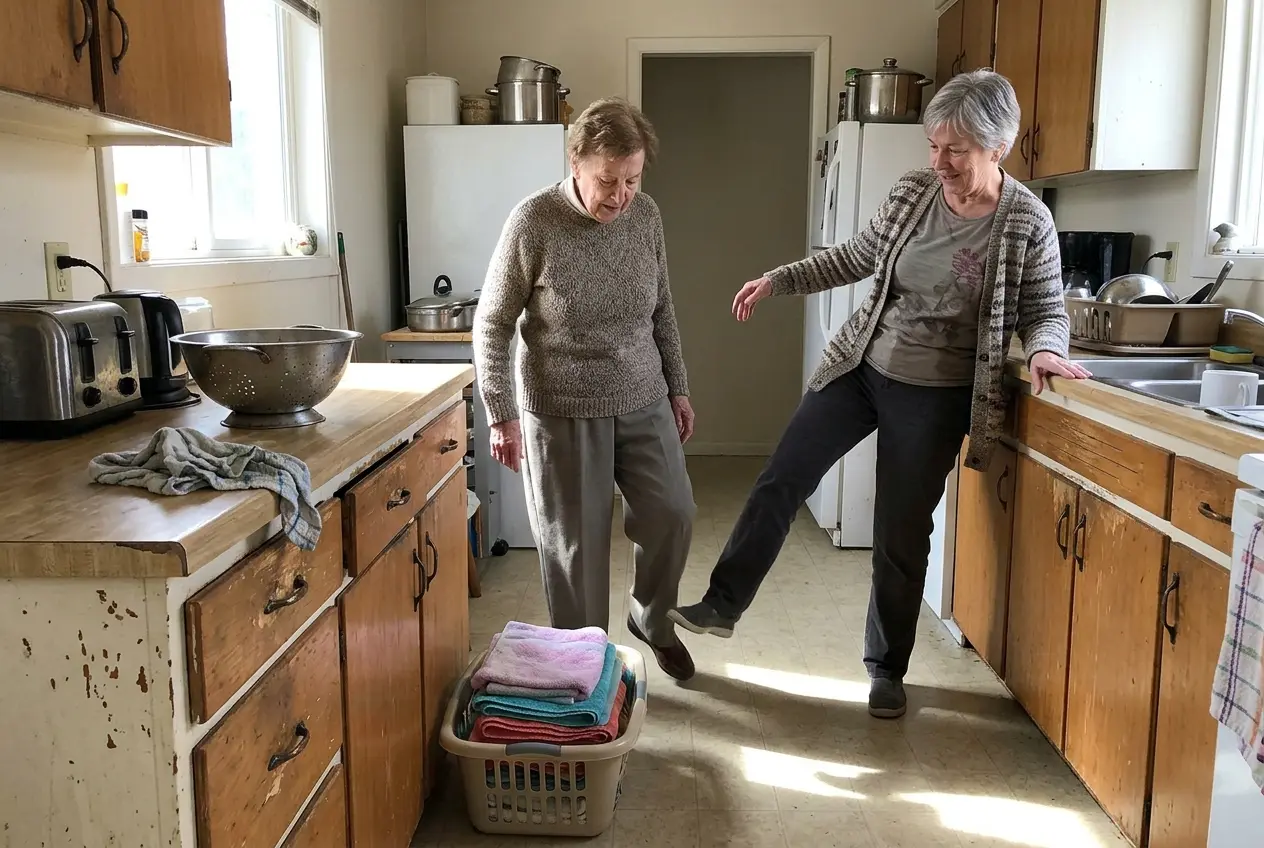
Face the kitchen counter and hold on. With your toes pointing forward, lift one leg out to the side. Bring it back beneath you before lifting again.
The National Institute on Aging's side leg raise uses a sturdy chair or counter for support. Its guide calls for 10 to 15 repetitions on each side and keeps the toes facing forward. Check their direction before worrying about height.
Clear the space beside you first. A stool or an open dishwasher shouldn't be part of your route.
Switch legs when you're ready, keeping a hand on the counter. If one side feels less controlled, use a smaller lift. There's no reason to swing higher to match the other leg. Take a moment with both feet on the floor between sides; that pause belongs in the session, too.
19Standing heel-to-toe walk along a wall
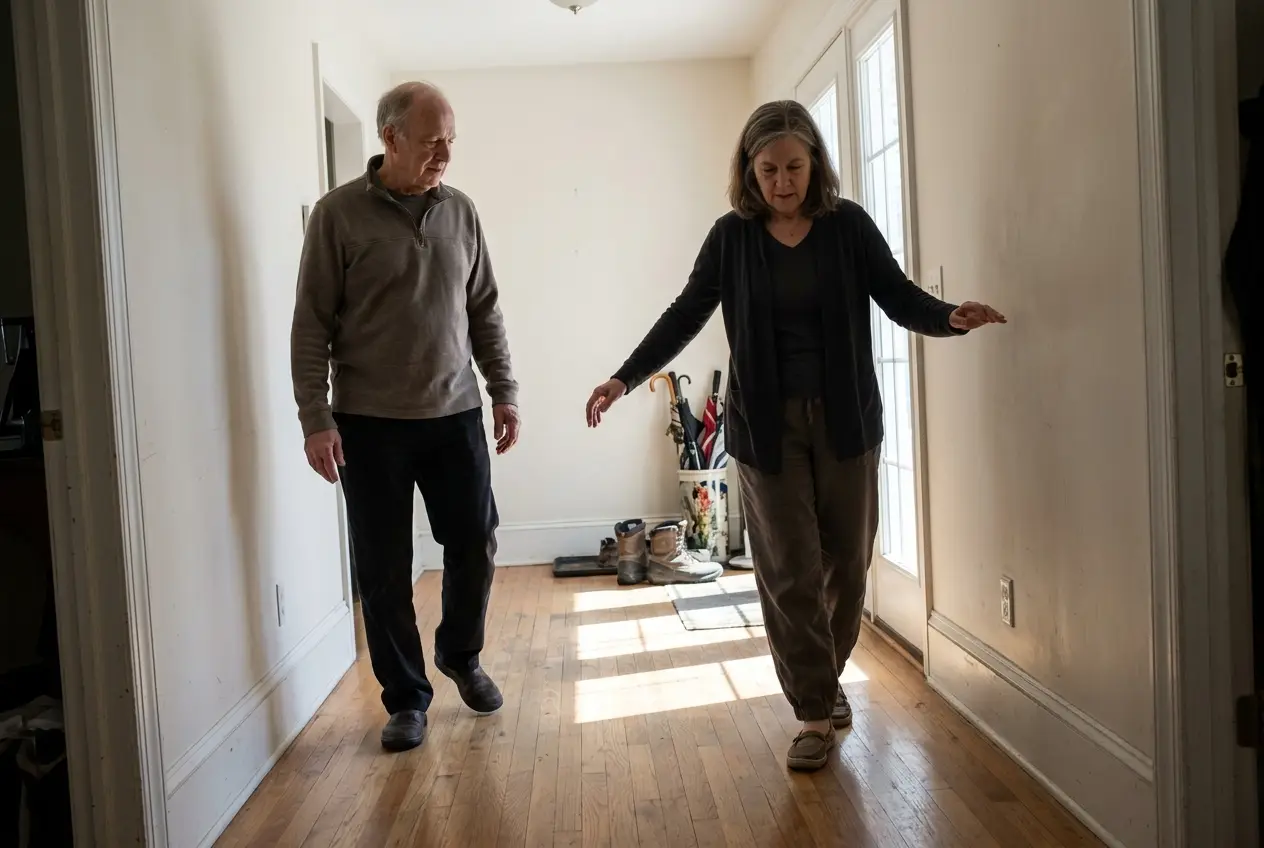
A hallway gives you a clear route for balance practice. Stand beside a wall and place one foot ahead of the other, bringing the front heel toward the back toes. Take the next step slowly enough to stop whenever you choose.
The National Institute on Aging's exercise guide includes a heel-to-toe walk with a chair or wall nearby for safety. Use the wall from the beginning if you want it. Keep your eyes on the clear stretch ahead, not on a destination at the far end.
Stop and find your footing before turning around. If you feel unsteady, hold the wall and return to ordinary walking. You don't need to finish the hallway for the practice to be useful.
18Single-leg balance with hip flexion
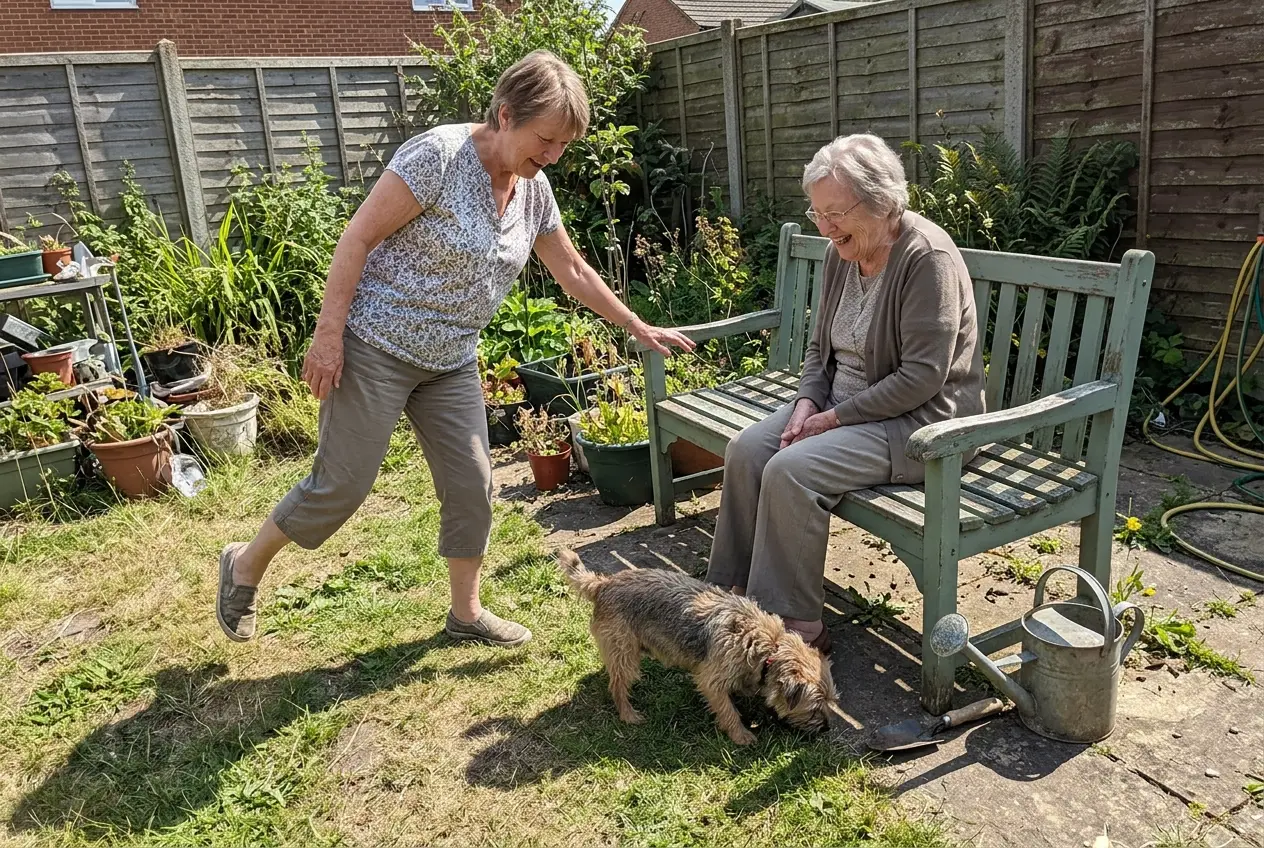
Set a clock where you can see it. Stand beside sturdy support, then lift one knee in front of you just enough to clear that foot from the floor. Note how long you feel steady. Put the foot down before you feel forced to grab.
The National Institute on Aging suggests timing a one-foot stand near support and checking again monthly. Treat the time as a note, not a score to beat. Keep a hand on the support if that helps you control the position.
Try the other side separately. The times don't have to match. If they differ, you've learned what to check again next month. Nothing needs fixing before you leave the room today.
See more: 25 Fears About Falling That Keep People Home, and the Fixes That Get Them Out →
17Lateral shoulder raises with light dumbbells
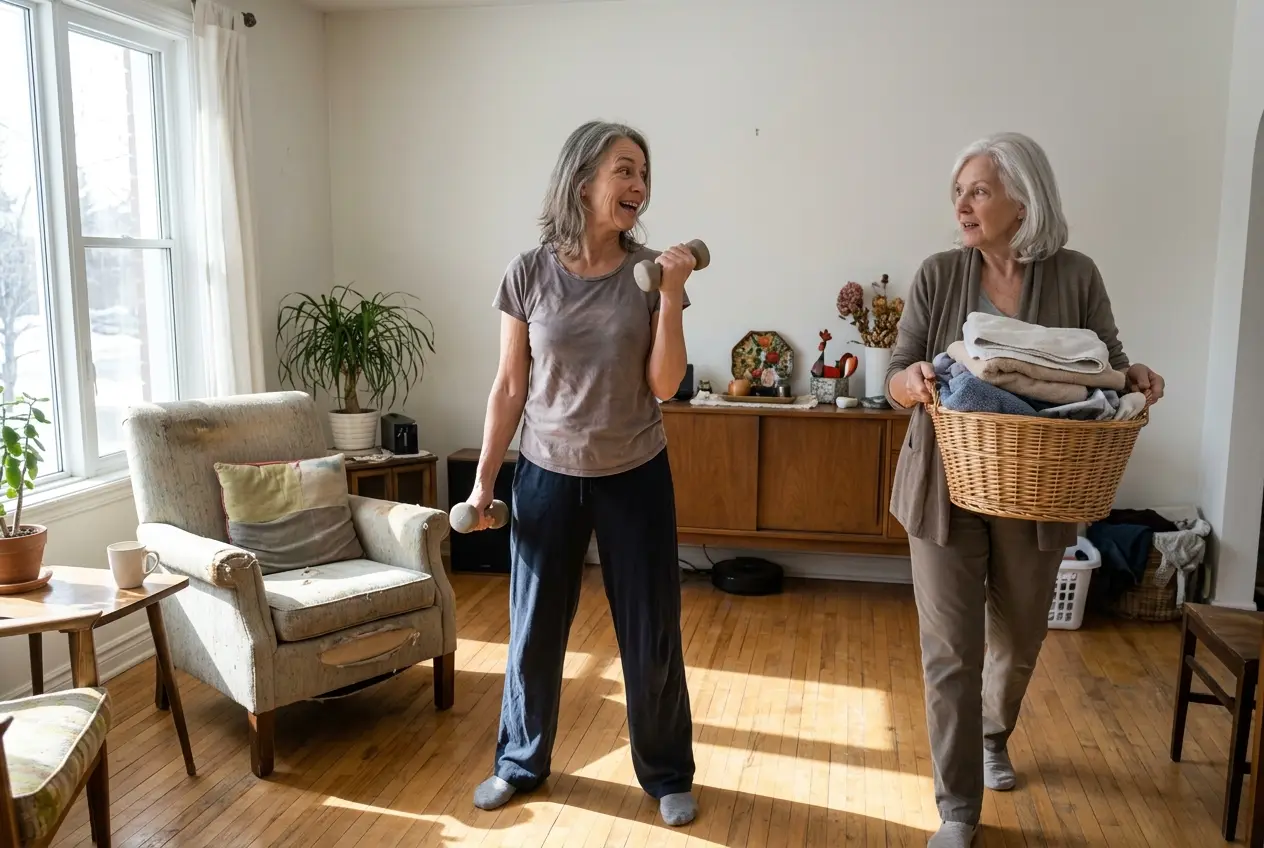
Lifting a weight sideways is easy to overdo when you're trying to make the movement look big. Start seated or standing securely. First, try the outward lift without weights. Lower your arms and ask yourself whether you controlled the whole path.
If that felt comfortable and you have light dumbbells, hold one in each hand. Lift your arms out to the sides within the same range, then lower them slowly.
The American Council on Exercise's lateral raise instructions describe the outward lift. They discuss changing arm rotation higher in the movement. You don't need to chase that upper range in a short first session.
Stop if a shoulder objects. When you're finished, put the dumbbells on a stable surface, not on the seat where you'll sit next.
16Seated bicep curls with light dumbbells
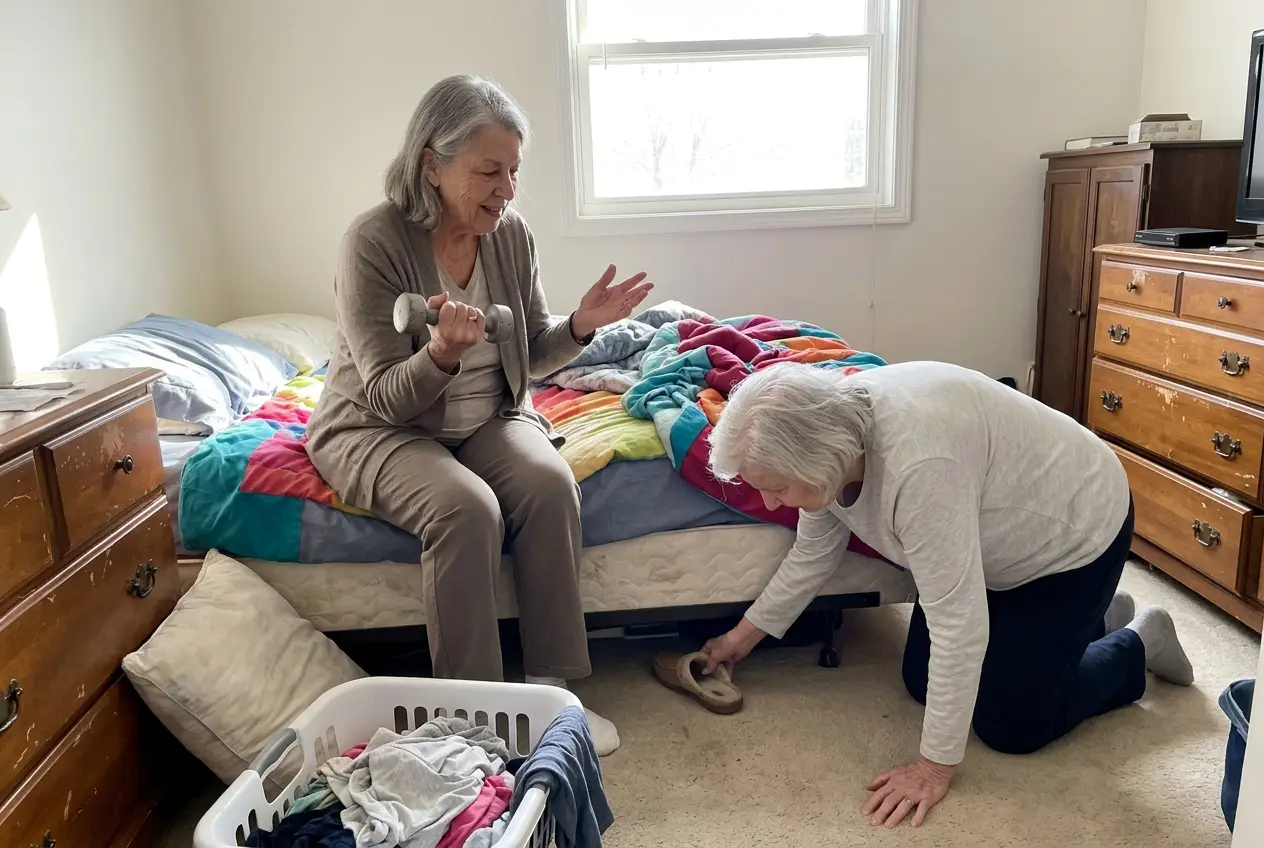
A dumbbell belongs in your hand only if you control it from start to finish. Sit in a sturdy chair with your feet planted. Hold a light weight at your side, bend your elbow to bring it upward, then lower it without letting the weight drop.
In Mayo Clinic's biceps curl demonstration, the wrist stays straight and firm. Check yours before lifting. If it bends backward to manage the weight, try the motion empty-handed instead.
You don't have to buy a pair before you know whether you like this move. Walmart listed a CAP Barbell 3-pound dumbbell when this article was researched in October 2026. That example is a product, not a weight you must use.
Between curls, let your arm return to its starting place. Take the time to notice whether your hand still holds the weight securely. If it doesn't, set the dumbbell down rather than trying to finish a set.
15Neck stretches and shoulder rolls for tension

Been looking at your phone for a long stretch? Start with your shoulders. Sit where your feet reach the floor. Roll both shoulders forward, then backward.
Cambridge University Hospitals' shoulder guidance includes rolls in both directions. It says to stop or reduce the range if they're painful. That matters more than making a large circle.
For the neck portion, turn your head only within a comfortable range, without pushing it with your hand. Look ahead again before switching sides.
If the neck movement brings pain or dizziness, stop and ask a clinician which movement is right for you. The shoulder rolls and the neck movement don't have to travel together; leave out the part that doesn't feel right.
See more: 27 Things That Get Better After 60 That Nobody Mentions →
14Hand strengthening exercises with a soft ball

The ball in a drawer is enough, provided it feels soft in your hand. Sit down, hold it in one palm, squeeze, then release. Let your hand open fully afterward.
The Arthritis Foundation's hand exercise calls for holding a squeeze for 5 seconds.
If you're shopping, check firmness rather than assuming every stress ball feels alike. A TheraBand hand exerciser listing describes a 2-inch ball in several resistance levels. At half compression, the extra-soft version takes about 1.5 pounds of force; the soft version takes about 3 pounds.
You don't need either product to try the motion. If squeezing increases pain, release the ball and stop. The next hand movement needs no ball at all.
13Hand strengthening exercises with finger lifts
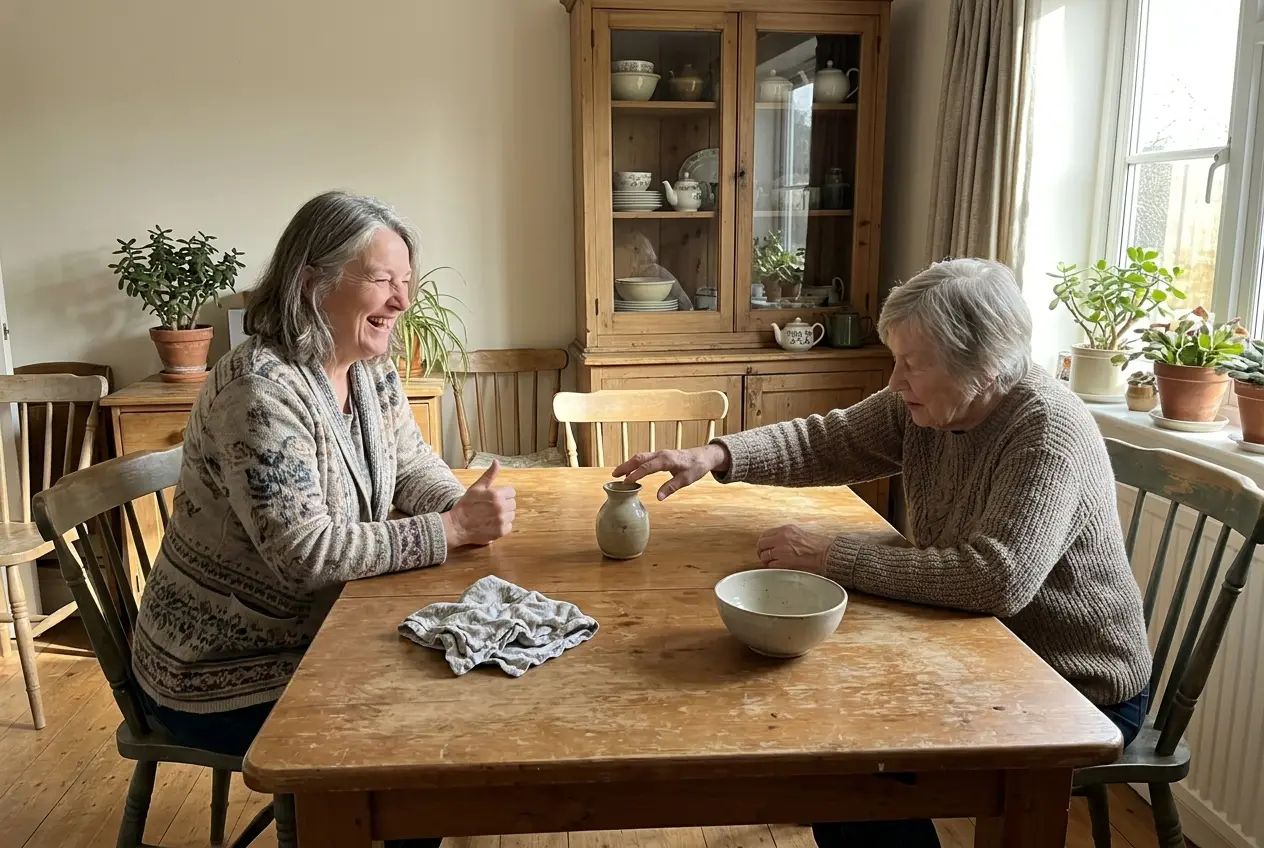
Put your hand flat on a tabletop. Lift your thumb a little, hold it, then let it settle back down. The Arthritis Foundation's thumb exercise uses a 2-second hold.
Afterward, try lifting a finger without forcing the others to stay perfectly flat. Notice which ones move freely and which want a smaller range. Grip work doesn't have to mean squeezing something.
NHS inform's hand exercise advice emphasizes avoiding a lasting increase in pain. If a finger resists, don't press it down with your other hand. Stop rather than trying to make both hands look alike.
This is an easy move to check while you're seated, with no ball to find and no weight to hold. Pay attention to what changes when you switch hands.
12Hand strengthening exercises with wrist curls
Rest your forearm on a firm surface so your hand extends beyond its edge. Start without a weight. Move your wrist up and down slowly, keeping the forearm supported instead of lifting your whole arm to help.
The American Academy of Orthopaedic Surgeons' wrist program describes staged strengthening with a light dumbbell, beginning around 1 pound. That's part of a therapeutic program. It isn't an instruction to add weight to a painful wrist today.
Try the empty-handed motion first. If it hurts, stop and ask a clinician whether wrist curls belong in your plan.
Leave the weight on the shelf until you know the movement itself feels manageable. A firm surface and a controlled path matter more than finding something heavy enough to hold.
11Seated chair dancing to favorite music
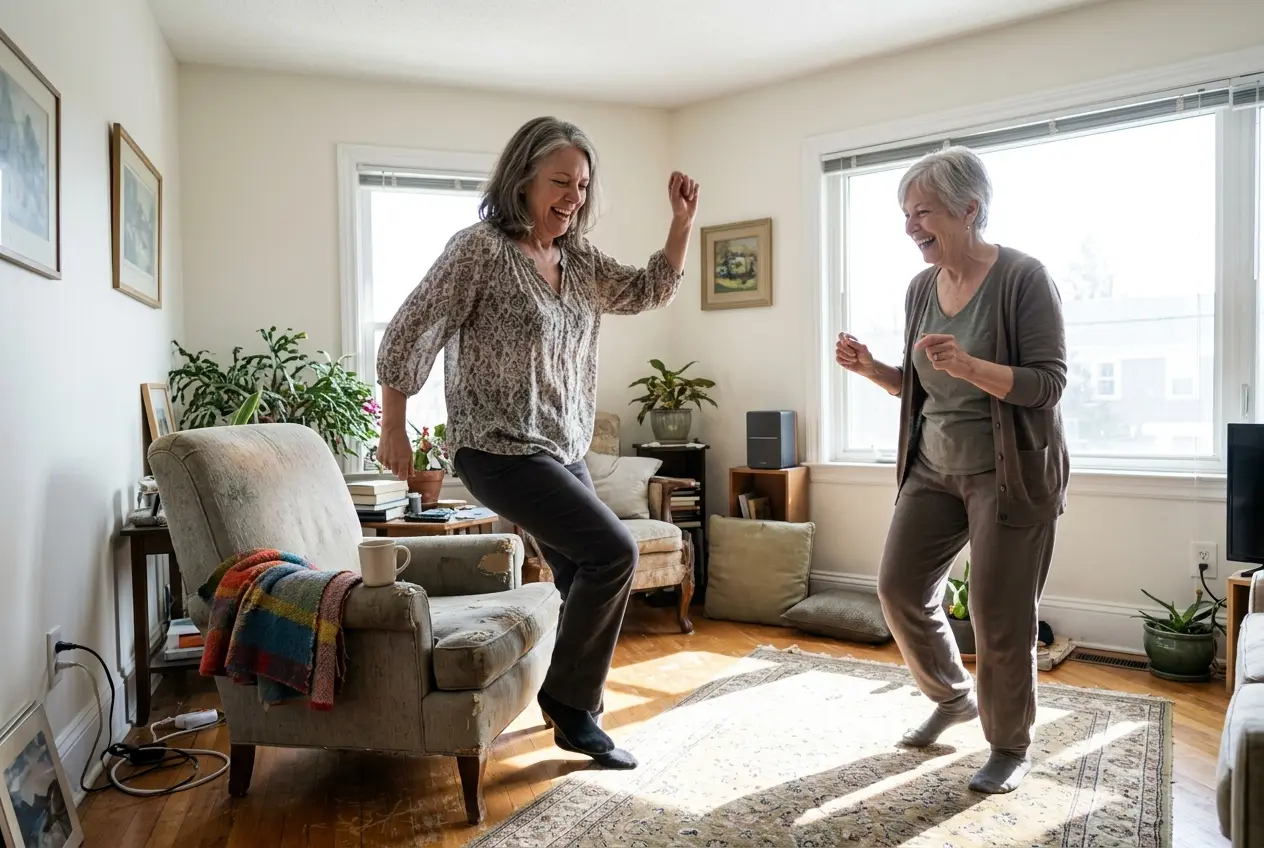
A song comes on while you're waiting for the kettle. Sit in a sturdy chair, plant your feet, and move your arms to the beat. Let your shoulders and upper body join in without leaning so far that you lose the chair back.
The National Center on Health, Physical Activity and Disability includes seated dance among adapted ways to move with rhythm. You don't have to learn a sequence or keep time with anyone else.
Pick a song you know.
If the beat gets faster, you needn't follow it. Finish the song, or stop sooner. Next time you hear it, you'll know whether that pace suited you.
10Chair dancing arm waves and shoulder sways

Keep the chair on level ground and sit back far enough to feel supported. Sweep one arm outward, bring it in, then try the other. Add a small shoulder sway if you feel steady. Your feet stay planted while your upper body moves.
The National Center on Health, Physical Activity and Disability's seated ballet arms show dance-inspired movement from a chair. You don't need a pillow on the seat or hand weights to begin. Either addition would change how steady you feel.
Try a slow piece of music for this version. Change direction with the melody instead of repeating the same wave until it feels like a chore. Keep the sway small enough that you remain centered over the seat.
9Resistance band seated rows for the back
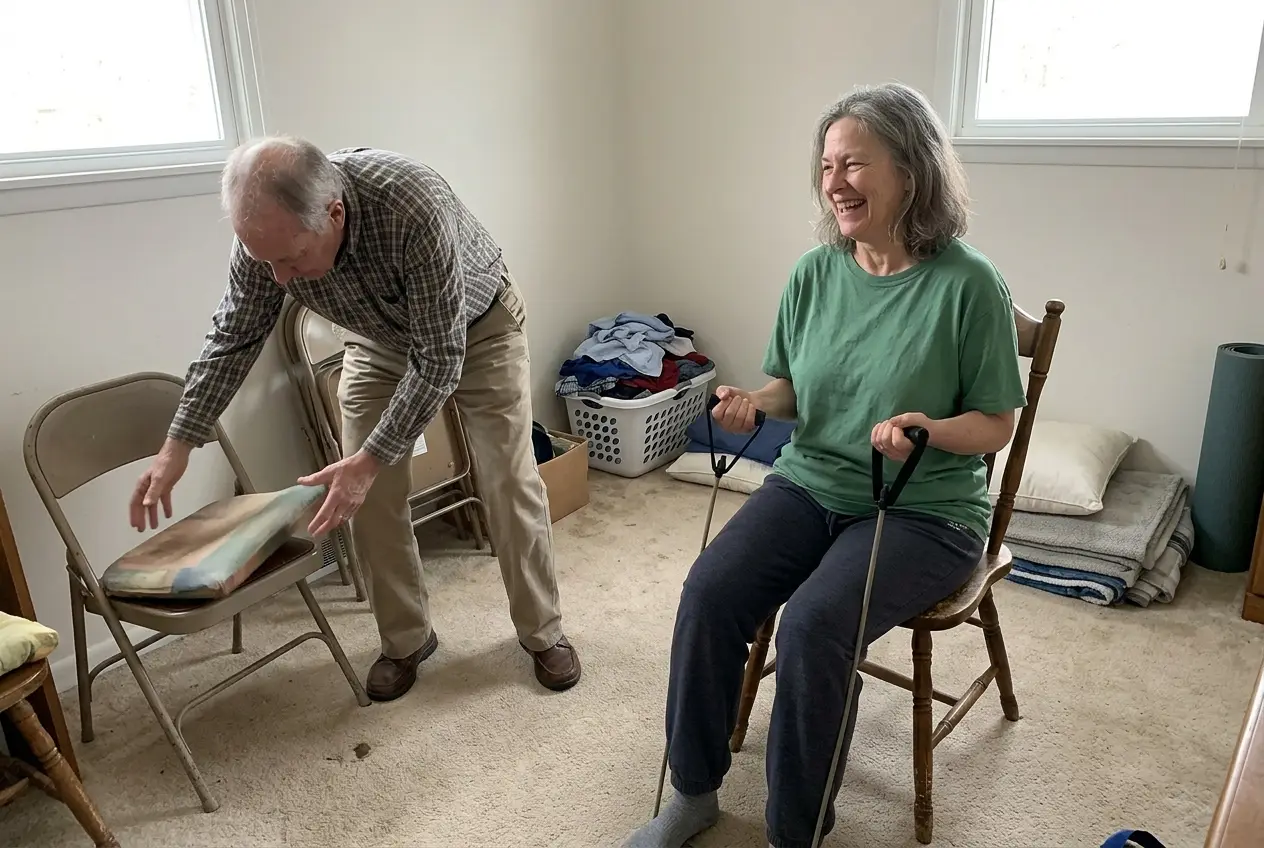
Before you pull, look at where the band goes. Sit securely and set up resistance tubing as shown in Mayo Clinic's seated row demonstration. Draw your hands toward your body. Return slowly so the band doesn't snap back.
Mayo Clinic identifies the seated row as an upper-back exercise. If you aren't sure how to secure the band, watch the demonstration first rather than looping it around loose furniture.
Inspect the band for damage and keep it away from your face. Setup taking most of your five minutes isn't wasted time. Learn the route today; save the repetitions for when you're sure the band stays put.
8Resistance band leg presses while seated
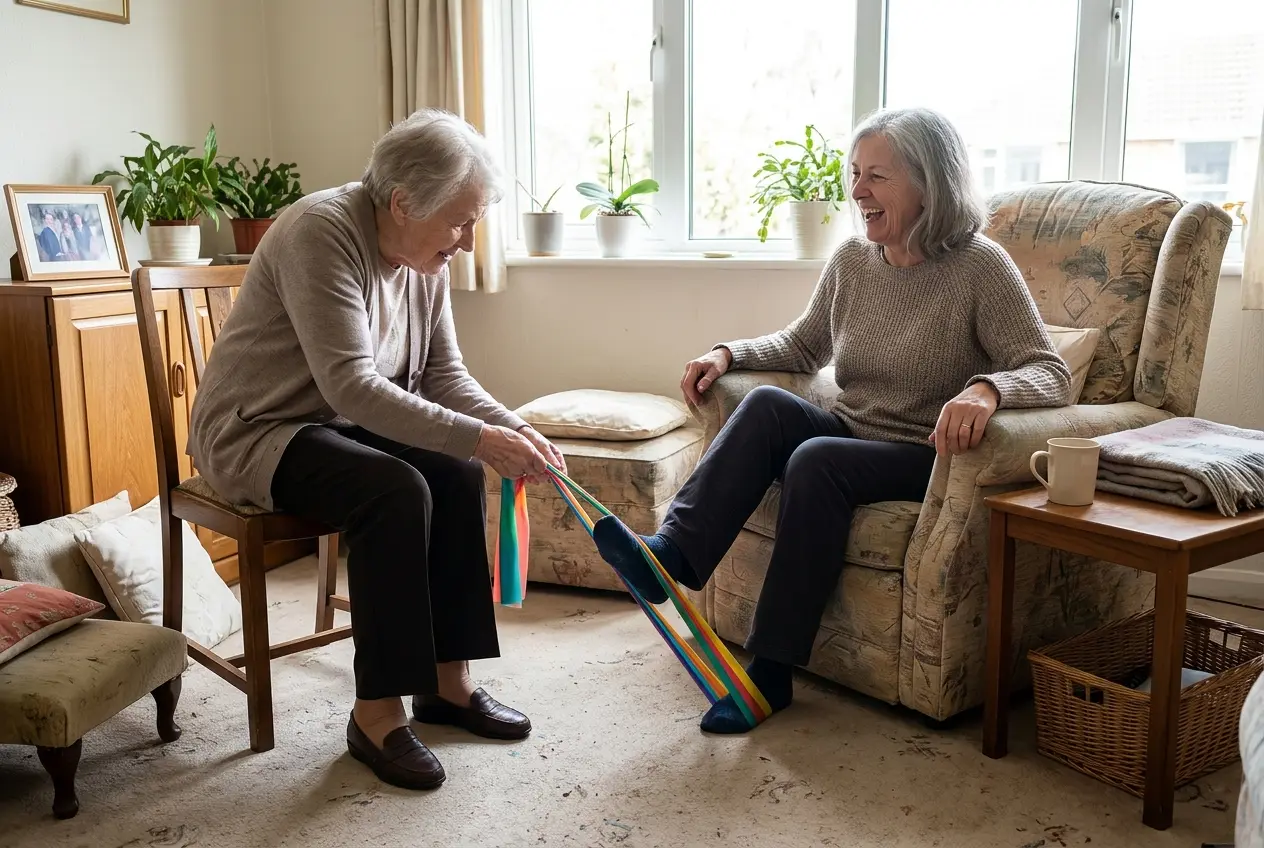
A band around your foot needs your attention before you press. Sit back in a sturdy chair and check the placement in Senior Exercise Charts' leg-press instructions. Hold the ends securely. Press the foot away in a controlled motion, then let it return slowly.
That chart includes the leg press among 6 band moves. Look at its setup before copying the motion from memory. If the band slips off your shoe or pulls your leg into an awkward angle, stop and reposition it.
Don't straighten the leg with a sharp kick.
If managing the loop feels like too much today, you don't have to make equipment work to earn a short session. Set it aside. The chair is still there when you're ready to try something else.
7Resistance band bicep curls in a chair
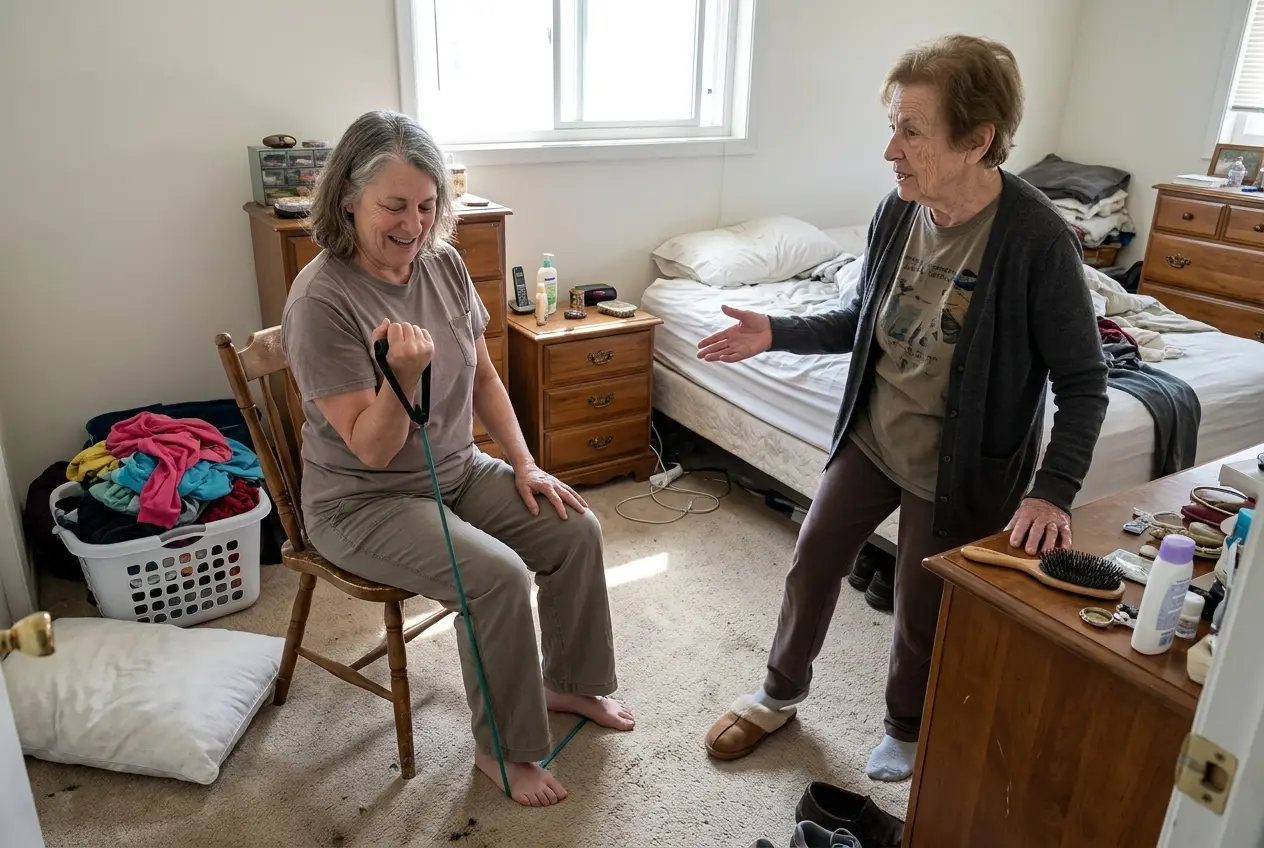
The band in the store looks harmless until it stretches. Choose one you can hold securely and control as it returns. Sit in a sturdy chair.
The CDC's participant guide names arm curls with a resistance band and points to the NIA's *Get Fit for Life* guide for instructions.
Color tells you which band is which within a set. It doesn't tell you how one will feel in your hands.
A TheraBand non-latex set sold at Walmart included 3 color-coded bands when this article was researched in October 2026. You don't need the strongest one, or a purchase at all, to begin with an empty-handed curl.
Follow the guide's band placement before pulling. Keep the band clear of your face. When your wrist starts bending to finish a curl, end the set rather than fighting it.
6Medicine ball seated chest press
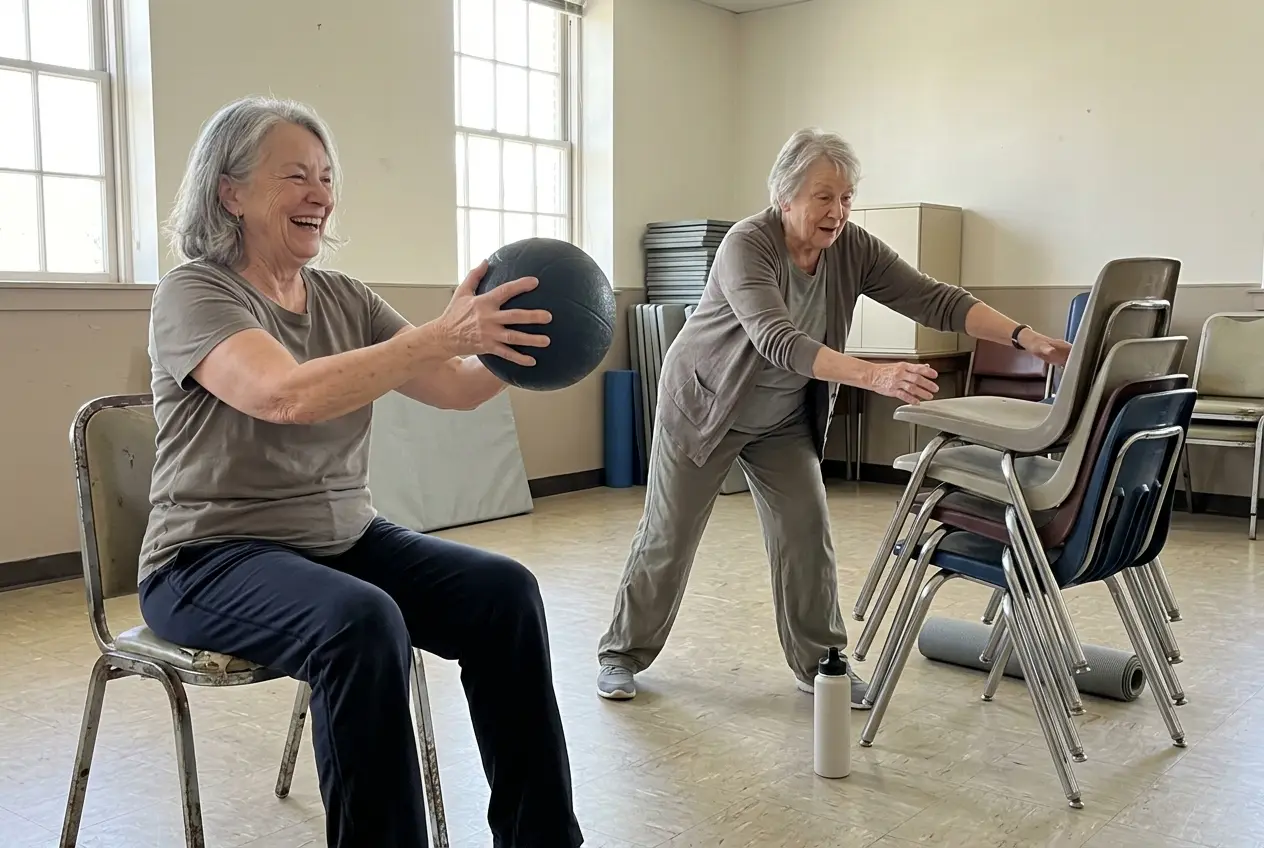
Place both feet on the floor and sit tall in a sturdy chair. Hold a medicine ball at chest height with both hands. Press it forward only as far as you control, then bring it back toward your chest.
An IDEA Health & Fitness Association seated class plan includes a medicine ball press from this position. The ball stays in your hands. You aren't throwing it or leaning forward to chase it.
Check your grip before each press.
If the ball feels heavy or slippery, put it down. Make the same arm motion without it. You can return to the ball another day, after you've decided whether you like the seated movement on its own.
5Medicine ball overhead reach and pass
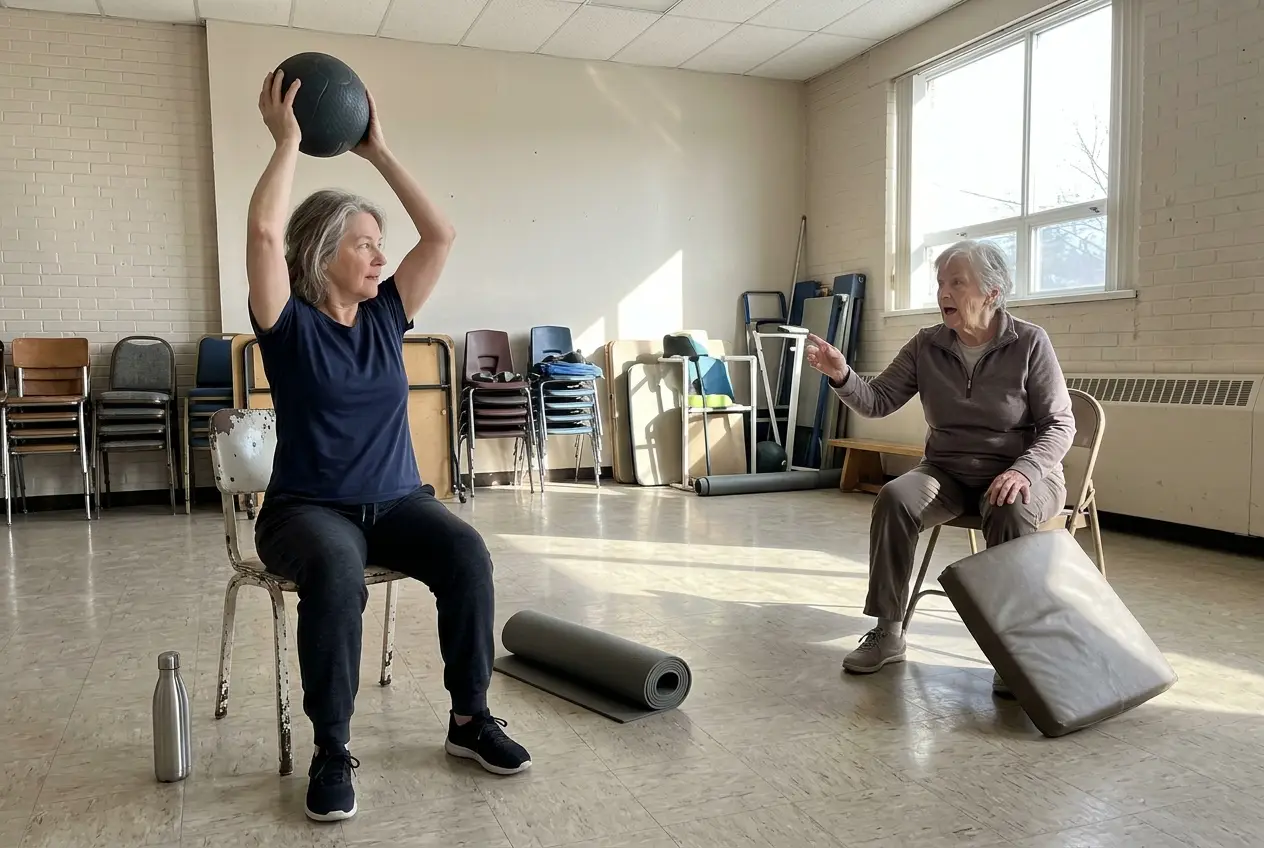
Before taking a ball overhead, test the reach without one. Sit in a sturdy chair with your feet planted. Raise your hands only through a comfortable path, then bring them down. If that feels controlled, hold a ball securely and repeat the path.
Human Kinetics describes a medicine ball overhead reach. A Portland Community College exercise guide includes a seated overhead medicine ball pass. For a first solo session, keep the ball in your hands; save passing it for an activity with another person.
A 4-pound GoFit medicine ball was one retail example when this article was researched in October 2026. It isn't a starting requirement. If a ball strains your grip or makes you lean back, put it down and return to empty hands.
4Seated cat-cow stretch for the spine
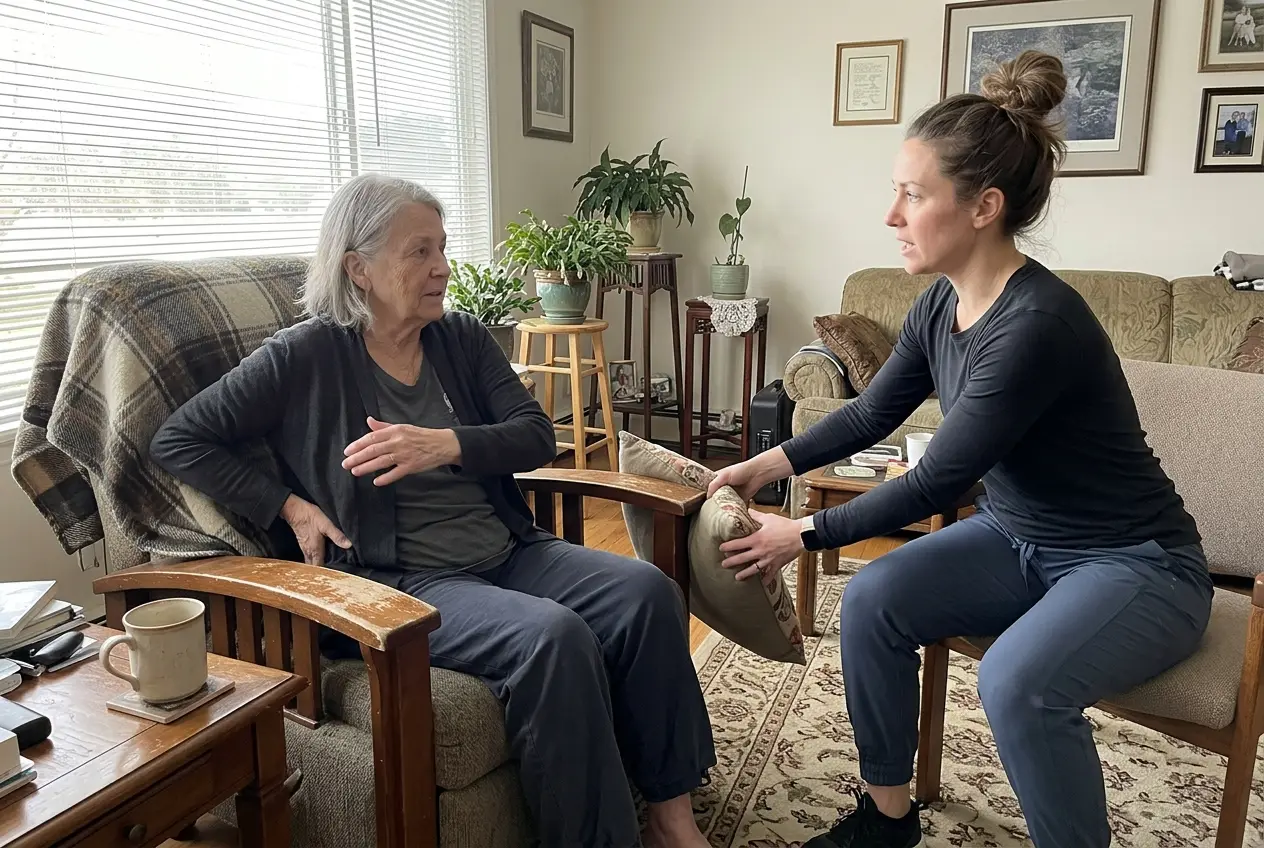
You sit down after standing work and notice how still your back has been. This article's research found no reliable guide to an exact seated cat-cow sequence for a short home session. There's no sourced set of instructions or repetitions to follow here.
If you want to make this part of your routine, ask a physical therapist to show you a version suited to your back. Bring up the chair you use at home and ask what range to stay within.
For today, leave out any spine movement that pulls or aches. Sitting within a comfortable range is enough while you decide what to ask.
3Seated ankle circles for joint mobility
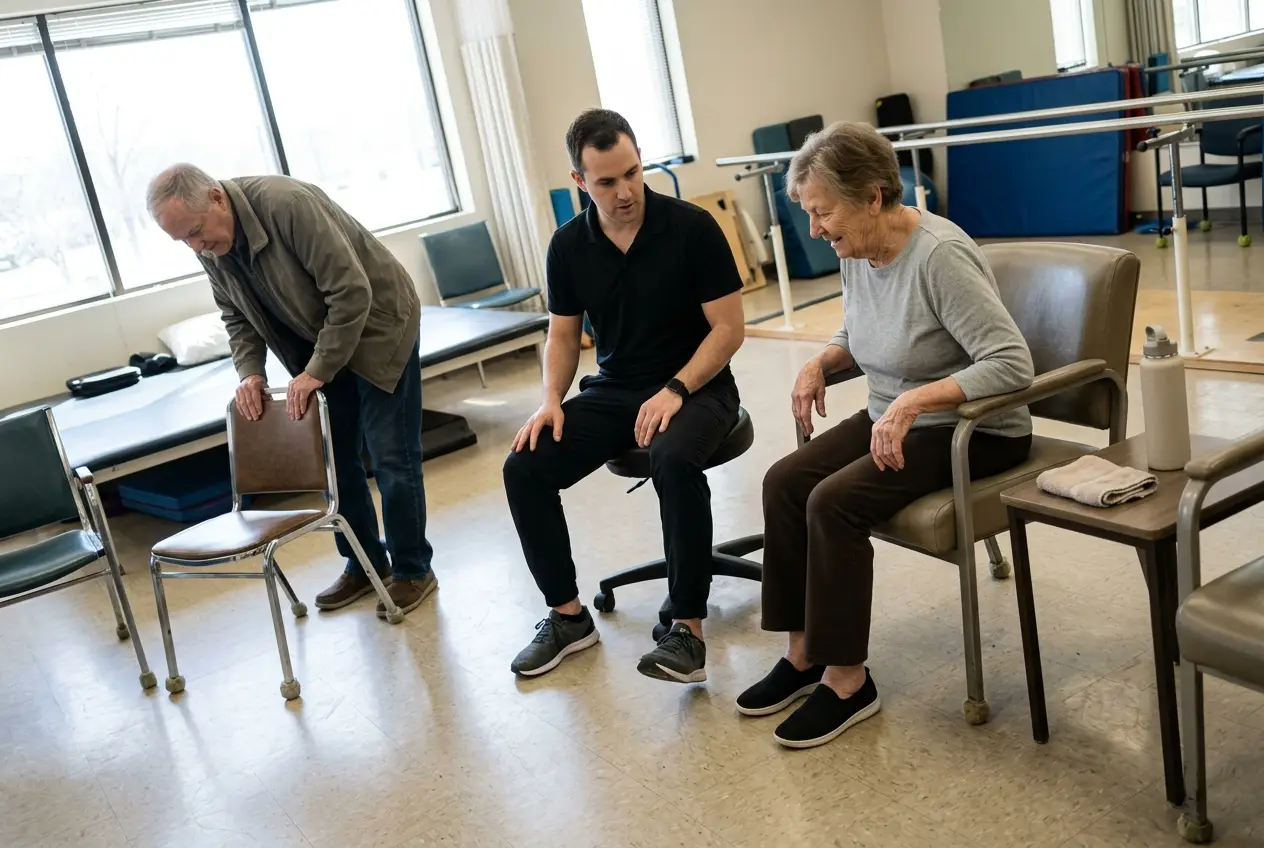
Can you sit with both feet supported and lift one without shifting on the chair? Check that before planning an ankle-circle session.
This article's research found no reliable instructions for this exact seated option. Rather than guess at circle size, direction, count, or hold time, ask your clinician or physical therapist to show you a version suited to your foot and ankle.
If you have a specific concern, ask what movement to avoid as well. Until you have that guidance, choose one of the sourced seated moves above. You don't have to invent a routine to use five minutes well.
2Seated leg extensions for the quadriceps
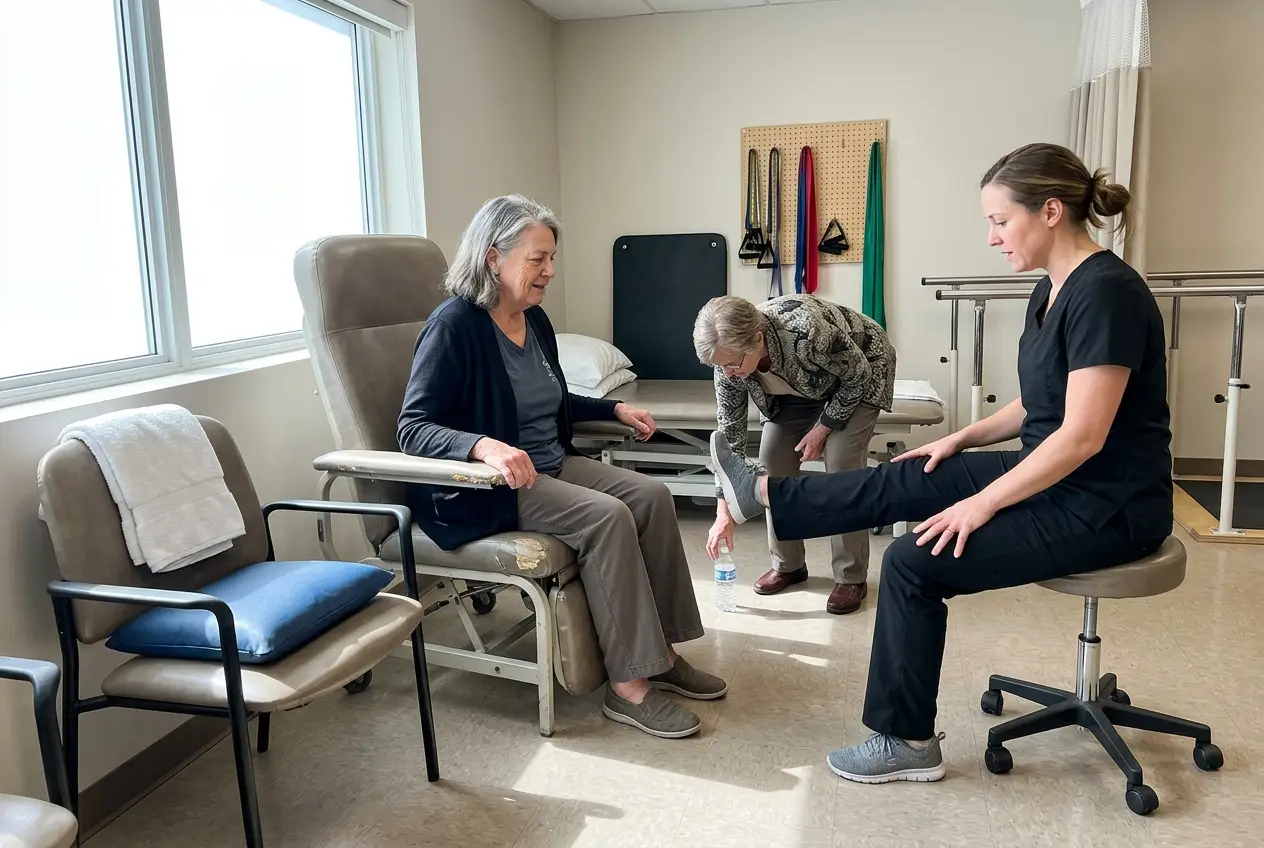
Sit in a sturdy chair and notice whether you stay supported when you move either foot. There's no band or ankle weight to set up for a body-weight seated option.
No reliable source in this article's research specified instructions, repetitions, or a hold time for this exact seated leg extension. If you want to use it for a knee condition, ask your clinician to demonstrate it and set your range.
You can say, “I want a chair move I can do at home. Show me where to stop.”
For today, leave out any motion that strains your knee. A sourced supported march gives you another choice.
1Five-minute warm-up before any routine
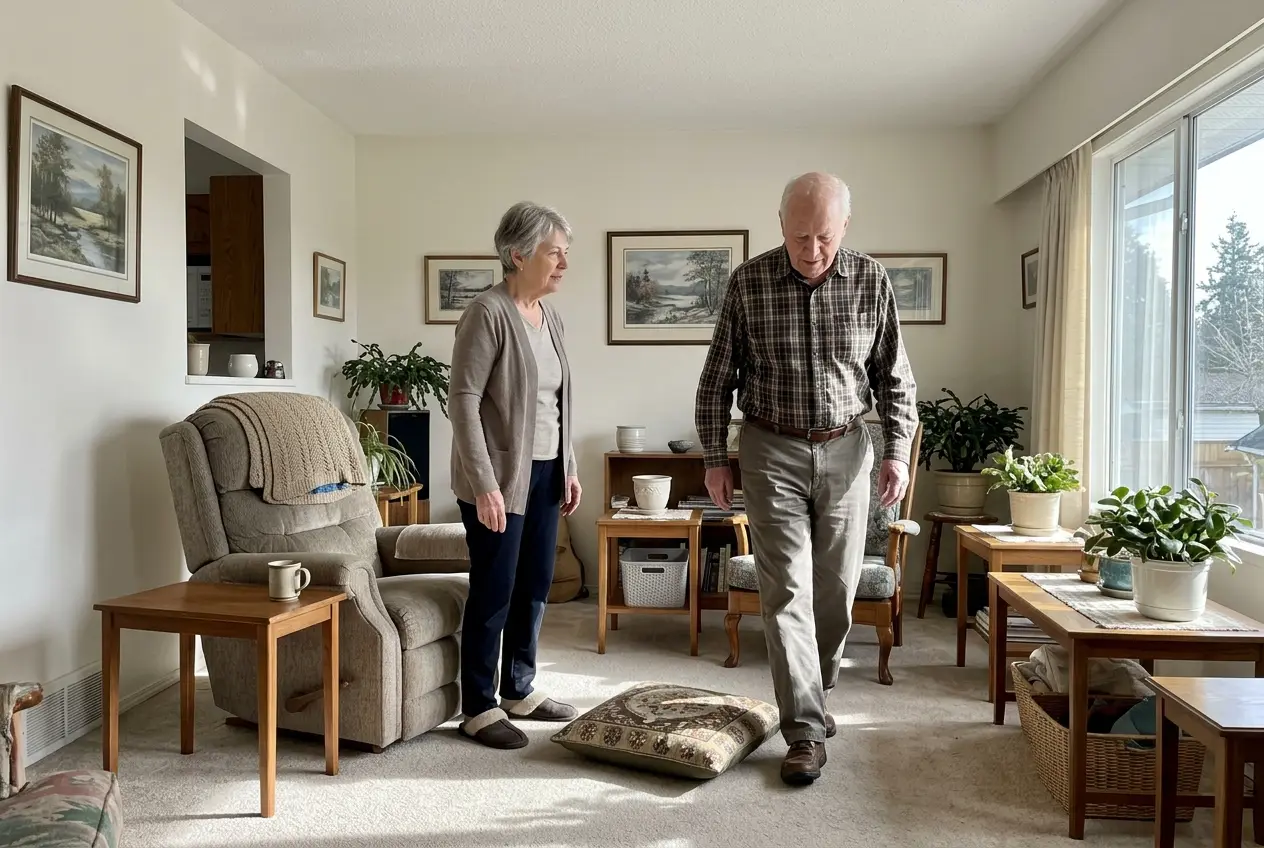
Before a harder move, allow about 5 minutes to get moving. Try easy hip circles while holding a sturdy support, keeping the range comfortable. Don't hurry toward the next exercise just because the clock is running.
The National Institute on Aging advises warming up before exercise and cooling down afterward.
The American Cancer Society suggests about 5 minutes of easy movement before a home workout. Hip circles are among its examples.
If standing doesn't feel comfortable, ask your clinician for a seated warm-up that suits you. On a low-energy day, this warm-up can be the whole session. Another day, you'll already know how you want to begin.
The bottom line
The starting point is one you set up before moving: a sturdy chair, a clear floor, and support within reach. Five minutes doesn't require 26 exercises. Pick the one you can do with control.
The well-prepared version of you has checked the chair and decided what to do if a movement feels wrong: stop, sit, and choose another move or another day.
Which exercise feels doable where you are right now, and what would make the space around you feel steadier?
Up next
26 Signs You're Getting Older That Have Nothing to Do With Wrinkles
A shorter stride, a dim restaurant menu, and a missed doorbell each point to a different change worth checking.
Read the list →


Reader quiz
Did you catch the details?
5 questions from this article.
What should you do if the chair moves when you stand?
Questions people also ask
What is a good 5-minute strength training workout for seniors?
Try chair stands, wall push-ups, seated band rows, counter-supported calf raises, and band curls, giving each a short turn. Rest when needed. The NIA's *Workout to Go* guide covers chair stands and toe stands, and Mayo Clinic demonstrates the seated row.
What is the best 5-minute workout?
There's no single best choice. A short session that mixes a leg move, an upper-body move, and supported balance practice gives you variety. The National Institute on Aging's exercise overview describes different types of activity, including strength and balance work.
Is 5 minutes of exercise actually enough for seniors?
Five minutes counts as activity; it doesn't have to be the only movement you do all week. U.S. physical activity guidance counts bouts of any length toward weekly totals. Start with a session you can manage, then decide when you want another.
What are five exercises that seniors can do every day?
Chair stands, supported marches, wall push-ups, counter-supported calf raises, and toe taps give you five equipment-light choices. You don't need to complete all five each day. The NIA exercise guide covers chair stands and toe stands; Cleveland Clinic describes supported marching.
Can seniors do these exercises with arthritis or balance problems?
Choose a move that doesn't worsen joint pain, and keep a sturdy chair or counter within reach for standing work. The Arthritis Foundation's hand exercise guidance offers small hand movements. The NIA exercise guide describes support for balance practice. Ask your clinician which movements to avoid if you have a specific restriction.
What is the best free exercise app for seniors?
No official source in this research names a best app. If you want free instructions without downloading one, use the National Institute on Aging's Exercise Toolkit. Look through a routine before starting so you know what chair, wall space, or other equipment it requires.
Did any of these feel familiar?
Know someone who needs this?
 Prime Journal · Free printable
The Everyday Health Readiness Checklist
- A clearer path from bed to bathroom
- A medicine list ready for the pharmacist
- A symptom story and follow-up plan you can use
Free printable: The Everyday Health Readiness Checklist. Enter your email and it is yours.
Sources cited in this article
This article links to 12 outside sources, listed here so you can read them yourself.
- U.S. physical activity guidance www.cdc.gov/physical-activity/media/pdfs/Physical_Activity_Guidelines_2nd_ed…
- National Institute on Aging's *Workout to Go* guide www.govinfo.gov/content/pkg/GOVPUB-HE20-PURL-gpo62941/pdf/GOVPUB-HE20-PURL-g…
- CDC participant guide www.cdc.gov/diabetes-prevention/media/pdfs/2026/aian-t2-curriculum/T2D_AIAN_…
- Mayo Clinic's modified push-up guide www.mayoclinic.org/healthy-lifestyle/fitness/multimedia/modified-pushup/vid-…
- Harvard Health www.health.harvard.edu/exercise-and-fitness/3-easy-ways-to-strengthen-your-s…
- American Council on Exercise's lateral raise instructions www.acefitness.org/resources/everyone/exercise-library/26/lateral-raise
- Arthritis Foundation's hand exercise www.arthritis.org/health-wellness/healthy-living/physical-activity/other-act…
- American Academy of Orthopaedic Surgeons' wrist program orthoinfo.aaos.org/globalassets/pdfs/2022-therapeutic-exercise-program-for-e…
- National Center on Health, Physical Activity and Disability www.nchpad.org/resources/promoting-physical-activity-for-older-adults
- Mayo Clinic's seated row demonstration www.mayoclinic.org/healthy-lifestyle/fitness/multimedia/seated-row/vid-20084…
- National Institute on Aging www.nia.nih.gov/health/staying-motivated-exercise-tips-older-adults
- American Cancer Society www.cancer.org/cancer/risk-prevention/diet-physical-activity/get-active/desk…
Dr. Alan Pierce, PT, DPT
Health Reviewer
Alan is a physical therapist who specializes in helping adults over 50 stay strong and mobile.
More from Dr. Alan Pierce