






16 Long Hairstyles Over 50 for Women Who Won't Cut Their Hair
Sixteen long hairstyles for women over 50 who don't want to cut their hair, from where the shortest layer should start to the one sentence that saves your length at the salon.

By Irina Byalik, Style Editor
Updated · 22 min read
- Written by our style editor
- Cited 36 sources
- How we review
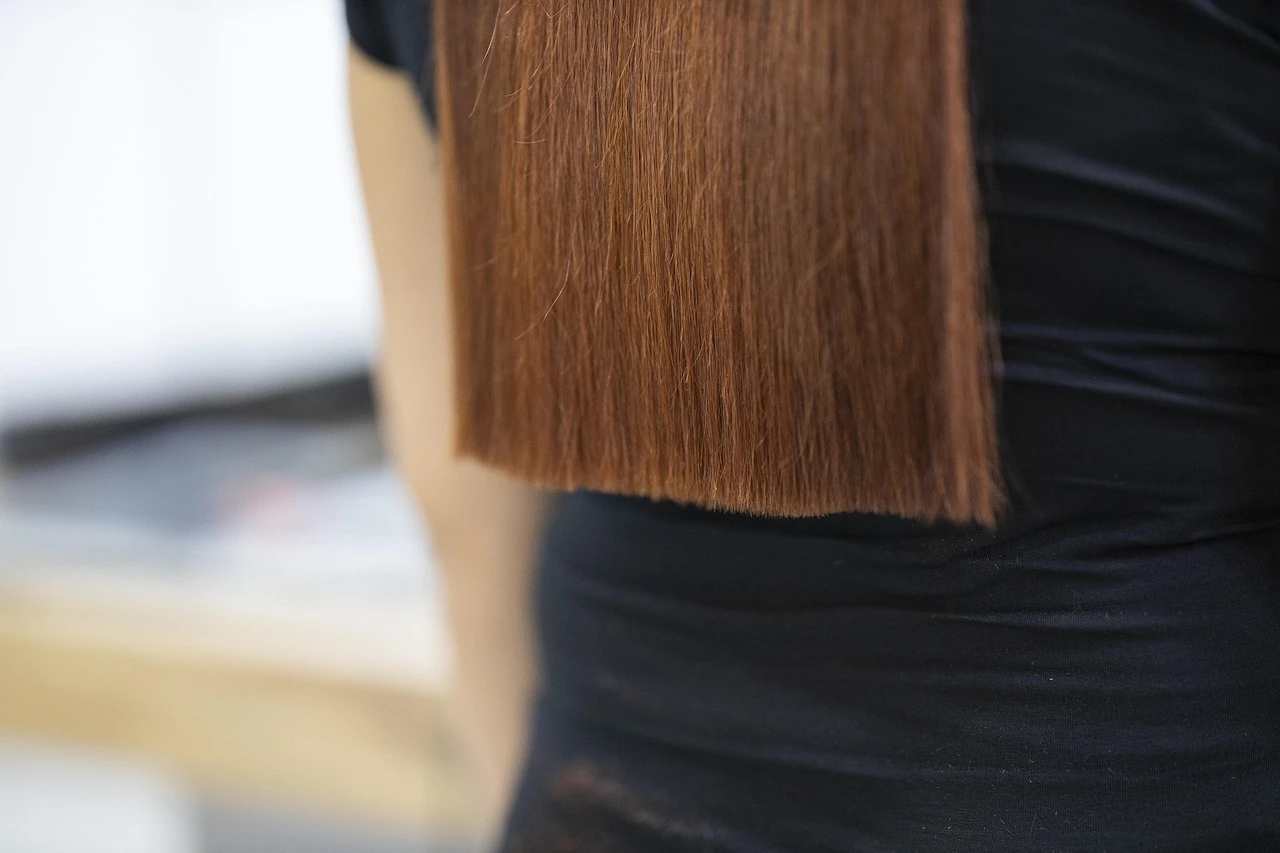
You pull a section forward over your shoulder and hold the last few inches up to the window. There it is: daylight through the ends. The crown feels flat. Somebody has already mentioned that you could always go shorter.
You're not going shorter. In more than 20 years behind the chair, I've found that tired-looking long hair usually comes down to a cut, a part or a habit, and only rarely to the hair itself. All of it is fixable without losing an inch.
16Long layers with soft waves

Long hair cut to one length is heaviest at the bottom, and that weight presses the top flat. Justin Hickox, a hairstylist since 1995, puts it simply: "If it is long in one length, it's likely that it's going to lay flatter on the top simply because of the weight of the hair."
He adds that the eye goes wherever hair is fullest, and on one-length hair, that's lower, toward the ends. Long layers help move some of that fullness higher up.
Where the layers stop matters most. Hickox tells women over 50 who want to keep their length to keep the hair below the parietal ridge "as close to one length as possible." That's the bony curve at the back of your head, running from behind your ears around the back. Below it, one length keeps your ends thick. Above it, layers add movement.
Then there's the shape nobody wants. "No one wants their top layers to resemble a mushroom," he writes. "This happens when the top layers are too short compared to the overall length." His check takes seconds:
- Lift a section from the back of your head straight up.
- Lift a section from the top of your head the same way.
- If the top comes up shorter than the back, those layers are too short.
Mark the length with a finger and use his line: "I want layers on top but I don't want my layers to be any shorter than this length."
If you have thick hair, ask about ghost layers too. Gad Cohen, a celebrity stylist whose clients include Jane Seymour and Susan Sarandon, describes "very imperceptible ones known as ghost layers or invisible layers" that "can add soft movement and fullness to the hair without compromising length." On fine hair, I'd keep layers to the top and leave the back alone.
Finish with soft waves. Cohen's word for modern long hair is "undone," which is a relief to hear. It's supposed to move when you turn your head.
15One-length hair with curtain bangs
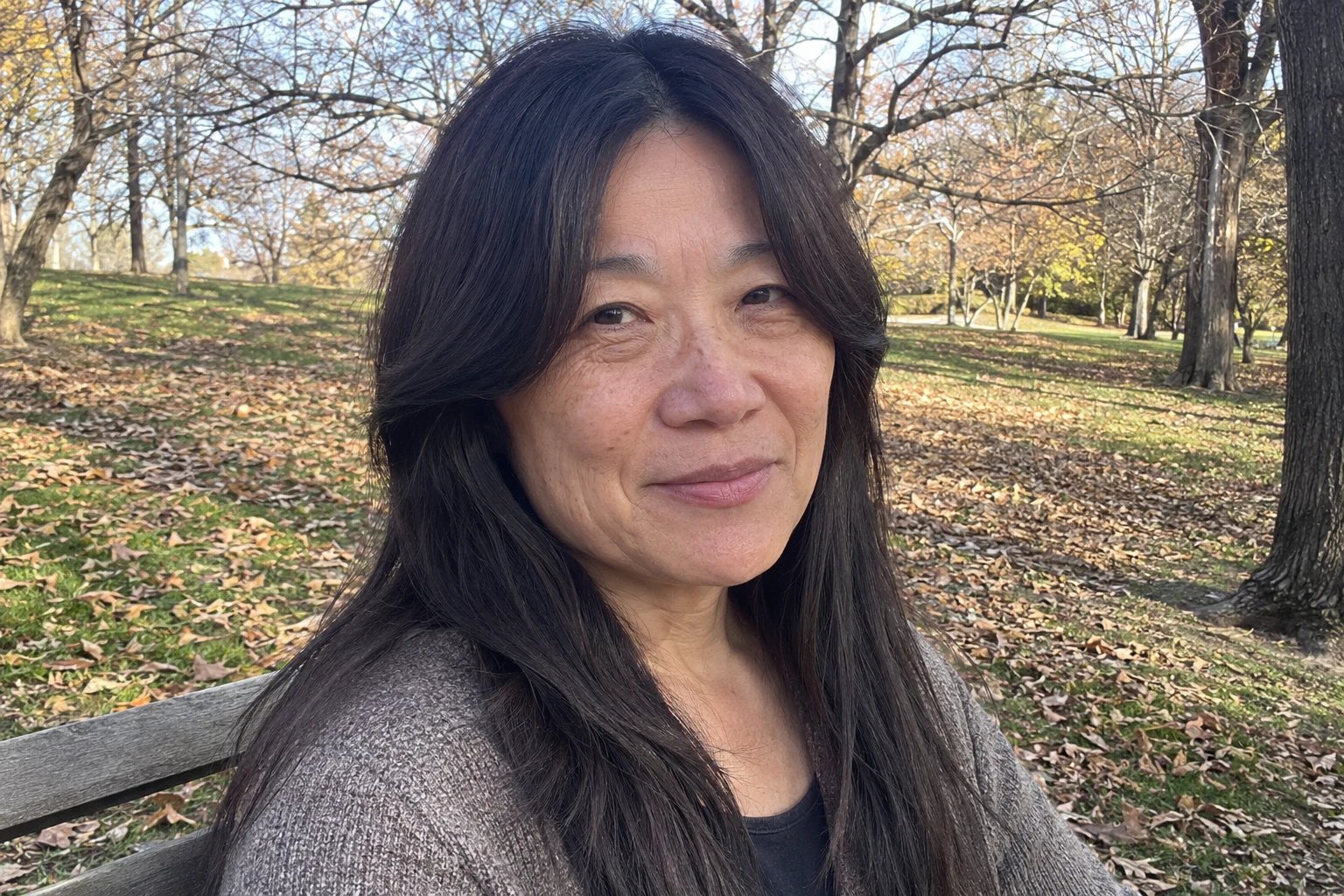
With curtain bangs, the rest of the cut stays one length and gets a soft opening at the front.
Placement does the work. L'Oréal Paris says curtain bangs typically "hit around the top of the cheekbones," parted in the middle. That puts the shortest hair right where you want the eye: up high, at the brightest part of your face.
On thick hair, ask for them a little longer, landing between cheekbone and jaw, so they don't puff out. On fine hair, the brand says the layered curtain-bang cut "creates movement that helps hair appear fuller and thicker."
To style them:
- Rough-dry your hair until it's about 80% dry.
- Blow-dry the bangs with a round brush, "upward and away from face."
The real cost is upkeep. L'Oréal suggests salon visits every 6 to 8 weeks.
14A loose low ponytail at the nape
On Reddit's r/AskWomenOver50, women in their 60s and 70s make the case that long hair is the practical choice. It goes up, it stays out of their eyes, and short hair can't do that.
The ponytail worth keeping sits low, at the nape of your neck, and loose. The American Academy of Dermatology (AAD) lists tightly pulled ponytails, buns and updos among the causes of traction alopecia, which is hair loss from constant pulling, and warns that once it advances, "your hair cannot grow back." Its warning signs are pain, stinging, crusts on the scalp and "tenting," where sections of scalp pull up like a tent; if you notice any, take it down and wear it loosely pulled back instead.
Two habits keep it kind to your hair:
- Tie it up only when it's completely dry. India's association of dermatologists warns that tying up wet hair can lead to a fungal infection of the hair shaft.
- Use a fabric-covered band, never bare rubber.
Slide the band down to the nape and keep it loose, with a little softness left at the temples.
See more: 17 Festive Hairstyles Over 50 for Holiday Parties →
13Face-framing layers starting at the cheekbone
Where should the shortest piece start? It's the question I hear most about face-framing layers, and it's the one almost nobody answers.
Hickox does. Not at the chin, because a layer that ends there points straight at it. Instead: "start those layers even in here at the cheekbone somewhere, right?"
If the cheekbone feels too short for you, he gives two other spots: "Just have the shortest layer start either a little bit above the chin, like around your lip, or a little bit lower than the chin."
This is the change I'd point anyone with fine hair toward first. "If your hair is thin, this is absolute gold for you," he says, because fullness around the face makes the whole head of hair look thicker.
It's also the safest first step if layers have burned you before. Front layers, Hickox writes, "grow out seamlessly," and "Styled straight, they can blend in with the rest of your hair for a one-length look."
So touch your cheekbone, or your lip, or just under your chin, and say: start here.
See more: 16 Gray Blending Highlight Ideas Over 50 That Hide Roots Longer →
12A blunt cut with a thick hemline
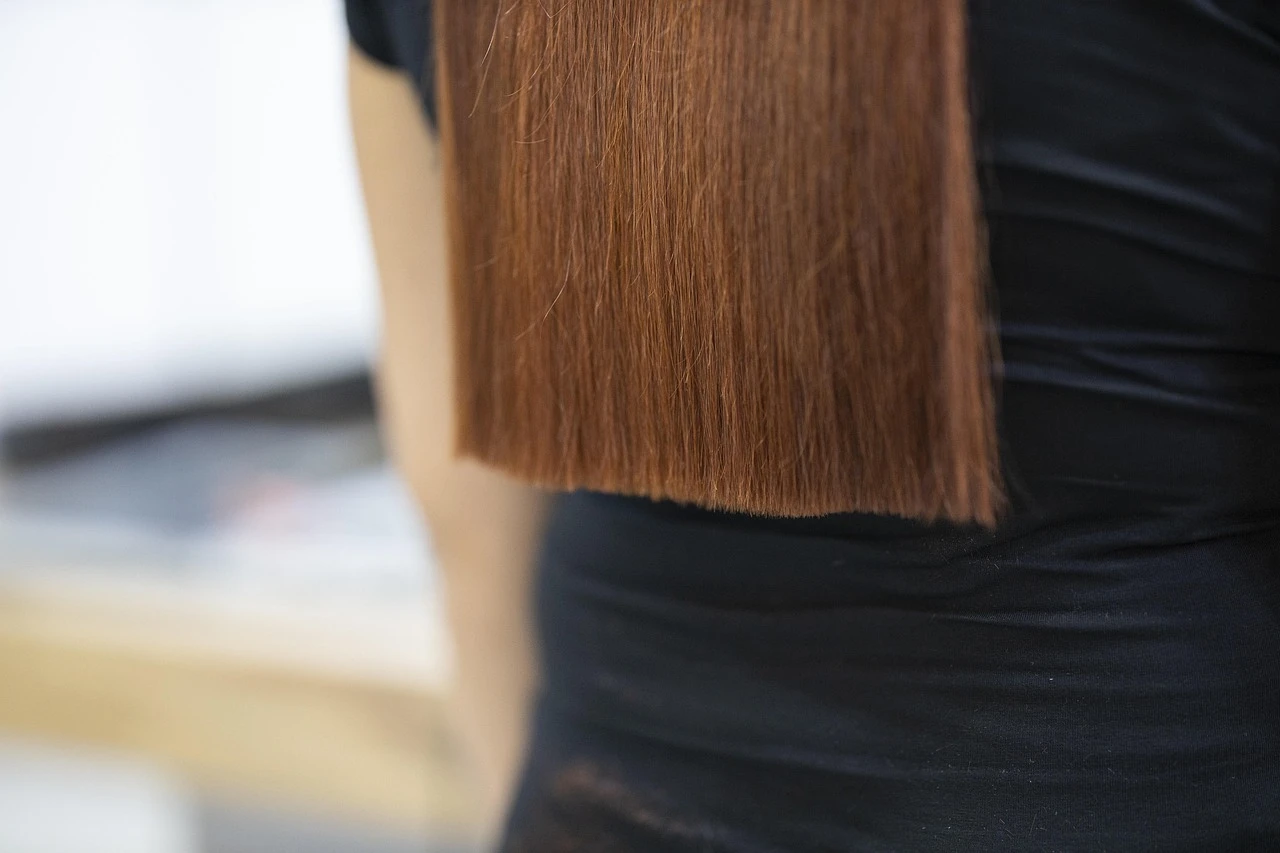
If you can see through the last three inches of your hair, look at the cut before you blame the hair. "The number one mistake that happens is that the bottom is just layered way too much," Hickox says.
On fine hair, every layer cut into the bottom thins the edge. On a TikTok about shags, commenters with fine hair said layering left them almost nothing at the bottom.
The fix is a blunt cut, where the ends are cut straight across so every strand finishes in the same place. L'Oréal Paris advises asking for "a blunt perimeter cut to make the bottom edge of your hair look thick and solid," and choosing "blunt ends over deep layers."
To soften the line, add the face-framing pieces from #13 and keep the back solid. If your hair is thick, ask about ghost layers, which Gad Cohen says add soft movement and fullness without compromising length.
Done right, your ends look like a hem instead of tassels.
11A butterfly haircut that keeps the back long
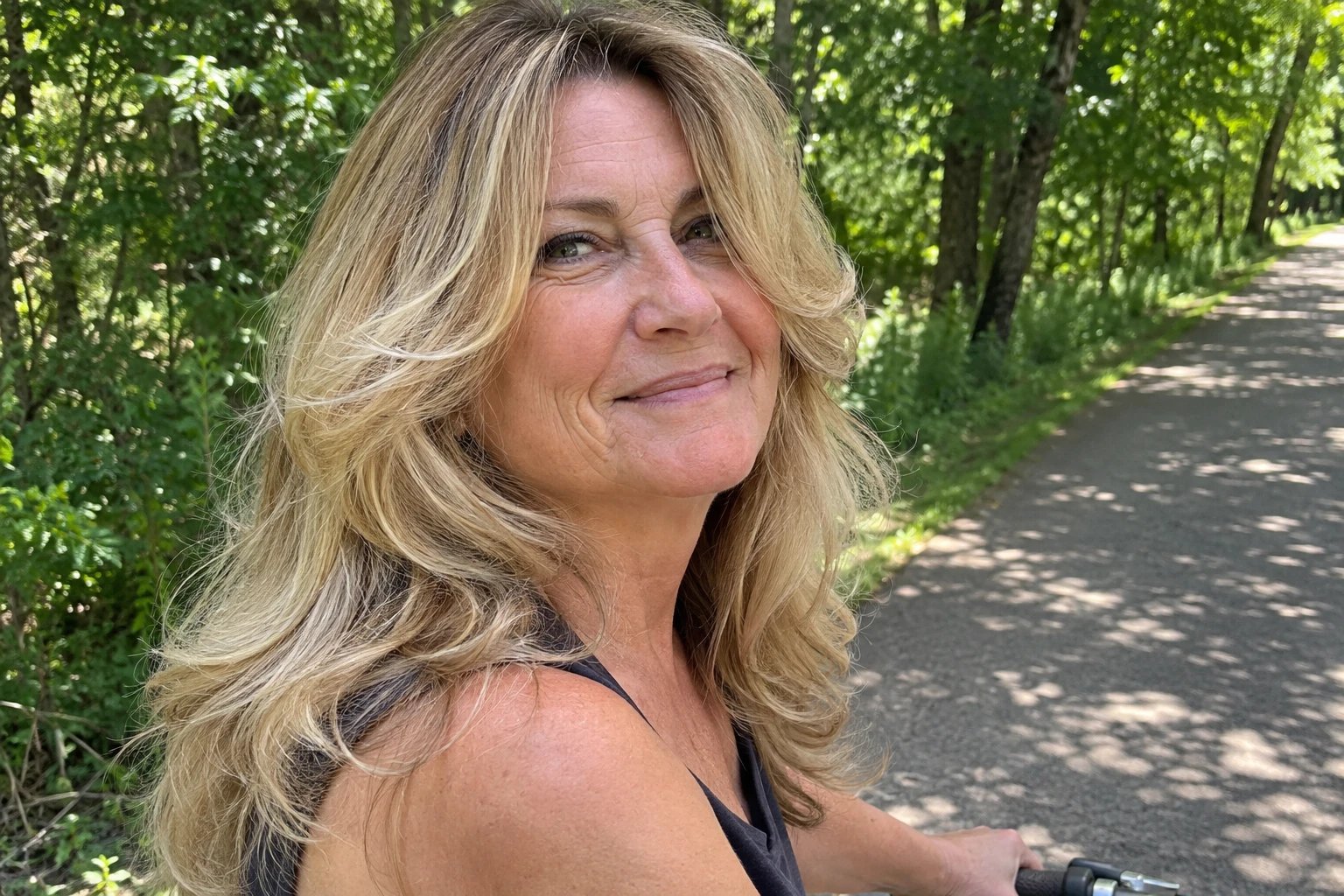
The butterfly is the trending cut you're most likely to be offered, and the one I'd think hardest about on fine hair.
Jason Collier, a celebrity hairstylist, describes it as "layers that give you the illusion of shorter hair while keeping the length overall." That means shorter face-framing pieces around the crown and longer layers through the ends. Every inch stays at the back.
Density is his sticking point. It "works well on medium to thick hair, as the layers need some natural density to create volume and movement." He's frank about the rest: "Because the layers remove weight, very fine or sparse hair may end up looking thinner."
My quick check is your ponytail. If the elastic needs an extra wrap it didn't need a few years ago, choose the long layers at #16. If your ponytail still fills your fist, the butterfly is a lot of fun.
10A long shag on wavy hair
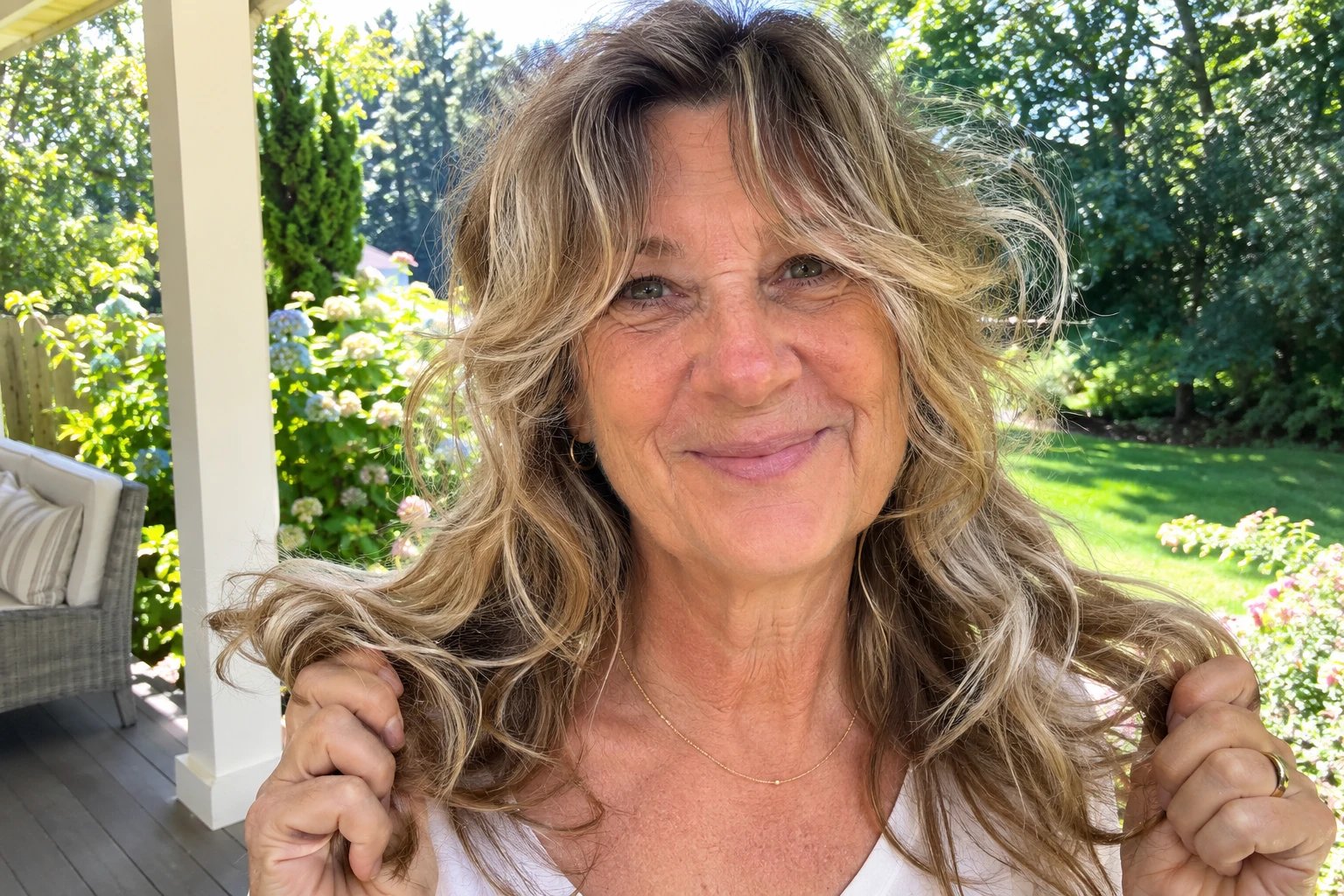
Two working stylists look at the same cut and see opposite futures. You deserve to hear both.
Sal Misseri of Reverie Salon calls the shag "one of the most graceful grow-outs in the business." Hickox says flatly: "It is not going to grow out gracefully."
Where they agree matters more. Misseri: "Very fine, very straight hair is the honest caution. A shag removes weight, and fine hair doesn't have weight to spare." Hickox: "If you've got stick straight hair, you might not be the best fit for this."
So the long shag belongs to wavy hair. Hickox points out that a shag gets away with thinner ends because the thinness looks deliberate. Misseri says it "wants about five minutes of encouragement. A texture spray, a scrunch, maybe a quick diffuse." A diffuser is the cupped dryer attachment that dries waves without blowing them apart.
It only stays low-maintenance if your hair already waves. On a TikTok about shags, commenters with straight or loosely wavy hair describe blow-drying, curling irons and rollers, and others say the hard part is finding a stylist who can cut one well.
Before you sit down, ask to see photos of shags that stylist has cut on hair like yours.
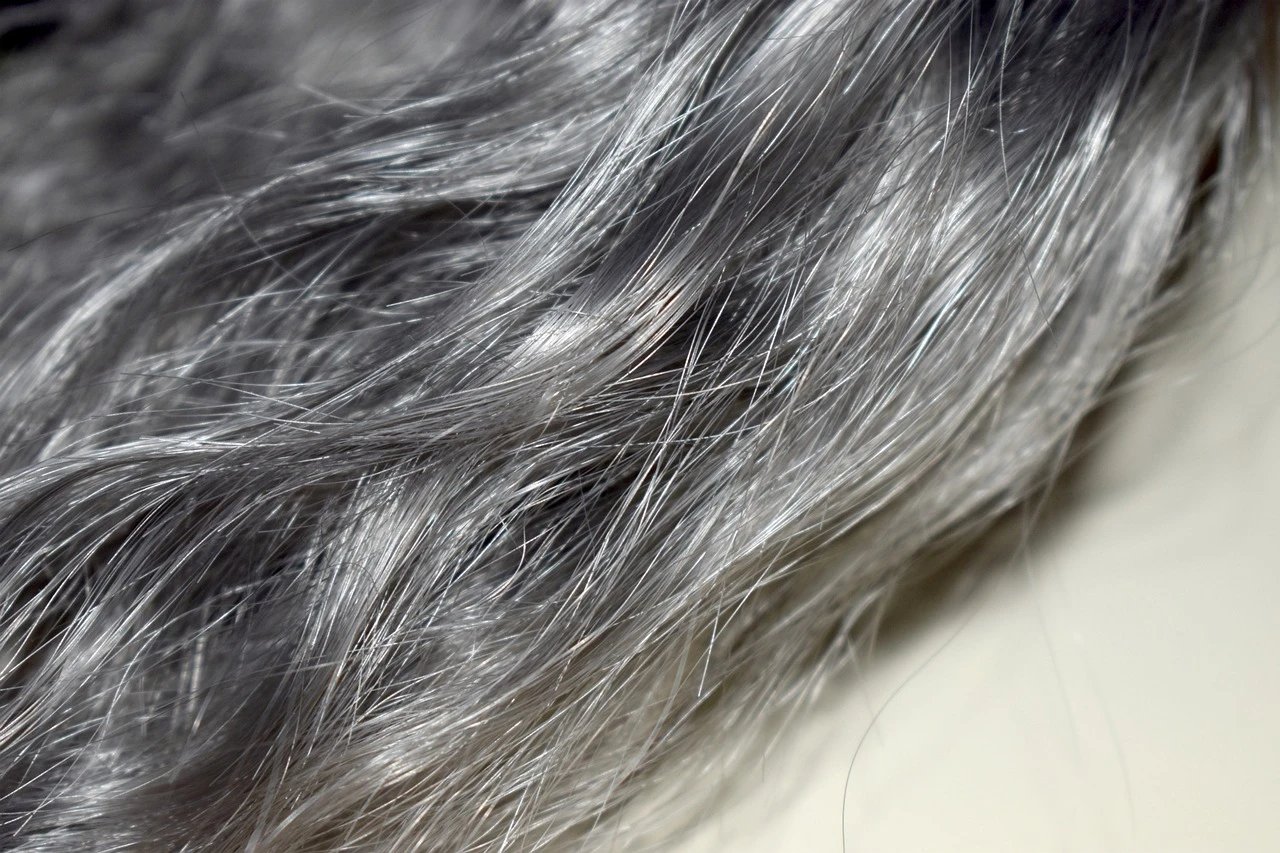
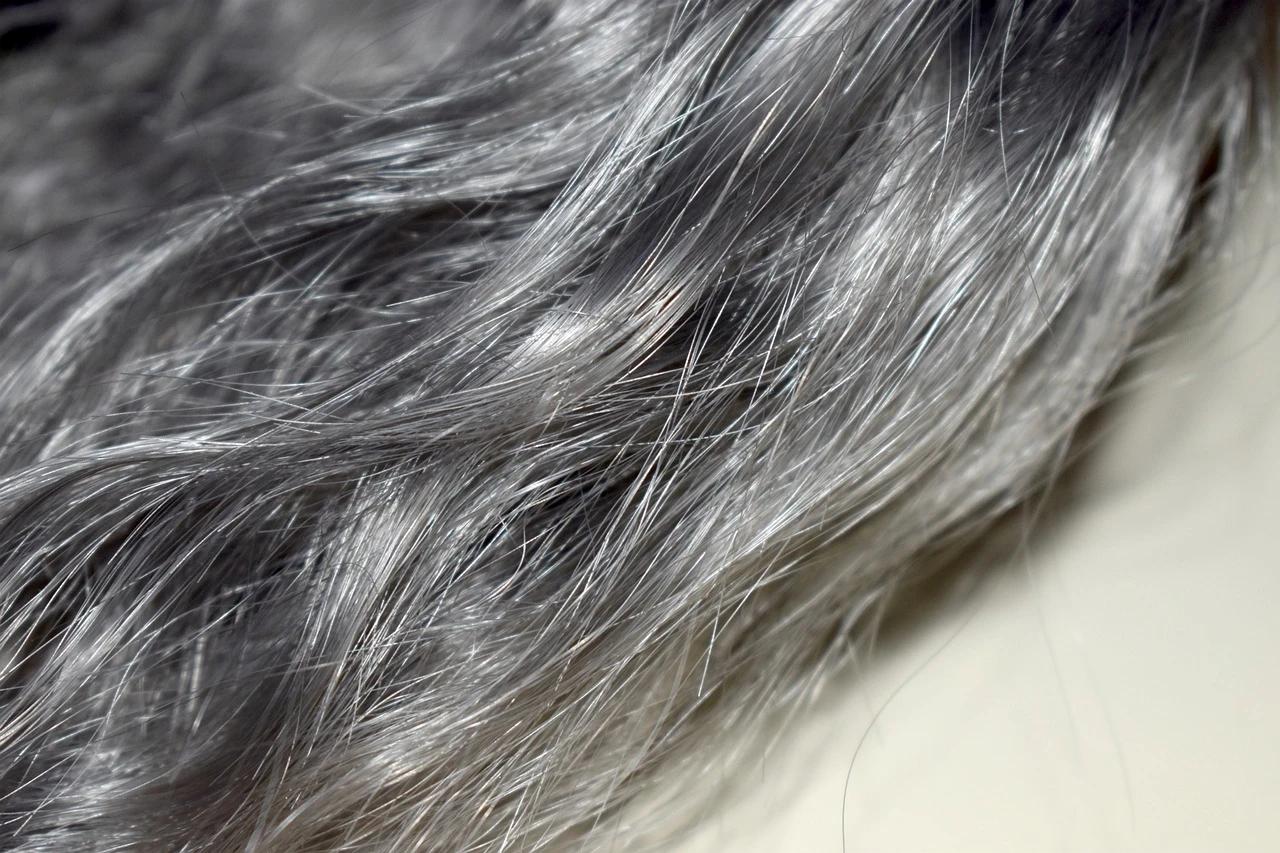
9Long natural silver hair

"I loved having long hair but the texture changed so much in my 50s it just looked horrible," a woman posted on Reddit's r/WhatHairSuitsMe. If your gray arrived with a mind of its own, there's a reason for it.
Dr. Antonella Tosti, a dermatologist at the University of Miami Health System, explains: "As hair turns gray, it often becomes thicker and coarser. This change in texture is due to the loss of melanin and alterations in the structure of the hair shaft." Melanin is the pigment that gave your hair its color.
Gray hair also "tends to be more brittle and less smooth," she says. "Regular conditioning is also essential."
Then there's the yellow. Nina Rubel, head of color at Rob Peetoom Salon, blames "product build-up, heat styling, sun exposure, and other external factors." Scientist Dr. Gaby Longsworth adds that white and gray hair is "more likely to oxidize, looking yellow and tarnished."
If you've been using purple shampoo every day, the stylists in that same piece suggest a calmer routine.
See more: 9 Short Gray Hairstyles Over 50 That Look Chic and Modern →
8A loose single braid for day and night
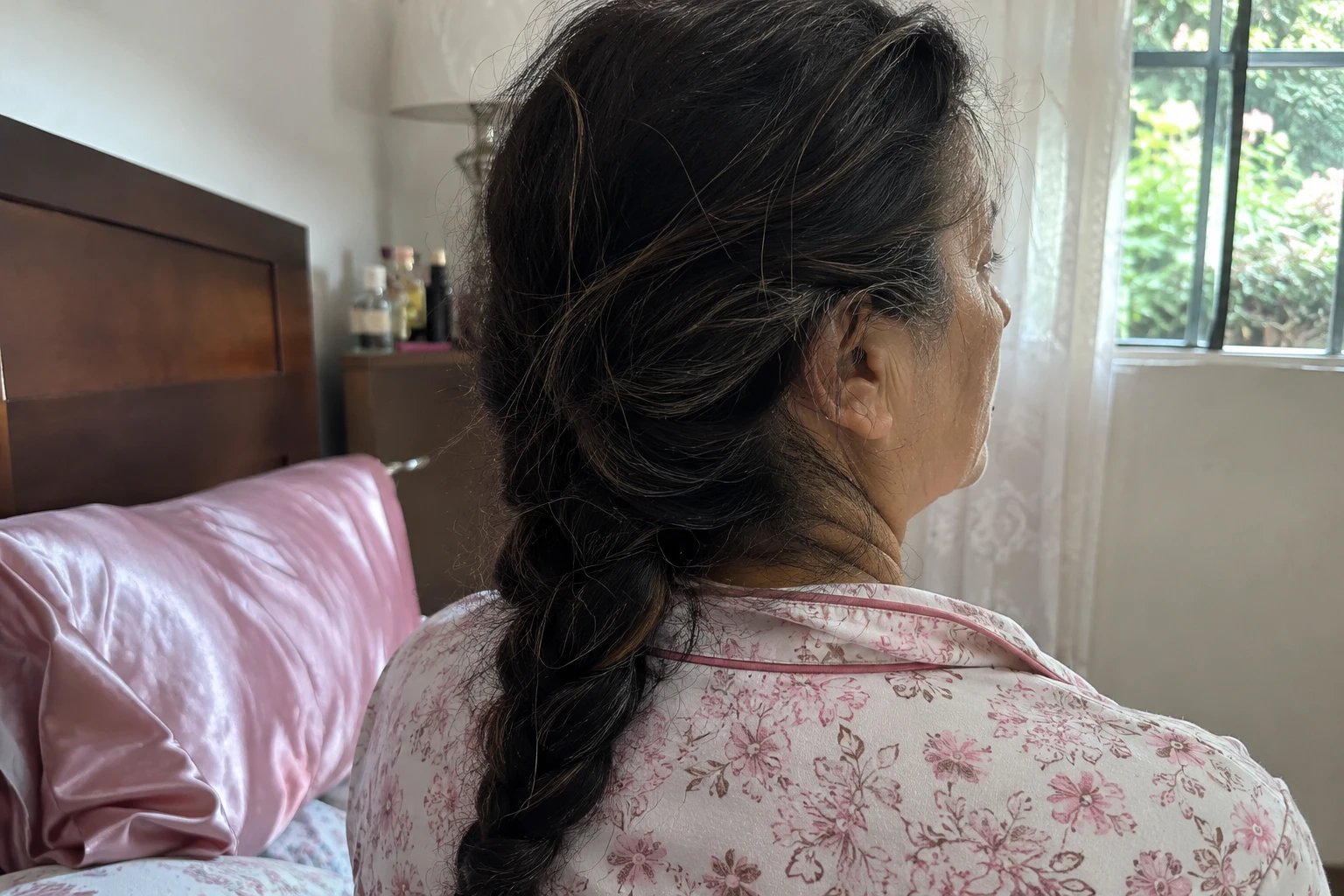
Wet hair and a pillow make a bad pair. "Wet hair strands are much more fragile than dry hair strands," says Dr. Michele Green, a cosmetic dermatologist in New York City, in NBC Select. Toss and turn on them all night and the ends pay for it.
A loose braid protects them at night and looks good by day. Dr. Anna Chacon, a dermatologist in Miami, suggests "loosely braiding your hair or tying it in a loose bun to limit friction." The same rule as the ponytail applies: let it dry first, and keep it loose enough that nothing tugs at your scalp.
Then change what holds the end. A hair clinic's guide says "a loose silk or satin scrunchie used for a low braid or loose top knot is usually more suitable than a thin elastic or hard clip." Green also likes silk pillowcases.
By day, gently tug each section of the braid a little wider with your fingertips. It looks fuller than your hair really is.
7An off-center part for lift on top
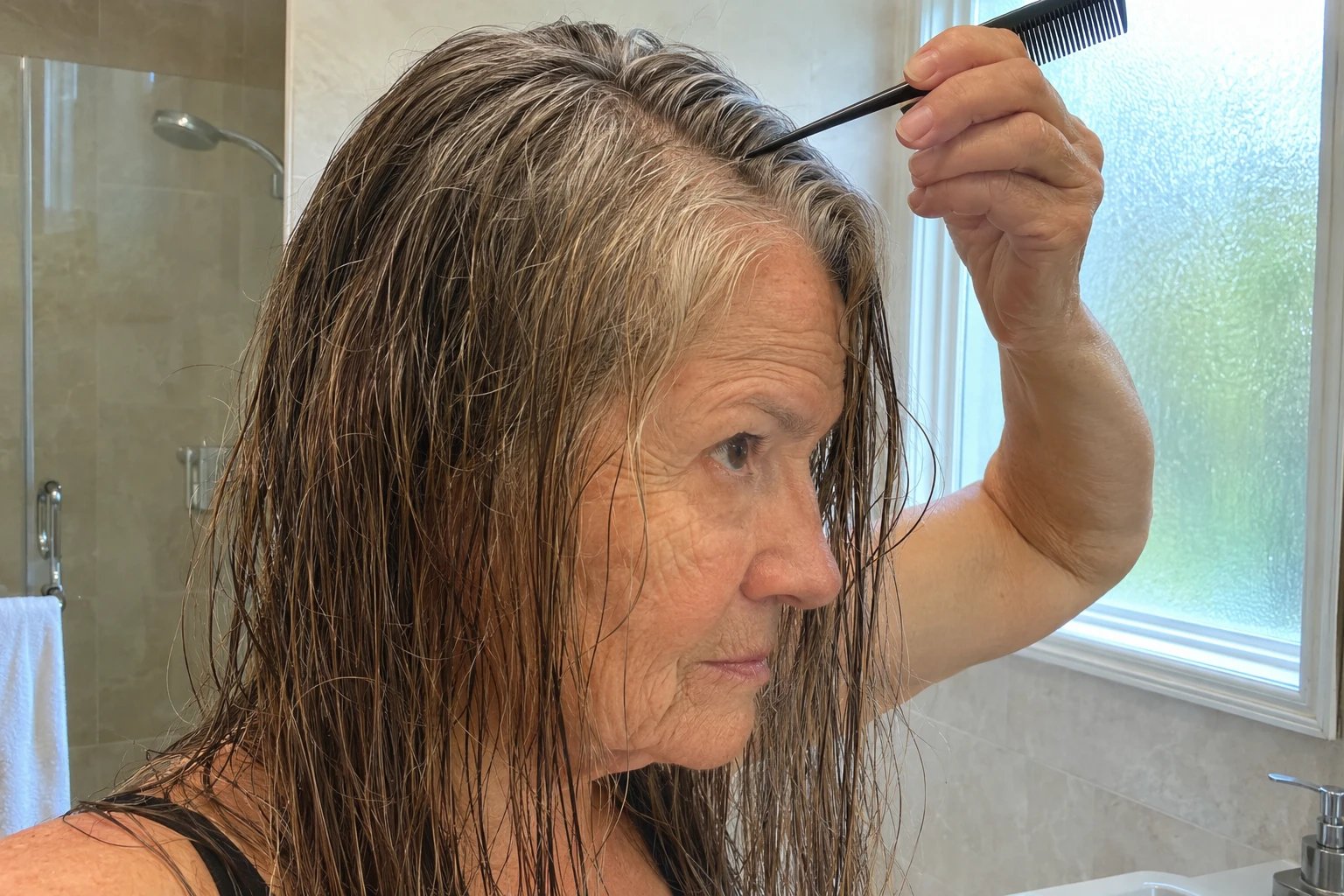
This one is free and takes two seconds. "I always say hair is an optical illusion," Hickox says. In his view, a center part dents the top of your head, so the sides look fuller by comparison. Move the part slightly off center and you get more lift on top.
The new part won't behave the first morning. Lili Bridger, senior stylist at Larry King salon in London, suggests: "Create the parting while your hair is wet to encourage it to fall into place as it dries." Then be patient: "It may take a couple washes and styles before it settles into its new position."
Don't swing too far if your hair is fine. "With fine or extremely thick hair, I would veer the side parting towards the centre crown for balance," Bridger says. In my experience, a deep side part on fine hair shows more scalp, not less.
If the scalp along your part is what bothers you, L'Oréal Paris notes that "a subtle zig-zag part breaks up continuous scalp exposure."
The one place I'd keep a middle part is with the curtain bangs at #15, since they're cut to be worn that way.
6Extensions through the back for density

If your thinning hair shows mostly through the lengths, a few lightweight wefts through the back can make long hair look as full at the bottom as it does on top. A weft is a strip of hair attached in a row close to your scalp.
They come with rules. The AAD lists hair extensions and weaves, especially on relaxed hair among the causes of traction alopecia, and says to remove them right away if they cause pain or scalp irritation.
What I'd ask for:
- Lightweight hair. The AAD advises choosing lightweight extensions.
- Sewn-in rather than glued-in, which the AAD prefers. It doesn't say sewn-in wefts suit hair that's already fine or thinning, so ask the stylist how your own hair will carry them.
- Removal booked at 6 to 8 weeks. That's the window in a Johns Hopkins review led by dermatologist Dr. Crystal Aguh, which rated extensions among the higher-risk styles, and it keeps you within the AAD's 2-to-3-month limit.
Prices vary a lot between salons and between types of hair. Before anything goes in, get a quote that includes taking them out.
5A hair topper for a thinning crown

Before you buy anything, make one check: is it thinning, or is it wash day?
Long hair holds on to the hairs it sheds. They stay tangled in the length until shampoo rinses them out all at once. The AAD says it's normal to shed between 50 and 100 hairs a day, and it advises people with thick, curly or dry hair to shampoo at least once every 2 to 3 weeks. If every shed hair stays caught until wash day, this is what can land in the drain:
| Days between washes | Hairs that can come out at once |
|---|---|
| 3 | 150 to 300 |
| 7 | 350 to 700 |
| 14 | 700 to 1,400 |
| 21 | 1,050 to 2,100 |
Dr. Sam Ellis, a board-certified medical and cosmetic dermatologist in Northern California, describes the same build-up: a big clump after a few days without washing is usually normal shedding, not a sudden jump in hair loss.
Thinning at the crown or along your part is a different matter. Dr. Alexis Stephens, a board-certified dermatologist, separates shedding all over the scalp, which can follow illness, stress or hormone changes, from thinning at the part or crown, which is female pattern hair loss. Her advice: "Early diagnosis is key, guys."
A hair topper is a hairpiece for the top of your head that blends into your own long hair. The American Hair Loss Association says it can be secured with clips, combs, tape or liquid adhesive. It also says "A hair topper does not treat the underlying cause of hair loss," and that sudden, patchy or rapidly worsening loss, or loss with scalp pain, burning, itching, redness or scaling, should be checked by a dermatologist first.
The association also warns that a topper can cause breakage or traction hair loss when repeated or excessive tension lands on fragile hair, so a fit that pulls or aches is a fit to change. And when you shop, remember the association's line: "Price is not a reliable proxy for quality." If you choose synthetic, budget for replacing it: one maker, Jon Renau, says a synthetic piece can last up to six to nine months with proper care.
4Waist-length hair kept with regular trims
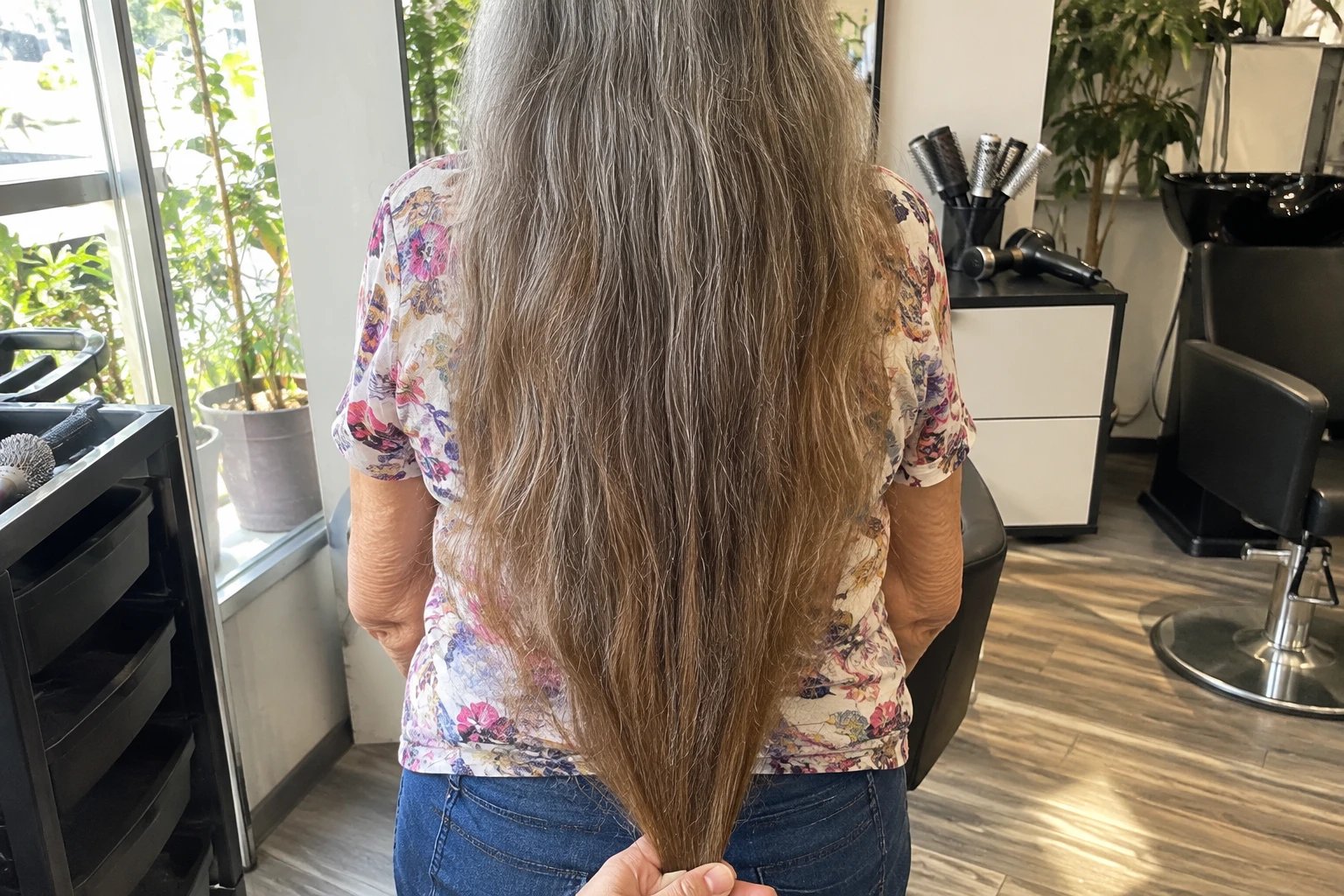
"I'm in my 60's and I'm wearing my hair the longest I've ever had it," a woman wrote on r/AskWomenOver50. For women over 60 growing their hair long, the trim you're tempted to skip is what keeps it possible.
Trims don't make hair grow. Dermatologist Dr. Yolanda Lenzy explains that trimming "prevents it from splitting up the shaft so you [don't] lose length." Left alone, split ends keep climbing, and eventually you lose more than a trim would ever have taken.
Hairstylist Lisa Huff suggests taking a quarter to half an inch every 12 weeks when you're growing your hair out. Hair grows about half an inch a month on average, so that trim still leaves you roughly an inch longer every 12 weeks.
One honest caveat. "Your ability to grow your hair longer as you get older goes down," Dr. Ellis says. If yours grows more slowly, keep the trim at the small end. Gad Cohen calls that kind of mini trim "dusting the ends," and says it keeps layers and the bottom line fresh "without sacrificing length."
Book the next one before you leave the salon, so it never turns into a rescue.
3Air-dried natural waves with mousse
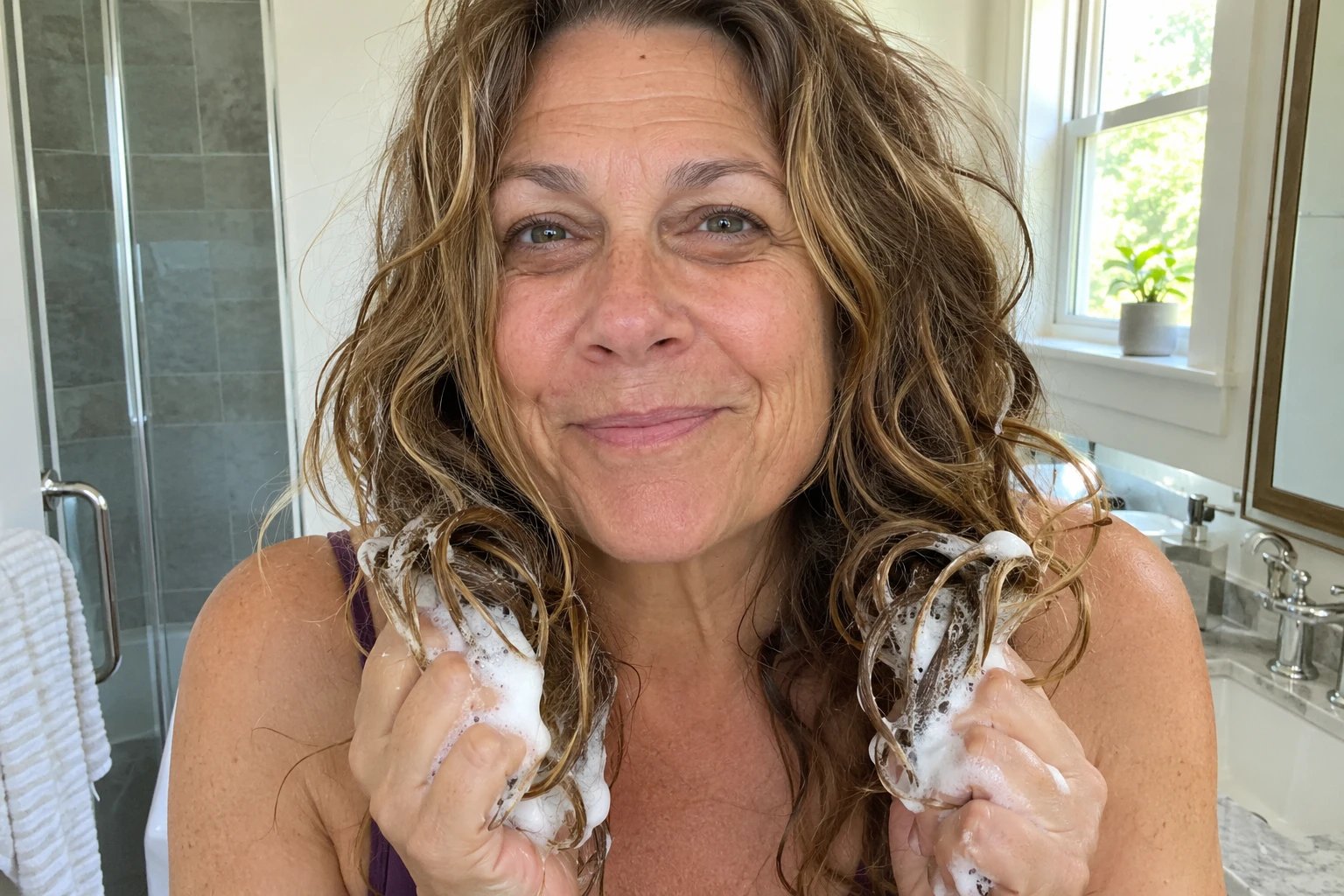
If you'd rather skip bangs and layers altogether, Hickox points to a little wave: "Styling your hair with a little bit of wave actually brings volume and movement." The work is mostly in what you don't do.
Match the product to your hair first. Celebrity hairstylist Eddy Scudo keeps it simple: "Use something airy like a mousse for fine hair, a cream for waves, and a gel for curls."
- Wrap, don't rub. The AAD says to wrap your hair in a towel or T-shirt, because rough rubbing can damage it.
- Scrunch the product in while your hair is still damp.
- Then stop touching it.
That last step is where most of us fail. "Once you've set your shape, the key is not to touch it," Scudo says. Dianna Cohen, founder of Crown Affair, explains why: "Every time you run your fingers through damp hair, you're disrupting the cuticle and inviting frizz in." The cuticle is the hair's smooth outer layer.
Set it, then go do something that needs both hands.
See more: 13 Wash-and-Go Haircuts Over 50 That Need Almost No Styling →
2A claw-clip twist for hot flashes
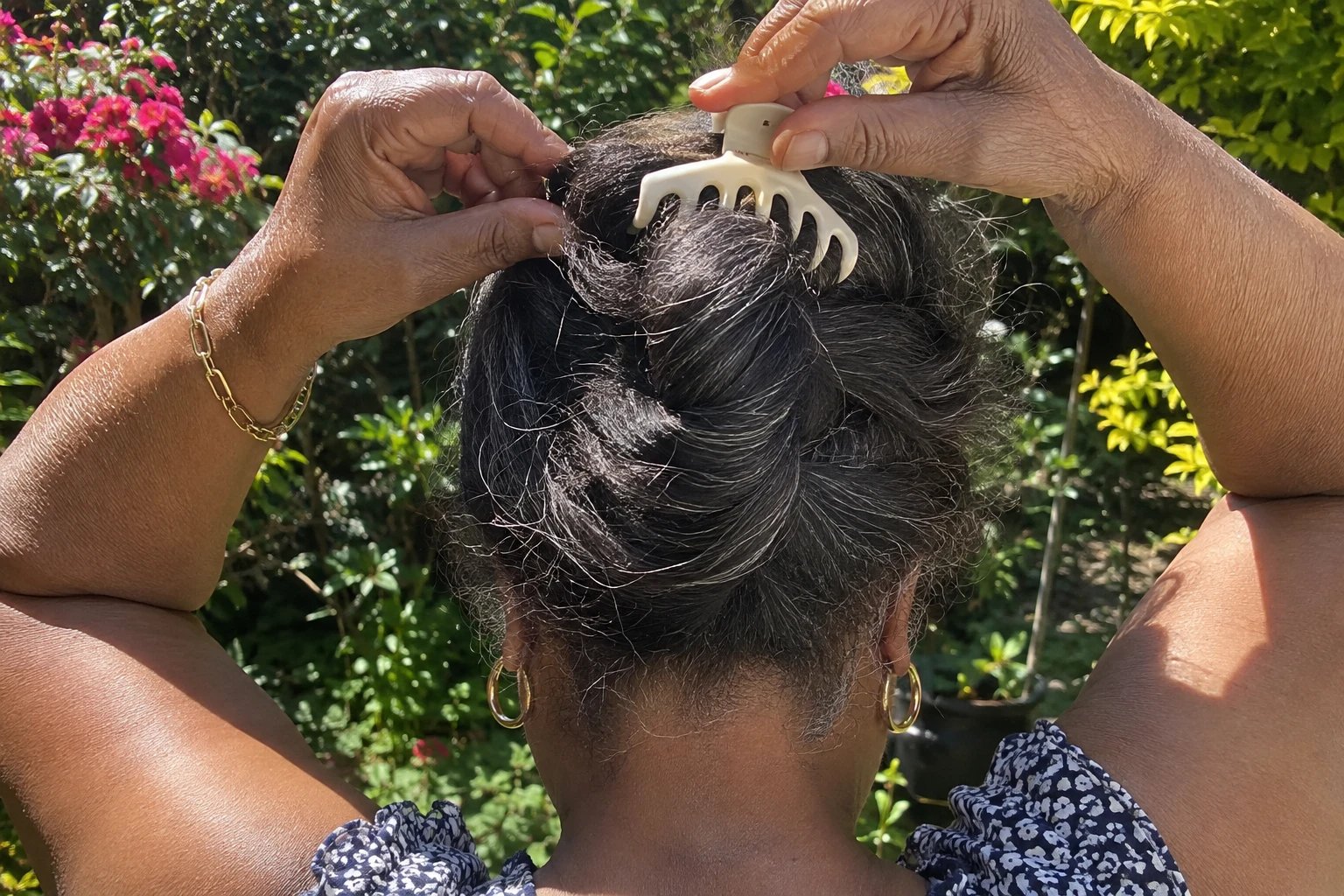
"Hot flashes feel worse with long hair," a commenter wrote on r/AskWomenOver50. If you get them, you know the moment: the heat climbs your neck and all that hair suddenly feels like a wool scarf in August.
You don't have to cut it to cool off. "If you have long hair, tying it up may keep your neck cooler," writes certified menopause practitioner Teresa Isabel Dias for MenopausED.
A claw-clip twist is the fastest way up. Gather your hair at the nape, twist it up the back of your head, fold the ends over and clip.
Choose the clip carefully. For fine hair, the same hair clinic's guide suggests "a small soft scrunchie or light smooth clip" and says to avoid "heavy clips and tight coils." If a clip feels heavy in your hand, it'll feel heavier on your head by mid-afternoon.
The air-drying from #3 helps here too. Ohio State OB-GYN Dr. Cynthia Evans puts it plainly: "If you have a hairstyle that can air-dry, all the better so you can avoid styling your hair under a sweat-inducing hair dryer."
Keep a light clip in your bag, in the car and by the bed, wherever the heat usually finds you.
1The script that keeps your length at the salon
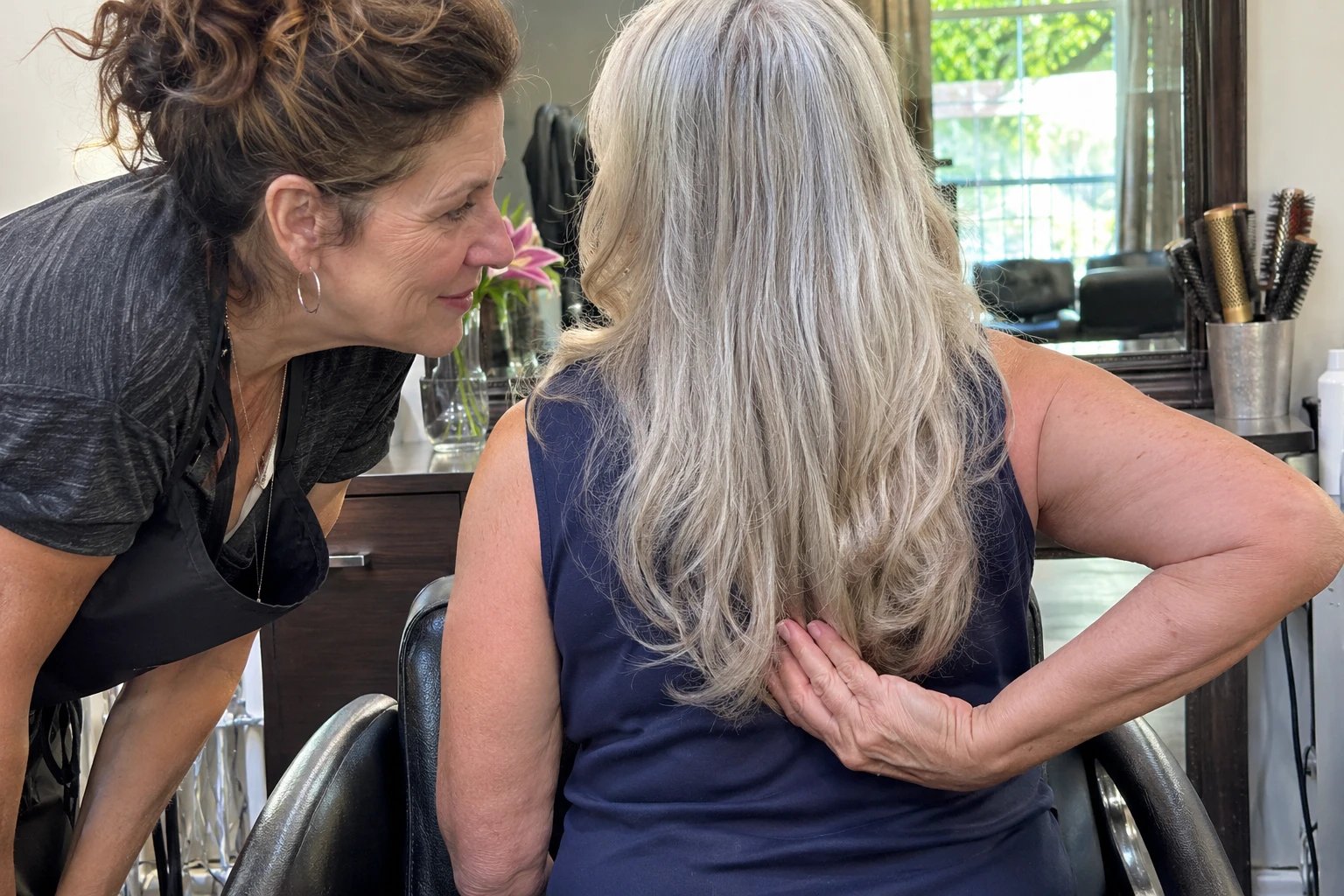
You asked for two inches. Then you look down at what's on the floor, and it's clearly more. Women on Reddit describe it in numbers: 8 inches gone when 2 to 4 were agreed, and 10 inches taken after 6 were shown. It happens often enough that I'd go in prepared.
Preparation is one sentence. Chris Healy, who writes for the long-hair site The Longhairs, suggests saying it before anyone picks up scissors:
"I would rather leave some split ends behind and keep the length than take too much off." Chris Healy, The Longhairs
Here's why it works. In my experience, a stylist trims until the ends look perfect, because that's what we're trained to do. When you say you'll trade a few split ends for the length, you've changed what "finished" means. You've given them permission to stop.
Healy's second step matters just as much: ask the stylist to repeat your instructions back before cutting. If what comes back isn't what you said, you've caught it while the hair is still on your head.
And if it keeps happening, a retired hairdresser with 40 years in the job had this advice on Reddit's r/NoStupidQuestions: "Try shopping around for a long hair specialist. Next time don't haggle. It's you who wears it."
The bottom line
Dr. Ellis said something I wish more stylists said out loud: "The same hairstyle that worked for you 20 years ago may no longer serve you."
Read it again and notice what it leaves out. It doesn't say shorter. The length can stay. The shape around it is what's due.
So here's a question about your own hair: when did a stylist last ask what you want your hair to do, instead of how much to take off? If you can't remember, start your next appointment there, with your hair dry and the scissors still on the tray.
Up next
17 Hair Colors Over 50 That Take Years Off
Seventeen shades, each with who it suits, how the roots grow out and how many salon visits a year it really takes, plus an honest look at going silver.
Read the list →
Reader quiz
Did you catch the details?
5 questions from this article. Finish them all to unlock the editor's bonus tip.
To check whether your top layers are too short, what does the article tell you to compare?
Questions people also ask
Is long hair too young-looking after 50?
No. Long hair after 50 looks polished or tired depending on the shape and condition of the ends, and your birthday doesn't come into it. Stylist Gad Cohen advises a "realistic-for-you 'long' length," which may be shoulder length, or an inch or two below that if your hair is thick and healthy. Female pattern hair loss often begins in your 40s, 50s or 60s, so if your hair has thinned, a slightly shorter "long" can look fuller than holding out for waist length.
What are the best hairstyles for women in their 50s with fine hair?
Long hair with blunt ends, a one-length back and only light layers on top suits fine hair best. L'Oréal Paris advises "blunt ends over deep layers," and stylist Justin Hickox keeps the hair below the ridge at the back of the head close to one length. Gad Cohen's ghost layers add movement without losing length, while stylist Jason Collier warns that butterfly layers can make "very fine or sparse hair" look thinner.
How often should I trim long hair after 50?
Advice runs from every 4 to 8 weeks to every 3 to 6 months for long hair, so how often you need a trim depends on which guide you follow. India's association of dermatologists recommends 4 to 8 weeks, while Healthline puts long hair at 3 to 6 months. Dermatologist Dr. Yolanda Lenzy says trimming doesn't make hair grow; it stops splits traveling up the shaft so you keep your length.
Does thinning hair in menopause mean I have to cut it short?
No. Thinning around menopause doesn't by itself mean you need short hair. The AAD says female pattern hair loss is more common after menopause, often shows first as a widening part, and that "Treatment delivers the best results when started at the first sign of hair loss." Heavy shedding can also be telogen effluvium, a temporary kind that usually settles within 6 to 9 months, so see a dermatologist to learn which you have before you decide anything about length.
Why does long hair look thin or stringy at the ends?
Long hair usually looks stringy at the ends because the bottom of the cut has been layered too much, which stylist Justin Hickox calls "the number one mistake." The fix is a blunt perimeter with the back kept close to one length. If the top also looks flat or puffs out over thin ends, that's the mushroom shape from top layers cut too short, so ask for top layers no shorter than the back section when both are lifted straight up.
Did any of these feel familiar?
Know someone who needs this?
 Prime Journal · Free printable
The Closet Fit and Color Checklist
- A clearer view of colors beside your face.
- Clothes that pass the sitting and walking test.
- Shoes and repairs checked before anything gets replaced.
Free printable: The Closet Fit and Color Checklist. Enter your email and it is yours.
Sources cited in this article
This article links to 36 outside sources, listed here so you can read them yourself.
- Puts it simply www.youtube.com/watch?v=GOuDkBf6CmA
- Women over 50 who want to keep their length www.justinhickox.com/blog2/transform-your-hair-over-50-without-losing-length
- His line www.youtube.com/watch?v=n1JcYPBwIks
- Describes www.aarp.org/entertainment/style-trends/info-2021/long-hair.html
- Typically "hit around the top of the cheekbones," www.lorealparisusa.com/beauty-magazine/hair-style/hairstyle-trends/how-to-ge…
- Women in their 60s and 70s www.reddit.com/comments/1kqie0i
- Lists tightly pulled ponytails, buns and updos www.aad.org/public/diseases/hair-loss/causes/hairstyles
- Wear it loosely pulled back www.aad.org/public/everyday-care/hair-scalp-care/hair/habits-that-damage-hair
- Warns public.iadvl.org/hair-care-basics
- He gives two other spots www.youtube.com/watch?v=KwhlIt-dAkY
- Commenters with fine hair www.tiktok.com/@glamgirlgabi/video/7522495000270228742
- Advises asking for www.lorealparisusa.com/beauty-magazine/hair-care/thin-hair/thinning-hair-hacks
- Describes it www.stylist.co.uk/beauty/hair/butterfly-haircut/1023238
- Calls the shag www.reveriesalon.com/blogs/news/modern-shag-who-it-works-on
- A woman posted www.reddit.com/comments/1x644tg
- Explains news.miami.edu/stories/2024/09/why-do-we-go-gray.html
- Blames graziamagazine.com/us/articles/goodbye-purple-shampoo-hairstylists-say-gray-…
- In NBC Select www.nbcnews.com/select/shopping/is-it-bad-to-sleep-with-wet-hair-rcna153476
- Says kiboclinics.com/hair/blog/hair-ties-vs-scrunchies-vs-clips
- Suggests graziamagazine.com/us/articles/goodbye-the-center-part-this-2-second-change-…
- Johns Hopkins review led by dermatologist Dr. Crystal Aguh practicaldermatology.com/news/tight-ponytails-braids-linked-to-traction-alop…
- It's normal to shed between 50 and 100 hairs a day www.aad.org/public/diseases/hair-loss/insider/shedding
- Shampoo at least once every 2 to 3 weeks www.aad.org/public/everyday-care/hair-scalp-care/hair/healthy-hair-tips
- Describes the same build-up www.youtube.com/watch?v=QSwmr0K2SKg
- Separates www.youtube.com/watch?v=6dnNpqF3EXo
- Secured with clips, combs, tape or liquid adhesive www.americanhairloss.org/non-surgical-hair-replacement/toppers
- Says jonrenau.com/blog/synthetic-guide
- Explains madamenoire.com/1214558/hair-split-ends
- Taking a quarter to half an inch every 12 weeks www.healthline.com/health/beauty-skin-care/how-often-should-you-cut-your-hair
- Says www.youtube.com/watch?v=nZ96qKH78Nk
- Keeps it simple www.newbeauty.com/view/air-dried-hair-guide
- For MenopausED menopaused.org/tips-to-improve-hot-flashes-in-hot-weather
- Puts it plainly wexnermedical.osu.edu/our-stories/managing-menopause-hot-flashes-in-the-summer
- Describe it in numbers www.reddit.com/comments/1p44v4e
- The Longhairs thelonghairs.us/blogs/library/what-to-say-at-the-salon
- Warn shopping.yahoo.com/beauty/hair/articles/truth-claw-clips-whether-theyre-1539…

Irina Byalik
Style Editor
Irina Byalik is a hairdresser and the owner of New Image Hair Salon in East Brunswick, New Jersey, with more than 20 years of experience. She came to the United States from Ukraine.
More from Irina Byalik