

How to Stay Motivated Over 50 When You've Quit Before
A restart plan built around the exact points where your last attempt broke down, from the first missed day to the week your knee started complaining.

By Peter Byalik, Food & Home Editor
Updated · 28 min read
The short answer: Pick a minimum small enough for a bad day, such as two minutes or two repetitions, tied to something already done daily. Schedule sessions like appointments instead of waiting to feel motivated. Use a reason that still matters once fear fades, such as staying independent. Track strength and ease rather than the mirror. After missing a day, a week, or longer, restart below the old level, not at it.
- Written by our food & home editor
- Cited 45 sources
- How we review
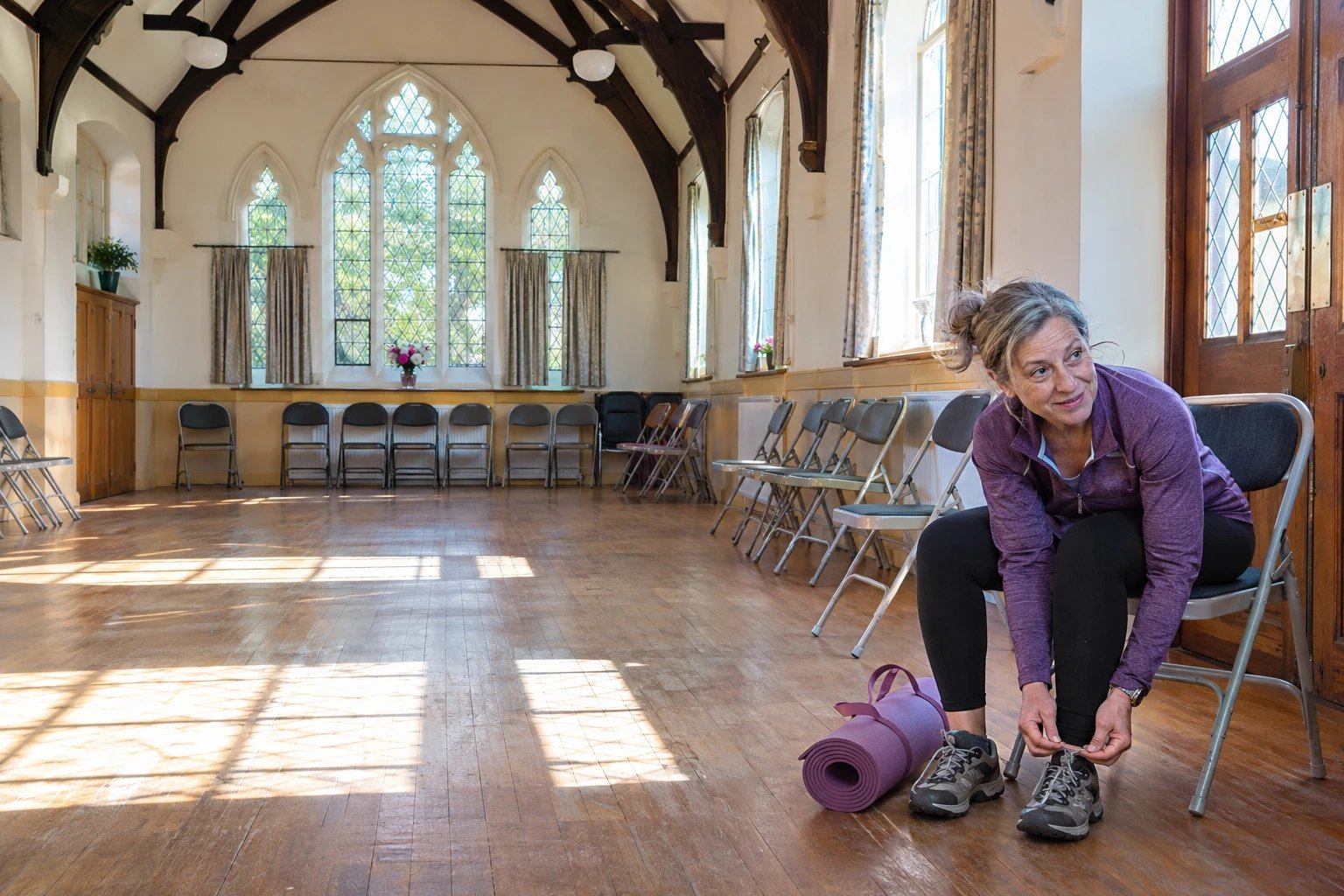
Turn over your walking shoes and look at the tread. If it still looks nearly new, you know the pattern. You start strong and have a few good weeks. Then one thing goes sideways, and the shoes sit by the door.
You don't need another pep talk on how to stay motivated to exercise over 50 when you've quit before. You need a plan for the exact spots where it fell apart last time.
In my experience, most plans fail at the joins, the places where one thing hands off to the next. Fitness is no different. So here are the joins: the bad day, the rocky early weeks, the first ache, and the missed week.
Why do I keep quitting exercise when I mean it every time?
Most of the time, the setup failed, and you can fix the setup. Willpower takes the blame because it's the only part anyone can see.
A 2021 review pooled 55 earlier reviews on older adults and people with chronic conditions. It found 14 key factors behind whether people stick with exercise. Here they are in plain words:
- how the program itself is designed
- having professionals from more than one field involved
- supervision
- technology
- sorting out, at the start, what gets in your way and what helps
- being told what to expect
- enjoyment, and no unpleasant experiences
- fitting it into daily life
- support from other people
- communication and feedback
- seeing your progress
- confidence that you can do it
- taking an active role
- setting goals
Count how many of those are about grit. Confidence, maybe, and taking an active role. The rest are about how the thing was put together.
The authors say so outright: "only those exercise programs which are in line with the preferences and characteristics of participants can become an actual long-term habit." They're just as plain about feelings: enjoyment is an immediate reward, and it may do more to keep people exercising than rewards that only come later. A workout you dread on Tuesday is one you'll find a reason to skip on Friday.
Restarters on Reddit's r/FitnessOver50 describe the same thing. They were active for years until a desk job, the pandemic or a hard stretch at work ended it. Since then they've swung between bursts of effort and long breaks. Their routine was built for one life and broke when the life changed.
Then there's pace. Mary Yoke, PhD, who teaches kinesiology (the science of movement) at Indiana University, told Consumer Reports: "Too much too soon either results in injury or burnout."
I've watched the same thing with new hires. The one who wants the busiest station on day three is usually gone by the end of the month.
Motivation itself turns out to be partly a setup problem. A Czech follow-up tracked older adults who had just finished a 12-week online exercise program. Six months and a year later, their main barriers were "lack of motivation and time." Take away the structure and those two are what's left.
Dr. Joe Risser is a preventive medicine physician and clinical professor at UC San Diego. He puts grit on the physical side of the ledger. Staying power, he says, is "rooted in biology," tied to a brain protein that exercise raises. In his view, the doing and the sticking build each other.
So skip the question "why am I like this?" Ask better ones about your last attempt:
- Whose plan was it?
- What time of day did it run?
- How hard did it start?
- What happened the first week it got inconvenient?
Is it normal to start, stop and start again?
Completely. If you're trying to get in shape at 50 or later and this isn't your first attempt, you have plenty of company.
CDC's count for 2020 found that 21.6% of men and 17.6% of women aged 50 to 64 met both federal activity guidelines: one for aerobic activity and one for muscle-strengthening. Turn that around and roughly four in five people in that age group weren't meeting both. At 65 and up, it was 15.3% of men and 10.8% of women.
Quitting early is common too. A 2017 UK study of community exercise groups for adults 60 and up repeats a finding from earlier research: "approximately half of participants who commence an exercise programme will drop out within the first six months."
The same study also reports that community group programs for older people kept 69 to 75 percent of their members. A different setup got a very different result.
What reason will still work once the scare wears off?
You want a reason you'd still care about on a dull Tuesday six months from now. Fear is a fine starter and a poor fuel, because it fades as soon as the test results come back normal.
If a scare got you moving last time, plenty of people have been there. Restarters list what finally pushed them:
- a heart-rhythm episode
- a doctor finding early blockage
- a blunt warning from a doctor
- a thyroid diagnosis on top of a family history of early death
- watching older coworkers come back from heart trouble
Those reasons work for a while. Then the alarm quiets.
A review of 66 studies points to what tends to outlast fear. Valuing what exercise does for you was the stronger predictor of getting started. But enjoying the activity for itself was "more predictive of long-term exercise adherence." The authors call this a trend rather than a settled finding. It matches what I've seen: people stay with what they like doing longer than with what they're scared of skipping.
So your why needs two layers.
The first layer is a result you value. For a lot of people over 50, that has shifted from looks to staying able. Asked what keeps them going, they talk about wanting to:
- stay independent
- travel and hike
- keep up with grandchildren, if they have them
- avoid ending up frail like relatives they watched
Older adults who stuck with UK community exercise groups said a desire to stay independent was one reason they kept going.
Write yours down as something you'll be able to do, tied to a date. "Carry my own suitcase up the stairs on next year's trip" beats "get healthier."
If strength is part of that picture, Dr. Robert Schreiber gives the plain case for it. He is physician-in-chief at Hebrew SeniorLife and teaches at Harvard Medical School. "Unless you are doing strength training, you will become weaker and less functional," he says.
The second layer is a part you enjoy. Watch for it in the first few weeks. It might be the podcast you only let yourself hear on walks, the quiet of a pool, or being done before the day gets loud. That's what carries you after the novelty wears off.
Looks still count, and two of the restarters admit as much. One example is wanting to wear sleeveless tops in summer. Vanity is a perfectly good reason. It's just a bad reason to have alone, because it's the one most likely to make you quit when your body changes more slowly than your strength does.
How small should you start, and how do you make it a habit?
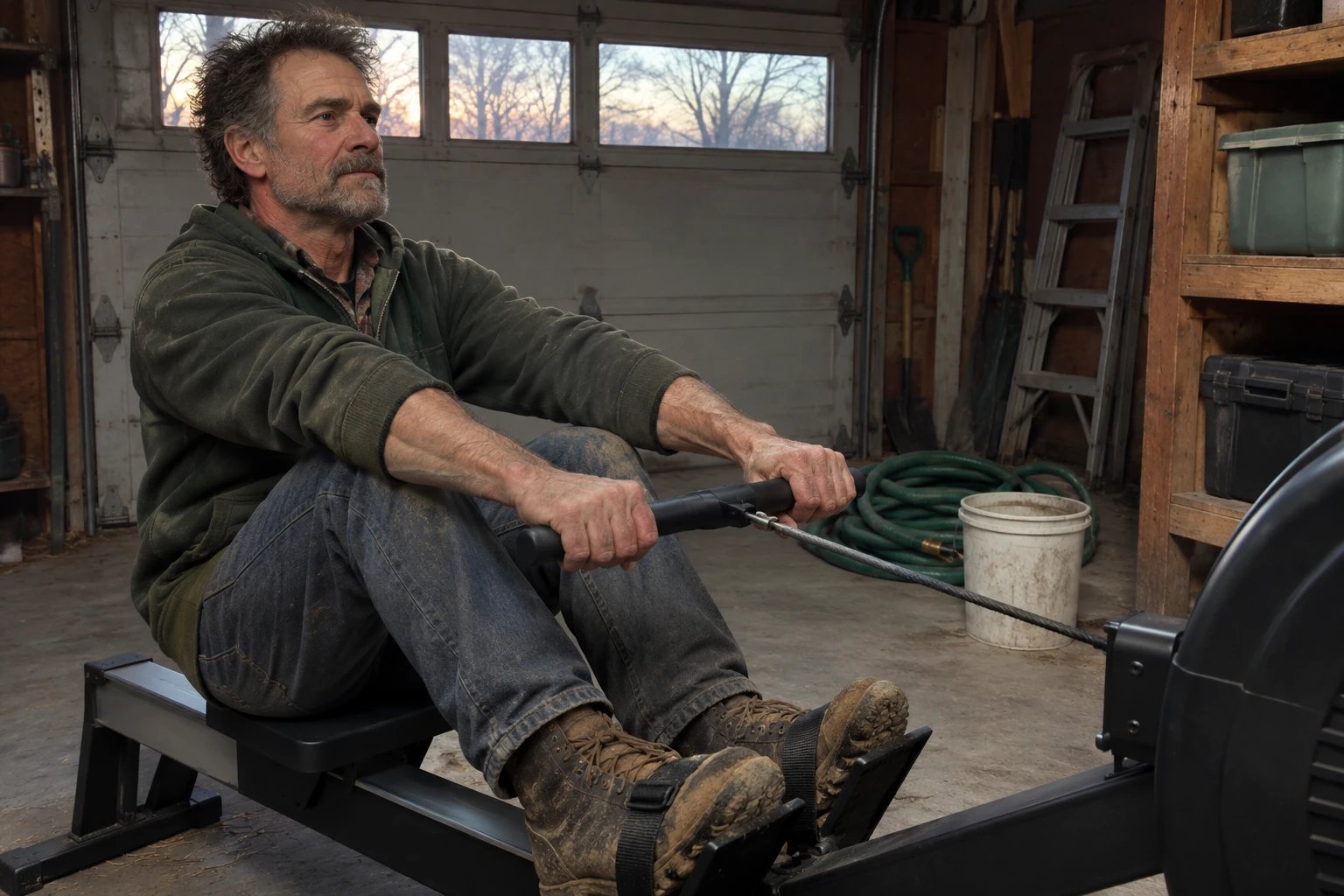
Small enough that you'd feel silly skipping it. Two push-ups, or two minutes. That's your floor for the worst day. On a good day, do more if you feel like it. On a bad day, the minimum counts as a full win.
The method comes from BJ Fogg, PhD, who created Tiny Habits and directs the Behavior Design Lab at Stanford. His recipe ties the tiny new thing to something you already do, which he calls an anchor: right after the anchor, you do the new tiny behavior. His own exercise examples are "Do two pushups" and "Do 3 crunches."
- Pick an anchor. Choose something you do every day, in the same place, without thinking: pouring the first coffee, feeding an animal, brushing your teeth.
- Pick the minimum. It has to survive your worst day. If it needs a change of clothes, it isn't a minimum.
- Write the sentence. For example: "After I pour my coffee, I will do two push-ups."
- Do it once today, right after the anchor.
A commenter in r/FitnessOver50, advising a 58-year-old who kept stopping and starting, described their own version:
"After feeding my animals I'd row for a couple minutes, even if I wasn't in the mood, it's only two minutes, right?"
Other restarters in the same forum and on TikTok describe similar tiny starts that stuck. Examples include two push-ups at every bathroom trip, "just 10 minutes," and short walks that grew over time.
The anchor does the remembering for you. Habit researchers at University College London describe habit formation as repeating "a chosen behaviour in the same context, until it becomes automatic and effortless." Same trigger, same spot, every time. Fitting exercise into daily life is also one of the 14 adherence factors from that 2021 review.
Tiny still counts. The federal guidelines say "any amount of physical activity has some health benefits," and they dropped the old rule that activity had to come in bouts of at least 10 minutes. If two minutes feels too small to bother with, Marcus Jackovitz, DPT, a physical therapist at the University of Miami Hospital, suggests starting with ten minutes of activity a day.
What can break this: an anchor that disappears on weekends or when you travel. If your weekday anchor is the commute, pick a second one for Saturdays, like the first coffee. Also, two push-ups won't suit everyone's shoulders. Swap in any move you can do without pain.
Schedule it like an appointment, not a hope
Put specific days and times on the calendar, the way you'd book the dentist, and keep them the same way. Motivation comes and goes. A standing appointment shows up whether you feel like it or not.
People who've made it stick say the same thing. They talk about treating workouts like walking the dog, a job that doesn't care about your mood. Two of them separately compare it to brushing their teeth. One was passing along a doctor's advice from 30 years ago.
The kitchen version: nobody on a line asks whether they feel like doing prep. It's on the list at 2 p.m., so it happens at 2 p.m.
What to book depends on where you're starting. In 2026, CDC's target for adults is still 150 minutes of moderate activity a week. One way to get there is "30 minutes a day, 5 days a week," plus muscle-strengthening on at least two days. CDC adds: "You don't have to do it all at once."
If you're restarting, I'd book the slots first and fill them later. Start with three short sessions at your minimum. Raise what happens inside them once showing up feels routine.
Expect showing up to feel routine later than you've been told. The 21-day habit claim is a myth. In the research summarized by the UCL team, automaticity plateaued "on average around 66 days", with wide variation between people. Automaticity is the point where you do something without having to decide. The researchers suggest expecting "around 10 weeks." For those ten weeks, consistency is the only score that counts, not how hard you went.
What can break this: booking times your life can't keep. Look back at your worst week of the last year. Choose slots that would have survived it.
How do you get back to exercise through the first rocky weeks?
Decide in advance what you'll do when small things go wrong, because small things are what usually end it. A member of r/FitnessOver50 put it exactly:
"I'm restarting after a several year lapse. It's the early phase where minor obstacles easily derail me."
Minor obstacles are predictable, so plan for them. Write down the three most likely to knock you off. Next to each, write your backup.
- Rain: the indoor minimum instead of the walk.
- A late night: the minimum only, no guilt.
- Visitors: a walk with them, or ten minutes before they're up.
- Feeling stiff: the walk instead of the weights.
Set goals about doing, not outcomes. Dominisha Felder is a physical therapist at Houston Methodist. She says "Starting with process-driven goals is better for us, so we can appreciate and build up little wins." Her example is a 15-minute walk three times a week. You control that. You don't control the scale.
Some early stiffness is expected. CDC-based guidance for arthritis says "It's normal to have some pain, stiffness, and swelling after starting a new physical activity program," and that sticking with it brings longer-term relief. Sharp or lasting pain is a different matter, and later sections cover it.
A single slip won't sink you either. In the habit research, "automaticity gains soon resumed after one missed performance." The damage comes when one missed day turns into "I'll start again Monday."
Which low-impact exercises are good to start with?
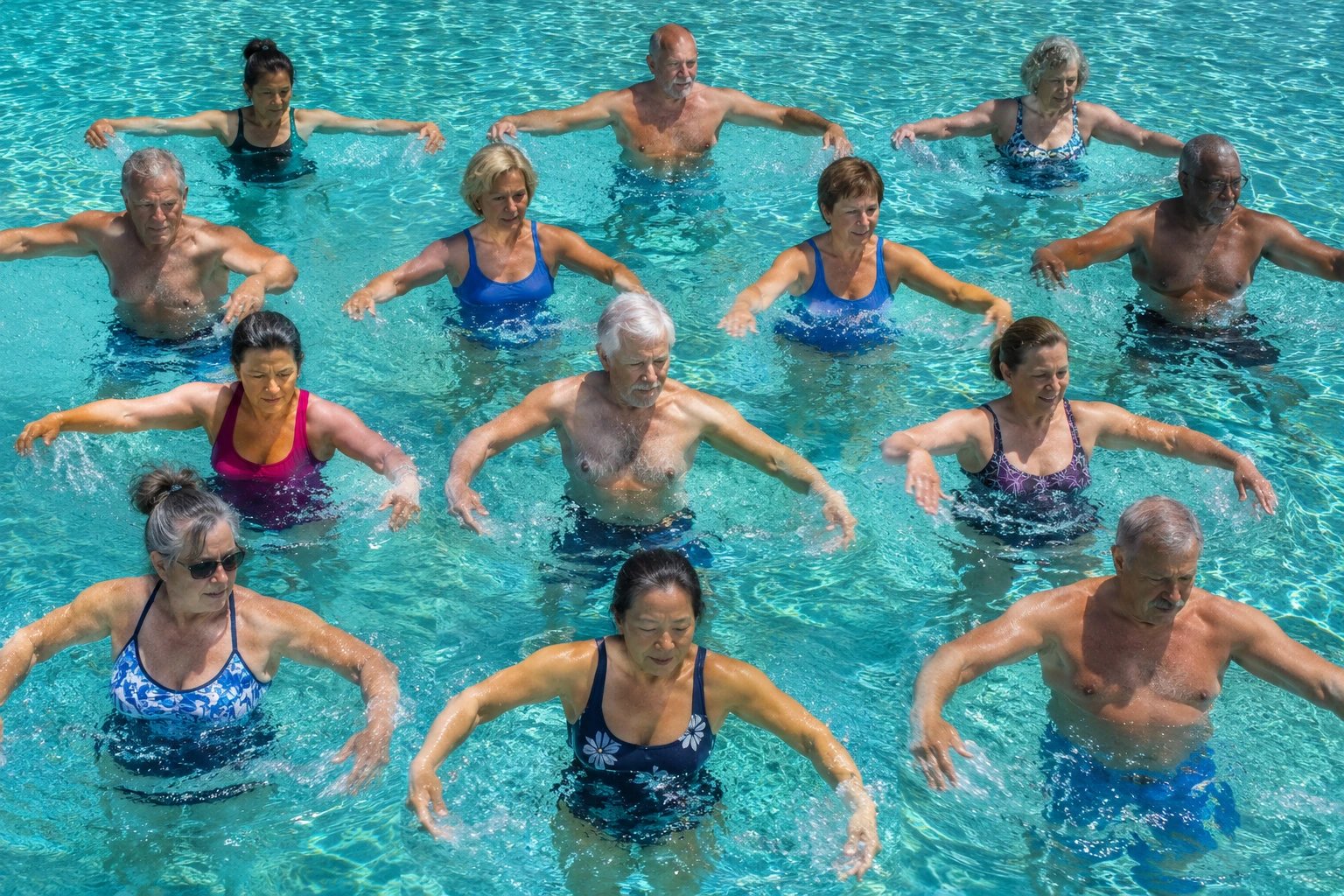
Walking, cycling, water aerobics and dancing. CDC's arthritis guidance picks these because they don't "twist or 'pound' the joints too much." That makes them a sensible restart for people managing joint pain.
On cost, walking is free, and a bike you already own is free too. For water aerobics, ask your local community center or pool what a class or a punch card runs before you commit to anything monthly. If you have a Medicare Advantage plan, check whether it includes SilverSneakers. Many of its locations offer pool classes, such as the shallow-water SilverSneakers Splash, at no extra cost on eligible plans.
To set the effort, use the talk test from the Arthritis Foundation. "If you can talk but not sing during an activity, you're probably working at moderate intensity." Carl Foster, PhD, of the University of Wisconsin-La Crosse, goes further: "For the non-athlete, there is almost no time when you would not want to be talking comfortably."
Going gently is no failure of nerve. A restarter in r/FitnessOver50 who began again at 53 after years of drifting said it simply: "I went slow because I felt so fragile."
If you have a joint condition or another health issue, CDC's tips advise talking with a health professional or a certified exercise specialist before you start.
Why is feeling strong early the moment to hold back?
Because your muscles get ahead of your tendons. Tendons are the cords that attach muscle to bone. Muscle responds within weeks. Tendons have a poor blood supply and slow chemistry, so they remodel and strengthen "at a significantly slower rate than muscle tissue," according to a 2025 review. Their ability to repair themselves also drops markedly with age.
That gap is the trap. A few weeks in, the weights feel lighter and the walk feels short, so you add more. Your muscles can take it. The tendons haven't caught up.
For an extreme example of a sudden jump in load, look at the NFL. After the 2011 lockout, players went 136 days without organized training. Ten Achilles tendons ruptured in the first 12 days of camp, against a typical average of about four a season. Those were young professional athletes, so the lesson is the jump, not the players: tendons need time to catch up to a new load.
The fix is boring, which is why it works:
- Hold each new level for a while before the next increase, even when it feels easy. Physical therapist Amy Brown, DPT, of Lee Health caps increases at about 10 percent a week.
- Treat recovery days as part of the plan. Strength training on two days a week leaves room between sessions.
Some aches and pains between workouts are normal. Learn the difference between ordinary soreness and the warning signs:
What can you do with bad knees, a bad back, hips or arthritis?
Work around the problem rather than stopping. Restarters describe hip arthritis, a yearly run of tendon injuries, bad knees and shoulders, and back damage. Several kept going by switching to cycling or lighter weights. One pointed out that the pain was there whether they sat or moved, so they chose to move.
| If it's your | Start with | Source |
|---|---|---|
| Knees | Wall squats, 6-inch step-ups | AAOS OrthoInfo |
| Low back | Exercise, tai chi, yoga | American College of Physicians |
| Arthritis | Walk With Ease | Arthritis Foundation |
| Fear of falling | A Matter of Balance, Tai Chi for Arthritis | NCOA |
For knees, the orthopedic surgeons' society (AAOS) gives two moves. Warm up first with 5 to 10 minutes of something low-impact "like walking or cycling."
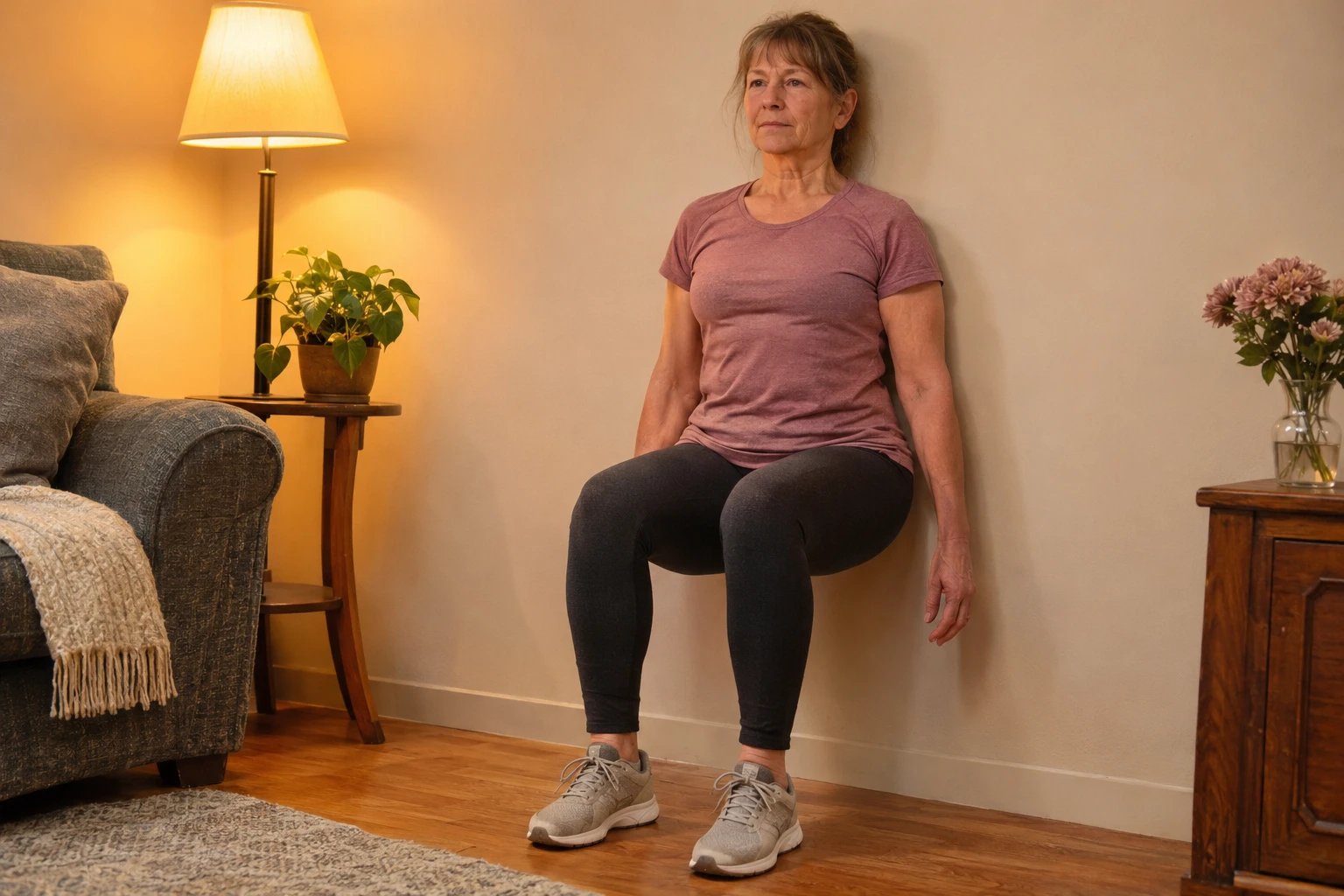
The wall squat:
- Stand with your back against a wall, feet about 2 feet out and hip-width apart.
- Slide down until you're almost sitting.
- Hold for 5 to 10 seconds, then slide back up.
- Don't let your knees move past your toes.
The step-up:
- Use a 6-inch platform, such as a single stair.
- Step up and lift the other foot off the floor.
- Hold for 3 to 5 seconds, then lower.
- Keep your whole foot on the platform, and don't lock the knee.
OrthoInfo's own line is the one to remember: "You should not feel serious pain during an exercise." If you do, stop and take it to a physical therapist.
For a bad back, the American College of Physicians recommends that people with chronic low back pain first try non-drug options. These include exercise, tai chi, yoga and motor control exercise, which retrains the deep muscles that hold your spine steady. A physical therapist is the usual place to learn that last one.
For arthritis, including in the hips, Walk With Ease is the Arthritis Foundation's walking program. It comes as a book, an online tool, an audiobook in English and Spanish, or a leader-led group, and there's a low-cost six-week worksite version. The self-guided guidebook costs $11.95 from the foundation's online store, and the helpline, 1-800-283-7800, is the place to ask what a group near you costs. For hip-specific exercises, a physical therapist who can see how your hip moves is the person to ask. If you're on Medicare, Part B covers medically necessary outpatient physical therapy once a doctor or other qualifying provider certifies you need it. After the deductible, you pay 20% of the approved amount.
For fear of falling, NCOA lists programs that meet federal criteria:
- A Matter of Balance: "an eight-week structured group intervention that emphasizes practical strategies to reduce fear of falling and increase activity levels."
- Tai Chi for Arthritis and Falls Prevention: also on the list.
- EnhanceFitness: a "low-cost" group that meets three times a week for an hour, so it doubles as a ready-made schedule.
To find one of these classes near you, search the federal Eldercare Locator at eldercare.acl.gov or call 1-800-677-1116.
What should you track instead of the scale?
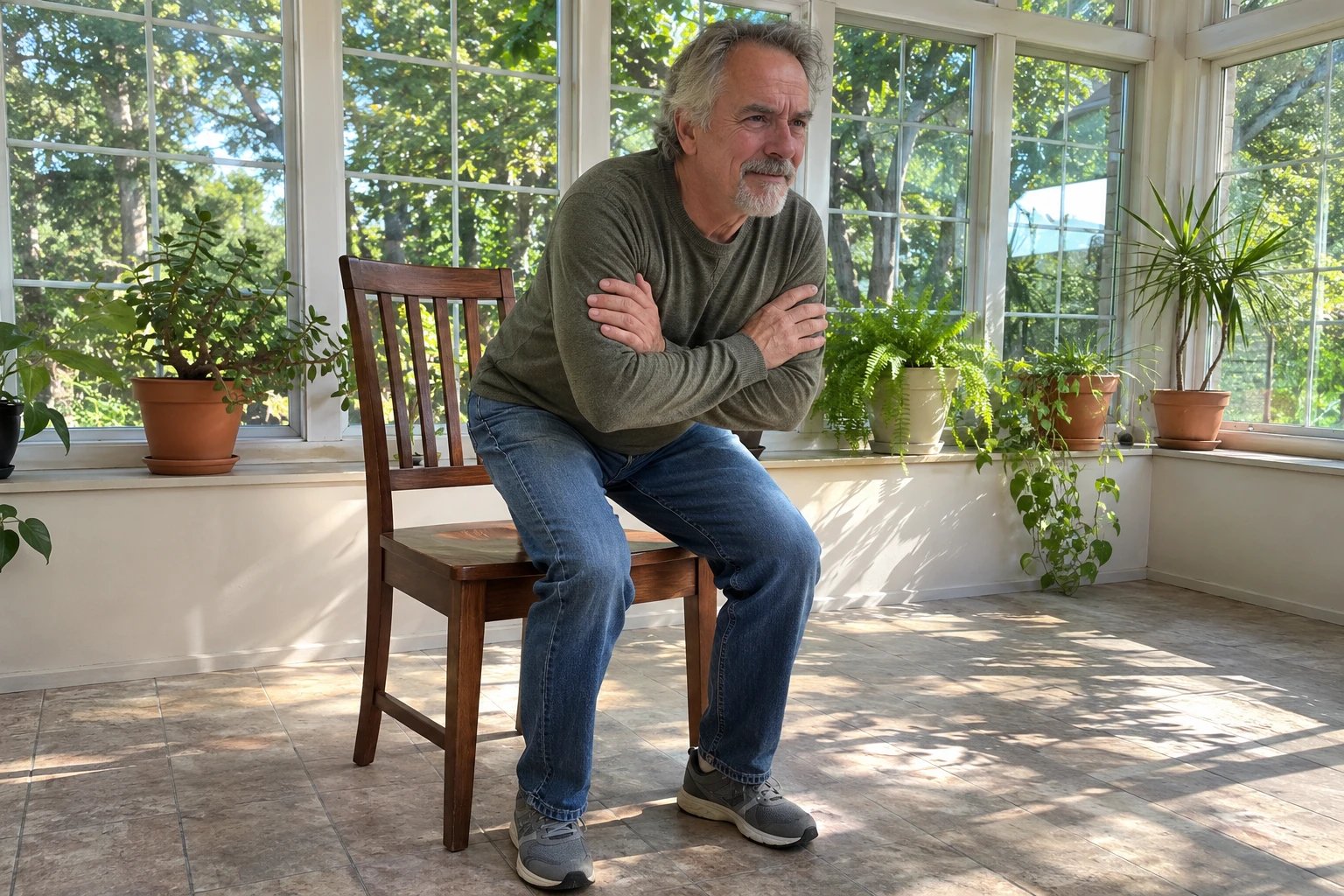
What you can do and how it feels. That gives you proof of progress in weeks, while your reflection is still deciding.
Strength moves first. Harvard Health says "You will experience noticeable gains in strength within four to eight weeks." How your body looks changes more slowly, and that gap is where many people quit. A few people over 50 on Reddit describe nearly giving up because their body wasn't changing the way it once would have, even while their lifts went up. The replies told them to judge by how they felt and what they could lift.
A 65-year-old on r/AskOldPeopleAdvice, answering someone who asked why bother after 45, put it best:
"I don't compare my 65 year old body to my 45 year old body."
Comparing yourself to who you were at 40 isn't useful either. Compare yourself to last month.
Dr. Josh, a physical therapist on YouTube, sets a sensible pace. He suggests starting at two or three sessions a week and adding reps only as the moves get easier. Within a few weeks, he says, a lot of them should start getting easier.
That "getting easier" is the thing to write down. Seeing your progress is one of the 14 adherence factors from the 2021 review. Keep a log with four things:
- Weights and reps: what you lifted and how many times.
- Minutes or distance walked, cycled or swum.
- One line on how you felt afterward.
- The chair stand, once a month.
The "how you felt" line matters more than it looks. In the Czech follow-up, the benefits people reported most at six months and a year were better well-being, flexibility and energy. Those are exactly the gains a scale can't show.
What to do after you miss a day, a week or a month
Restart below where you left off, and how far below depends on how long you were gone. There's no official chart for this. The working rule below is built on the studies in the rest of this section.
| Time missed | What's changed | How to restart |
|---|---|---|
| A day | Almost nothing | Your next scheduled session, as planned |
| A week or two | Little lost | First session at your minimum, then back to normal |
| One to six months | Muscle mostly holds | Drop well below your old load, about half |
| Longer | Muscle size drops | Start over at the minimum and rebuild |
The table rests on three findings:
- Missed days: the UCL habit research found that progress resumed soon after one missed day.
- Months off: a 2022 analysis of adults 65 and over found muscle size didn't drop significantly after 12 to 24 weeks without resistance training. It did drop after 31 to 52 weeks. Earlier work it cites found strength gains hold as long as the break is shorter than the training that built them.
- What half looks like: Consumer Reports gives a concrete example. If you used to lift 10-pound dumbbells for three sets of 10, restart with 5-pound dumbbells for one set of 10. Then build time, distance and weight back gradually.
Jason Cruickshank, an athletic trainer at Cleveland Clinic, says it straight: "You're not being fair to yourself if you think you'll jump back in at the same spot."
Then there's the guilt, which does more damage than the missed week. A 53-year-old five months into a restart summed it up in r/FitnessOver50: "I'm excited about my progress, and I hate myself for procrastinating." Only the first half moves you forward.
Jessica Valant, a physical therapist in Denver, loses her balance mid-move in one of her videos, catches it, and keeps going. "That's the key. You don't get discouraged, you just come right back to it again. This is a long game," she says. Her other line is the right one for a restart day: "Meet your body where it is and know that long term you're doing something good for yourself."
Can a workout buddy or a dog keep you accountable?
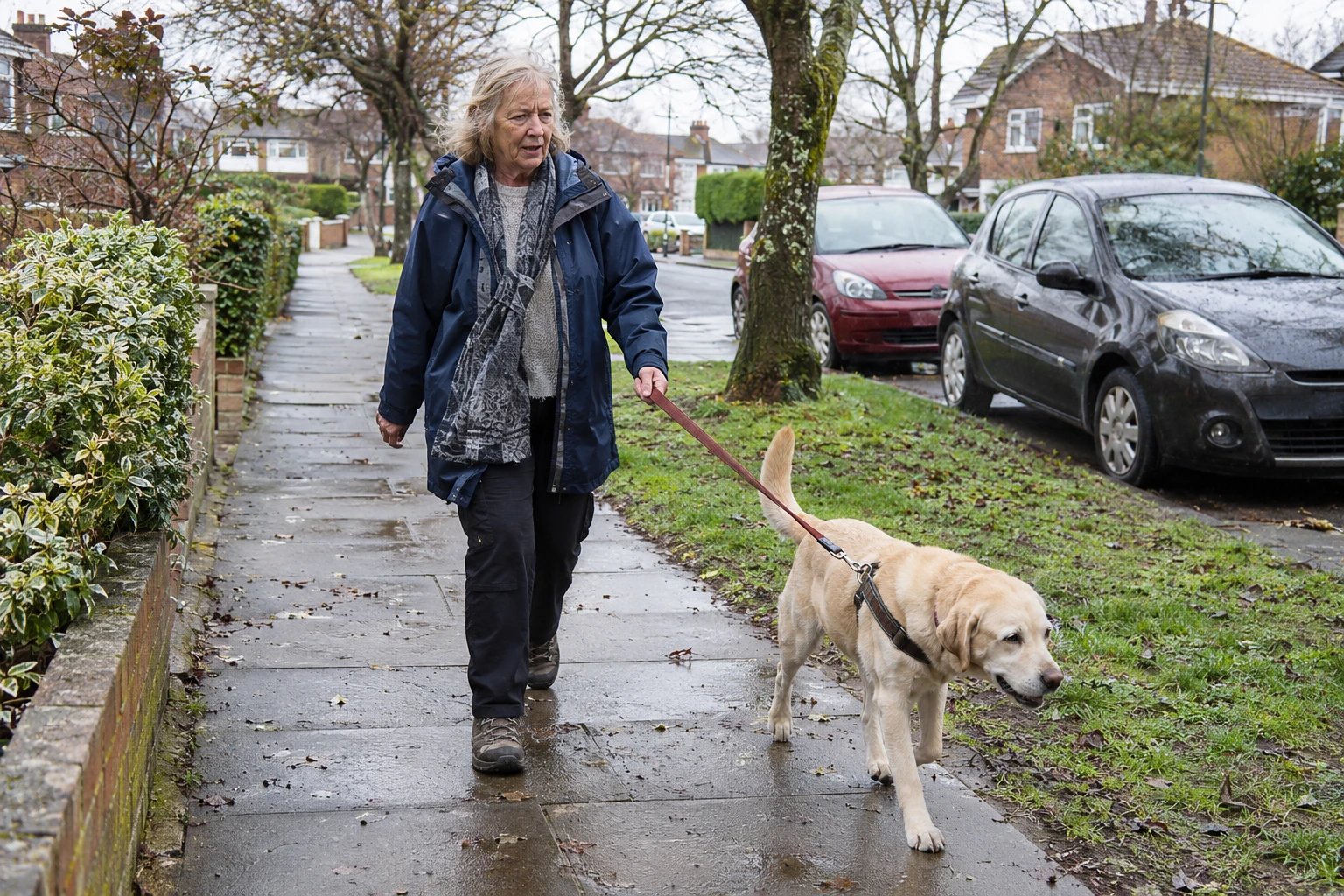
Yes, if someone or something is counting on you to show up. Accountability works best when skipping costs you something besides your own disappointment.
In UK community exercise groups for adults 60 and up, people stayed for the instructor and for the social side: "sense of belonging, friendships, group dynamic." In the Czech follow-up, "social support and external incentives" were what helped most.
Pick an exercise buddy who is more reliable than you are. A partner who cancels takes you down with them. That's why I'd rather lean on a class that runs whether your friend shows or not. The NCOA programs above meet on fixed days, which makes them a schedule and a group in one.
Dogs make a strong case. In a study of 3,123 older adults in Norfolk, England, people wore activity trackers for a week. Regular dog walkers were more active on the worst-weather days than people without dogs were on the best days. They also spent about 30 minutes a day less sitting when the weather was at its worst. The study shows a link, not proof that the dog caused it.
On Reddit, a few people over 50 name what keeps them moving: dogs that need long walks, a training partner three days a week, teaching a dance class, a spouse who needs their care. Each one comes with an obligation that won't wait for a mood.
If you have a dog, the walk is your anchor and your accountability at once. If you don't, a dog is a far bigger commitment than any gym contract, so get one only if you want a dog anyway. Offering to walk a neighbor's dog is a cheaper test.
How do you make exercise less boring?
Add a challenge, a deadline or something new on purpose. Boredom is a setup problem too.
Dr. Tracey Marks, a psychiatrist, was talking about ADHD, but her point applies to anyone who stalls: motivation comes from interest, urgency, challenge and novelty. Her tactics translate straight to a workout:
- Use a timer. Walk your usual loop and try to beat last week's time, or count how many step-ups fit into two minutes. A timer, she says, makes the task a challenge, and that can make it more interesting.
- Work alongside someone. She calls this body doubling: doing the task near someone who won't shame you. A friend on the next bike counts. So does a video call.
- Change the location. Take the same walk in a different neighborhood, or move the stretching from the bedroom to the porch.
Variety helps people stay with it, though the best trial on this is in a much younger group. A six-week study randomly assigned 121 inactive university students to high- or low-variety programs, and the high-variety group stuck with it significantly better. Students aren't you, but the logic carries. You get the enjoyment now, while the health payoff takes months to show up.
Does sleep affect whether you stick with exercise?
Yes, and it's the part almost nobody plans for. In Finland's FINGER trial, 1,259 adults aged 60 to 77 followed a two-year program of strength and aerobic exercise. People who slept under 6 hours, or 9 hours or more, had less than half the odds of sticking with the exercise compared with people sleeping 7 to 8.
Two other findings from that trial matter. Pain didn't affect who stuck with it. People with depressive symptoms stuck with it less, but still benefited.
CDC recommends 7 or more hours for adults up to 60, 7 to 9 hours from 61 to 64, and 7 to 8 hours from 65 on. Its tips include going to bed and getting up at the same time every day.
The two help each other. The federal guidelines list better sleep quality among the immediate benefits of physical activity. Sleep, in turn, makes the next session easier to start.
Dr. Andrew Huberman, a neuroscientist at Stanford, frames it as your starting level of drive. "Getting sufficient sleep each night literally restores your dopamine reserves," he says. Dopamine is the brain chemical tied to drive. Movement keeps that level up too: "By engaging in regular movement, you ensure that you're maintaining elevated levels of baseline dopamine."
Morning daylight is the cheap extra. University of Surrey researchers studied adults over 60 with sleep problems. Those who got more blue-enriched morning light "had better sleep and more stable daily activity", and those who spent more time outdoors in daylight were more active. If your schedule allows a morning walk, you get the light and the movement in one trip.
The bottom line
Write your sentence today: "After I [something you do every day], I will [something you can do on your worst day]." Two push-ups after the coffee. Two minutes on the bike after you brush your teeth. Then do it the next time the anchor comes around, so the first rep is behind you.
Next, put three sessions for the coming week on the calendar, with times, and give them the same standing as any other appointment. If you've been off for months, start those sessions at half your old load. When the sessions start feeling easy a few weeks in, hold steady instead of adding.
When you miss one, the next session on the calendar is when you start again, no matter what day of the week it falls on.
Your shoes are already by the door.
Up next
Walking for Weight Loss Over 50: A Beginner Plan
A week-by-week walking schedule that starts from your own step count, with honest numbers on how much weight it will actually move.
Read the story →
Reader quiz
Did you catch the details?
5 questions from this article.
In the habit section, what does the article say shows your worst-day minimum isn't really a minimum?
Questions people also ask
Is it too late to start exercising at 50 or 60?
No. A large study of 315,059 adults found that people who became active only in midlife, between ages 40 and 61, had about a 35 percent lower risk of dying from any cause than people who stayed inactive. The study tracked people over time and relied on what they remembered of their activity, so it shows a link rather than proof. Its authors concluded that "midlife is not too late to start physical activity." The usual line that it's never too late to start has real evidence behind it for this age range.
How do I get my workout motivation back?
Act first and let the motivation follow: pick a tiny version of the activity and tie it to something you already do every day. BJ Fogg of Stanford's Behavior Design Lab uses the formula ["After I [anchor], I will [tiny behavior],"](https://sites.google.com/view/learn-tiny-habits/5-design-your-habits) such as two push-ups. Set process goals, like a 15-minute walk three times a week, to build up little wins. If you miss a session, habit research found progress resumed soon after one missed day.
How long does it take to see results from exercise after 50?
Expect noticeable strength gains within four to eight weeks, according to Harvard Health. A new routine takes about 66 days on average to feel automatic, so plan on around ten weeks, though it varies a lot between people. Some benefits, such as better sleep quality, arrive almost immediately.
How many days a week should I exercise when starting again?
The federal target is 150 minutes of moderate activity a week, such as 30 minutes on five days, plus muscle-strengthening on at least two days. Adults 65 and over should also add balance activities. If you're restarting, short sessions count, and CDC says some activity is better than none. Three short sessions in the first week is a sensible place to begin, building from there.
How much weight should a beginner over 50 lift?
Choose a weight you can lift for two sets of ten repetitions in good form, where you need a rest after ten, says the Arthritis Foundation. If you're coming back after a break, drop well below your old load. Consumer Reports' example is going from 10-pound dumbbells for three sets of ten to 5-pound dumbbells for one set of ten. Harvard Health put a basic starter set of dumbbells at about $50 to $100 in 2021.
What exercise can I do with bad knees or arthritis?
Walking, cycling, water aerobics and dancing are the joint-friendly options in CDC's arthritis guidance, and you can start with as little as three to five minutes twice a day. For knees, AAOS OrthoInfo describes wall squats and 6-inch step-ups and says you shouldn't feel serious pain during an exercise. The Arthritis Foundation's Walk With Ease is a walking program you can follow on your own or in a group.
Did any of these feel familiar?
Know someone who needs this?
 Prime Journal · Free printable
The Everyday Health Readiness Checklist
- A clearer path from bed to bathroom
- A medicine list ready for the pharmacist
- A symptom story and follow-up plan you can use
Free printable: The Everyday Health Readiness Checklist. Enter your email and it is yours.
Sources cited in this article
This article links to 45 outside sources, listed here so you can read them yourself.
- 14 key factors behind whether people stick with exercise pmc.ncbi.nlm.nih.gov/articles/PMC7922504
- Active for years www.reddit.com/comments/1rqefj9
- Told Consumer Reports www.consumerreports.org/health/exercise-fitness/how-to-get-active-again-a745…
- "lack of motivation and time." pmc.ncbi.nlm.nih.gov/articles/PMC12433213
- Rooted in biology www.youtube.com/watch?v=rNxC16mlO60&t=126s
- 21.6% of men and 17.6% of women aged 50 to 64 www.cdc.gov/nchs/products/databriefs/db443.htm
- Approximately half of participants who commence an exercise programme will drop out within the first six months pmc.ncbi.nlm.nih.gov/articles/PMC5264485
- Enjoying the activity for itself was "more predictive of long-term exercise adherence." pmc.ncbi.nlm.nih.gov/articles/PMC3441783
- Unless you are doing strength training, you will become weaker and less functional www.harvardhealth.org/healthy-aging-and-longevity/want-to-live-longer-and-be…
- Right after the anchor, you do the new tiny behavior sites.google.com/view/learn-tiny-habits/5-design-your-habits
- TikTok www.tiktok.com/@the50plusrebuild/video/7693887048289225998
- "a chosen behaviour in the same context, until it becomes automatic and effortless." pmc.ncbi.nlm.nih.gov/articles/PMC3505409
- "any amount of physical activity has some health benefits," odphp.health.gov/our-work/nutrition-physical-activity/physical-activity-guid…
- CDC-based starting point news.calpers.ca.gov/5-s-m-a-r-t-exercise-tips-to-help-manage-arthritis
- Some physical activity is better than none at all www.cdc.gov/physical-activity-basics/guidelines/older-adults.html
- "30 minutes a day, 5 days a week," www.cdc.gov/physical-activity-basics/guidelines/adults.html
- Put it exactly www.reddit.com/comments/1s2fkt1
- "Starting with process-driven goals is better for us, so we can appreciate and build up little wins." www.houstonmethodist.org/blog/articles/2026/jan/how-to-start-exercising-afte…
- "If you can talk but not sing during an activity, you're probably working at moderate intensity." www.arthritis.org/health-wellness/healthy-living/physical-activity/success-s…
- Remodel and strengthen "at a significantly slower rate than muscle tissue," journalmsr.com/tendons-under-load-understanding-pathology-and-progression
- Lee Health www.leehealth.org/health-and-wellness/healthy-news-blog/health-hub/starting-…
- AAOS OrthoInfo www.orthoinfo.org/staying-healthy/knee-exercises
- American College of Physicians www.acponline.org/acp-newsroom/american-college-of-physicians-issues-guideli…
- Arthritis Foundation www.arthritis.org/health-wellness/healthy-living/physical-activity/walking/w…
- NCOA www.ncoa.org/article/evidence-based-falls-prevention-programs
- Guidebook costs $11.95 www.arthritis.org/health-wellness/healthy-living/physical-activity/walking/w…
- Covers medically necessary outpatient physical therapy www.medicare.gov/coverage/physical-therapy-services
- Eldercare Locator acl.gov/FallsPrevention
- Reddit www.reddit.com/comments/1hytzk9
- Put it best www.reddit.com/comments/1sq3zhe
- Starting at two or three sessions a week www.youtube.com/watch?v=W_at1A4zlMY&t=242s
- Published norms pmc.ncbi.nlm.nih.gov/articles/PMC7650655
- Didn't drop significantly after 12 to 24 weeks without resistance training pmc.ncbi.nlm.nih.gov/articles/PMC9657634
- Says it straight health.clevelandclinic.org/how-to-get-back-to-exercising-after-a-long-break
- "That's the key. You don't get discouraged, you just come right back to it again. This is a long game," www.youtube.com/watch?v=uth_9K3EmDI&t=492s
- Meet your body where it is www.youtube.com/watch?v=uth_9K3EmDI&t=680s
- Regular dog walkers were more active on the worst-weather days pmc.ncbi.nlm.nih.gov/articles/PMC5561362
- Comes from interest, urgency, challenge and novelty www.youtube.com/watch?v=Xp805f-j1VI&t=183s
- Makes the task a challenge www.youtube.com/watch?v=Xp805f-j1VI&t=244s
- The high-variety group stuck with it significantly better researchportal.bath.ac.uk/en/publications/variety-support-and-exercise-adher…
- Less than half the odds of sticking with the exercise pmc.ncbi.nlm.nih.gov/articles/PMC11954347
- 7 or more hours for adults up to 60 www.cdc.gov/sleep/about/index.html
- Getting sufficient sleep each night literally restores your dopamine reserves www.youtube.com/watch?v=35lS7gJVTyA&t=65s
- By engaging in regular movement, you ensure that you're maintaining elevated levels of baseline dopamine www.youtube.com/watch?v=35lS7gJVTyA&t=371s
- "had better sleep and more stable daily activity" theconversation.com/why-morning-blue-light-therapy-could-improve-sleep-and-d…

Peter Byalik
Food & Home Editor
Peter Byalik is a professional chef with more than 20 years of experience, including years running his own business. He came to the United States from Ukraine.
More from Peter Byalik