


17 Easy Home Workouts Over 50 (No Equipment)
Seventeen moves built from your counter, wall, chair, stairs and broom, plus the one skill fitness lists never teach: getting back up off the floor.

By Peter Byalik, Food & Home Editor
Updated · 24 min read
- Written by our food & home editor
- Cited 40 sources
- How we review
The woman in the workout video is on her third "Let's go, ladies!" and you're still hunting for the remote to mute her. You didn't come for a pep rally. A member of r/AskWomenOver50 who exercises only for her health said it better than any instructor: "Just please show me what to do and let me slog my way through it in silence." So here are beginner workouts for women over 50 at home, built from bodyweight exercises and things already in the house. It's a free workout routine, with no equipment and nobody yelling.
Everything you'll use is already here:
| What's in the house | The moves |
|---|---|
| A sturdy chair | #17, #6 |
| A wall | #16, #4 |
| The kitchen counter | #15, #14, #12, #11, #7 |
| The bathroom sink | #13 |
| The bottom stair | #10 |
| A broom, a laundry basket, a backpack | #9, #8, #3 |
| A towel and a solid door | #2 |
| The floor and a chair beside you | #1 |
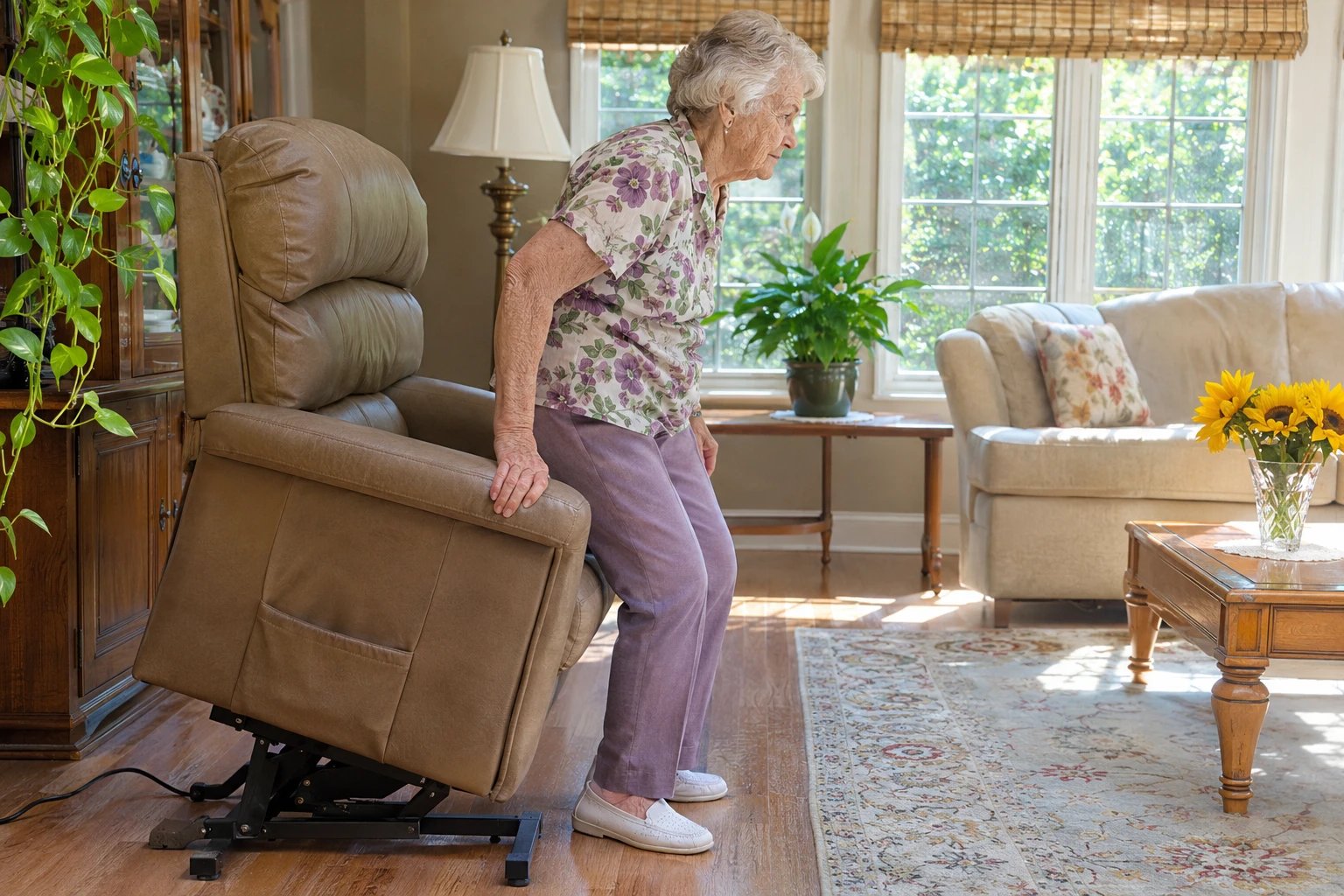
17Standing up from a chair, no hands
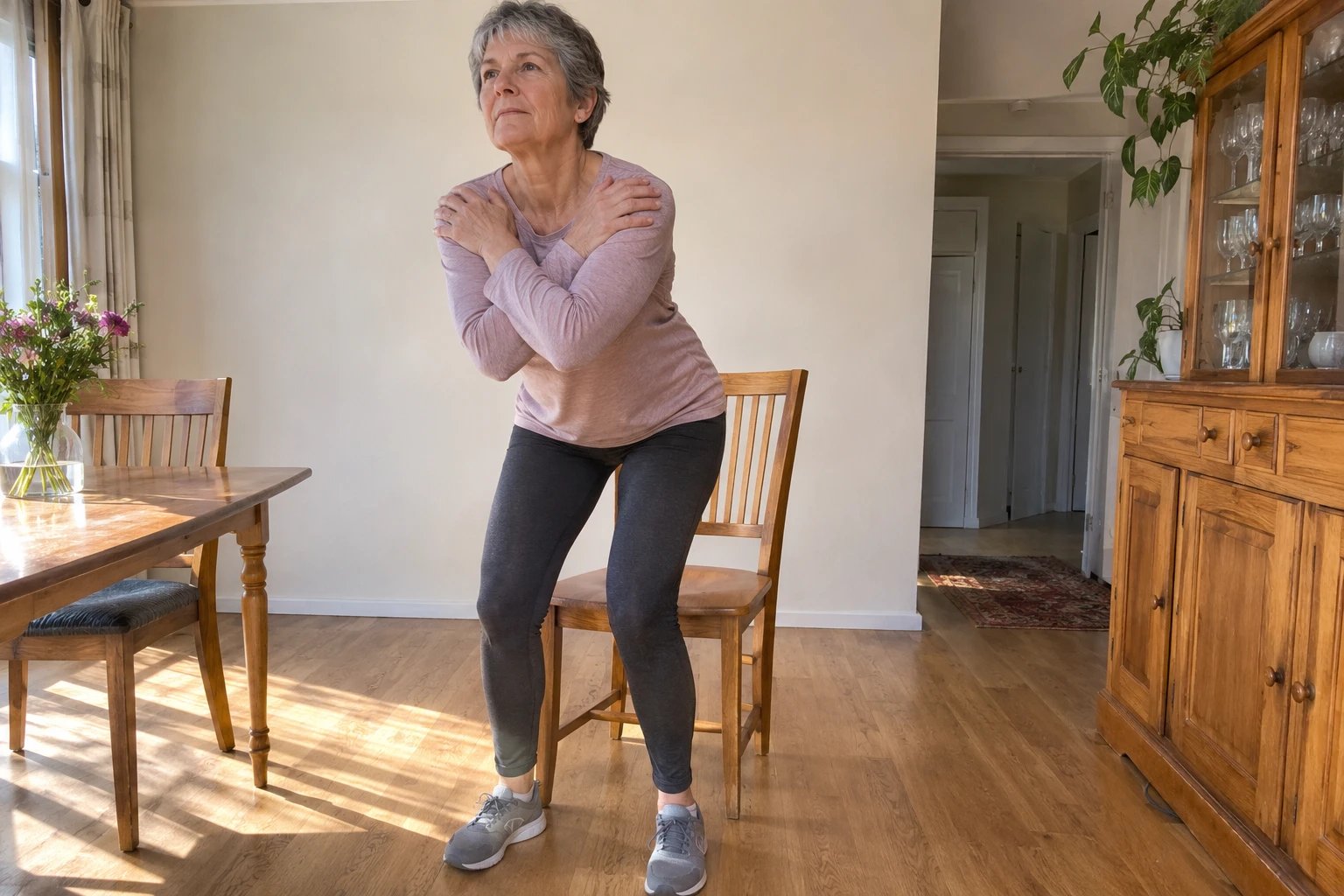
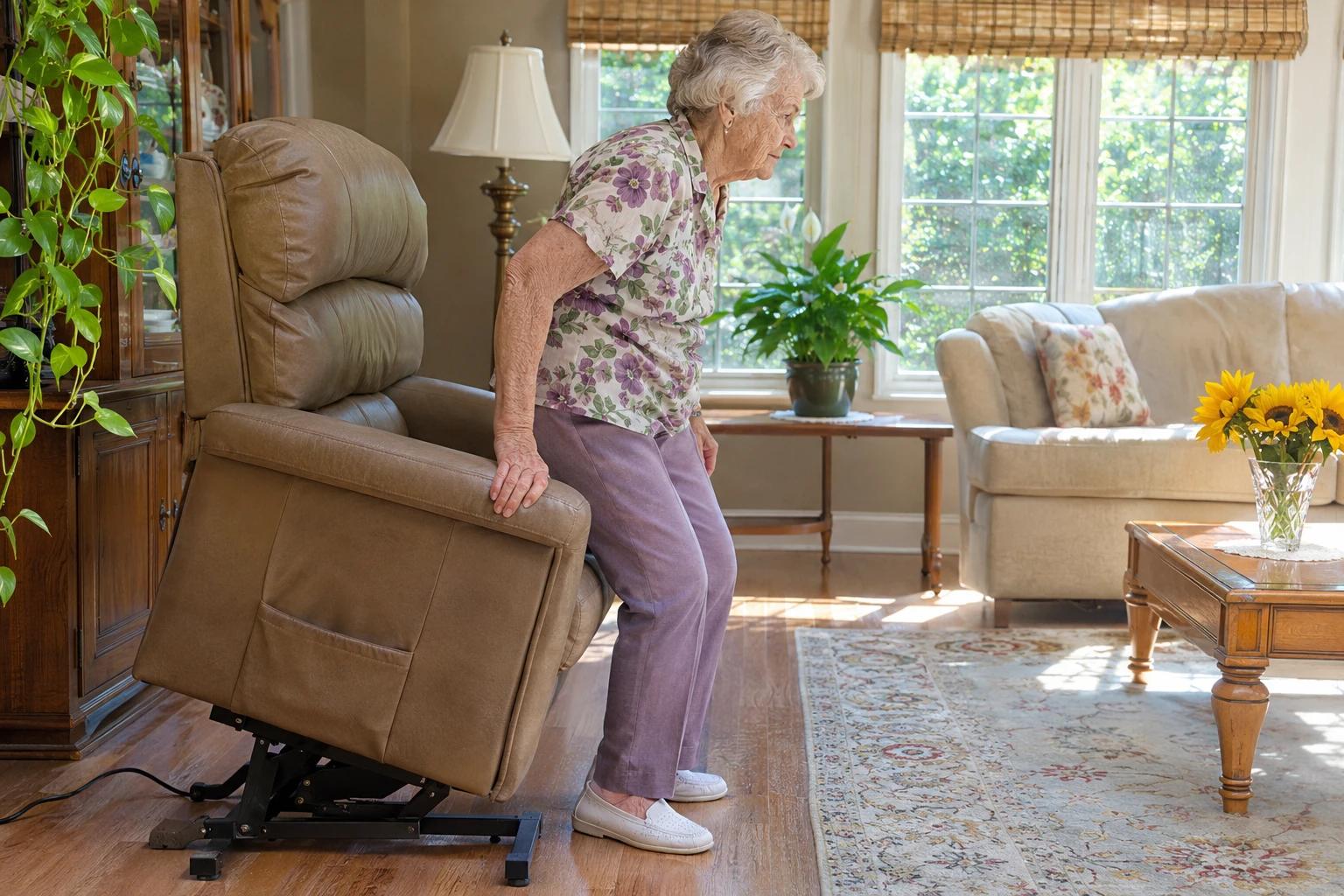
You've already done this one since breakfast. Standing up from a chair without pushing on the armrests is a real strength test.
It's also more practice than you'd guess. Researchers in Finland had people in their seventies and eighties wear a small motion sensor on the thigh for up to a week, and they counted every time someone got up from a seat. Women at 75 averaged 42.8 stands a day. At 85 it was 34.4. Every one of those is a rep. A chair stand is really a chair squat, with the chair waiting for you at the bottom.
So start here, and start by counting.
CDC's scoring only starts at age 60, and that's fine. The score that matters is yours today against yours next month.
If you need your hands right now, use them. The UK's Otago home exercise program starts people on a two-hand version: feet a little behind your knees, lean forwards over your knees, and push up with both hands. Dropping the hands comes later.
In my experience, the cooks who swore they couldn't squat were dropping to a low oven door all shift long. For practice, do 10 slow stands from a dining chair, never one with wheels.
16Wall push-ups, then the counter
You only need one push-up. It gets harder when you put your hands on something lower, so you never have to learn a second "easier" exercise.
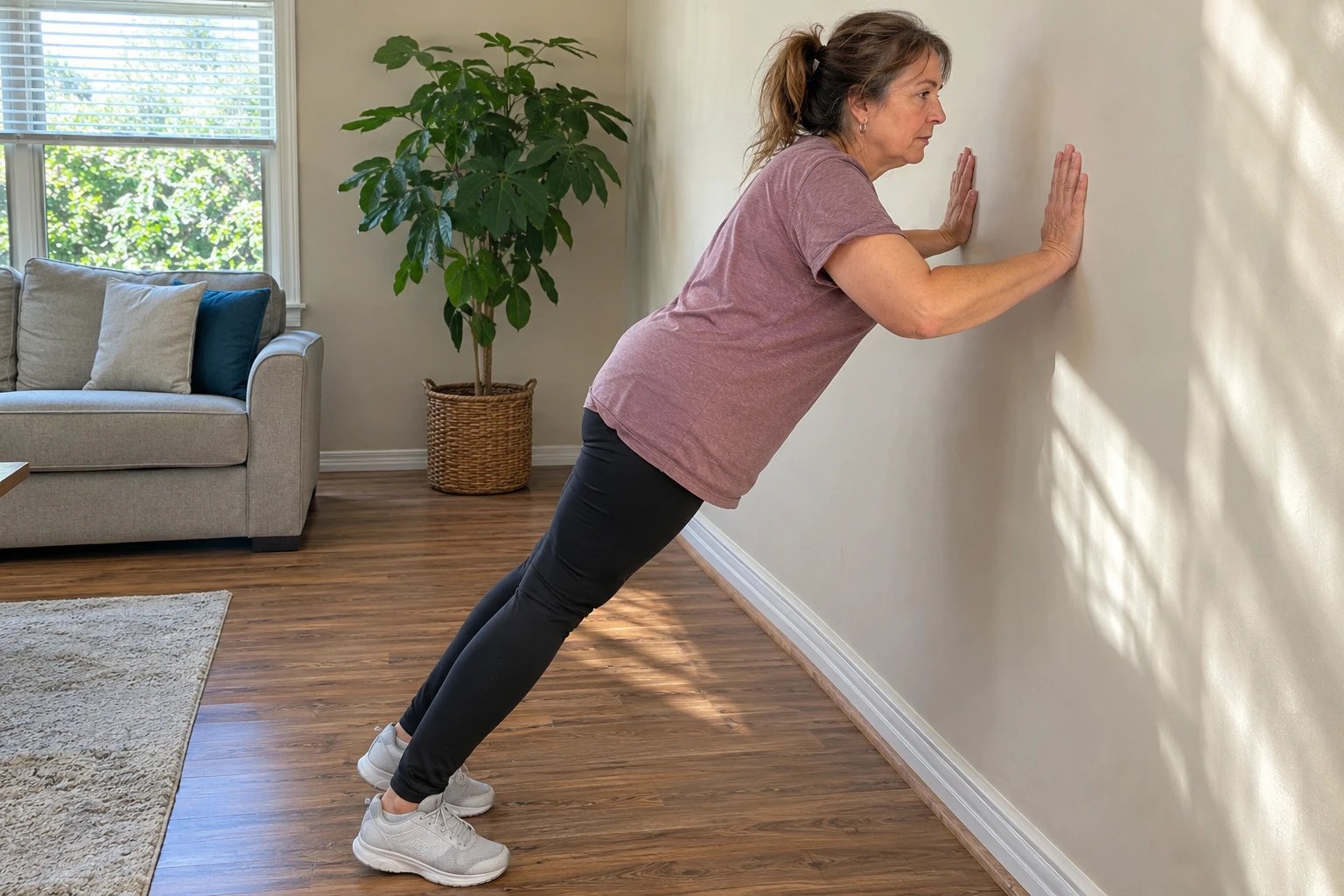
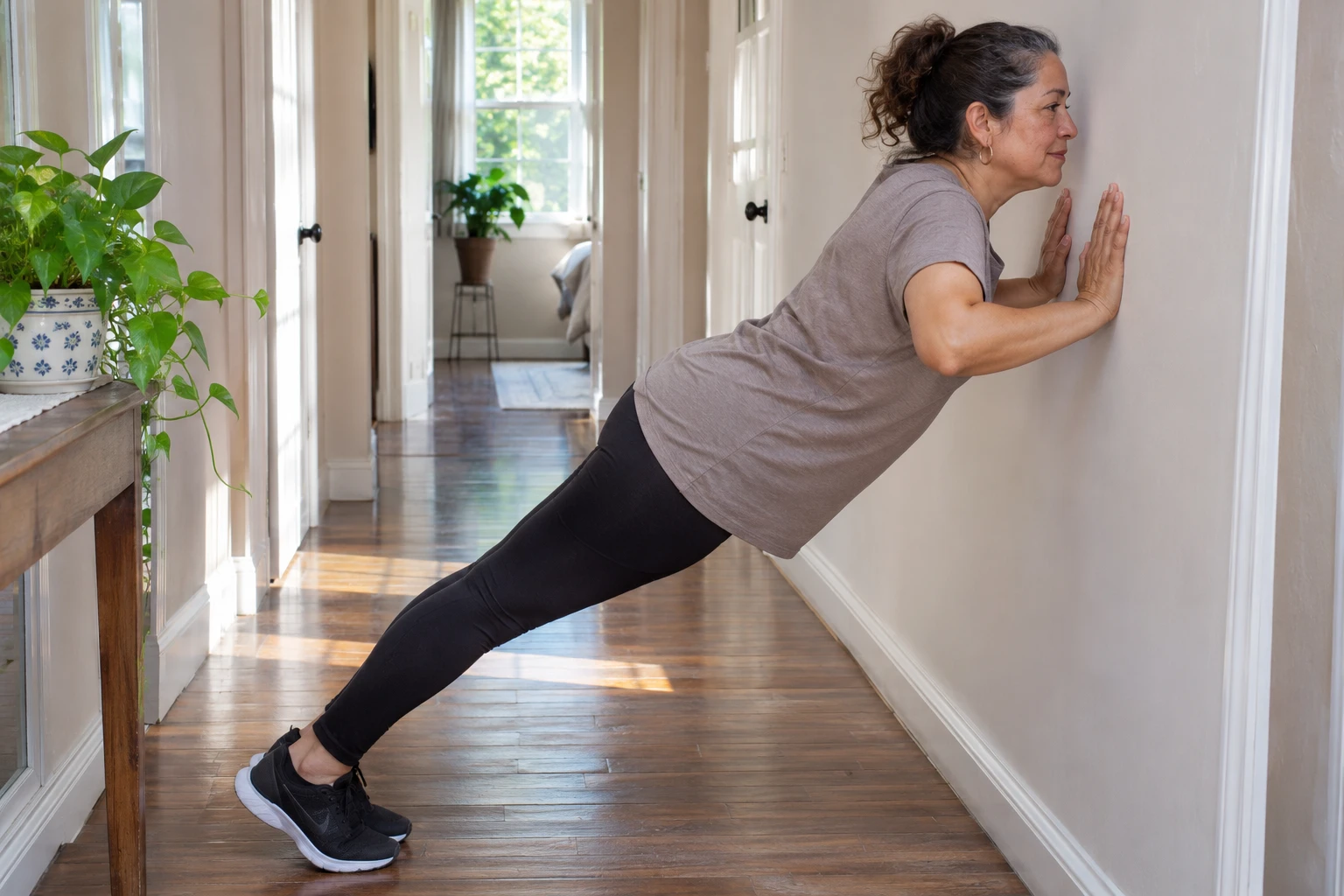
Harvard Health's version: stand in front of a wall with your arms straight out at chest height and palms flat. Bend your elbows to bring your upper body toward the wall, "keeping a straight line from head to heel." Push back. That's one.
"Basically, the lower the surface, the harder it would be." Dr. Josh, physical therapist, on YouTube
To make the wall push-up harder, Harvard says to gradually move your feet back so your body is at a greater angle to the wall. As that gets easy, try the move with your hands on the kitchen counter instead of the wall.
Dr. Edward Phillips of Harvard Medical School says you adjust push-ups by changing "your body's angle, your hand placement, and the speed you do them." Speed is the one nobody uses. Once you can push up from your knees, a doctor of physical therapy at Village Fitness and Physical Therapy in Southern California suggests lowering yourself slowly from your toes, then pushing back up from your knees. Working hard on the lowering half builds strength before you can do the full move.
Dr. Josh also keeps his elbows close to his body instead of flaring them out like wings.
15A plank against the kitchen counter
If getting down on the floor for a plank sounds like a negotiation, skip the floor. Put your forearms on the counter, walk your feet back, and you're planking.
Margaret Martin, a physical therapist with 40 years in osteoporosis and fall prevention, gives the cue: keep your ear, shoulder, hip, knee and ankle in a straight line, tuck your tummy gently, and "do not let your hips sag." At a counter around belly-button height, she has you step back a little farther than you would at a wall and shift your weight onto the balls of your feet.
Most plank advice says to hold as long as you can. Martin's is a ladder, and you climb it one rung at a time:
- Six holds of 5 seconds
- Three holds of 10 seconds
- Two holds of 15 seconds
- One hold of 30 seconds
- Two holds of 30 seconds
- Three holds of 30 seconds, with 30 seconds' rest between
Move up a rung each time the one you're on feels easy. Once three 30-second holds feel easy, you're ready for a lower surface. The first rung adds up to half a minute of actual holding, which is about right for a first day. Blood pressure can rise sharply during a plank, as it does during a wall sit, so if you have high blood pressure or a heart condition, check with your doctor first.
A counter taller than your belly button makes it easier. A wall is the gentlest start of all. Martin's sequence runs wall, counter, chair, and only then the floor, so you can stop at whichever step suits you. Ears over shoulders. Hips stay up.
14Heel-to-toe stance by the counter
Put one foot directly in front of the other, heel touching toe, and stand there. You know the pose from every roadside sobriety test on television. Clinics use it for something else.
It's the third stage of CDC's 4-stage balance test, and each stage is held for 10 seconds:
- Feet side by side
- The instep of one foot touching the big toe of the other
- One foot directly in front of the other, heel to toe
- Standing on one foot
By CDC's measure, an older adult who can't hold the heel-to-toe stance for 10 seconds is at increased risk of falling. So 10 seconds is your target, and the counter is where you practice.
Stand at the counter with one hand on the edge. Line your feet up, heel to toe. Look at something across the room, not at your shoes, and hold for 10 seconds. Balance and fall prevention programs like the UK's Otago program teach this same stance, then switch feet.
When it's easy, rest two fingertips on the counter instead of a hand. Then let the hand hover an inch above it. Switch which foot is in front every time, so you can compare the two sides.
13Standing on one leg while brushing teeth
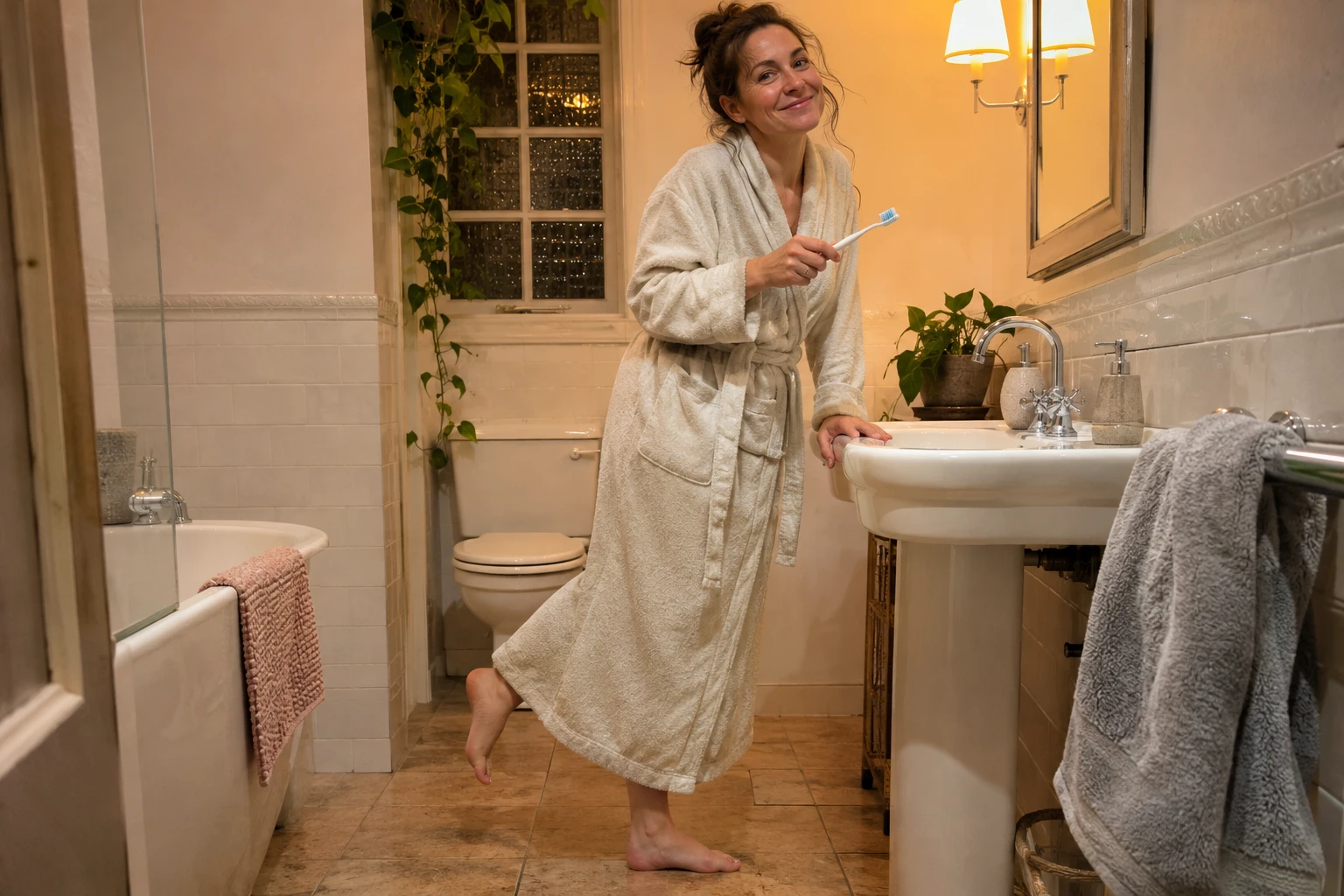
Toothbrush in one hand, the other hand on the edge of the sink. Lift one foot an inch off the floor. Now brush.
That's stage four of the same balance test, folded into time you were already spending at the sink. CDC lists standing on one leg among the balance activities that help prevent falls. Aim for 10 seconds, switch feet, then rinse.
Why the sink? Habit researcher Dr. Pippa Lally of the University of Surrey puts it plainly: "If you make a clear plan of when and where you will do something you are more likely to do it than if you have a vague intention." The sink is a when and a where you're never going to skip. Women in r/AskWomenOver50 threads who finally made exercise stick say the same thing: they tied it to brushing their teeth, making the bed, or a show they already watched.
See more: 17 Tai Chi Exercises and Honest Truths for Women Over 50 →
12Side steps across the kitchen
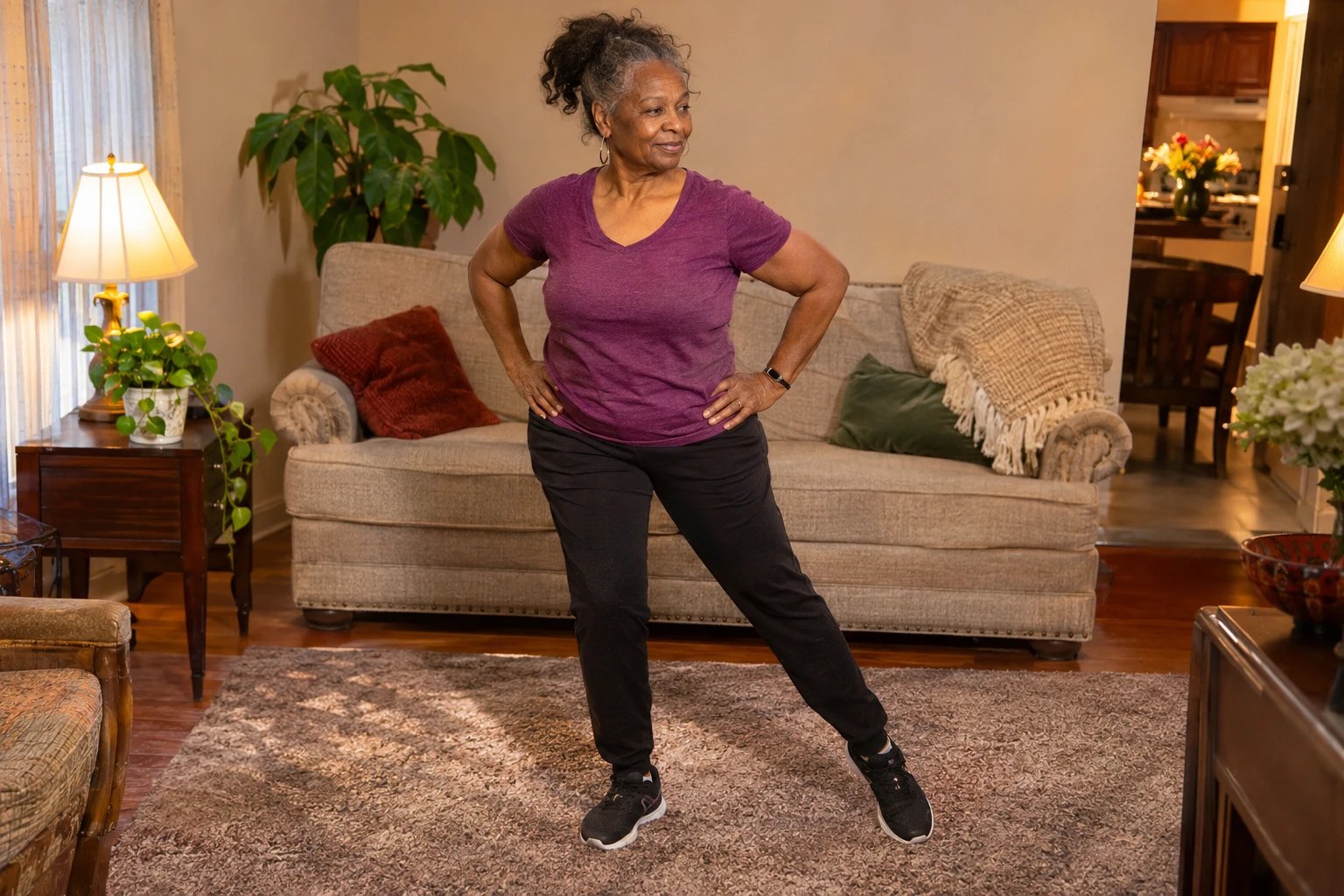
Watch anyone who's unsure of their footing and you'll see the steps shrink. Physical therapist Alyssa Kuhn, DPT, makes this point in a balance workout she films with her 87-year-old grandmother-in-law. People who don't trust their balance start shuffling and taking smaller steps, she explains, and drills like this one rebuild the confidence to take bigger ones.
Here's the Otago version:
- Stand tall with your hands on your hips.
- Take 10 side steps to the right, then 10 to the left.
- Repeat.
Run it along the length of the counter so a hand can drop to the edge whenever you want it. Kuhn tells people to hold a chair or stand in a corner for support whenever they need to.
Stepping sideways works your outer hip muscles. In a study of people over 65, the strength of those muscles told people who had fallen apart from people who hadn't about as well as the standard fall-risk tests did. Those are the muscles that hold you steady from side to side.
Before you start, clear your path. That means the kitchen chair you always forget to push in.
11Heel-and-toe raises at the counter
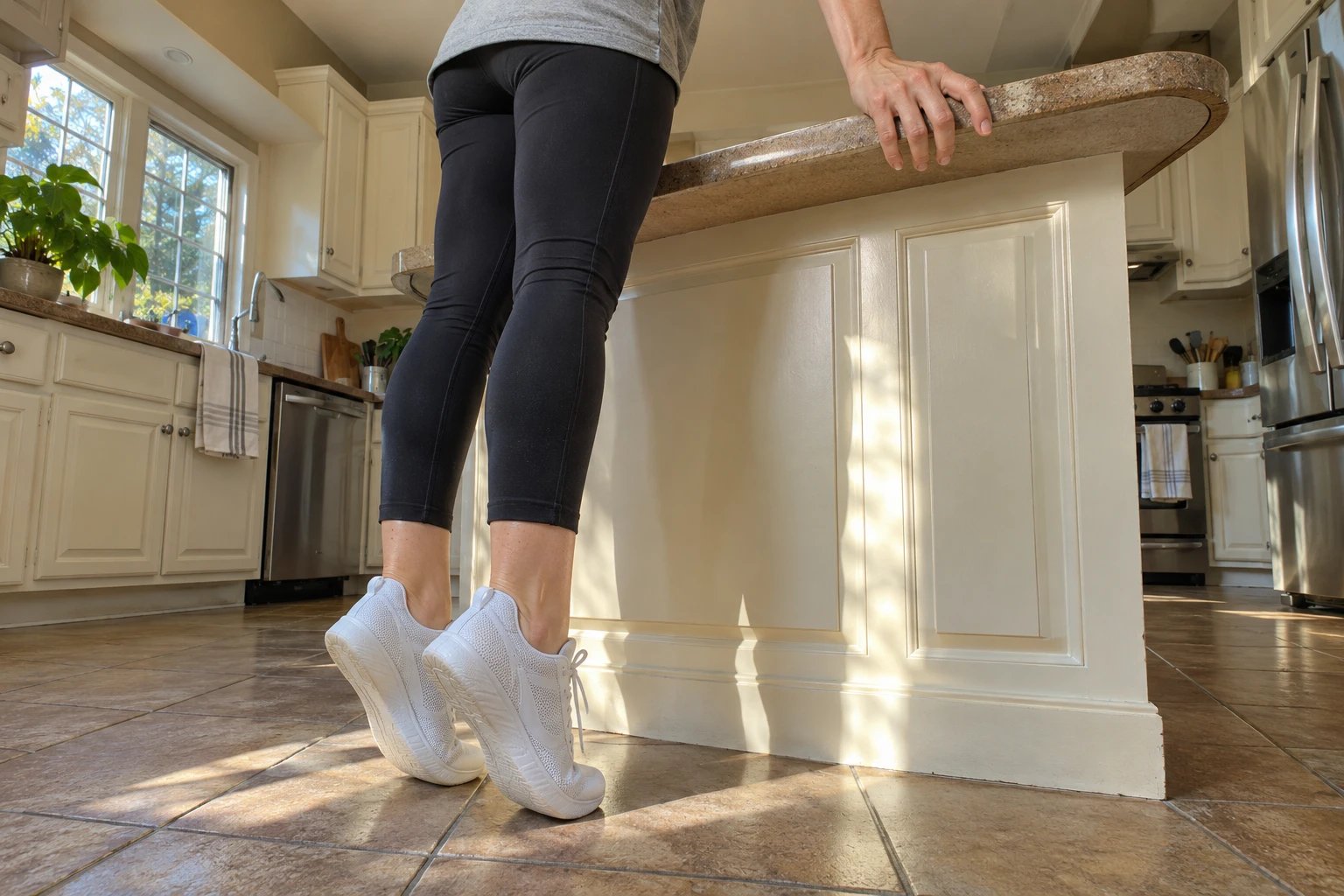
Hold the counter. Rise up onto your toes, then lower. Then rock back onto your heels so the front of each foot lifts off the floor. That's two moves at one counter, and each one works a specific muscle.
The toe lift works your shins. When researchers in Iran compared adults aged 60 to 70 who had fallen in the past six months with adults who hadn't, the fallers had noticeably weaker shin muscles, the ones that lift the front of your foot as you step. Weak shins and falls showed up together.
The heel raise works your calves. A review of 34 studies found calf strength had a moderate link to reactive balance, which is the quick catch after a stumble. It had only a weak link to standing still or to walking speed. Think of it this way: your calves help catch you, and your shins help you not need catching.
Start with 10 of each and build toward 20, which is what the Otago program uses.
10Step-ups on the bottom stair
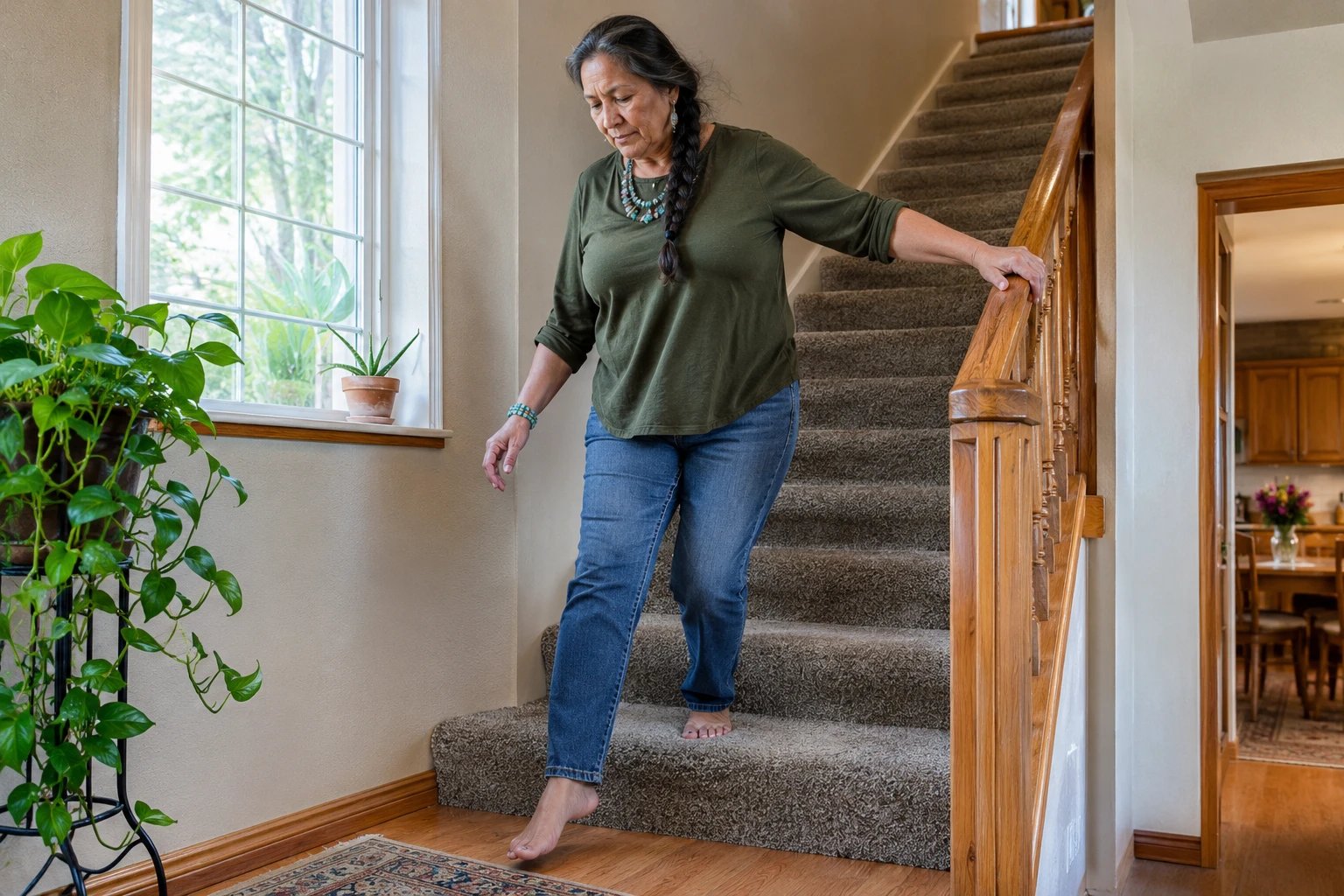
If going down the stairs feels harder than going up, there's a reason. Stepping down a stair can push about one and a half times your body weight back up through your legs. On the way down, your thigh muscles work as brakes while they lengthen, and that's harder than the push up.
So train the brakes. Here's how:
- Hold the rail.
- Step up with your right foot, then bring the left up beside it.
- Step down with your right foot, slowly, to a count of three.
- Repeat 10 times leading with the right, then switch and lead with the left.
The slow step down is the exercise. The step up is just how you get back to the top.
If you live in a one-story house, a single back step with a rail or something solid to hold will do the same job. In my experience, the walk-in cooler had three steps down into it, and nobody ever complained about the climb back out.
See more: Walking for Weight Loss Over 50: A Beginner Plan →
9A hip hinge with a broom
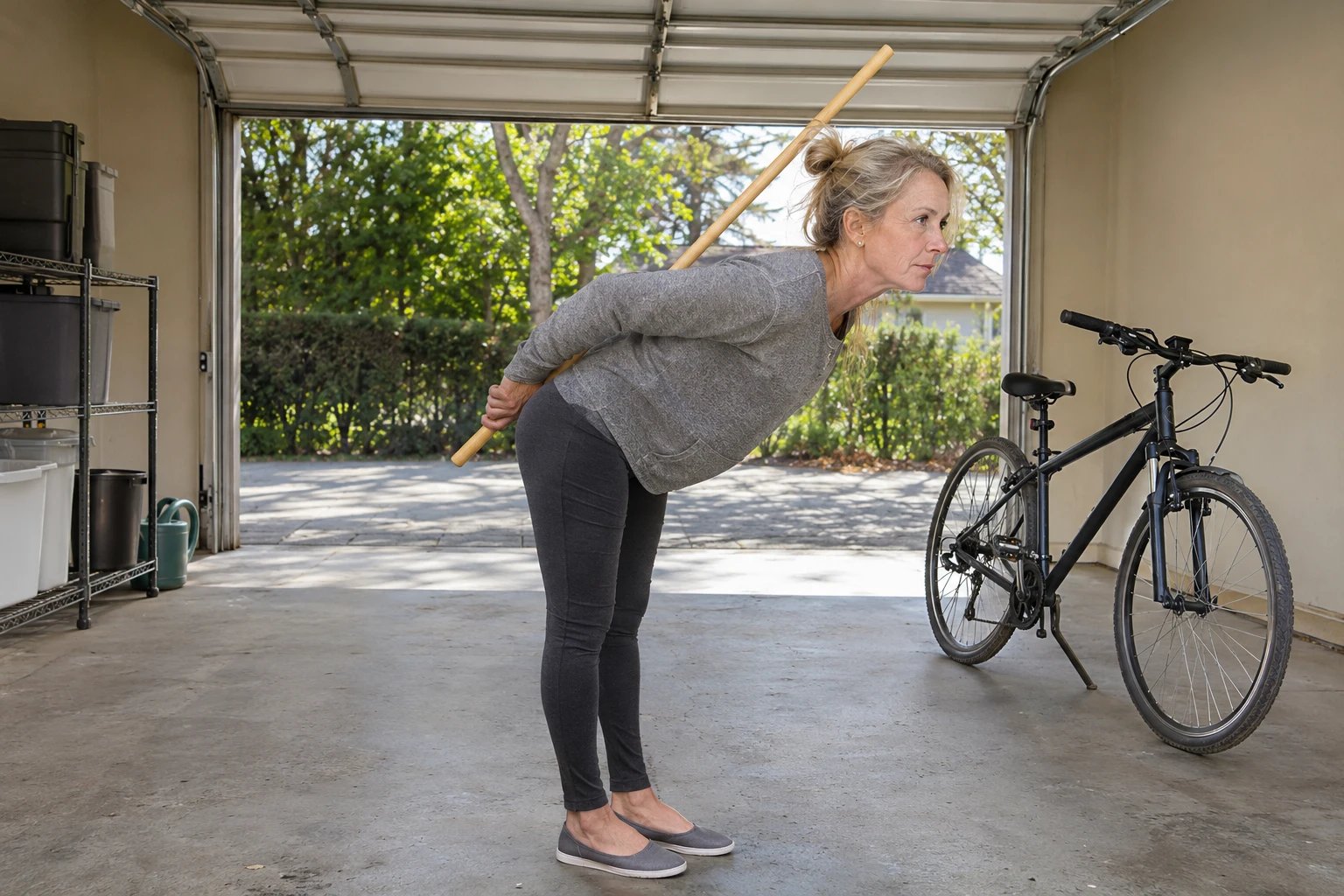
Take the broom out of the corner and hold it straight along your back, one hand behind your neck and one behind your lower back. Three spots should touch the handle: your head, between your shoulder blades, and your tailbone.
Now push your hips back, as if you were closing a car door with your backside, and let your chest tip forward. Keep all three points on the broom. The moment your head or tailbone peels away, you've stopped hinging and started folding at the waist. Do 10 slowly, and stand all the way tall between each one.
This is how you should be loading the bottom rack of the dishwasher, filling the pet bowl if you have a pet, or picking up the basket in #8. The Bone Health & Osteoporosis Foundation tells people to bend only at the knees and hips and not at the waist, because a rounded upper back can lead to broken bones in the spine. That warning matters most if you've been told your bone density is low, but the hinge is the better way to bend for anyone.
Any long, straight handle works. A mop is fine. The ones that unscrew into three pieces aren't, unless you screw them back together first.
8Carrying a full laundry basket
You know the one-trip grocery carry: six bags hooked over your fingers, the car door bumped shut with a hip, the house door opened with an elbow. The NHS counts that as real exercise. It lists carrying heavy shopping bags as a strengthening activity for adults 65 and older, as long as you carry them to the point where you need a short rest before going again.
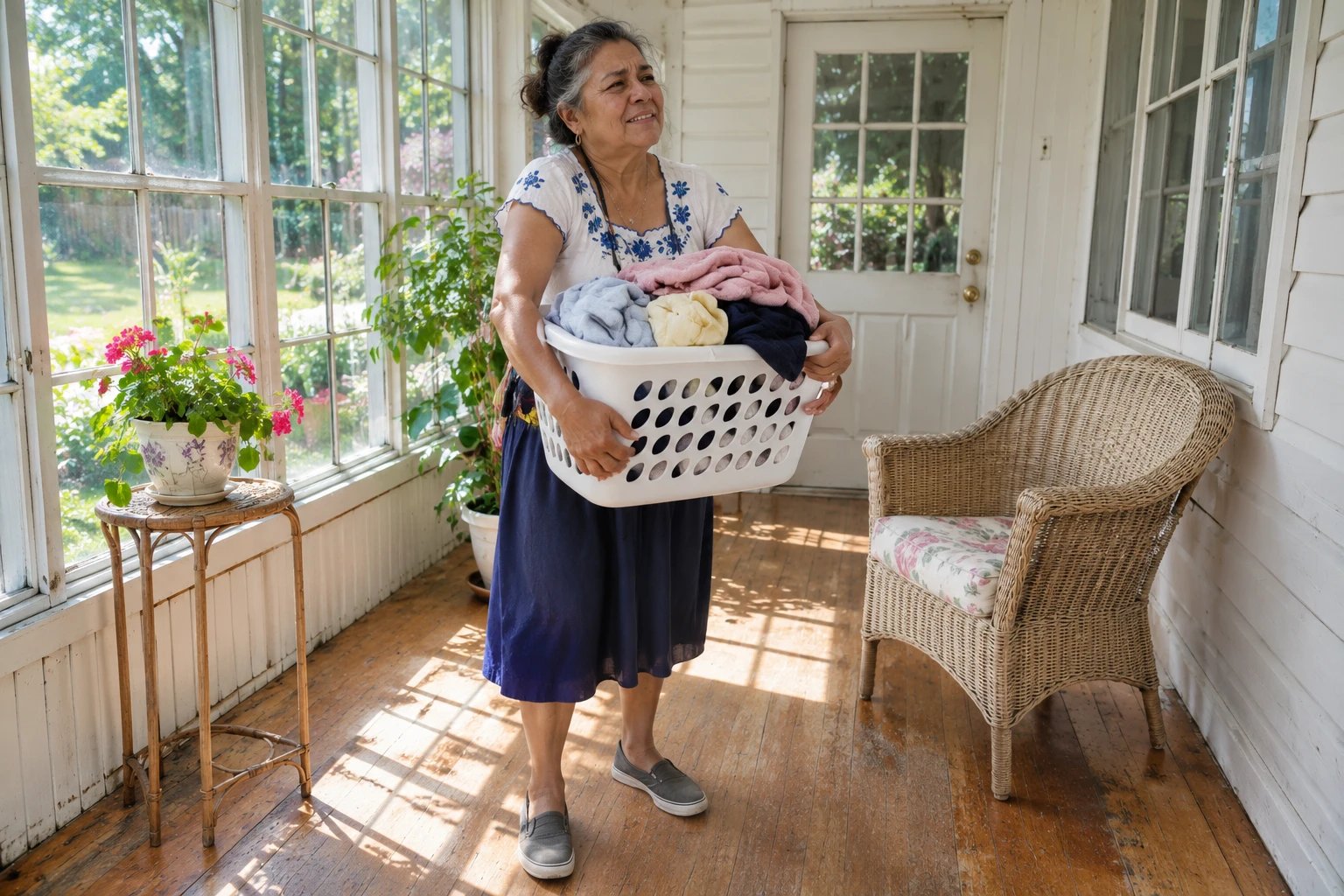
Carrying a full laundry basket works the same muscles. Carry it the long way through the house, set it down when your grip says so, rest, and pick it up again.
How you hold it matters more than how far you take it. The Bone Health & Osteoporosis Foundation says to bring the object close to your body at waist level and pull your stomach in gently to support your back. Hug it against you.
If your machine is down in the basement or your laundry goes out to a laundromat, split the load into two bags, one in each hand, so your weight stays balanced. I spent years hauling sacks of onions and stockpots of water around a kitchen. Two even loads always beat one lopsided one.
7A standing bird dog at the counter
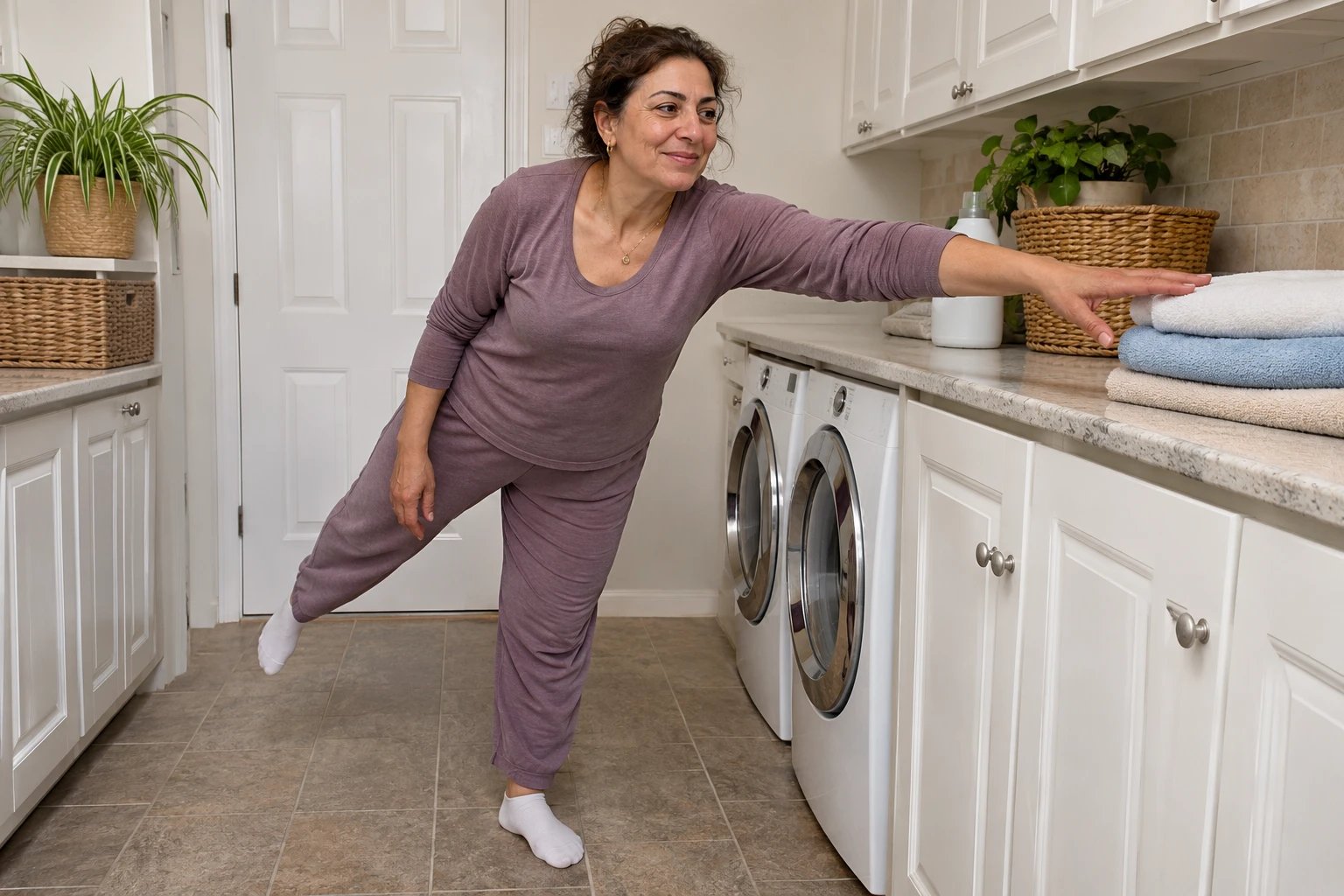
Bird dog is the move physical therapists hand out for back pain, and it usually begins on your hands and knees. That's where plenty of beginners stop reading.
Physical therapist Tim Fraticelli, DPT, offers a standing version for anyone who can't kneel comfortably. It takes both the floor and the pressure on your knees out of the move:
- Stand facing the counter with both hands on the edge.
- Lift one arm forward and the opposite leg back at the same time.
- Hold steady for a moment, then switch sides.
Keep the leg low, a few inches back. You're aiming for steady hips, not a ballet pose.
6Seated marching in a chair
"You know you're doing a moderate-intensity activity if you can talk in full sentences, but you sound a little out of breath." Leonid Kim, MD, on YouTube
That's the talk test. CDC's version says that at moderate effort you can talk, but not sing. You can pass it without ever standing up.
In a small study of adults aged 62 to 87, seated chair aerobics landed in the same moderate range as standing aerobics. Chair yoga and tai chi came out light. So sitting down doesn't mean you're doing the easy version. It's a low-impact choice that still counts as a real effort.
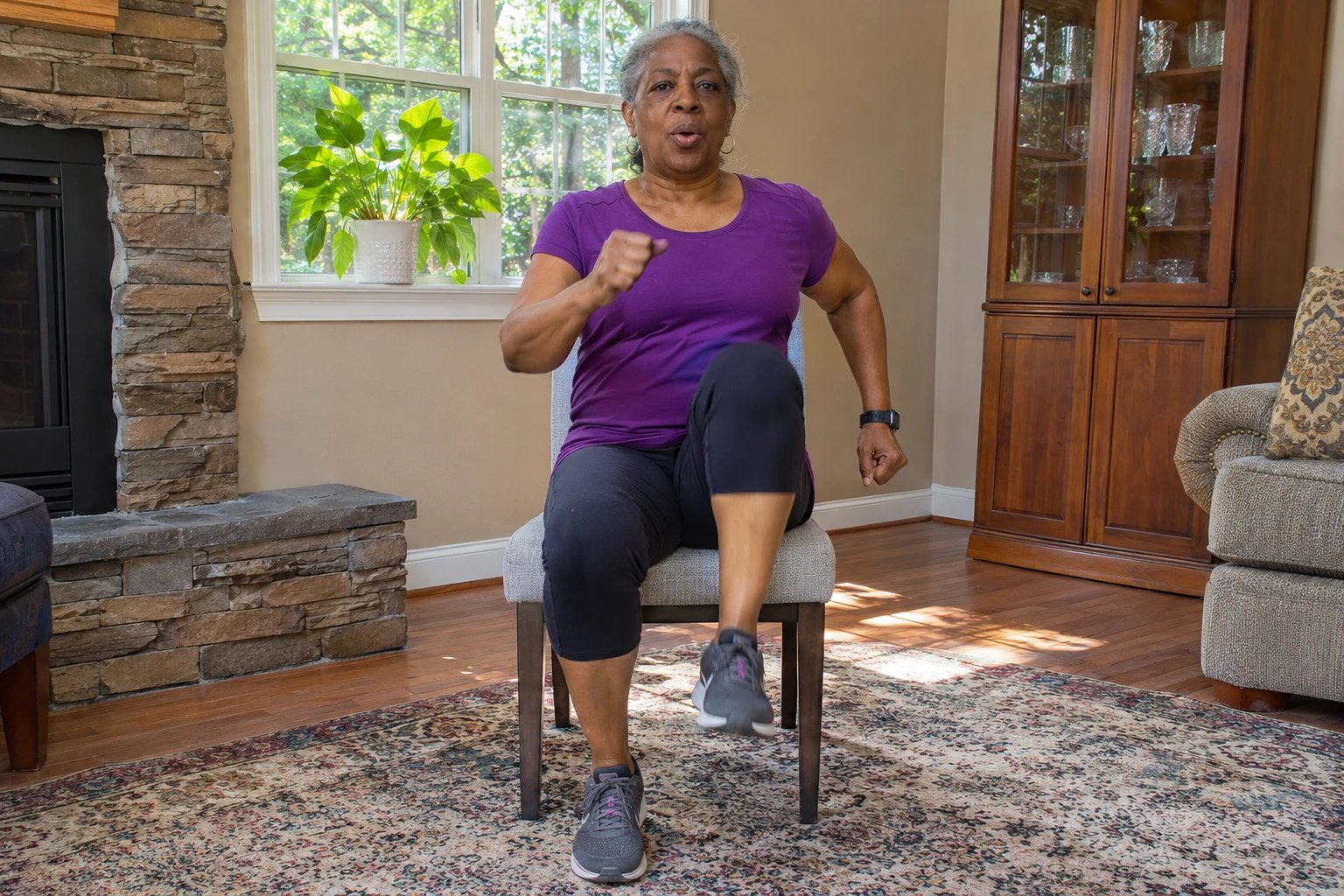
To do it, sit toward the front of a chair without arms. March your knees up one at a time and swing your arms as if you meant it. Go for the length of a few songs.
This is the one for a day your knees vote no, or a day you just can't face standing. If you live with POTS, a condition where your heart rate jumps when you stand, Dysautonomia International says reclined aerobic exercise, such as swimming, rowing or recumbent cycling, has been found most helpful. That's not upright seated marching, so check with your doctor for the right option.
If you can sing along, march faster.
5Stretching for ten minutes before bed
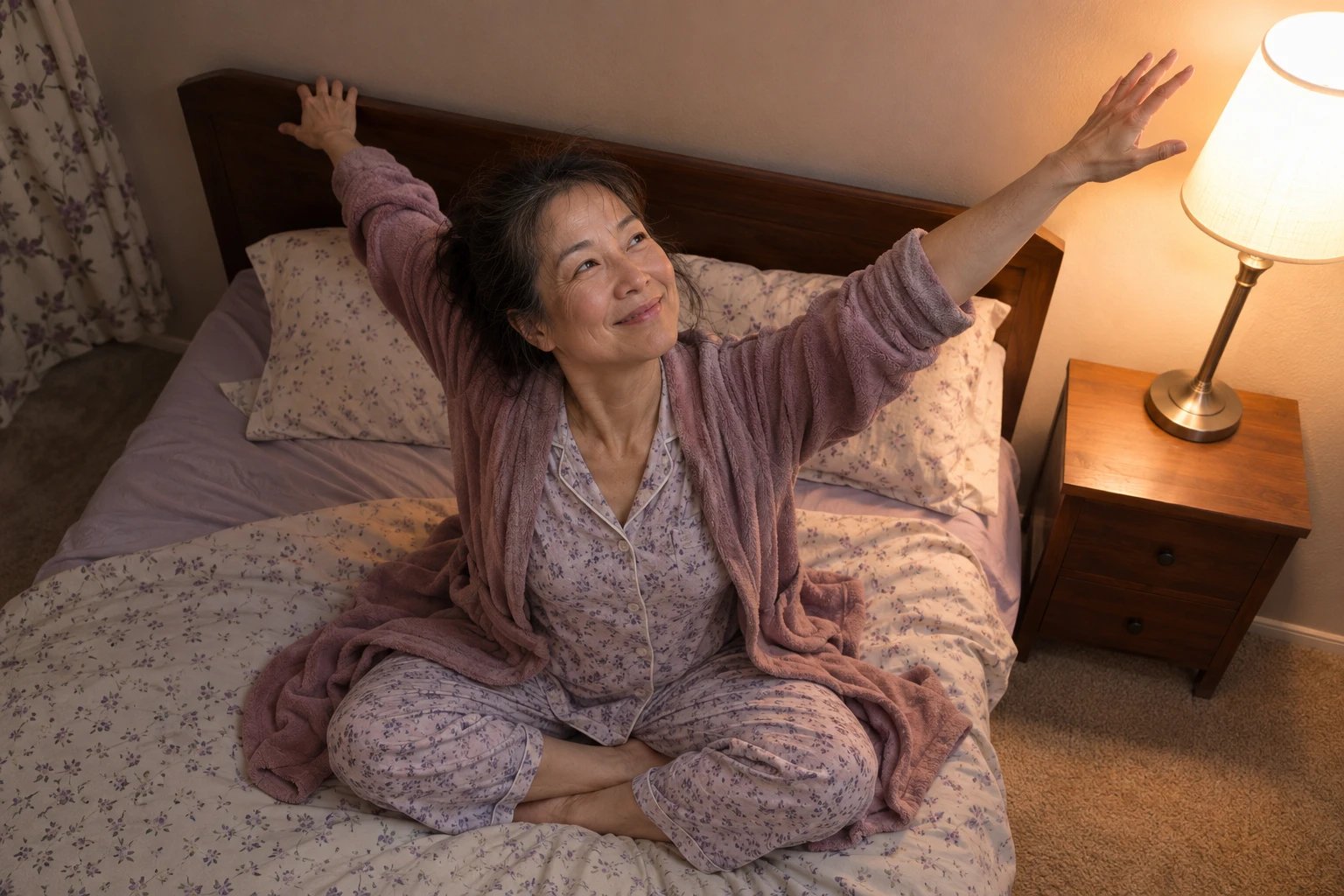
You may already stretch at night, somewhere between the last show and turning off the lamp. A study in Japan gave that habit a job.
Forty women with an average age of 51, just over half of them past menopause, stretched for 10 minutes just before bed, every night for three weeks. Their menopause symptom scores, including hot flashes, mood and physical symptoms, dropped compared with women who were waiting their turn. No one reported any problems.
None of that has anything to do with the scale.
The study tested bedtime. So if the TV is your cue, stretch through the last show of the night rather than the first. You don't need a mat. Try a calf stretch with your hands on the wall, arms reaching overhead, slow shoulder rolls, and a gentle turn of the head side to side. Hold each one long enough to breathe out twice.
People on Reddit who say short sessions at home were what finally stuck often name stretching during TV as the one they kept. Set a kitchen timer if you don't trust yourself.
See more: How to Stay Motivated Over 50 When You've Quit Before →
4A short wall sit
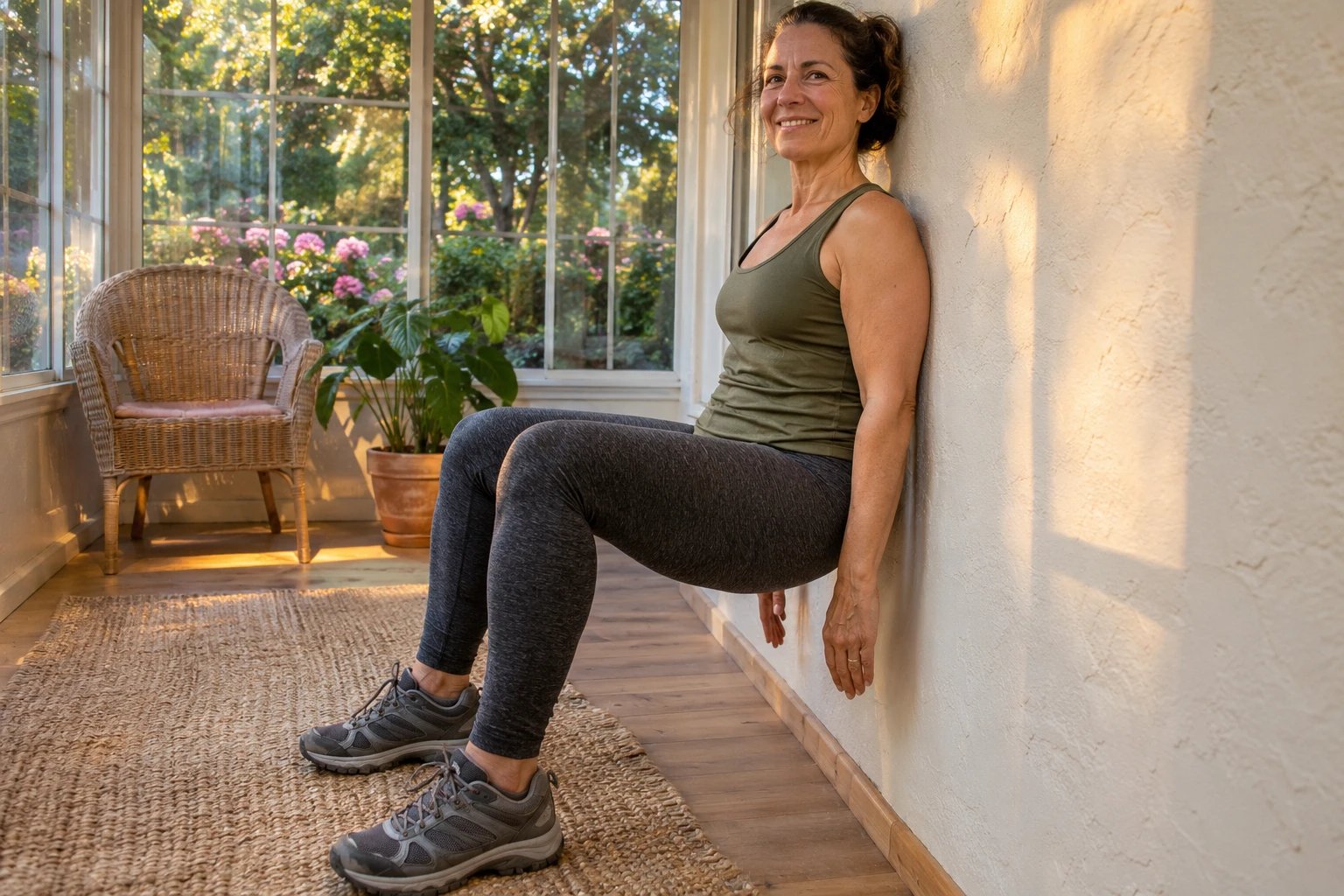
Back flat against a bare wall, feet out in front of you, slide down a few inches and stay there.
This plain little hold won a big contest. A 2023 analysis of 270 trials, covering about 16,000 adults, found every kind of exercise lowered blood pressure. Holds without movement lowered it most, and wall squats ranked as the single most effective. Researcher Jamie O'Driscoll of Canterbury Christ Church University explains why: they "increase the tension in the muscles when held for two minutes, then cause a sudden rush of blood when you relax."
Two things before you try it. Those trials covered adults in general, not women over 50 in particular, and the British Heart Foundation notes that only a small number of them tested holds like this, so don't drop an exercise you already enjoy. And blood pressure rises sharply during the hold itself, so if you have high blood pressure or a heart condition, check with your doctor first.
Keep the bend shallow. The Arthritis Foundation's mini squat is a good model: lower yourself a few inches, keep your feet flat, and don't let your knees go past your toes. Breathe the whole time. Hold for as long as feels comfortable while breathing normally, and build up gradually. The two minutes in O'Driscoll's quote is where some people end up, not where anyone starts.
Wear shoes, and pick a wall with nothing hanging on it unless you want the framed print at the back of your head.
3Squats with a water-bottle backpack
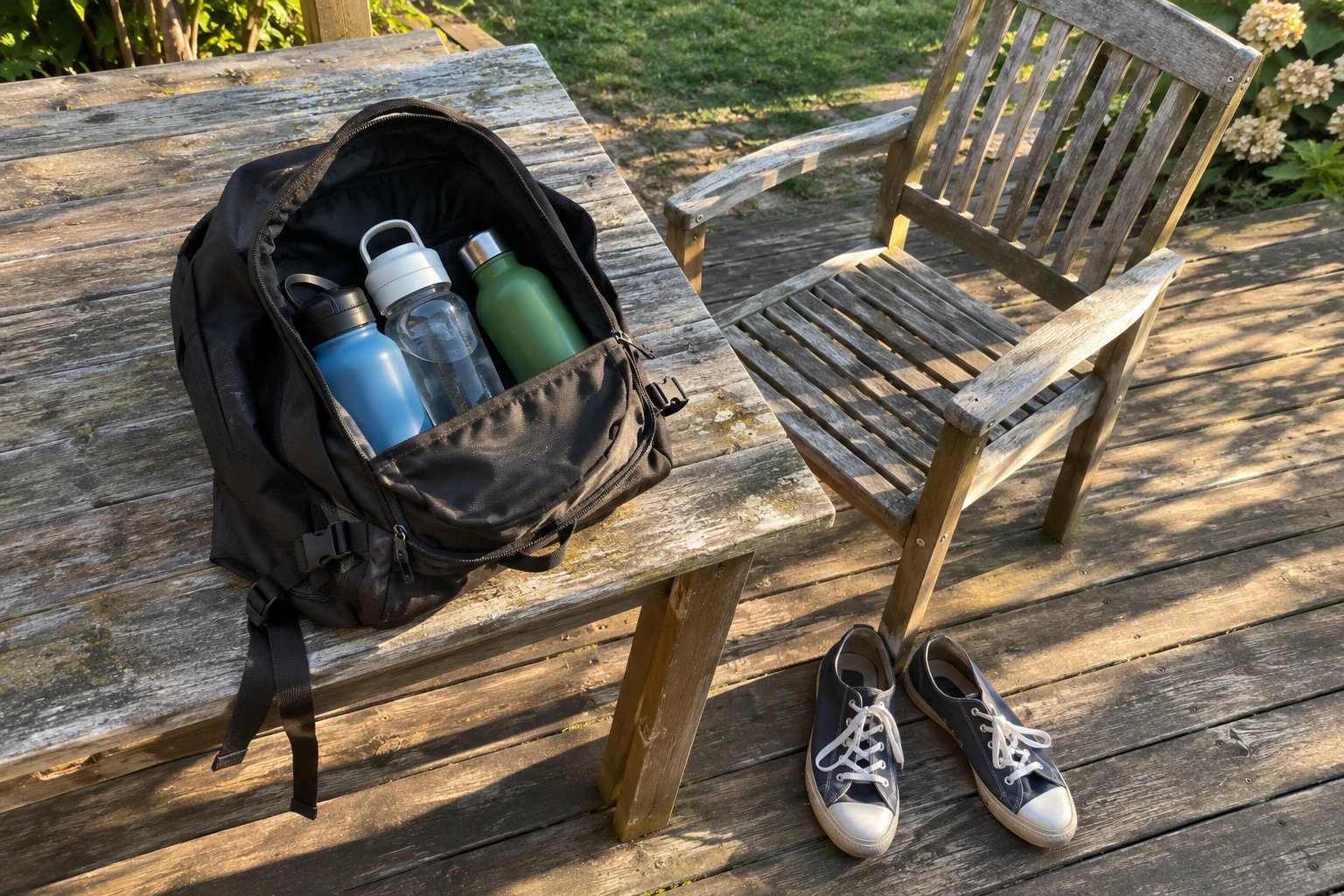
Bodyweight squats run out of road eventually. That same Southern California physical therapist makes the honest point that over the long run, bodyweight training is hard to keep making harder. The fix doesn't cost anything: you wear the weight.
Athletic trainer Emily Putney of Athletico says a backpack can be loaded "as heavy or light as you want" for squats and push-ups. Water weighs 8.34 pounds a gallon, so the pantry turns into a rack of weights:
| What goes in the pack | About how much it weighs |
|---|---|
| A half-full gallon jug | 4 lb |
| Six 16.9-ounce bottles | 6.6 lb |
| A full gallon jug | 8.5 lb |
| A whole 24-pack of bottles | 26 lb |
Canned goods work too. Putney says cans "make great light weight dumbbells," and the weight is printed right on the label.
Start your chair squats with an empty pack. Sit back until you just tap the seat, then stand, keeping your heels flat on the floor the way Dr. Josh does. When 10 feel easy, add a bottle or a can. Add one more each week the squats stay easy. For loaded walking, the National Strength and Conditioning Association suggests starting around 10% of your body weight and not going past 30%. That's a reasonable general ceiling to keep in mind for any backpack weight, squats included. The 24-pack is a goal, not a starting point.
Cinch both straps snug so the load rides high on your back. A tote bag on one shoulder pulls you sideways, and a loose pack swings every time you stand up.
See more: How to Lose Weight After 50 Without Going to the Gym →
2A towel row for your back
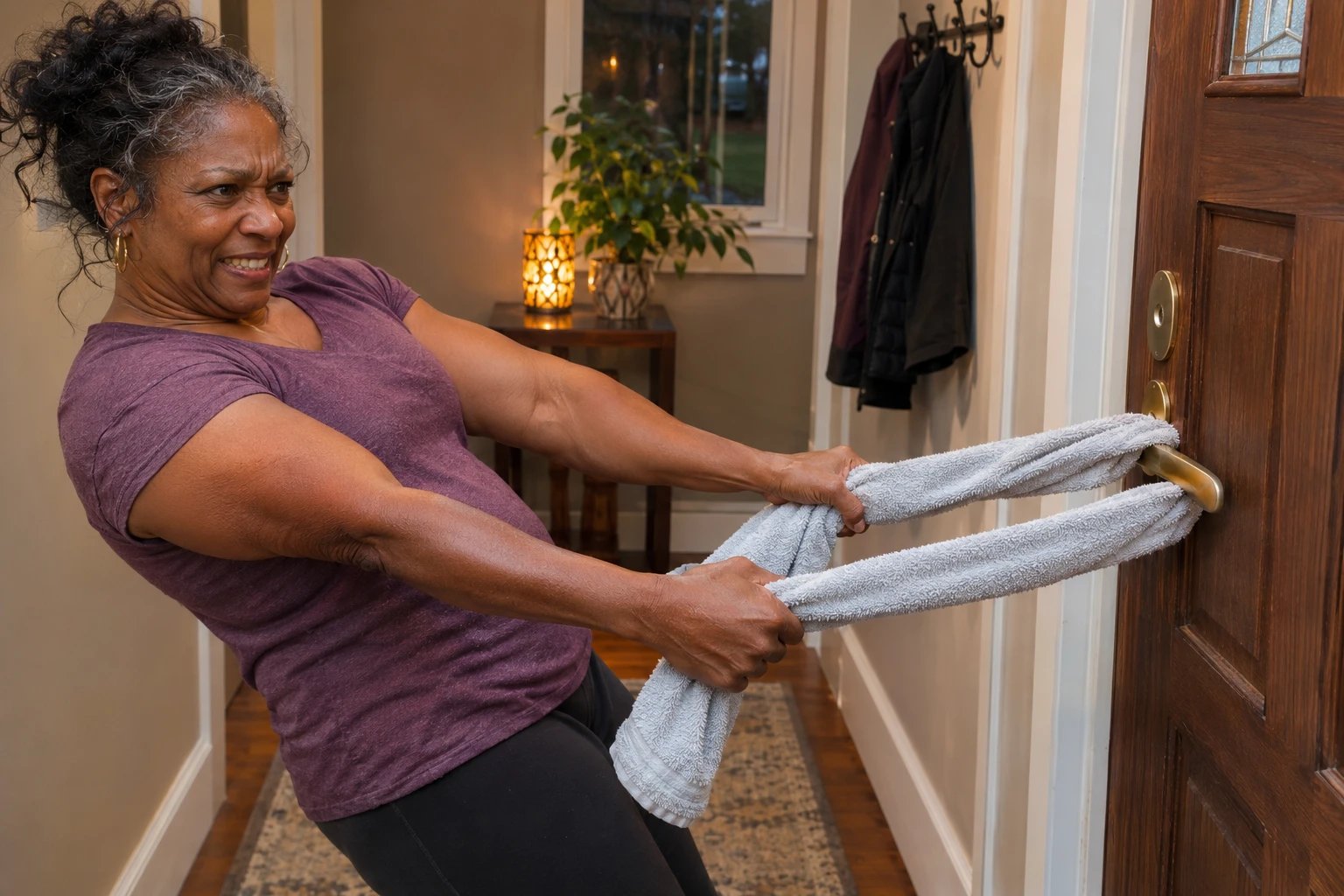
Most no-equipment routines push plenty and pull nothing. The back exercise is usually where a resistance band or a dumbbell sneaks in. This one needs a bath towel and a door.
The door decides whether you can do it at all. It has to be solid and closed, with a handle that can hold your body weight. If the handle wiggles, or the door sounds hollow when you knock on it, skip to the wall version below. Stand on the side you'd push to open the door. That way your pull presses the door into its frame instead of pulling against the latch.
- Loop the towel around the handle and hold one end in each hand.
- Walk your feet in close to the door and lean back until your arms are straight.
- Pull your chest toward the handle and squeeze your shoulder blades together.
- Lower yourself back slowly. Do 8 to 12.
It scales the same way your push-ups did. Stand more upright and it's easier. Walk your feet closer and lean back farther and it's harder.
No suitable door? Physitrack, a home-exercise service used by physical therapists, has a wall version that works the same muscles, the ones that draw your shoulder blades back. Stand with your back to a wall and bend your elbows so the backs of your hands touch it. Press the backs of your forearms and wrists into the wall, and hold. Dr. Josh does something similar with his elbows against a door, and he says just pressing still works the muscles even if your upper back never moves off it.
In my experience, the people who did the most work over a stove were all pushing. Their backs were the first thing to complain.
1Practicing getting up off the floor
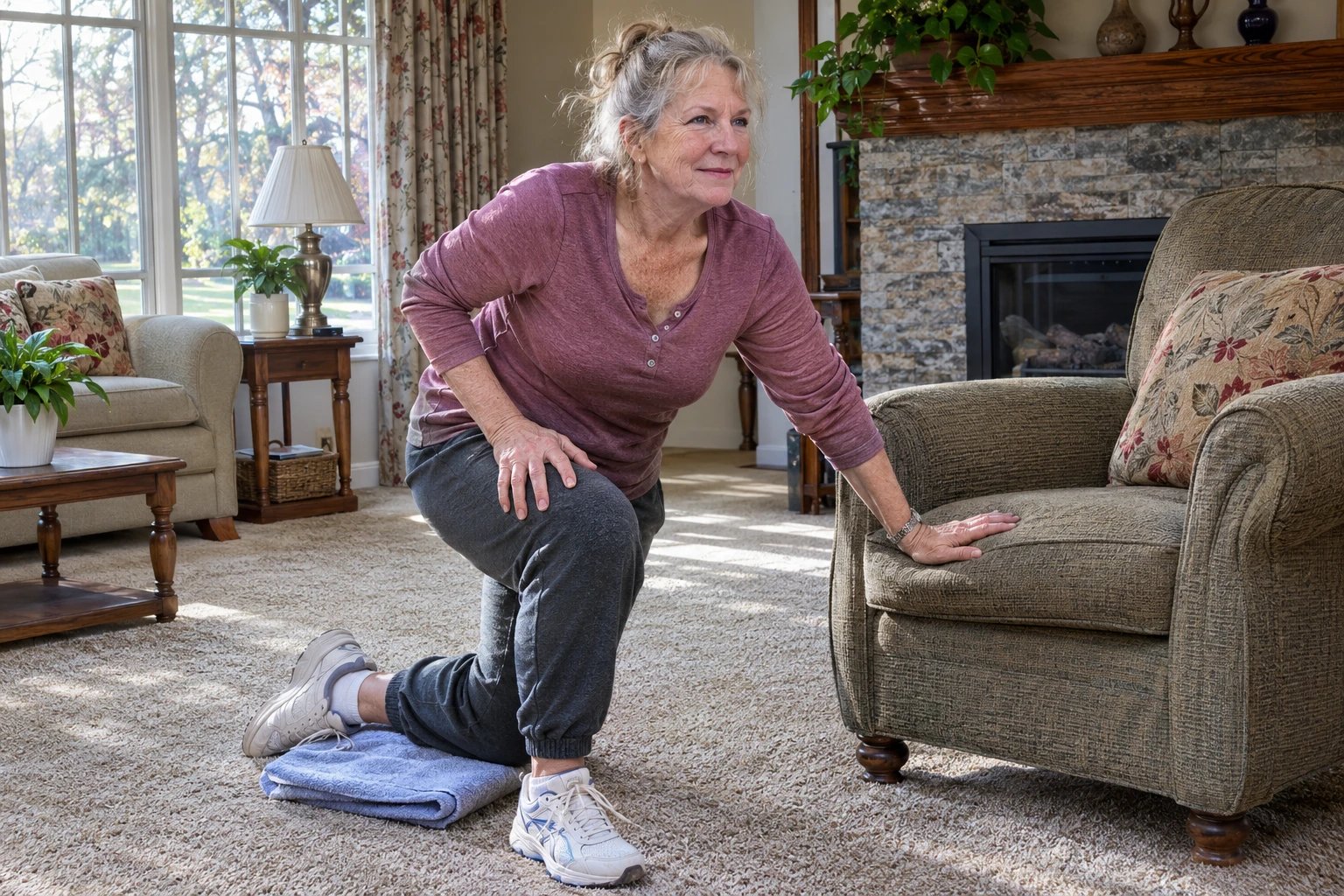
This is the one nobody puts on a workout list, because it doesn't look like a workout. It may be the one that matters most.
In a Brazilian study of 4,282 adults aged 46 to 75, people did a simple test: sit down on the floor and get back up, scored out of 10. Over about 12 years, 42% of the lowest scorers died, compared with under 4% of those with perfect scores. Two-thirds of the group were men, so how well this holds for women is less certain.
Before you rush to the rug to grade yourself, hear the lead researcher, Claudio Gil Araújo: "This is not a self test or an exercise, it's a screening tool in a supervised environment." So don't score yourself. Practice the route instead.
That route has a name, the Backward Chaining Method, and it's taught in stages. It exists because a long time spent on the floor after a fall is linked to losing strength, falling again, and a worse year afterward. In a small trial with women in long-term care, most in their eighties, the group who learned it ended up less afraid of falling.
Going down:
- Half-kneel, one knee down, holding a sturdy chair.
- Kneel on both knees.
- Hands and knees.
- Sit to one side.
- Lie on that side.
- Roll onto your back.
Coming up is the same list, read from the bottom.
Don't do all six on day one. Go to stage one and come back up. Next session, go to stage two. Fold a towel under your knees, and practice on carpet or a rug that won't slide.
The first few times, have someone else in the house, or better, a physical therapist coaching you. If you've had hip or back surgery, the National Institute on Aging says to talk with your doctor first. If you feel dizzy or lightheaded, stop and sit, and the National Council on Aging lists chest pain, pressure or discomfort as a reason to call 911.
The day you go all the way down to your back and come all the way up, put the chair back at the table. You didn't need it.
The bottom line
Half of what's here you were already doing: standing up, carrying the laundry, climbing the stairs, brushing your teeth. The only change is that now you're counting it, doing it slowly, and doing it on purpose.
Leonid Kim, MD, says "consistency beats the perfect plan every time." So the honest question is which two days of your week already have a quiet half hour in them, and which of these moves would fit into it without a fight.
Nobody is going to cheer. The applause, such as it is, will be the number from the chair test going up. Sit down, cross your arms over your chest, and count.
Up next
16 Five-Minute Exercises for Seniors That Keep You Steady and Independent
Sixteen moves built around your kitchen counter and a sturdy chair, with real starting numbers and the cautions for a pacemaker or a new hip.
Read the list →
Reader quiz
Did you catch the details?
5 questions from this article. Finish them all to unlock the editor's bonus tip.
In Margaret Martin's plank ladder, when are you ready to move to a lower surface?
Questions people also ask
How many times a week should a 50-year-old woman work out?
Aim for strength work at least two days a week. That's the federal guideline for adults, and a position statement for healthy older adults from the National Strength and Conditioning Association, summarized by Len Kravitz, PhD, recommends two to three times a week. CDC's guidance for adults 65 and older adds about 150 minutes of moderate activity, such as 30 minutes on five days. If you're starting from nothing, start low and go slow: two days first, a third once two feel routine.
Is it okay to do these exercises every day?
You don't need to do strength and balance work every day. The NHS tells adults 65 and older to be physically active every day, even if it's light, and to fit in strength, balance and flexibility work twice a week or more. The Otago home program runs its strength and balance exercises three times a week with rest days between.
How many reps should a beginner over 50 start with?
Start with one set of 8 to 12 reps of each move. CDC counts 8 to 12 repetitions as one set and says to work up to two or three sets for more benefit, going until another rep would be hard without help. The strength association's summary suggests 10 to 15 for beginners, so 10 reps fits both.
What if I can't get down on the floor?
Most moves here are done standing, seated, or against a wall or counter. Even the wall push-up (#16) can stay at the wall or move to the counter instead of the floor. Physical therapist Margaret Martin's plank progression runs from the wall to the counter to a chair before it ever reaches the floor, and the bird dog works standing at a countertop. Getting down and up can be learned one stage at a time, ideally with a physical therapist.
Why am I sore the day after exercising, and is that normal?
Yes, soreness after a new exercise is normal. It usually starts 12 to 24 hours afterward and peaks between 24 and 72 hours. A bike commuter in their 50s who switched to bodyweight and band training wrote on r/homefitness that they're "way less sore than weight training and no less fit."
Can you build muscle after 50 with just bodyweight exercises?
Bodyweight moves count as real muscle-strengthening exercise. CDC lists exercises that use your body weight, such as push-ups, alongside lifting weights. A review found that older adults can do slow-lowering training at low to high intensity with few or no injuries. When the moves get easy, a backpack of water bottles keeps them working without buying anything.
Did any of these feel familiar?
Know someone who needs this?
 Prime Journal · Free printable
The Everyday Health Readiness Checklist
- A clearer path from bed to bathroom
- A medicine list ready for the pharmacist
- A symptom story and follow-up plan you can use
Free printable: The Everyday Health Readiness Checklist. Enter your email and it is yours.
Sources cited in this article
This article links to 40 outside sources, listed here so you can read them yourself.
- Said it better than any instructor www.reddit.com/comments/1v3m8im
- 42.8 stands a day academic.oup.com/biomedgerontology/article/77/8/1644/6551691
- Lean forwards over your knees roh.nhs.uk/services-information/therapy/otago-strength-and-balance-exercises
- Stand in front of a wall www.harvardhealth.org/exercise-and-fitness/modify-your-push-ups-to-meet-your…
- On YouTube www.youtube.com/watch?v=W_at1A4zlMY&t=0s
- Lowering yourself slowly from your toes www.youtube.com/watch?v=0p8Hir9oAOc&t=548s
- Keep your ear, shoulder, hip, knee and ankle in a straight line melioguide.com/core-exercises/wall-plank-exercise
- 4-stage balance test www.kinetically.ai/resources/news/four-stage-balance-test
- Standing on one leg www.cdc.gov/physical-activity-basics/adding-older-adults/what-counts.html
- "If you make a clear plan of when and where you will do something you are more likely to do it than if you have a vague intention." www.surrey.ac.uk/news/does-it-really-take-66-days-form-habit-we-asked-expert…
- R/AskWomenOver50 threads www.reddit.com/comments/1p4oiyb
- A balance workout she films with her 87-year-old grandmother-in-law www.youtube.com/watch?v=EvjZMQJSY5I&t=0s
- The strength of those muscles www.dovepress.com/the-role-of-hip-abductor-strength-in-identifying-older-per…
- Noticeably weaker shin muscles pmc.ncbi.nlm.nih.gov/articles/PMC13625262
- A moderate link to reactive balance academic.oup.com/ptj/article/101/4/pzab018/6106269
- About one and a half times your body weight pmc.ncbi.nlm.nih.gov/articles/PMC9958977
- Your head, between your shoulder blades, and your tailbone nextleveldr.com/perfecting-the-hip-hinge
- Bend only at the knees and hips www.bonehealthandosteoporosis.org/patients/treatment/exercisesafe-movement/p…
- Carrying heavy shopping bags www.nhs.uk/live-well/exercise/physical-activity-guidelines-older-adults
- Standing version for anyone who can't kneel comfortably www.ptprogress.com/big-3-exercises-for-back-pain
- On YouTube www.youtube.com/watch?v=Zt6WaTBnj7E&t=426s
- You can talk, but not sing www.cdc.gov/physical-activity-basics/measuring/index.html
- The same moderate range as standing aerobics pmc.ncbi.nlm.nih.gov/articles/PMC10464768
- Reclined aerobic exercise, such as swimming, rowing or recumbent cycling www.dysautonomiainternational.org/page.php?ID=44
- 10 minutes just before bed, every night for three weeks pmc.ncbi.nlm.nih.gov/articles/PMC4961267
- Short sessions at home were what finally stuck www.reddit.com/comments/1ux0mn2
- Wall squats ranked as the single most effective www.bhf.org.uk/informationsupport/heart-matters-magazine/news/behind-the-hea…
- A few inches www.arthritis.org/health-wellness/healthy-living/physical-activity/other-act…
- Bodyweight training is hard to keep making harder www.youtube.com/watch?v=0p8Hir9oAOc&t=729s
- "as heavy or light as you want" www.athletico.com/2020/04/06/workout-at-home-with-these-household-items
- 8.34 pounds a gallon www.usgs.gov/water-science-school/science/a-million-gallons-water-how-much-it
- Starting around 10% of your body weight www.nsca.com/education/articles/ptq/implementing-ruck-training-loaded-walkin…
- Wall version that works the same muscles us.physitrack.com/home-exercise-video/isometric-wall-angel
- Just pressing still works the muscles www.youtube.com/watch?v=W_at1A4zlMY&t=60s
- 42% of the lowest scorers died academic.oup.com/eurjpc/advance-article/doi/10.1093/eurjpc/zwaf325/8158620
- "This is not a self test or an exercise, it's a screening tool in a supervised environment." www.tctmd.com/news/simple-sitting-rising-test-linked-natural-and-cv-mortality
- In stages pmc.ncbi.nlm.nih.gov/articles/PMC12347776
- Chest pain, pressure or discomfort www.ncoa.org/article/heart-rate-zones-by-age
- The test stops with a score of zero www.kinetically.ai/resources/news/30-second-chair-stand-test
- TikTok comments www.tiktok.com/@dr.nancy.dpt/video/7478526878408510763

Peter Byalik
Food & Home Editor
Peter Byalik is a professional chef with more than 20 years of experience, including years running his own business. He came to the United States from Ukraine.
More from Peter Byalik