




How to Build Muscle After 50
A weekly routine, the right weights to start with, and what to put on your plate, so you can start Monday without wrecking your knees.
By Peter Byalik, Food & Home Editor
Updated · 26 min read
The short answer: Muscle can still be built after 50, even past 85. Lift weights two to three times a week through full range of motion, and add weight or reps gradually. Eat 1.0 to 1.6 grams of protein per kilogram of body weight daily, in meals of about 25 to 35 grams. Improvements, including strength, can show within about eight weeks; measurable muscle growth is most reliable over several months.
- Written by our food & home editor
- Cited 53 sources
- How we review
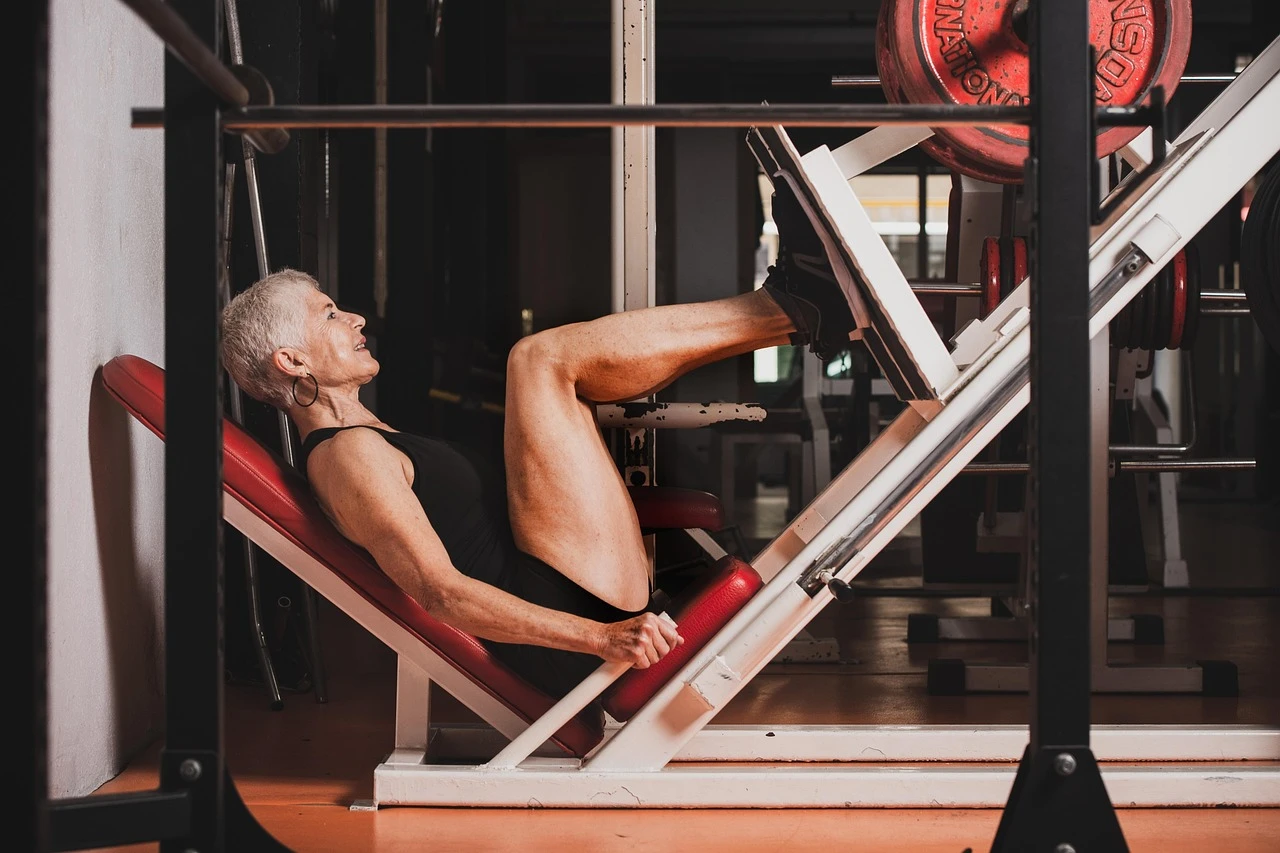
I spent years around kitchens where people lifted all day: stockpots, cases of produce, sacks of flour. Plenty of them never got any stronger. Hauling heavy things is work. Building muscle takes a plan, with amounts and timing, the way a recipe does. That's the part most advice on how to build muscle after 50 leaves vague.
This is the plan with the numbers filled in. It covers what to lift, how often, how heavy and how fast to add weight. It covers what to eat. It also gives straight answers on losing weight, sleep, creatine and testosterone.
Is it too late to build muscle after 50, or after 60?
No, and the best evidence comes from people a good deal older than 60.
A 12-week study put two groups through whole-body resistance training three times a week. Resistance training means lifting against weights, machines or your own body. One group was 65 to 75, and the other was over 85. Thigh muscle grew 10 to 11% in both groups. Leg strength rose 38 to 46%. The researchers found no differences between the two age groups.
"It shows that healthy older people can certainly respond to resistance training, that their muscles are still plastic." Tommy Lundberg, exercise researcher at the Karolinska Institute, in the Washington Post, as reposted by Corner On Wellness
What you're working against is age-related muscle loss, called sarcopenia. Harvard Health puts it at 3 to 5% of muscle per decade after 30.
Training outpaces it by a wide margin. One analysis pooled 49 studies of people aged 50 to 83. After about 20 weeks of training, they gained an average of 1.1 kg of lean mass, about 2.4 pounds. Lean mass is everything in the body that isn't fat, and muscle is most of it. The authors set that gain against an estimated 0.18 kg a year that people lose when they don't exercise. That gain is about six times what a year without exercise takes away.
So how long does it take to build muscle? Here's how the research lines up:
- About 8 weeks: improvements "can be seen," according to David Scott and Robin Daly of Deakin University, who study exercise and ageing.
- 12 weeks: thigh muscle grew 10 to 11% in the study above.
- 18 to 20 weeks: adults add about 2.4 pounds of lean muscle and become 25 to 30% stronger overall, according to the University of Michigan.
- About a year: in a review of 25 trials of adults 60 and older, programs lasting 50 to 53 weeks produced the biggest strength gains.
That same review found training had a "large effect" on strength and only a "small effect" on muscle size. You'll feel it in the grocery bags long before you see it in your sleeves.
Late starters in Reddit forums for lifters over 50 describe the same pattern. Some report a best-ever bench press at 59. Others say they were noticeably muscular four years after starting at 51. These are individual stories, not a forecast for you. A 61-year-old in r/FitnessOver50 gives the most useful warning: "You will go through periods where you see lots of gains, and periods where it feels like your stuck."
A 56-year-old in his first year of lifting, posting in r/fitness50plus, put it more bluntly: "Still don't know why I waited so long to start lifting."
How do you start strength training safely?
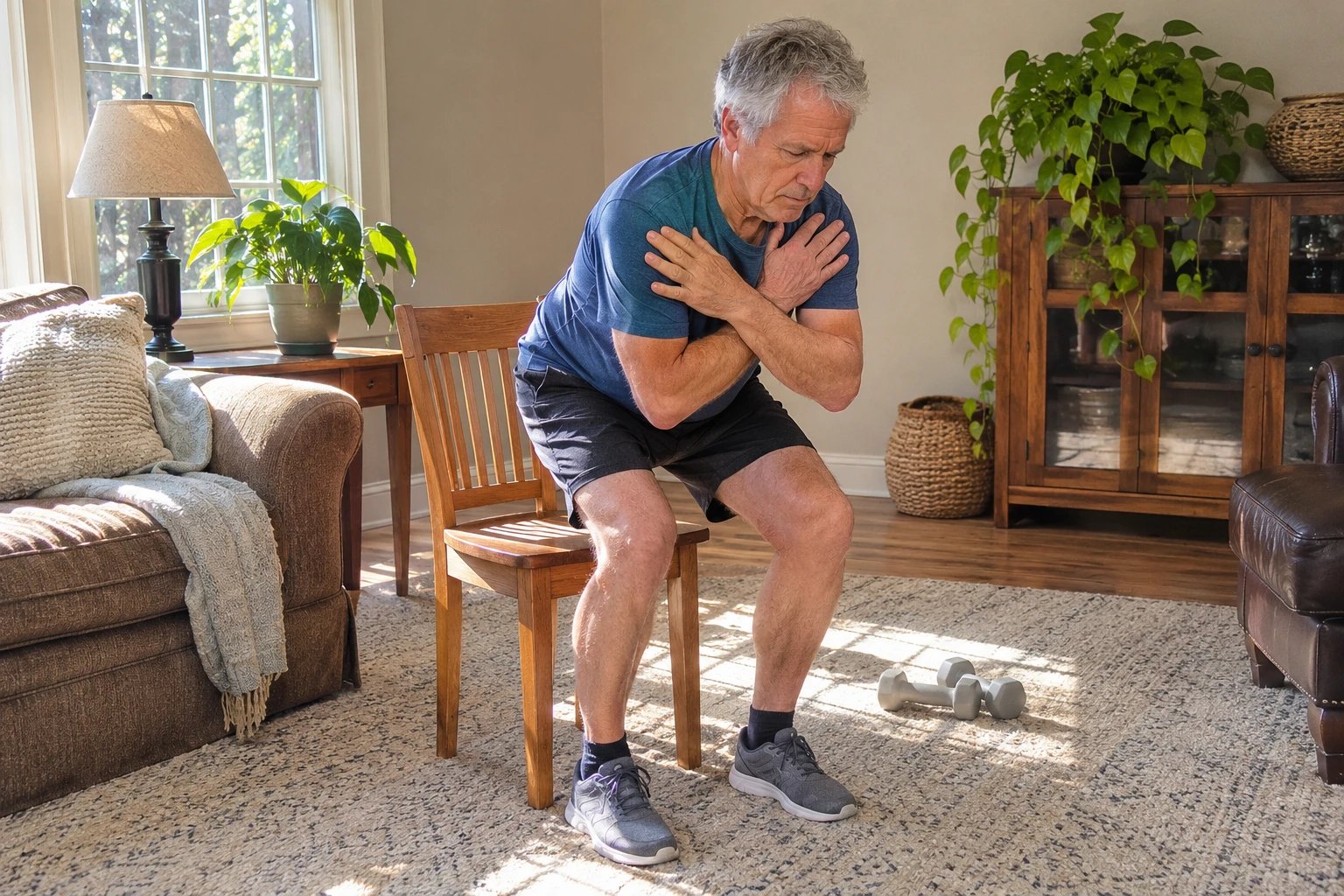
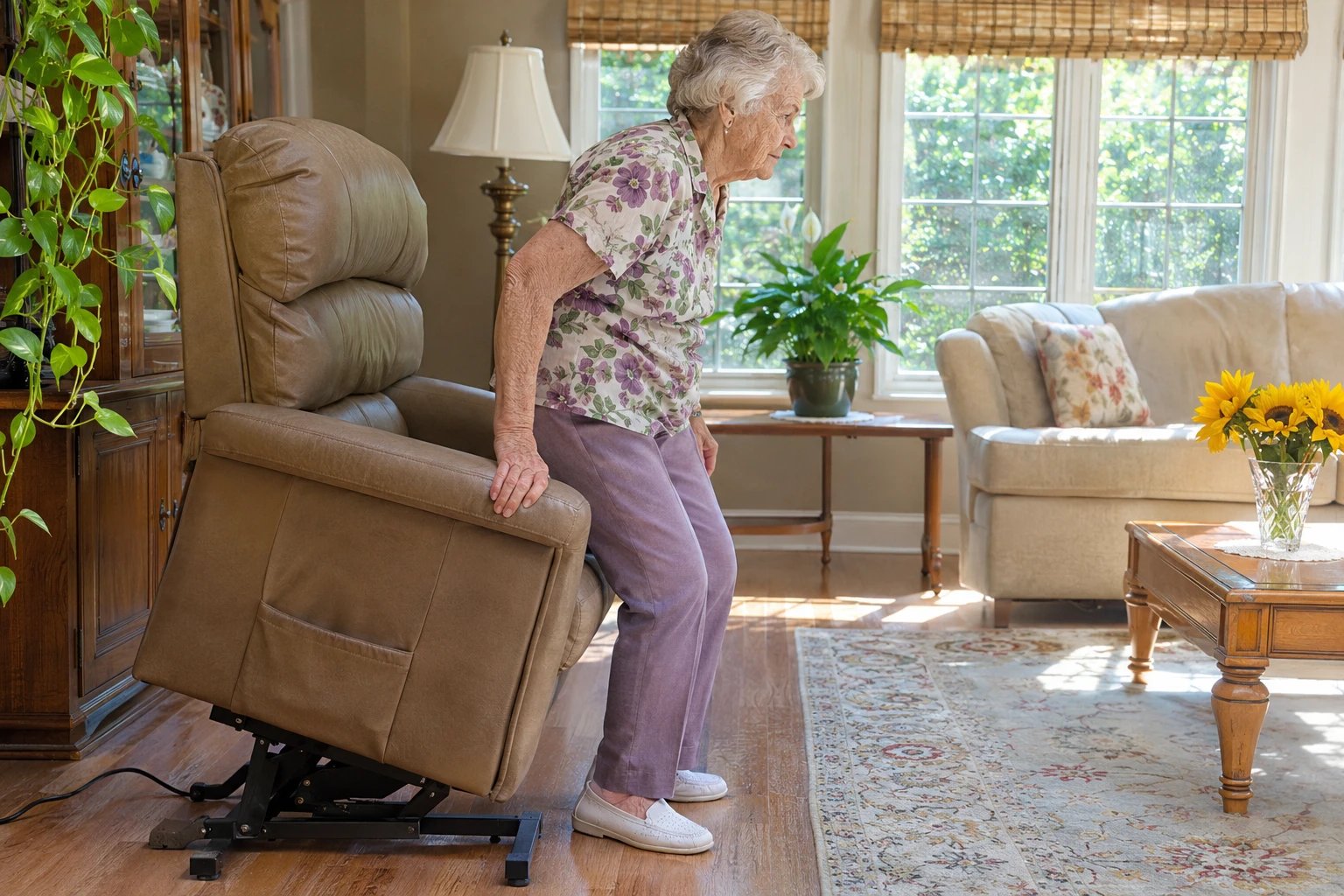
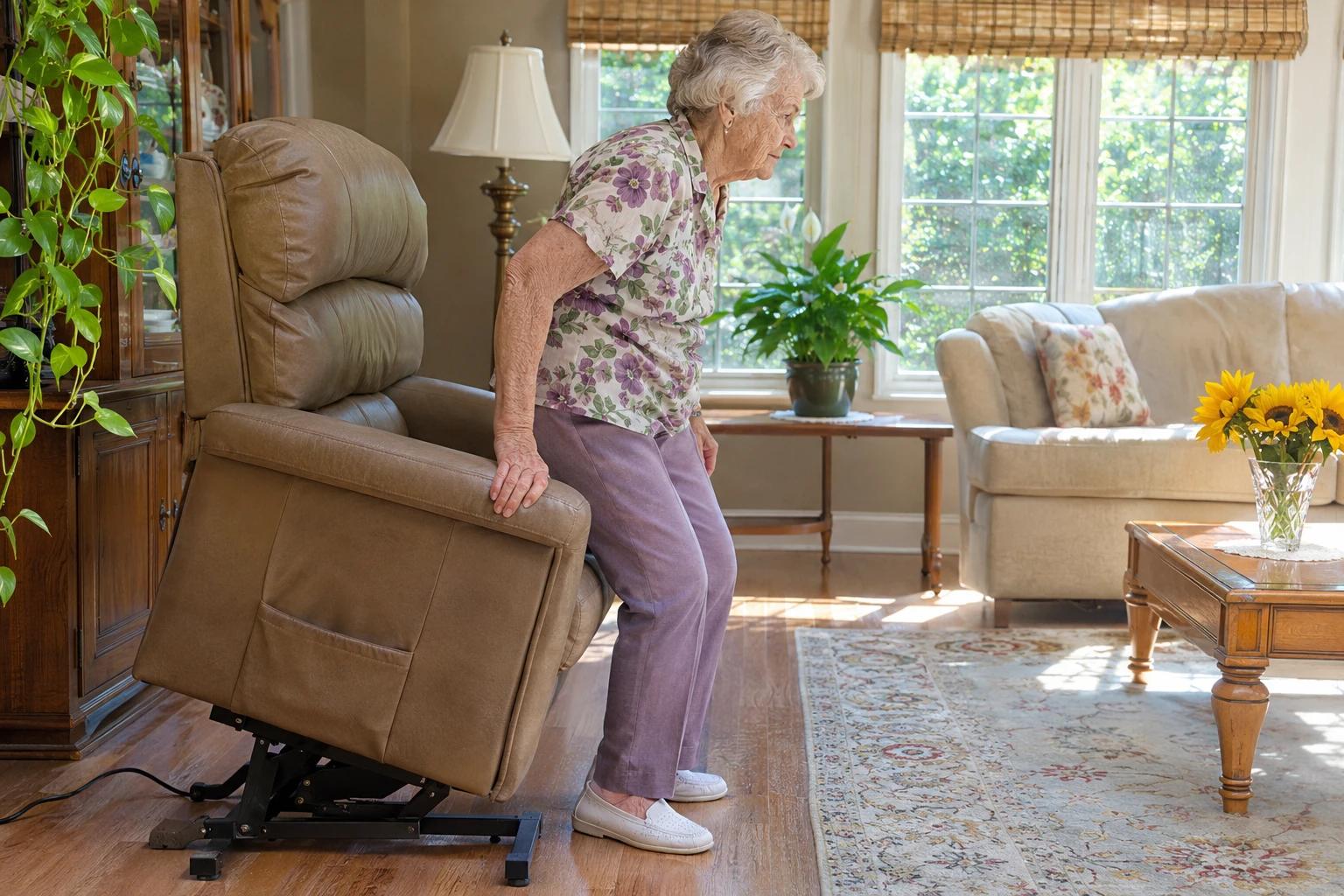
Before you lift anything, do three quick checks from Harvard Health:
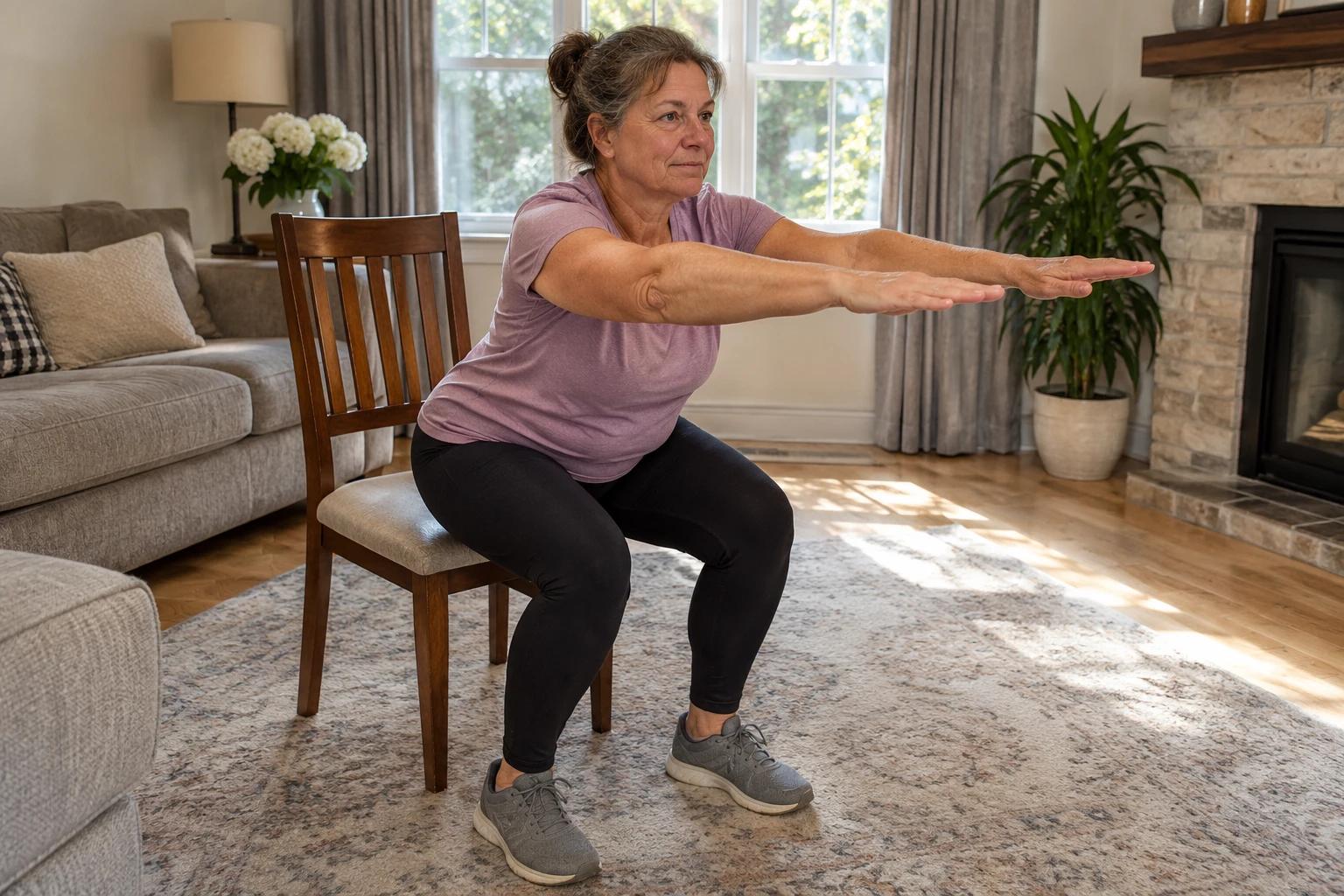
- Rise from an armless chair.
- Climb 10 stairs without the handrail.
- Stand on one foot for five seconds.
If any of them is hard, start with professional supervision, such as a physical therapist or a strength class for older adults. Gym and community-center programs for older people are often covered by insurance, including some Medicare plans, so check your plan before you pay. For a physical therapist, Medicare covers outpatient therapy once a doctor certifies you need it, and you pay 20% of the approved amount after the Part B deductible.
Gabriel Marzuca-Nassr is an associate professor at the University of La Frontera in Chile and led the over-85 study. His advice to anyone unsure about their readiness is simple: talk with your doctor. If a doctor has already set limits on you, take this exact plan in and ask what's off the table. That might be a heart condition, a back problem or a knee that hasn't healed. I won't guess at workarounds for an order I haven't read.
If you have arthritis, the Arthritis Foundation has specific advice:
- Start with dumbbells of 2 to 3 pounds for women or 5 to 8 pounds for men. If you can't do 12 reps, the weight is too heavy.
- Lift slowly, "counting four counts up and four counts down."
- Don't lock your knees or elbows straight at the top.
- If you have arthritis in your knees or hips, talk to your doctor before using a leg press machine.
### Your first weeks
Physical therapist Will Harlow specializes in clients over 50. His first rule is "Your number one goal in the gym should not be to gain strength and muscle. It should be to not get injured."
Here's what that looks like in practice.
Start lighter than feels worth your time. Scott and Daly suggest about 30 to 40% of your maximum effort at first. Over time you'll work up to 70 to 80%. Harvard's starter program uses 12 to 15 reps a set, at an effort of 5 to 7 on a 10-point scale.
Slow down. Harvard recommends a 3-1-3 tempo: three seconds to lift, a one-second pause, three seconds to lower. Breathe out as you lift and in as you lower. Holding your breath and straining through a hard set taken close to exhaustion can push blood pressure up sharply, the American Heart Association warns.
Go all the way down. Full range of motion means moving a joint through its whole natural arc, like squatting to a chair rather than bobbing a few inches. A general-population analysis, not specific to older adults, found full range gave slightly better results for most outcomes than partial reps, with partial reps a reasonable fallback after injury.
A physical therapist at Village Fitness and Physical Therapy in Southern California runs two group strength studios. He described older men in his studios doing heavy quarter squats. "When we finally pulled their weights back to a point where they could squat to depth, they were doing a third of that weight." Their joints felt better, and the strength carried over into daily life.
### Which moves to start with
The first moves should be compound exercises, meaning moves that work several joints and muscle groups at once. Mark Peterson, a researcher at the University of Michigan, suggests starting with your own body weight:
- squats
- chair stands
- modified push-ups
- hip bridges
After that, he suggests moving on to the leg press, chest press and row machines.
You can do every one of those bodyweight moves at home, and a pair of light dumbbells adds the rest.
Between free weights and machines, my judgment is to start on machines if you have access. A machine sets the path of the movement, and a dumbbell asks you to set it yourself. It's the same reason a new cook gets a guide on the mandoline before freehand knife work.
A simple strength-training routine you can follow each week
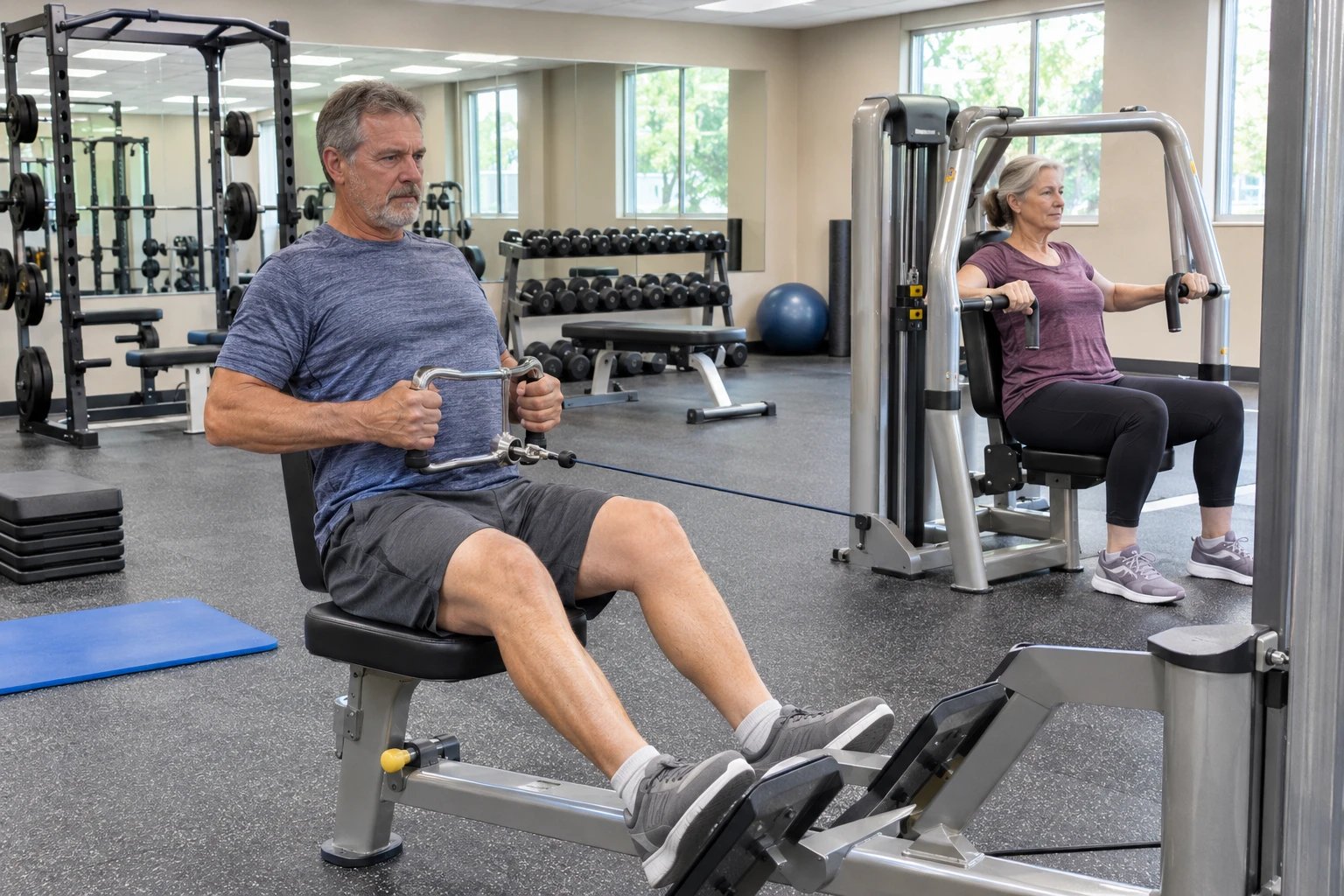
The routine the research supports is shorter than most people expect. It takes two or three sessions a week, on days that aren't back to back.
Two days is the floor, and it isn't a compromise. The CDC asks adults 65 and older for muscle-strengthening work on at least 2 days a week. That work should cover "legs, hips, back, abdomen, chest, shoulders, and arms." In a review of trials in adults 65 and older, two sessions a week produced larger strength gains than three. The Village therapist still aims his beginners at three: "I would shoot for 3 days a week most weeks. And if you miss it some weeks and only get two, you know, don't worry about it."
Pick Monday and Thursday, or Monday, Wednesday and Friday. Harvard advises 48 hours between workouts, which caps you at three a week. Rest at least one minute between sets.
Here's a starter week that covers every group on the CDC's list.
| Exercise | What it works | Sets and reps |
|---|---|---|
| Squat (chair stand to begin) | Thighs, hips | 2 x 12 to 15 |
| Hip bridge (leg press later) | Hips, back of legs | 2 x 12 to 15 |
| Row (machine or dumbbell) | Back, arms | 2 x 12 to 15 |
| Chest press or modified push-up | Chest, shoulders, arms | 2 x 12 to 15 |
| Overhead press | Shoulders, arms | 2 x 12 to 15 |
| Plank or other core hold | Abdomen | 2 short holds |
Do the same session each training day.
### How the sets and reps change
As the top of your range starts to feel easy, follow Harvard's advice: add a third set, or raise the weight and drop back into the 8-to-12 rep range.
For pure strength, the most effective programs in the review of trials used 2 to 3 sets of 7 to 9 reps per exercise, with about 60 seconds of rest. The weight was 70 to 79% of the most you could lift once.
Don't let more become the goal. An analysis of 151 trials in adults 60 and older found that low weekly volume worked best for everyday function, lean mass and muscle size. Volume here means total sets per week. The Village therapist puts it his own way: "one set was infinitely better than zero sets."
### Missed a session, or short on time?
If you miss a session, let it go and pick up on your next training day. Don't do two sessions on back-to-back days to catch up, because the 48-hour gap is part of your rest and recovery.
On a short week, a 2024 overview found that one set each of four or more exercises, twice a week, raises strength by about 20%. Even a single weekly session beats none.
Heavy weights or light weights, and how do you keep your strength as the years pass?
Both build muscle. Heavy weights win on strength, and on keeping it.
An analysis of 15 studies compared heavy loads with light-to-moderate ones in people averaging 68 years old. Heavy meant about 80% of what you could lift once, and light-to-moderate meant about 45%. Heavy loads tended to give larger strength gains, and muscle growth was modest either way. The authors found that, as long as people did enough reps, lighter loads "may suffice to induce substantial gains in muscle strength" in older adults.
Will Harlow leans further toward light: "There's no need to lift heavy weights if your goal is to build muscle mass." He calls anywhere from 10 to 30 reps a great set for most people over 50, as long as the set ends hard.
### How hard each set should feel
The Village therapist's target is "two to three good form reps left in the tank at the end of your set". He adds that "You don't need to go to absolute failure." Coaches call this reps in reserve: how many more clean reps you could have done.
Most people misjudge it. A study of adults averaging 68 tested this on a chest press. People aiming to stop two reps short underestimated by about two reps. When you think you have two left, you probably have about four.
The fix is simple. When you think you're done, try one more rep, but only if your form holds.
### What to choose
My judgment from all this:
- Start light with higher reps.
- Move toward heavier sets of 6 to 12 once your form is solid, if strength is the goal.
- If a doctor has limited heavy lifting, ask whether lighter sets of 15 or more fit inside that limit. Lighter loads still build real strength when you do enough reps.
### If you've lifted for years and it's slipping
Long-time lifters in their 50s and 60s describe a different problem: holding on. A 64-year-old in r/Testosterone wrote: "I get a really nice pump like I always have, however it doesn't stick around as long and my overall strength has gradually gone down some."
Denmark's LISA trial points to one answer. Retirement-age adults did a year of supervised heavy training: three sets of 6 to 12 reps at 70 to 85% of their max, three times a week. Four years later, they still had their starting leg strength. The group that trained at moderate weights had lost strength, and so had the group that didn't train. Lean leg mass declined in every group. The researchers think the nervous system's training explains the strength that stayed.
The 151-trial analysis adds that bigger strength gains after 60 took moderate-to-high weekly volume. So if you're experienced, keep some heavy sets in the week, and don't trim your total sets just because you've been at it a long time.
How much weight should you add each week?
Add as little as it takes to make the work slightly harder than last time. That's progressive overload: small, regular increases in weight, reps or sets.
Harvard's version is the simplest. Add reps first. When the top of your range feels easy, add weight and drop back into the 8-to-12 rep range, or add a set. That two-step approach saves you when the next dumbbell up is too big a jump.
### How big a jump
The standard rule, from the American College of Sports Medicine, is to add 2 to 10% once you can do one or two more reps than your target range, and it holds for older adults too. The best practical numbers in pounds come from the Village therapist. Early on, he starts people "at a weight that's incredibly easy and then just add 5 lb, maybe 10 lb each training session". His reason is that joints and tendons need time to keep up with muscle.
Once lifters have been at it a while, the steps shrink. "With an exercise like an overhead press, we're increasing our clients by a quarter pound to a half pound per week."
Thomas W. Storer runs the Exercise Physiology and Physical Function Lab at Brigham and Women's Hospital. He says it "takes work, dedication, and a plan." The plan part is easier with a written record.
### Keep a log
Will Harlow keeps it plain: "I just take a little notebook into the gym. And then I just write down the exercise, the weight I used, and the number of reps for each set."
In my experience, the same rule holds for a kitchen inventory and a training log. If it isn't written down, you're guessing, and guesses drift in your favor.
What should you eat to build muscle after 50?
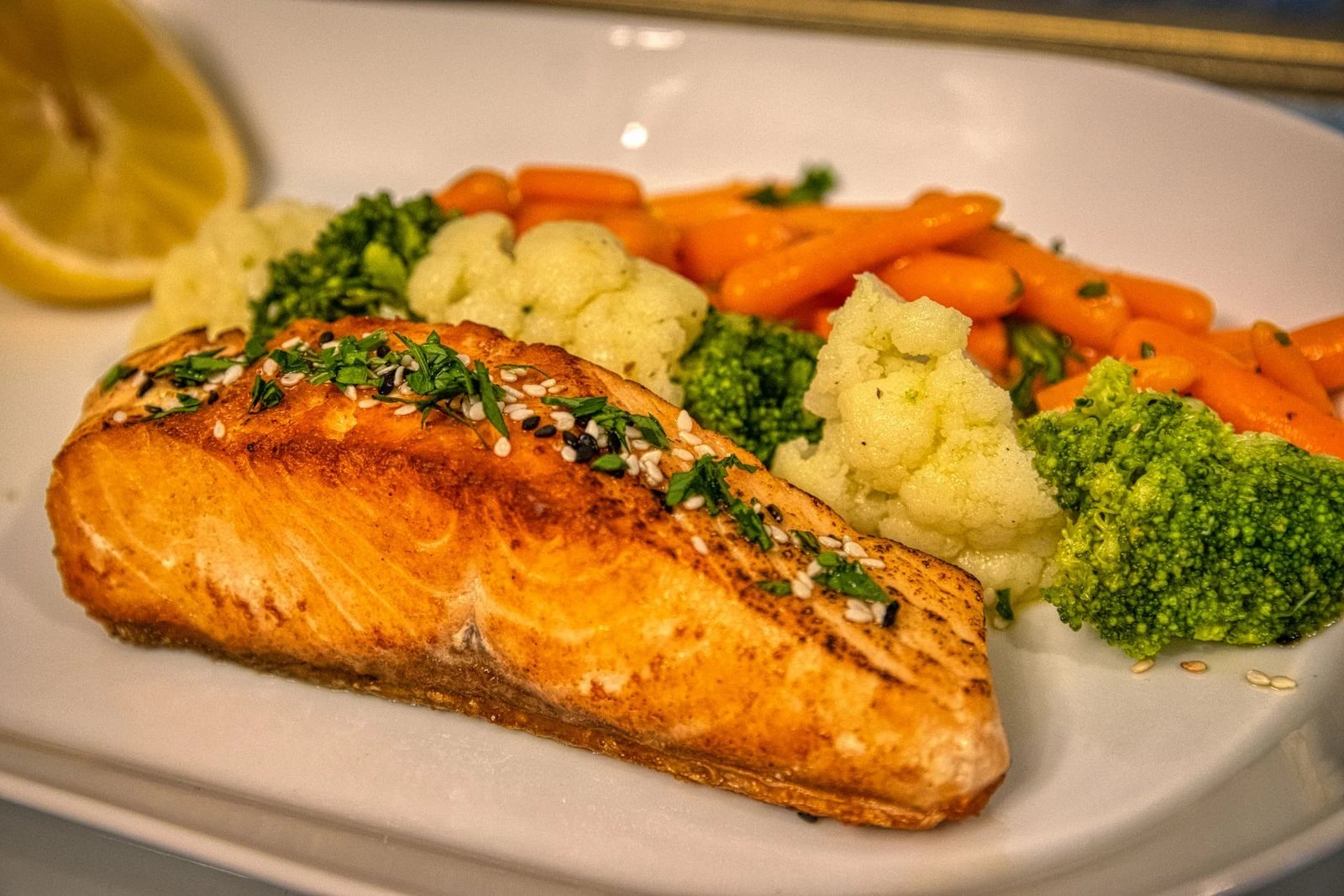
Start with protein, because it's the part most people underestimate.
We read the protein advice from Harvard, Stanford and a 2025 review aimed at Americans 65 and older. Their daily targets:
- Harvard Health: 1.0 to 1.3 grams per kilogram of body weight if you strength-train.
- Stanford Lifestyle Medicine: 1.2 to 1.6 g/kg for adults 50 and older.
- The 2025 review: 1.0 to 1.2 g/kg for healthy older adults, and 1.2 to 1.5 for people with chronic conditions.
To convert, divide your weight in pounds by 2.2 to get kilograms. At 150 pounds, that's about 70 to 110 grams of protein a day. These targets assume healthy kidneys. With chronic kidney disease at stages 3 to 5, not on dialysis, the National Kidney Foundation advises far less for stable adults, about 0.55 to 0.6 g/kg a day, so get your number from a doctor.
### Protein per meal
How you split it matters too. In men averaging about 71, the protein that best switched on muscle building in one meal was 0.40 g/kg. That's about 32 grams for a 176-pound man. Men averaging 22 needed 0.24 g/kg.
Marily Oppezzo, a Stanford nutrition scientist and dietitian, describes it this way: "The men in their 70s needed more than 20 grams of protein at a time to get their muscles to listen." Stanford suggests 30 to 35 grams a meal, plus the same within two hours after training.
If spreading protein evenly sounds like a chore, the evidence gives you some room. In one trial of adults 52 to 75, the daily total mattered and the split across meals didn't. A 2023 review found that at least one high-protein meal a day may be enough, even with the rest uneven.
Get the total right first, then make one or two meals big ones.
| Food | Serving | Protein |
|---|---|---|
| Lean chicken | 3.5 oz | 31 g |
| Salmon | 3.5 oz | 24 g |
| Cooked beans | 1 cup | about 18 g |
| Plain Greek yogurt | 6 oz | 17 g |
| Skim milk | 1 cup | 9 g |
| Protein powder | 1 scoop | about 30 g |
Greek yogurt blended with a cup of milk gets you to about 26 grams before you've chewed anything.
### Do you need more than that?
Some men in their mid-50s on Reddit fitness forums aim for 170 to 180 grams a day, or their body weight in pounds. That works out to about 2.2 g/kg, well above every target here.
From a cost standpoint, it's the menu item nobody needed. You pay for it at the butcher and get nothing back that the research can show.
### Calories and carbs
To grow, you need to eat a little more than you burn. That's a calorie surplus.
Anthony Balduzzi is a naturopathic doctor (NMD) who sells his own Fit Father Project programs. He recommends adding "250 to 500 calories on top of" what you need to hold steady. For newer lifters in general, a review suggests 10 to 20% above maintenance, gaining about 0.25 to 0.5% of body weight a week. At 2,200 calories a day, that's 220 to 440 extra. The two ranges are close, though neither has been tested in people over 50.
Go modest. Aim to gain no more than about 0.5% of your body weight a week.
Carbs pull their weight too. Balduzzi builds each of about four daily meals around a protein. He also says "carbs are extremely important for muscle building." Harvard suggests a post-workout snack within 30 minutes, with three to four times as much carbohydrate as protein. Fruit with yogurt fits.
Can you build muscle while losing weight, or when eating enough is hard?
You can protect muscle while losing weight. Adding much of it at the same time is hard.
A 55-year-old in r/fitness50plus had lost 60 pounds. Then he wrote, "I am surprised to find it was so much easier to lose weight than gain muscle." Others in those forums say they wish they'd lifted during the weight loss rather than after.
The research backs them up. A trial put 160 adults 65 and older with obesity on a diet 500 to 750 calories below their needs for six months. Everyone also exercised. All the groups lost about 9% of their body weight, but what they lost differed:
| Exercise during the diet | Lean mass lost |
|---|---|
| Resistance training | 1.0 kg |
| Resistance plus aerobic | 1.7 kg |
| Aerobic only | 2.7 kg |
If you're dieting, lift. Keep the deficit small. A meta-analysis across age groups found a gap of about 500 calories a day prevented lean-mass gains, though strength still improved. The authors advise staying under that when you're trying to hold on to muscle. Expect to get stronger while the scale drops, and save muscle-building for when you've reached your goal weight and are eating at maintenance or a little above.
### When eating enough is the hard part
For some people the problem runs the other way. Lifelong thin eaters on Reddit say food is the real workout. Some lean on simple high-protein foods and stir protein powder into yogurt.
The 2025 review names eggs as an affordable protein and points to legumes, nuts and seeds too. If chewing meat has become a chore, eggs, yogurt, milk and soft-cooked beans do the same job. The review also mentions about 40 grams of casein or whey protein before bed, taken alongside exercise.
From a cook's point of view, the easy wins are adding protein to things you already eat. Stir an egg into the rice. Put beans in the soup. Use milk where you'd use water.
How do cardio, walking and sleep affect building muscle?
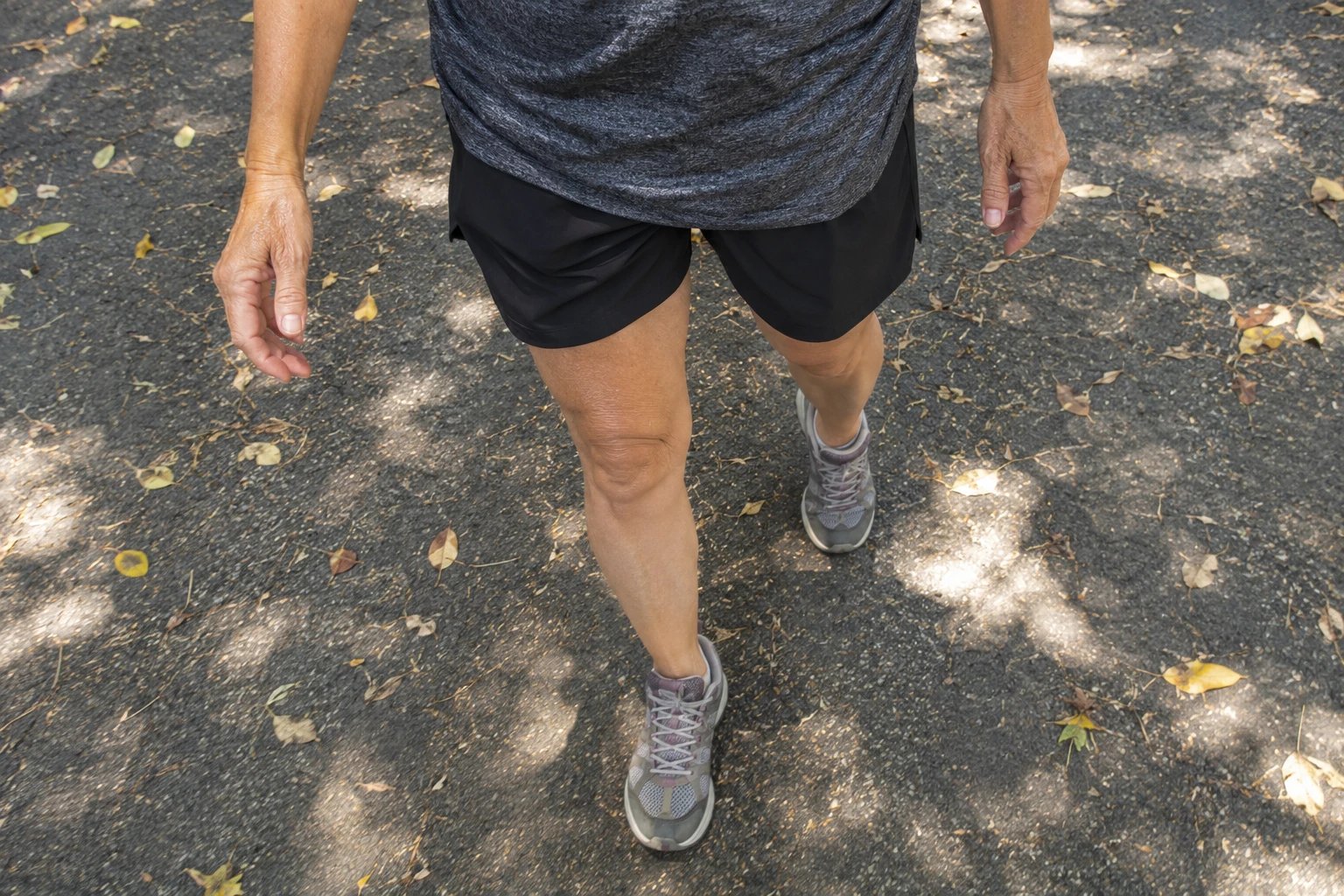
Cardio doesn't cancel out your lifting.
An analysis of 53 studies covered adults 50 and older. It found that combining cardio with strength training was "as effective as RT for increasing muscle mass", meaning as effective as resistance training on its own. The CDC asks older adults for at least 150 minutes of moderate aerobic activity a week, plus balance work. Do both.
Will Harlow advises keeping hard cardio to one or two sessions a week, and the 53-study analysis doesn't back a limit that strict. On walking, he's clear: "If it's just walking, trying to get your 6 to 10,000 steps per day, that does not seem to interfere with recovery."
My take: if you run a lot and your strength numbers stall for weeks, cardio is the first dial to turn down for a while. It's an easy experiment and costs you nothing.
### Sleep
Sleep is where the cheap gains hide. In a lab study of young adults, one sleepless night cut muscle protein synthesis by 18%. That's the process of building new muscle. The authors said one night was enough to cause anabolic resistance, meaning muscle that responds less to food and training. Nobody has run that study in people over 50.
Two men on Reddit fitness forums name short sleep as what held them back.
### Time
Time is the other half of rest and recovery. A semi-retired man in r/fitness50plus wrote: "I'm building more muscle after 50 than I did in my 20s. Why? I'm semi retired and have more time to train, eat, rest and recover." If you're still working full time, you can't have his schedule. You can have the routine above, and a full night's sleep.
Creatine, protein powder and testosterone: what's worth asking your doctor?
Of these three, creatine has the strongest safety record. Testosterone is the one you shouldn't touch without a diagnosis. Protein powder is just food in a tub.
### Creatine
Creatine is a compound your muscles use for short bursts of effort, sold as a powder. The International Society of Sports Nutrition says your body's stores can be maintained with 3 to 5 grams a day. It found "no compelling evidence" that creatine harms the kidneys in healthy people. It also says anyone with existing kidney disease should see a doctor first.
Creatine can make a routine kidney blood test look worse. It raises creatinine, a waste product doctors use to estimate kidney function. A 2026 analysis of 26 trials found that creatine lowered those creatinine-based estimates. Kidney tests that don't depend on creatinine showed no change. The authors read that as a change in how creatinine is handled, not kidney injury.
If you take creatine, tell your doctor before blood work. Otherwise you might get a scare you don't need. Another 2026 review found no meaningful change in kidney function, and its authors want studies longer than a year.
### Protein powder
Protein powder at about 30 grams a scoop is useful only if food falls short. If you can hit your numbers with chicken, yogurt and beans, the tub is an expense.
### Testosterone
The Endocrine Society's advice in 2026 is plain. Its July statement says diagnosis needs symptoms plus at least two early-morning fasting blood tests that are consistently low. It adds that "symptoms alone are not diagnostic." For men with a BMI over 27, weight loss usually comes first. BMI is a weight-for-height score.
The statement also cites trial data showing roughly a 50% relative increase in pulmonary embolism (blood clots in the lungs), and more fractures, in treated men. The society's guideline suggests against routinely prescribing testosterone to men 65 and older just because their levels are low. It also lists men who shouldn't take it at all, including men with prostate or breast cancer, or a heart event in the past six months.
For strength, exercise did what testosterone gel didn't. One trial followed 80 men aged 50 to 70 with low-normal levels for 12 weeks. The gel raised lean mass but didn't improve strength, and exercise improved every strength measure. The authors concluded that "an exercise program is likely to be more beneficial than T treatment."
Some men on Reddit credit testosterone for their gains. In the same threads, others push back on taking it without a diagnosed deficiency. If you have symptoms, the conversation belongs with a doctor, starting with the two tests.
The bottom line
This week, try the chair, the ten stairs and the one-foot stand. If any of them gives you trouble, your first call is to a physical therapist or a supervised class, and to your plan to ask what it covers.
If they're easy, pick two training days 48 hours apart. Buy or borrow dumbbells light enough to feel almost silly. Do the six moves in the starter table, two sets each, slowly and all the way down. Write every number in a notebook.
Then look at breakfast. If it's toast and coffee, it's the cheapest meal to fix: 6 ounces of Greek yogurt and a cup of milk get you most of the way to 30 grams.
Up next
17 Tai Chi Exercises and Honest Truths for Women Over 50
Real tai chi moves you can start today, standing or seated, plus straight answers about your balance, your bones and those belly-fat videos.
Read the list →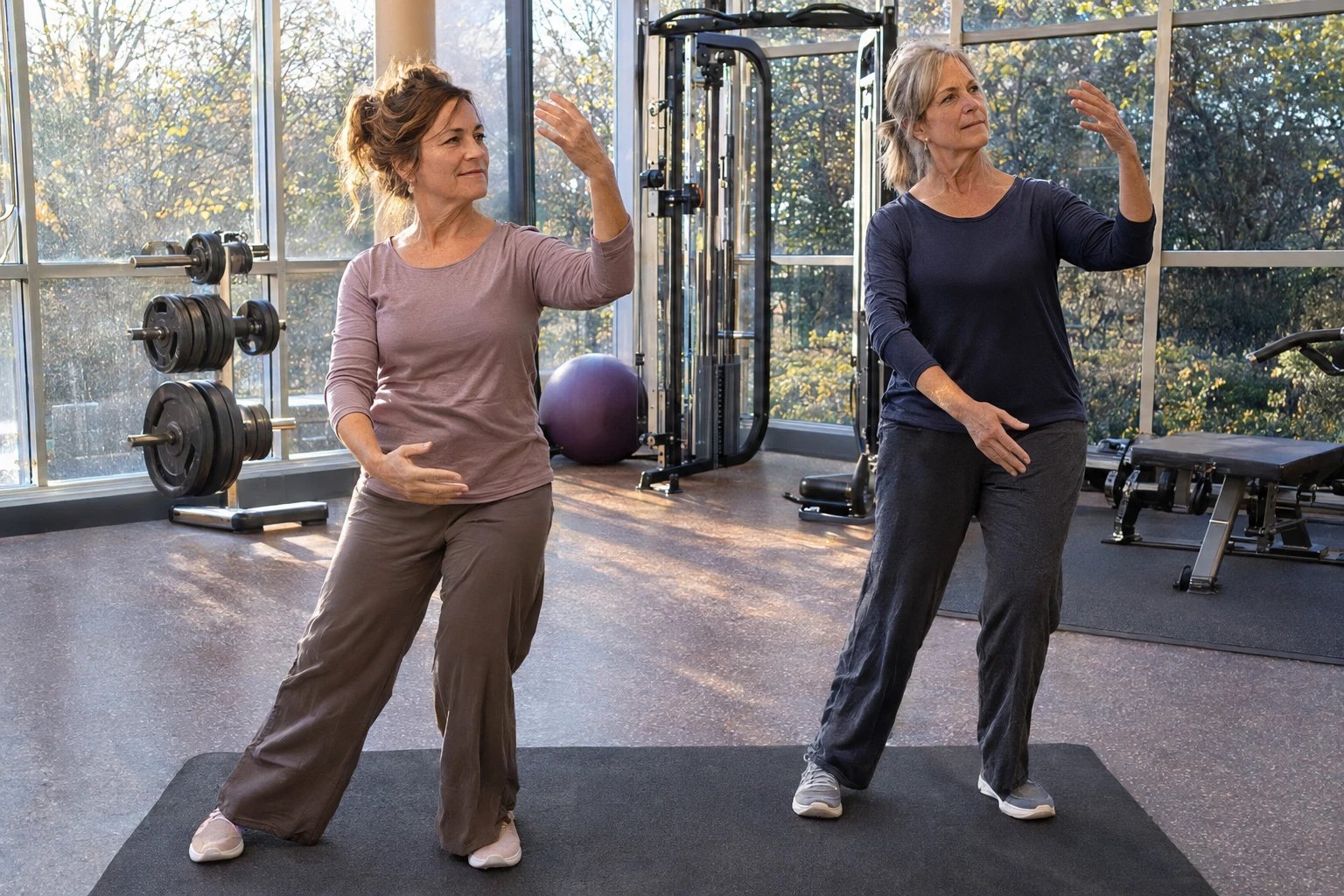

Reader quiz
Did you catch the details?
5 questions from this article.
Which of these is one of the three quick checks the article suggests doing before you lift anything?
Questions people also ask
Is it harder to build muscle after 50?
Yes, somewhat, but real gains are still the norm with training. Across 49 studies of adults aged 50 to 83, older participants gained less lean mass, though the average was still about 1.1 kg in roughly 20 weeks (Peterson and colleagues). Older muscle also needs more protein per meal to respond: about 0.40 g/kg in men around 71, versus 0.24 g/kg in men around 22 (Moore and colleagues).
How long does it take to build muscle after 50?
Improvements, including strength, can show within about eight weeks; measurable muscle growth takes longer, typically several months. In one study, 12 weeks raised thigh muscle size 10 to 11%, and about 20 weeks brings around 2.4 pounds of lean mass on average (Peterson and colleagues). The largest strength gains came from programs lasting close to a year (Borde and colleagues).
Can you build muscle after 75 as a man?
Yes. Resistance training improves strength and muscle size well past 75, and the effect on strength was even larger in people over 80, with few reported problems (Grgic and colleagues). In a 12-week study, people over 85 gained as much as people aged 65 to 75 (Marzuca-Nassr and colleagues). These studies included men and women; none looked at men alone.
Is creatine safe for your kidneys after 50?
For people with healthy kidneys, standard doses of 3 to 5 grams a day show no compelling evidence of kidney harm (International Society of Sports Nutrition). Creatine does raise blood creatinine, which can make a routine kidney estimate look worse without any measured drop in function. Anyone with existing kidney disease should check with a doctor first.
Should I get my testosterone checked before trying to build muscle?
Only if you have symptoms of low testosterone. Diagnosis needs symptoms plus at least two low early-morning fasting tests (Endocrine Society). The society advises against routinely treating men 65 and older for low levels alone. In men aged 50 to 70 with low-normal levels, exercise improved strength and testosterone gel did not (Sports Medicine Open).
Can you build muscle at 50 in a calorie deficit?
Adding muscle while eating well below your needs is difficult, though you can still get stronger and protect what you have. A meta-analysis across ages found a deficit of about 500 calories a day prevented lean-mass gains while strength still improved (Murphy and Koehler). In dieting adults 65 and older, resistance training cut lean-mass loss to 1.0 kg, against 2.7 kg with aerobic exercise alone (NIHR Evidence).
Did any of these feel familiar?
Know someone who needs this?
 Prime Journal · Free printable
The Everyday Health Readiness Checklist
- A clearer path from bed to bathroom
- A medicine list ready for the pharmacist
- A symptom story and follow-up plan you can use
Free printable: The Everyday Health Readiness Checklist. Enter your email and it is yours.
Sources cited in this article
This article links to 53 outside sources, listed here so you can read them yourself.
- No differences between the two age groups researchportal.vub.be/en/publications/muscle-mass-and-strength-gains-followi…
- As reposted by Corner On Wellness www.corneronwellness.com/its-never-too-late-to-lift-weights-older-bodies-can…
- 3 to 5% of muscle per decade after 30 www.harvardhealth.org/healthy-aging-and-longevity/preserve-your-muscle-mass
- An average of 1.1 kg of lean mass pmc.ncbi.nlm.nih.gov/articles/PMC2995836
- David Scott and Robin Daly of Deakin University theconversation.com/am-i-too-old-to-build-muscle-what-science-says-about-sar…
- 25 to 30% stronger overall www.eurekalert.org/news-releases/550308
- Produced the biggest strength gains pmc.ncbi.nlm.nih.gov/articles/PMC4656698
- Noticeably muscular four years after starting at 51 www.reddit.com/comments/1p5mmq4
- "Still don't know why I waited so long to start lifting." www.reddit.com/comments/1x240ze
- According to the CDC www.cdc.gov/mmwr/volumes/71/wr/mm7118a6.htm
- More than doubled between 1998 and 2018 pmc.ncbi.nlm.nih.gov/articles/PMC11000248
- Harvard Health www.harvardhealth.org/staying-healthy/getting-a-start-on-growing-stronger
- Medicare covers outpatient therapy www.medicare.gov/coverage/physical-therapy-services
- Arthritis Foundation www.arthritis.org/health-wellness/healthy-living/physical-activity/getting-s…
- His first rule www.youtube.com/watch?v=kq0K-GVFwNY&t=921s
- American Heart Association www.ahajournals.org/doi/10.1161/circulationaha.107.185214
- Slightly better results for most outcomes sportrxiv.org/index.php/server/preprint/view/198
- "When we finally pulled their weights back to a point where they could squat to depth, they were doing a third of that weight." www.youtube.com/watch?v=0p8Hir9oAOc&t=304s
- Cdc.gov www.cdc.gov/physical-activity-basics/guidelines/older-adults.html
- "I would shoot for 3 days a week most weeks. And if you miss it some weeks and only get two, you know, don't worry about it." www.youtube.com/watch?v=0p8Hir9oAOc&t=488s
- Low weekly volume worked best research-repository.uwa.edu.au/en/publications/effects-of-resistance-trainin…
- "one set was infinitely better than zero sets." www.youtube.com/watch?v=0p8Hir9oAOc&t=366s
- One set each of four or more exercises, twice a week pmc.ncbi.nlm.nih.gov/articles/PMC11127831
- Tended to give larger strength gains ucrisportal.univie.ac.at/en/publications/effects-of-resistance-training-with…
- "There's no need to lift heavy weights if your goal is to build muscle mass." www.youtube.com/watch?v=mqd9PYmOqYU&t=366s
- "two to three good form reps left in the tank at the end of your set" www.youtube.com/watch?v=0p8Hir9oAOc&t=1034s
- "I get a really nice pump like I always have, however it doesn't stick around as long and my overall strength has gradually gone down some." www.reddit.com/comments/1i2bozm
- They still had their starting leg strength www.news-medical.net/news/20240624/12-months-of-heavy-resistance-training-ar…
- American College of Sports Medicine journals.lww.com/acsm-msse/fulltext/2002/02000/progression_models_in_resista…
- "at a weight that's incredibly easy and then just add 5 lb, maybe 10 lb each training session" www.youtube.com/watch?v=0p8Hir9oAOc&t=244s
- "With an exercise like an overhead press, we're increasing our clients by a quarter pound to a half pound per week." www.youtube.com/watch?v=0p8Hir9oAOc&t=913s
- "I just take a little notebook into the gym. And then I just write down the exercise, the weight I used, and the number of reps for each set." www.youtube.com/watch?v=kq0K-GVFwNY&t=367s
- 1.2 to 1.6 g/kg lifestylemedicine.stanford.edu/protein-needs-for-adults-50
- 1.0 to 1.2 g/kg pmc.ncbi.nlm.nih.gov/articles/PMC12348035
- National Kidney Foundation www.kidney.org/sites/default/files/Nutrition_GL+Submission_101719_Public_Rev…
- 0.40 g/kg academic.oup.com/biomedgerontology/article/70/1/57/2947642
- At least one high-protein meal a day academic.oup.com/biomedgerontology/article/78/Supplement_1/67/7199271
- He recommends adding www.youtube.com/watch?v=yliHX5u3HZY&t=245s
- 10 to 20% above maintenance pmc.ncbi.nlm.nih.gov/articles/PMC6680710
- "carbs are extremely important for muscle building." www.youtube.com/watch?v=yliHX5u3HZY&t=307s
- "I am surprised to find it was so much easier to lose weight than gain muscle." www.reddit.com/comments/1vm2eku
- What they lost differed evidence.nihr.ac.uk/alert/resistance-training-may-prevent-obese-older-people…
- About 500 calories a day prevented lean-mass gains portal.fis.tum.de/en/publications/energy-deficiency-impairs-resistance-train…
- "as effective as RT for increasing muscle mass" pmc.ncbi.nlm.nih.gov/articles/PMC11989159
- "If it's just walking, trying to get your 6 to 10,000 steps per day, that does not seem to interfere with recovery." www.youtube.com/watch?v=kq0K-GVFwNY&t=554s
- Cut muscle protein synthesis by 18% pmc.ncbi.nlm.nih.gov/articles/PMC7785053
- "I'm building more muscle after 50 than I did in my 20s. Why? I'm semi retired and have more time to train, eat, rest and recover." www.reddit.com/comments/1vxkf47
- 3 to 5 grams a day pmc.ncbi.nlm.nih.gov/articles/PMC5469049
- Its July statement www.endocrine.org/news-and-advocacy/news-room/2026/statement-on-testosterone…
- Suggests against routinely prescribing testosterone www.endocrine.org/clinical-practice-guidelines/testosterone-therapy
- Didn't improve strength pmc.ncbi.nlm.nih.gov/articles/PMC10987448
- Normal adult range www.endocrine.org/patient-engagement/endocrine-library/hypogonadism
- Removed the boxed heart warning content.govdelivery.com/accounts/USFDA/bulletins/3d4b849
Peter Byalik
Food & Home Editor
Peter Byalik is a professional chef with more than 20 years of experience, including years running his own business. He came to the United States from Ukraine.
More from Peter Byalik