






How to Cover Neck Wrinkles With Clothes Over 50
A plan matched to your own neck, from the right collar to the fabric facts on how much sun a scarf really blocks.
By Irina Byalik, Style Editor
Updated · 24 min read
The short answer: Covering neck wrinkles with clothes means matching the fix to the problem. Choose a soft cowl, mock neck or draped scarf for loose, hanging skin. Choose a V-neck, scoop or open cowl to frame lines and crepey texture rather than hide them. Choose an upturned collar or high neckline for sun blotches on the neck's sides. Skip tight turtlenecks and chokers, and choose dense, dry fabric for sun protection.
- Written by our style editor
- Cited 37 sources
- How we review
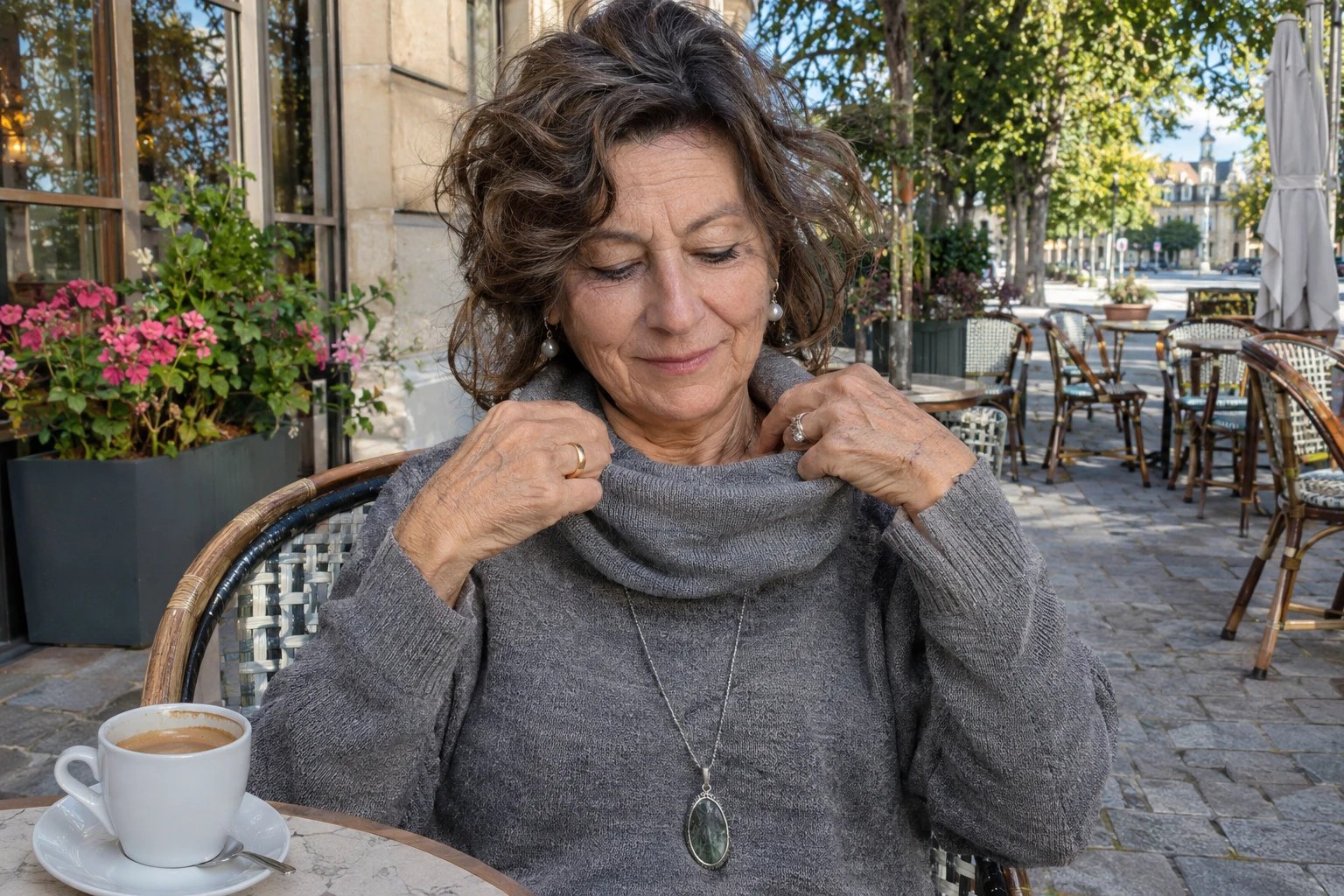
When I fasten a cape at the back of someone's neck, I watch what their hands do next. People who are bothered by their neck tug the cape higher or ask me to loosen it. Then they check the mirror and look away.
If you've been reading up on how to cover neck wrinkles with clothes over 50, you've probably seen the same list everywhere: V-neck, scarf, long necklace. That list flatters some necks and does nothing for others. A deep V is lovely on fine lines and does little for loose skin under the chin.
So before you shop, work out which change you're dressing for. The rest of the plan follows from that.
Which kind of neck change are you dressing for?
Look in a mirror by a window with your chin level. Most necks show one or two of four changes, and each one wants a different fix.
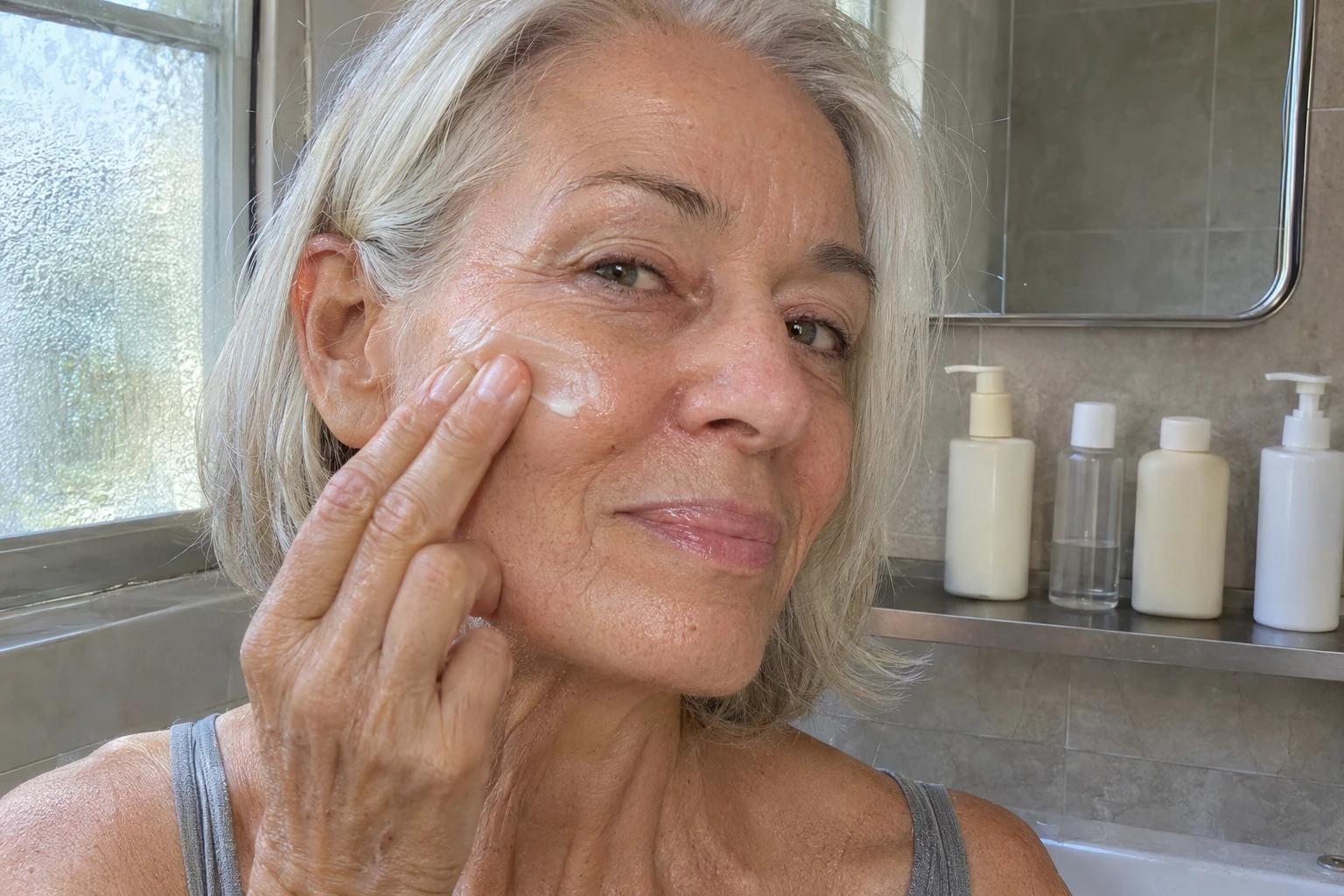
- Lines and crepey texture. Cleveland Clinic lists the neck's changes as "wrinkles, discoloration, crepiness, redness and other signs of aging." It puts horizontal lines partly down to "tech neck," which comes from looking down at a phone for hours.
- Loose, hanging skin or bands. The American Society of Plastic Surgeons describes "loose neck skin" and "muscle banding in the neck." Together, this is the look often called a turkey neck.
- Fullness under the chin. The same group lists "excess fatty deposits under the chin" as its own change.
- Sun blotches on the sides. This one is red and brown mottling with a long name, poikiloderma of Civatte. DermNet says it affects "the sides of the neck" and "usually spares the shaded area under the chin." DermNet also calls it "a chronic and irreversible condition," so covering it is a sensible everyday answer.
Those rings around the neck may have been with you for decades. Dr. Sam Ellis, a board-certified dermatologist, says horizontal necklace lines are partly genetic, and that you don't have to treat them if they don't bother you. In a Reddit thread about neck lines, commenters say the rings run in their families. Others point out that in Ghana and across West Africa they're seen as a mark of beauty.
The neck also tends to change before the face does. Dermatologist Dr. Jing (Jenny) Liu points to thinner skin, fewer oil glands and the sunscreen people skip there. She sums it up well: "No one talks about the neck until it's suddenly talking back."
If you see two of these, dress for the one that bothers you most. In my experience, that's the one you'll notice in every photo.
Does anyone else really notice your neck, and when is it a doctor's job?
Plenty of forum commenters say no. A commenter on the Gransnet forum put it bluntly: "No one except you minds your wrinkly neck." In the Reddit thread above, several commenters told worried posters the same thing, that nobody else sees the lines.
A commenter in r/AskWomenOver60 had a solution of her own: "I find putting my glasses on top of my head before going in the bathroom works great."
There is one case where a neck needs more than a new collar. A woman posted in r/30PlusSkinCare: "I'm 50 and really not sure when this happened. I hate my neck." Her neck had changed quickly. About six commenters urged her to see a doctor, and several mentioned thyroid trouble from their own or their families' history. She booked an appointment and wrote, "Quite frankly I hadn't even thought of it possibly being a medical issue."
Lumps in the neck are common and usually harmless. The American Thyroid Association says about half of all people have a thyroid nodule by age 60, and over 90% of these are benign. It also notes that people often find them while "buttoning their collar, or fastening a necklace."
Get checked for a neck lump that's growing, or for any trouble swallowing, speaking or breathing. Dr. Allen Ho, who directs Cedars-Sinai's Head and Neck Cancer Program, says it's "important for your doctor to palpate and evaluate any unusual or long-lasting lumps or nodules around your neck."
The one styling rule behind every neckline that works
The eye follows a line and stops where it ends.
Here's how I think about it: lines that run up and down, like a V-neck, a long pendant, an open collar or the ends of a scarf, tend to carry the eye down and past your neck. A line that sits flat across the throat, like a choker, a high crew neck or the hard top edge of a snug turtleneck, tends to stop it there and frame the very spot you'd rather people skipped.
Two stylists back the specific moves. Deborah Boland of Fabulous After 40 says cowl necks "draw the eye to your chest rather than your chin." Robin LaMonte, who writes the blog Hello I'm 50ish, says longer statement necklaces "finishing on or below the breastbone will draw the eye downwards away from your neck."
I think about haircuts the same way. The shape of a cut matters less than where it ends, because the end is where people look. To test a top, put it on, stand a few feet from the mirror and notice where your eye lands first. If it lands on the part of your neck you came here about, the line ends in the wrong place.
Which necklines hide loose or sagging neck skin without looking like you're hiding?
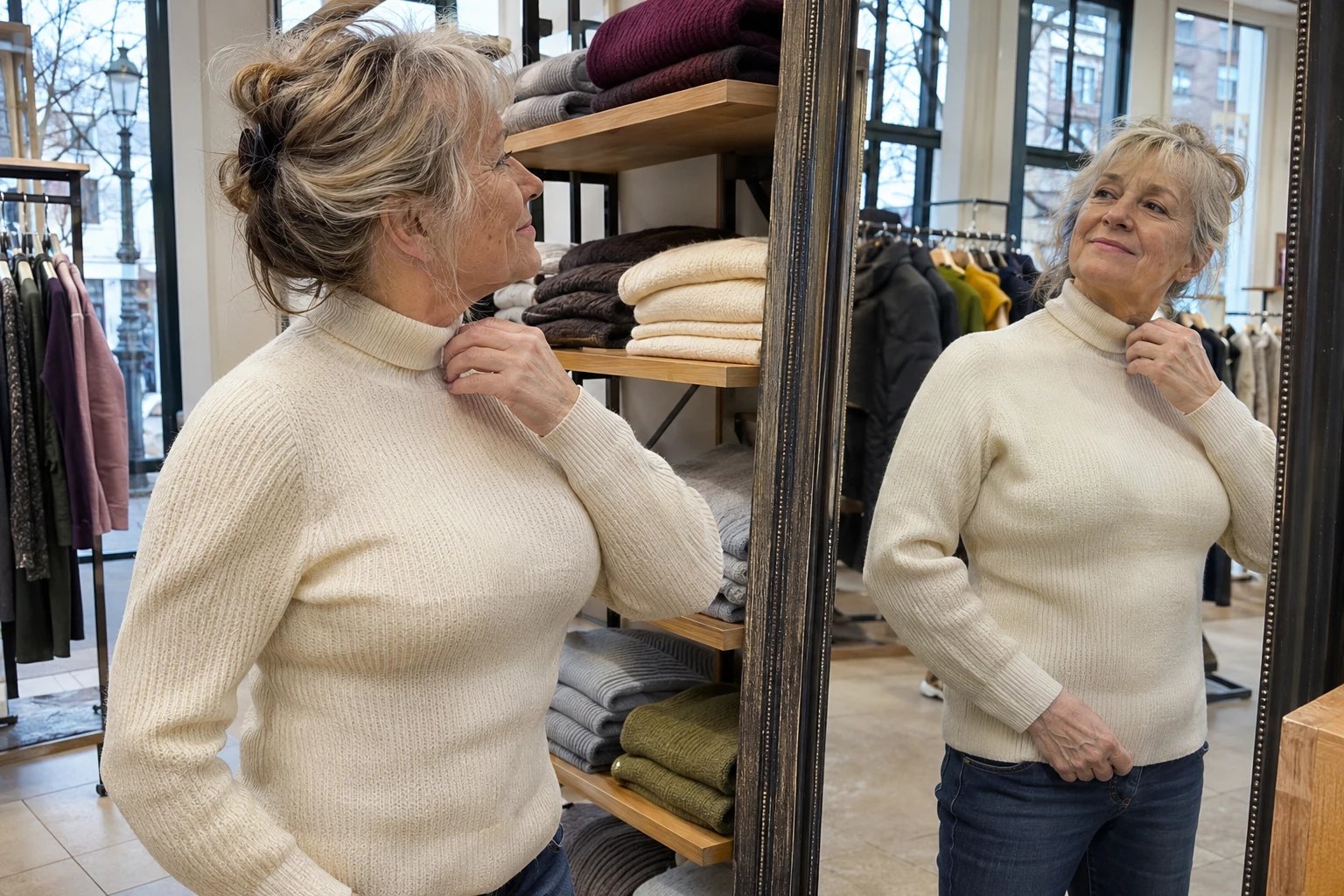
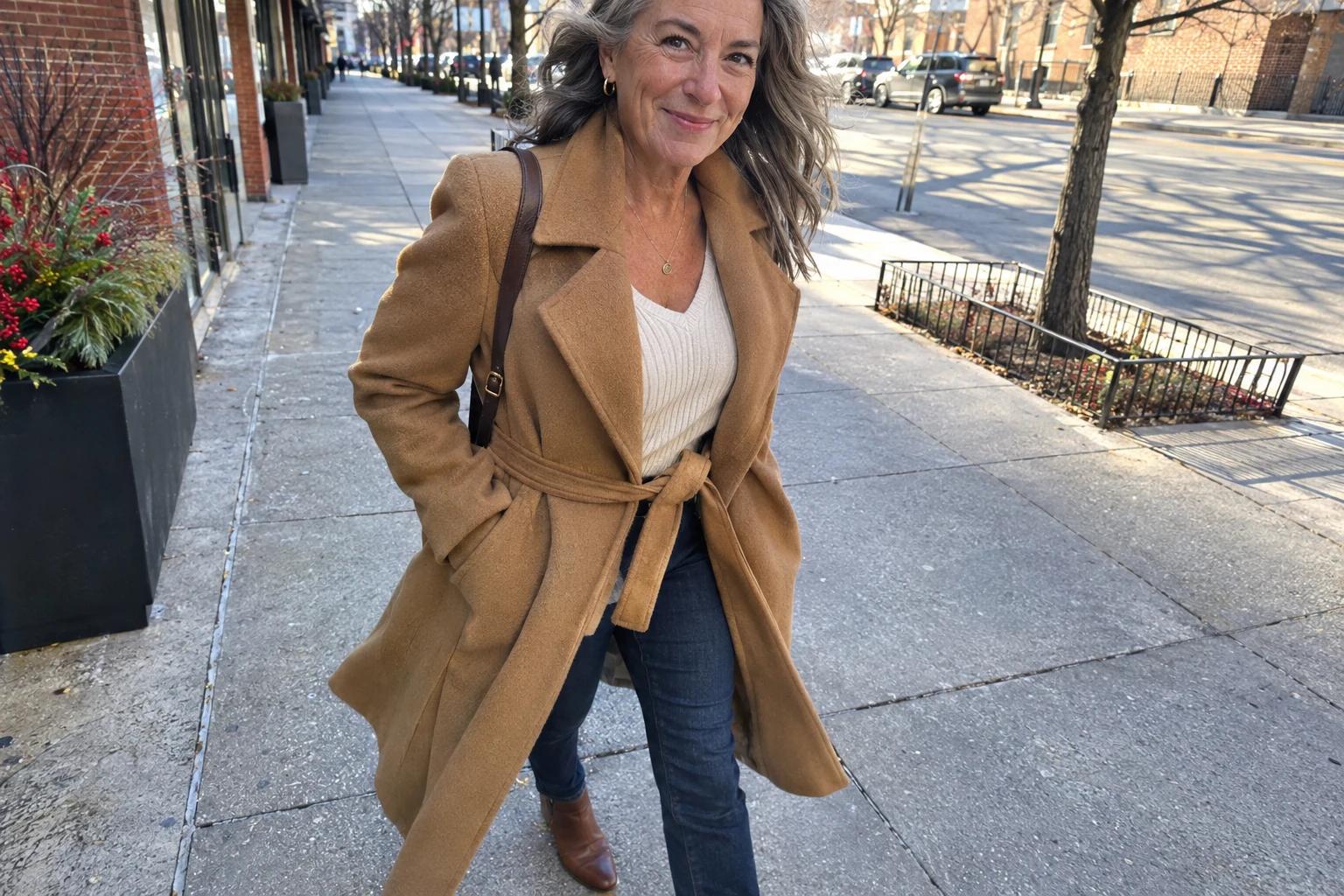
For a turkey neck, the best choices are a mock neck, a soft cowl neck, a higher neckline that sits slightly away from the skin, or a collar worn up. Loose, hanging skin is the change that clothing helps with most every day, because so little else reaches it.
Dermatologist Dr. Sam Ellis says it plainly:
"Every single product and every single procedure I've talked about up until this point does not help with a waddly turkey neck." Dr. Sam Ellis, board-certified dermatologist, on YouTube
In the same video, Dr. Ellis says only a neck or lower-face lift fixes it. The American Academy of Dermatology (AAD) agrees that with lots of sagging skin, skin-tightening "may not be helpful," and that a cream "cannot penetrate the skin deeply enough." That makes a good collar the sensible everyday answer.
These are the necklines that work for loose skin:
- The mock neck. Boland calls it "a shorter version of the turtleneck" that gives "coverage without overwhelming your face" and is "easier to wear with jewelry." It's the one I'd buy first.
- The cowl neck. She describes it as "soft, drapey, and forgiving." The folds hide the skin and still move the eye down to the chest.
- Higher necklines in general. LaMonte groups "turtlenecks, mock turtlenecks, cowl necks, and higher necklines" together as ways to hide an aging neck and décolletage.
What separates covering from hiding is how close the fabric sits. A neckline with a little air between it and your skin looks like a choice. A tight band looks like you're holding something in.
Fullness under the chin needs one adjustment. A big, thick cowl adds width right under the jaw, which is exactly where you don't want it. For that change, choose a structured collar or a fine-knit mock neck and let a long necklace or the ends of a scarf supply the vertical line.
Open necklines that frame lines and crepey texture instead of hiding them
If your concern is lines or crepey texture, rather than loose skin, you don't need to cover much at all. Boland's view is that while turtlenecks work for some people, cowl necks and open V-necks are often the better choices for drawing attention away from the neck.
- V-neck: the most reliable choice. A V that ends just above the bust makes a long line that the eye follows.
- Scoop neckline: softer than a V and kind to a rounder face. A deeper scoop does more than a shallow one.
- Open cowl: draped low, it frames rather than covers.
- Boat neck: a wide line across the collarbones. It suits lines and texture and does less for fullness under the chin, since it's a horizontal line.
- Tie-neck blouse: keep the bow loose and low, so the tails hang down like a scarf's.
Choose a fabric that skims the skin rather than clinging to it.
How do you wear a shirt collar turned up?
The upturned collar, also called a popped collar, began as sun protection. René Lacoste designed his tennis shirt in 1929 with "a thick piqué collar that one would wear turned up to block the sun from one's neck skin." A collar that covers the sides of your neck and leaves the front open is still one of the best fixes for blotchy sides.
Robin LaMonte recommends the popped collar and starches her collars so they stay up. Here's how I'd do it:
- Start with a collar that can stand. You need a shirt with a collar stand, the narrow band the collar folds over, or a firm piqué polo. A soft, washed-out collar will flop however much you fuss with it.
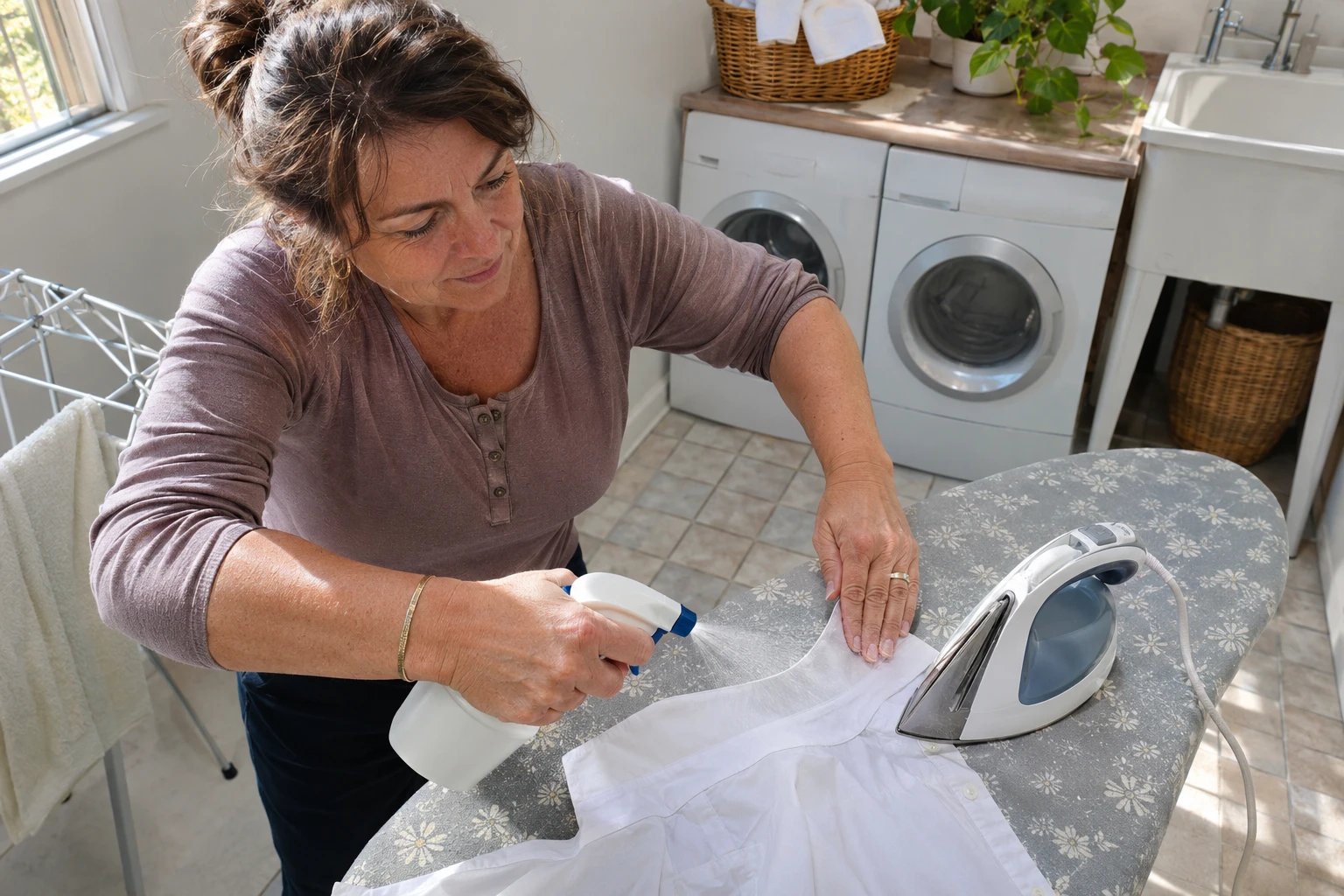
- Starch the underside. Spray the inside of the collar, iron it flat, then fold it up along its natural line.
- Open one or two buttons. The collar then frames an open V instead of closing around your throat, so the front opens and the sides stay covered.
- Fold the points back if it looks stiff. Letting just the tips turn down softens it for a dinner rather than a golf course.
If your shirts never quite look right, check the collar before you blame your neck. A collar that's too small pinches, and a pinched collar makes any neck look fuller.
Turtlenecks and chokers: when do they help and when do they backfire?
Fit decides it. Boland is direct: "A snug, traditional turtleneck rarely hides what you want it to. In fact, it usually does the opposite."
The mock turtleneck fixes most of that. It's shorter and usually looser. If you love the look of a turtleneck, buy a fine-gauge mock in a soft knit and see how it sits.
High necklines don't suit everyone. A Gransnet commenter wrote, "I look ridiculous in high necklines." If that's you, go back to the open necklines in the previous section and add a scarf when you want more cover.
There's also a sun argument for a high neck. The Skin Cancer Foundation says "the more skin you cover (high neck, long sleeves, pants), the better." For sun blotches on the sides of your neck, a mock neck in dense fabric works as both a style choice and sun protection.
Chokers are an easy decision. LaMonte's advice is "Avoid chokers and short necklaces," and I agree. A choker sits at the base of the neck and points straight at it.
Which scarves drape well and don't make you sweat?
The scarf that works best is long, light and wrapped loosely once. A Gransnet commenter recommends "A fairly long silk scarf just wrapped once around the throat," and that's the one I'd reach for too. Boland likes a lightweight scarf because "you can adjust it if you get too warm."
Scarves aren't only for summer. Dermatologist Dr. Andrea Suarez, known online as Dr Dray, points out that a scarf shields you in winter too: "you can still get a lot of sun even if it's cold out." The best scarves to hide turkey neck skin are the same ones that block sun: long enough to drape, light enough to forget about, and dense enough that you can't see through them.
How to hide your neck in the summer without overheating
In summer, the advice to stay cool and the advice to stay covered pull in different directions. You can satisfy both if you choose your fabric carefully.
Heat is the first concern. The CDC's heat advice is to "wear loose, lightweight, light-colored clothing and sunscreen." It lists older adults among the people at higher risk of heat illness, so on a hot day, take the scarf off as soon as it makes you hot.
Plenty of people have been there. A Gransnet commenter wrote that she would "turn beetroot and pour with sweat cos the damn scarf is so big and makes me hot." That's what an oversized scarf in July does.
The best summer choice is loose and light in weight but tightly woven. A collared shirt in a dense, mid-toned fabric worn open over a tank top covers the sides of the neck and lets air in at the front. A UPF label, explained below, tells you the shirt blocks sun even when it's thin. A thin white cotton tee isn't much protection: the University of Arizona Cancer Center says it probably lets through about a fifth of the sun's UV.
Which fabrics actually protect a wrinkly or sun-damaged neck?
For sun damage, the fabric matters more than the neckline. A collar made of lace covers your neck and still lets the sun through.
DermNet lists which fabrics protect well and which don't, and the AAD adds lace and other open weaves to the weaker side:
| Protects well | Protects less |
|---|---|
| Blue or black denim | Bleached cotton |
| 100% polyester | Viscose |
| Merino wool | Lace and other open weaves |
| Satin-finish silk of any weight | Anything you can see through |
Two points from that table change how I shop. First, satin-finish silk protects at any weight, so a light silk scarf can cover sun blotches. Second, viscose offers weaker sun protection, so for sun blotches a polyester or merino cowl does both jobs.
How much sun does a collar or scarf really block?
It depends on the fabric, and the difference is bigger than most people expect. We took the AAD's own clothing figures, a white T-shirt at about SPF 7 and a long-sleeved denim shirt at about SPF 1,700, and worked out how much of the sun's burning rays gets through each one. We compared that with SPF 30 sunscreen, which the AAD says blocks 97% of those rays.
| What covers your neck | AAD figure | Sun getting through |
|---|---|---|
| SPF 30 sunscreen | Blocks 97% | About 3% |
| Thin white T-shirt fabric | About SPF 7 | About 14% |
| Long-sleeved denim | About SPF 1,700 | About 0.06% |
A thin white cotton collar lets through nearly five times as much sun as SPF 30 applied properly. Dense, dark fabric lets through so little that it's barely measurable. The AAD's figures are for shirts. It's our judgment that a thin, light scarf behaves like the T-shirt and a dense, dark one more like the denim.
Stretch matters too. Dr. Valencia Thomas, who directs MD Anderson's Mohs Center, says "dry, tightly woven, dark-colored fabrics offer the most protection." Her example is dark biking shorts, which "start out at about UPF 85 before the material is stretched, and UPF 8 when worn." A snug knit pulled tight around the neck may lose protection in a similar way, though her figures are for biking shorts.
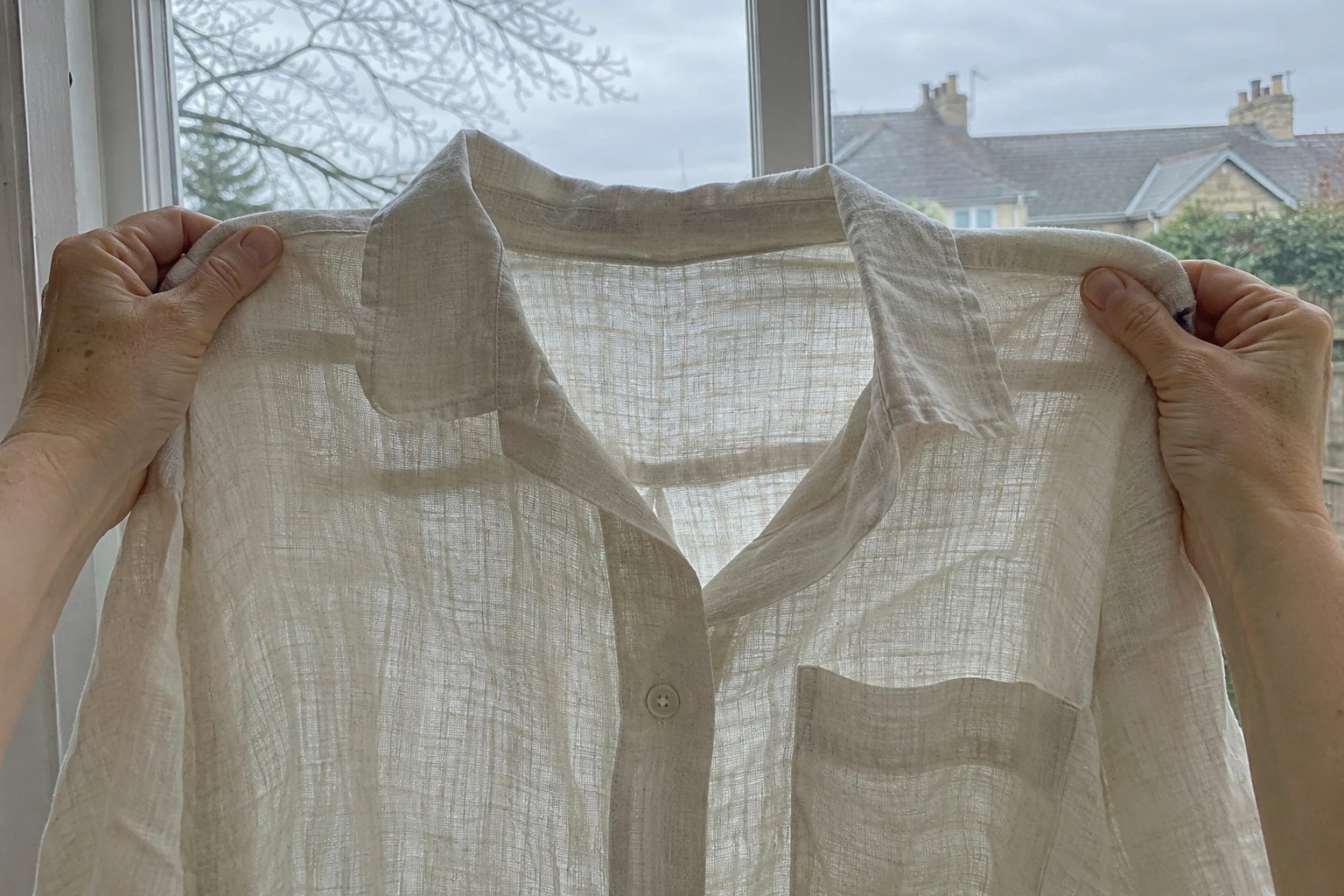
You don't need a label to check a scarf you already own. The University of Arizona Cancer Center's test is simple: "Hold your item up to the light", and if you can't see through it, it's a good choice.
If your favorite collars are thin white cotton, there's a laundry option. UCSF says the additive SunGuard (Tinosorb FD) can raise a white cotton T-shirt "from SPF 5 to SPF 30." It isn't permanent: the maker says one treatment lasts up to 20 washings, and in 2026 a 1 lb pouch sells for $29.99 on SunGuard's own site.
How do you protect the back and sides of your neck?
Cover the sides and the back first, because that's where sun damage shows most. Dermatologist Dr. Daniel Sugai says the red and brown blotching he sees on the sides and back of the neck leaves the skin under the chin untouched, and is hard to reverse with skincare alone once it sets in. Dr Dray adds that "some people develop very prominent deep wrinkles on the back of their neck related to sun exposure."
A V-neck does nothing for any of that. These do:
- A collar with height at the back. A shirt collar, a stand collar or a mock neck covers the nape. DermNet recommends tops with "high collars or necklines."
- A hat with a real brim. The Skin Cancer Foundation recommends a brim of "three inches or more" all the way around to shade the face and neck. The AAD says to avoid baseball caps and straw hats with holes.
- A scarf with a hat that has no brim. DermNet says "a scarf can protect the vulnerable neck if a non-brimmed hat is worn."
If you're outdoors a lot, Dr. Sam Ellis suggests a neck gaiter or bandana for tennis, golf or hiking, and keeping one in the car or your sports bag. The reason: "Things rub on the neck and they can rub off your sunscreen." Dr. Ellis also notes that covering up has become ordinary: "It's less of a social or like fashion taboo to wear sun protective clothing."
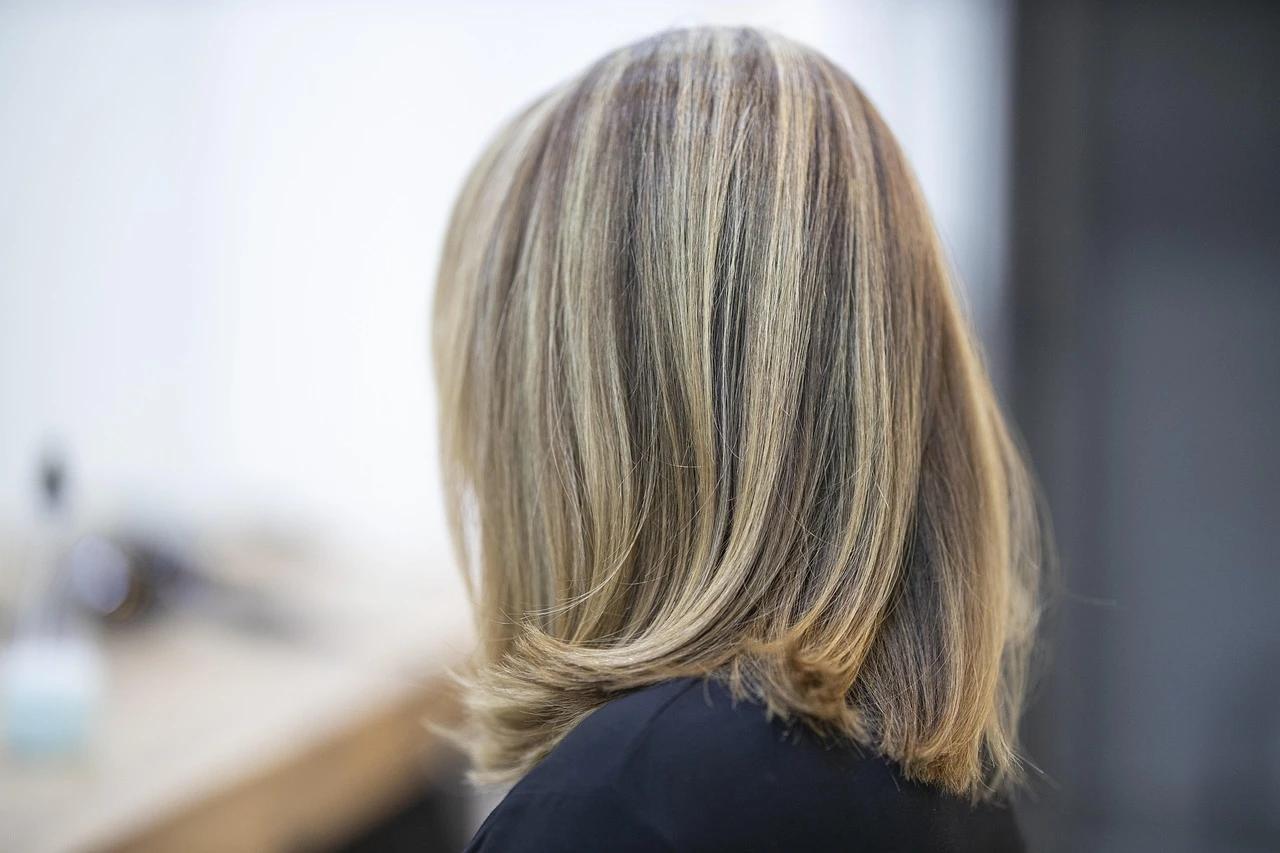
Matching your haircut to your collar for how you look from the side
This is the view you never see. People see you from the side across a table, in the passenger seat or in line at the pharmacy. From there, your hair and your collar work together.
Justin Hickox, a hairstylist who has been cutting hair professionally since 1995, explains the hair half of it in a video on cuts. His point is that a style should be judged by where it sends the eye of the person looking at you, and the eye goes to where the hair is fullest. Weight at the bottom of a cut pulls attention down to the jaw and neck. A blunt bob ending right at the jaw puts the focus on the jawline. He suggests starting front layers at the cheekbone instead of the chin. He also advises against very short cuts that leave the neck bare, and says some softness coming forward around the jaw draws the eye up when people see you from the side.
He's talking only about hair. Applying it to collars is my own reasoning, and it's how I'd pair them:
- Blunt bob at the jaw: keep the neckline open and low. A high collar plus a jaw-length edge makes two lines meeting at the jaw, which boxes in the neck.
- Short, close cut: this is where a collar or mock neck helps most. It covers what the cut shows, especially at the back.
- Long hair worn down: it already covers the sides, so an open V-neck is enough. Once you wear it up, the back of your neck is uncovered, so add a collar.
- Layers starting at the cheekbone: these lift the eye on their own, so you can choose almost any neckline.
To check it at home, take a phone photo of yourself from the side in the top you plan to wear.
Which necklace lengths pull the eye away from your neck?
Choose 28 inches or longer. LaMonte's rule is a necklace that finishes on or below the breastbone, and on Blue Nile's length chart that's roughly opera length or longer.
| Length name | Inches | Where it falls |
|---|---|---|
| Choker | 14 to 16 | Snug around the base of the neck |
| Princess | 17 to 19 | Just below the collarbone |
| Matinee | 20 to 24 | Upper chest |
| Opera | 28 to 34 | To the breastbone or lower |
| Rope | 35 and up | Longer than opera |
Opera and rope lengths do the most for loose skin and fullness under the chin, because the pendant pulls the eye straight down. A princess length works with a V-neck if your concern is lines, since it sits below them. Skip the choker for the reasons in the turtleneck section.
How should men over 50 cover the neck?

Men have long had the best tools for this, even if nobody calls them neck coverage. The upturned collar started on Lacoste's men's tennis shirt, designed to keep the sun off the neck.
AARP's wardrobe guide for men recommends a Banana Republic Factory Lightweight Mock-Neck Jacket, with "a high zip-up collar," for men in their 50s. For men in their 60s, it suggests a Lands' End quarter-zip with "a stand collar." Neither is meant to hide anything. They're simply good clothes that happen to cover the throat and the back of the neck. A quarter-zip with a stand collar is about as ordinary as menswear gets.
For a man, I'd put these at the top of the list:
- A quarter-zip or half-zip in merino, worn zipped up partway. It covers the sides of the neck and leaves the front open.
- A polo with a firm collar, starched and worn up in the sun, as Lacoste intended.
- A crew-neck knit over a collared shirt, which covers two layers deep at the back of the neck.
- A brimmed hat outdoors, since a baseball cap leaves the back of the neck exposed.
How do you keep sunscreen, makeup and perfume off your collars?
Collars that touch your neck all day will pick up whatever's on it. These are the three problems I'd fix first.
Sunscreen stains. CBS News reported in 2024 that avobenzone, a chemical sunscreen filter, can react with iron in hard water and turn clothes orange. Mineral sunscreens don't contain it. Stain expert Mary Gagliardi's steps for getting the stain out:
- Pretreat with liquid dish detergent for 5 minutes.
- Apply a nonbleach stain remover for 10 minutes.
- Wash in warm water.
- Air-dry, and repeat if the stain is still there.
Two habits prevent most of it. Dr. Daniel Sugai recommends untinted sunscreen on the neck: "tinted sunscreens ruin clothes. They've ruined so many of my white shirts." And since the AAD says skin takes about 15 minutes to absorb sunscreen, put it on before you get dressed, not after.
Foundation on the neck. I'd leave it off. A woman in r/AskWomenOver60 described what it did to her new wrinkles: "The foundations just seem to sink in and highlight them."
Perfume. Spray it on your wrists, and keep it off your neck and off any scarf or collar that touches it. DermNet notes that fragrance can reach your skin indirectly through clothing, and that light acting on perfume on the skin can set off a reaction. DermNet links perfumes to the sun discoloration on the sides of the neck and advises: "Avoid all perfumes on or near the affected area." Dr Dray says it in fewer words: "consider spraying your perfume elsewhere, not on your neck."
The bottom line
Start with the mirror. Decide whether you're dressing for lines, loose skin, fullness under the chin or blotches on the sides, and buy for that change.
If it's loose skin, buy one soft mock neck in a fine knit and wear it with an opera-length necklace. If it's lines, wear the V-necks you already own and add a longer pendant. If it's sun blotches, choose a collar that covers the sides and a fabric you can't see through when you hold it up to the light. If it's fullness under the chin, choose a structured collar over a bulky cowl.
Then look at your hair and your hat as well as the top. Ask your hairdresser to look at you from the side, and put on a brimmed hat the next time you're out in the sun.
Up next
14 Steps to a Simple Skin Care Routine for Women Over 60
A short routine built on a real teaspoon of sunscreen, the order things go on, and a straight answer about what no cream can do.
Read the list →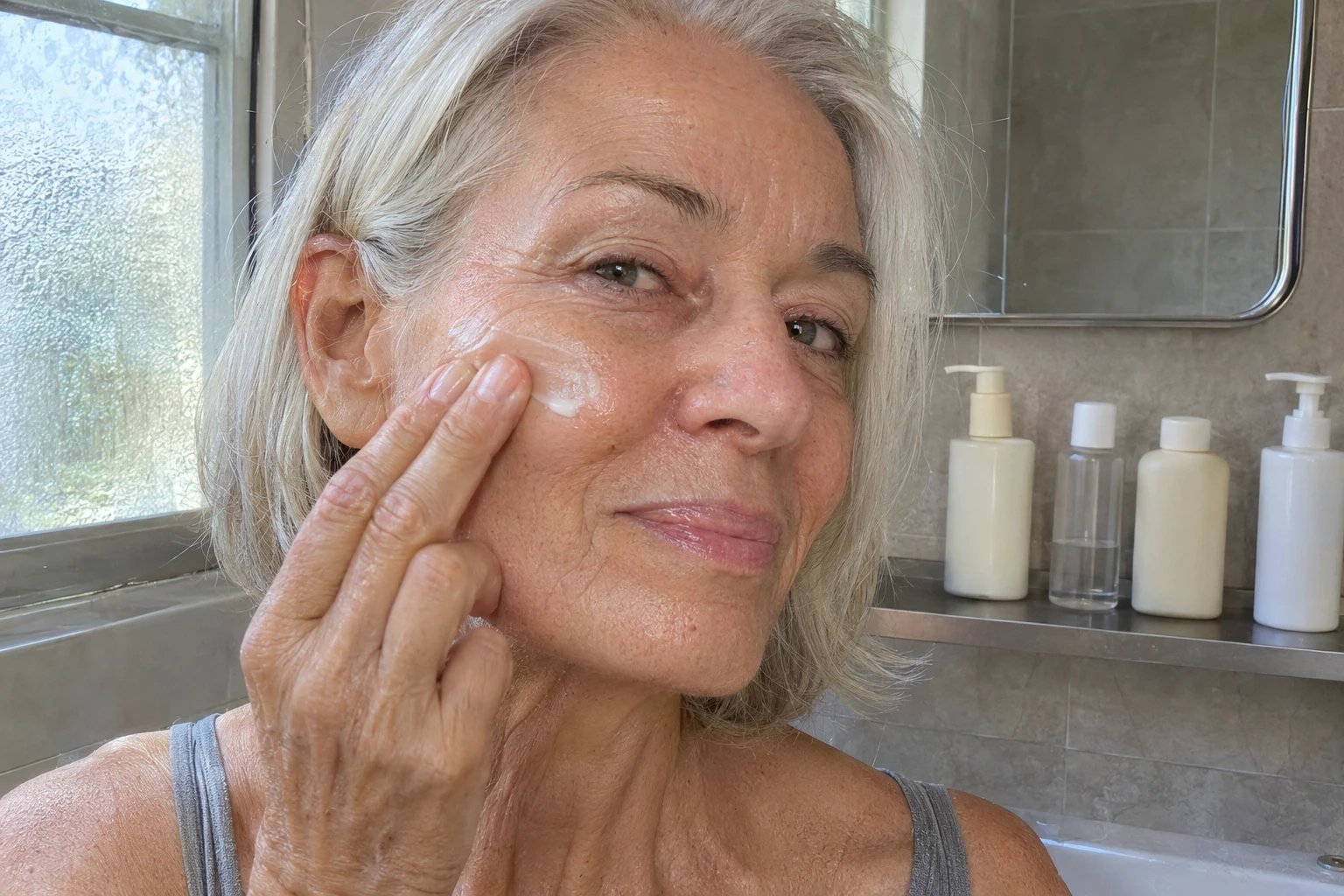

Reader quiz
Did you catch the details?
5 questions from this article.
When wearing a shirt collar turned up, what does the article say to do to the collar's underside?
Questions people also ask
What is the best way to disguise a turkey neck?
A loosely draped scarf, a soft cowl or mock neckline, or an upturned collar is the best way to disguise a turkey neck. Stylist Deborah Boland recommends cowls and mock necks over snug turtlenecks, which she says usually do the opposite. Clothing makes sense here because the AAD says creams can't reach sagging skin, and tightening "may not be helpful" when there's a lot of it.
Can I tighten a saggy neck without surgery?
You can tighten mild sagging somewhat without surgery, but a lot of sagging skin usually needs surgery. The AAD says most people see "modest lifting and tightening within 2 to 6 months" after one ultrasound treatment. The ASPS gives an average neck-lift surgeon's fee of $7,885, which excludes anesthesia and facility fees, so check its page and ask your surgeon for a full quote.
Are turtlenecks good for hiding neck wrinkles?
A soft mock-length turtleneck hides neck wrinkles better than a snug, traditional one. Boland says the snug style "rarely hides what you want it to." For sun, a high neck helps: the Skin Cancer Foundation says the more skin you cover, the better.
How do I hide my neck in the summer?
Choose a loose, lightweight top that's also tightly woven or labeled UPF 30 or higher. The CDC advises loose, lightweight, light-colored clothing in heat. Thin, airy cotton feels cool but blocks far less sun: the University of Arizona Cancer Center says a thin white tee lets through about a fifth of the sun's UV.
Does wearing a scarf make it obvious you're hiding your neck?
In my experience, a scarf wrapped loosely once around the throat reads as a style choice, while a tight knot or an oversized scarf looks more like cover. On Gransnet, one commenter recommends "a fairly long silk scarf just wrapped once around the throat," another says an oversized scarf made her "pour with sweat," and a third says "no one except you minds your wrinkly neck."
Do I need to wear sunscreen on my neck if it's covered?
You only need sunscreen on skin left uncovered, as long as the fabric covering your neck actually blocks the sun. MD Anderson's Dr. Valencia Thomas says "the current recommendation is to apply sunscreen only to exposed skin." A dry, tightly woven fabric that you can't see through counts as covered. A thin white T-shirt rates only about SPF 7, so under a thin collar, keep the sunscreen on.
Did any of these feel familiar?
Know someone who needs this?
 Prime Journal · Free printable
The Closet Fit and Color Checklist
- A clearer view of colors beside your face.
- Clothes that pass the sitting and walking test.
- Shoes and repairs checked before anything gets replaced.
Free printable: The Closet Fit and Color Checklist. Enter your email and it is yours.
Sources cited in this article
This article links to 37 outside sources, listed here so you can read them yourself.
- Cleveland Clinic lists the neck's changes health.clevelandclinic.org/the-best-skin-care-ingredients-for-your-neck
- American Society of Plastic Surgeons www.plasticsurgery.org/cosmetic-procedures/neck-lift
- DermNet says it dermnetnz.org/topics/poikiloderma-of-civatte
- Horizontal necklace lines are partly genetic www.youtube.com/watch?v=G5suYJw9-oM&t=0s
- Reddit thread about neck lines www.reddit.com/comments/1txcgn5
- "No one talks about the neck until it's suddenly talking back." www.tiktok.com/@drjennyliu/video/7648924853059292430
- Gransnet forum www.gransnet.com/forums/style_and_beauty/1226228-Hiding-a-wrinkly-neck
- "I find putting my glasses on top of my head before going in the bathroom works great." www.reddit.com/comments/1ifc67s
- "I'm 50 and really not sure when this happened. I hate my neck." www.reddit.com/comments/j755bj
- American Thyroid Association says www.thyroid.org/thyroid-nodules
- "important for your doctor to palpate and evaluate any unusual or long-lasting lumps or nodules around your neck." www.cedars-sinai.org/stories-and-insights/healthy-living/when-to-worry-about…
- Cowl necks "draw the eye to your chest rather than your chin." www.fabulousafter40.com/turtlenecks-or-more-like-turkey-neck
- Longer statement necklaces "finishing on or below the breastbone will draw the eye downwards away from your neck." helloim50ish.com/fashion-over-50-2-ways-to-hide-the-aging-neck
- On YouTube www.youtube.com/watch?v=yHOeFO9VE9I&t=856s
- American Academy of Dermatology (AAD) www.aad.org/public/cosmetic/younger-looking/firm-sagging-skin
- René Lacoste designed his tennis shirt in 1929 en.wikipedia.org/wiki/Upturned_collar
- Skin Cancer Foundation says www.skincancer.org/skin-cancer-prevention/sun-protection
- A scarf shields you in winter too www.youtube.com/watch?v=DlWCzY1ckes&t=244s
- CDC's heat advice www.cdc.gov/climate-health/php/resources/protect-yourself-from-the-dangers-o…
- UCSF Health says www.ucsfhealth.org/health-articles/protective-clothing-for-skin-cancer-preve…
- DermNet puts dark clothing dermnetnz.org/topics/sun-protective-clothing
- University of Arizona Cancer Center says cancercenter.arizona.edu/research/skin-cancer-institute/skin-cancer-preventi…
- AAD adds lace www.aad.org/public/everyday-care/sun-protection/shade-clothing-sunscreen/wha…
- AAD says blocks 97% www.aad.org/media/stats-sunscreen
- "dry, tightly woven, dark-colored fabrics offer the most protection." www.mdanderson.org/cancerwise/7-things-to-know-about-upf--sun-protection-and…
- SunGuard's own site www.sunguarduv.com/shop/category/sunguard-250
- Leaves the skin under the chin untouched www.youtube.com/watch?v=6vqI1mnho_Y&t=123s
- A neck gaiter or bandana www.youtube.com/watch?v=yHOeFO9VE9I&t=367s
- A video on cuts www.youtube.com/watch?v=GOuDkBf6CmA&t=495s
- Very short cuts that leave the neck bare www.youtube.com/watch?v=GOuDkBf6CmA&t=866s
- Blue Nile's length chart www.bluenile.com/blog/fashion/necklace-length-chart
- Wardrobe guide for men www.aarp.org/entertainment/beauty-style/mens-wardrobe-updates-by-decade
- React with iron in hard water www.cbsnews.com/news/sunscreen-orange-clothing-stains-avobenzone
- "tinted sunscreens ruin clothes. They've ruined so many of my white shirts." www.youtube.com/watch?v=6vqI1mnho_Y&t=61s
- AAD says www.aad.org/public/everyday-care/sun-protection/shade-clothing-sunscreen/how…
- DermNet notes dermnetnz.org/topics/consort-allergic-contact-dermatitis
- That light acting on perfume on the skin dermnetnz.org/topics/photocontact-dermatitis
Irina Byalik
Style Editor
Irina Byalik is a hairdresser and the owner of New Image Hair Salon in East Brunswick, New Jersey, with more than 20 years of experience. She came to the United States from Ukraine.
More from Irina Byalik