



17 Europe Vacation Outfits Over 50 for Walking All Day
Seventeen ways to dress for a 20,000-step day in Europe, from the sole that grips wet cobblestones to the trousers that pass at dinner, all packed into one carry-on.

By Irina Byalik, Style Editor
Updated · 23 min read
- Written by our style editor
- Cited 50 sources
- How we review
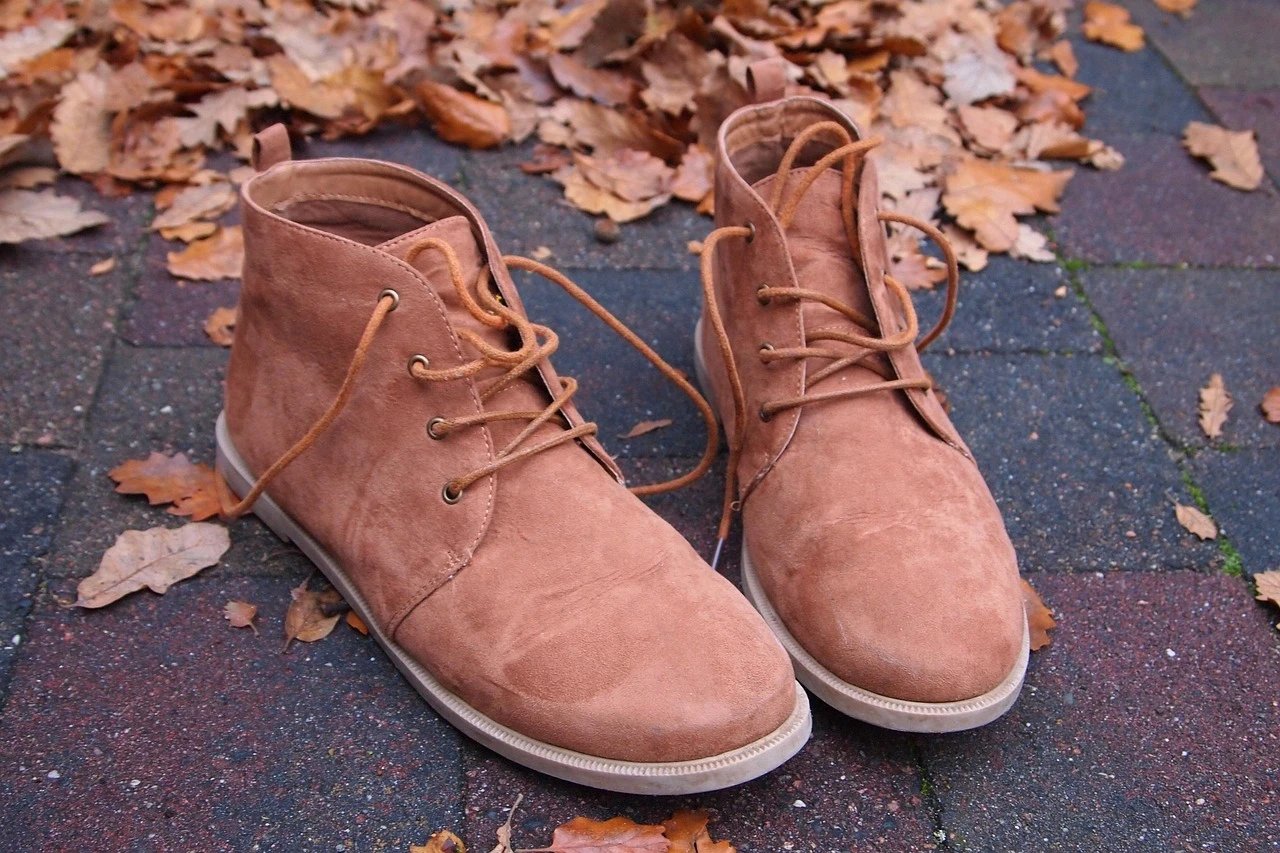
Several travelers say the real giveaway isn't your shoes. That's at #1.
It's half past eight in a little trattoria off a Roman piazza. The bread basket has just landed, and under the tablecloth you've eased one heel out of your shoe. Nobody can see your feet. They can see whether you look like you belong at that table, and you settled that at nine this morning, when you dressed for a day of walking. Good Europe vacation outfits for women over 50 who walk all day start at the sole and finish at dinner.
17Clean leather sneakers with wide-leg trousers
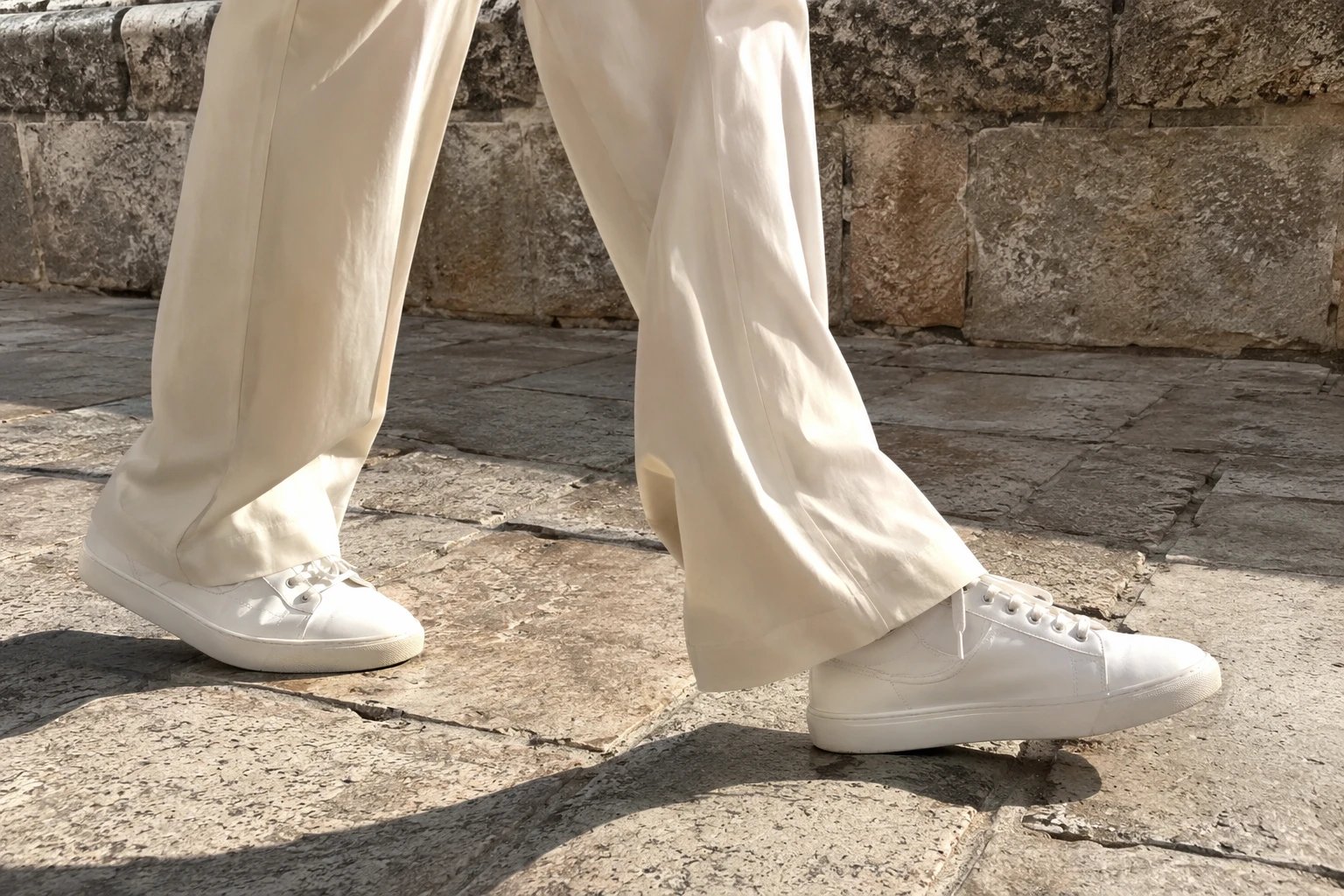
Start with this pair. It will carry more of your trip than anything else in the bag.
Pick a plain leather sneaker in white, cream, tan or black, and wear it under wide-leg trousers that cover about half the shoe. Together they look like a choice, not a compromise. A Rome guide written for Americans draws the line plainly: sneakers are fine "if they're clean and stylish (Italians wear them), less so if they're clearly athletic trainers with shorts."
So the outside should look ready for lunch, and the inside should be built like a travel shoe. Podiatrist Dr. Priya Parthasarathy, a spokesperson for the American Podiatric Medical Association, told SmarterTravel that healthy travel shoes need "arch support, a thicker sole, and shock absorption." In the store, I press a thumb into the heel. A fashion sneaker with a sole as thin as a sandal's fails that test however pretty it is.
Then there's the distance. A tour company that plans European trips for travelers 50 and up rates very active city days in Paris or Rome at 15,000 to 20,000-plus steps. It says a Paris-and-Versailles day can "approach or exceed 20,000 steps." At roughly 2,000 to 2,500 steps a mile, 20,000 steps comes to about 8 to 10 miles.
That's why you break in your shoes at home. The same guide is blunt: "Never rely on brand-new shoes for your first European sightseeing day." It suggests walking on back-to-back days, with hills or stairs added if your trip has them. Work up to one practice walk of 8 to 10 miles. Then you'll learn at home whether these comfortable walking shoes rub at mile three or mile nine, while you can still swap them.
A pair bought the week you fly gets broken in on the cobblestones.
16A midi dress worn with sneakers
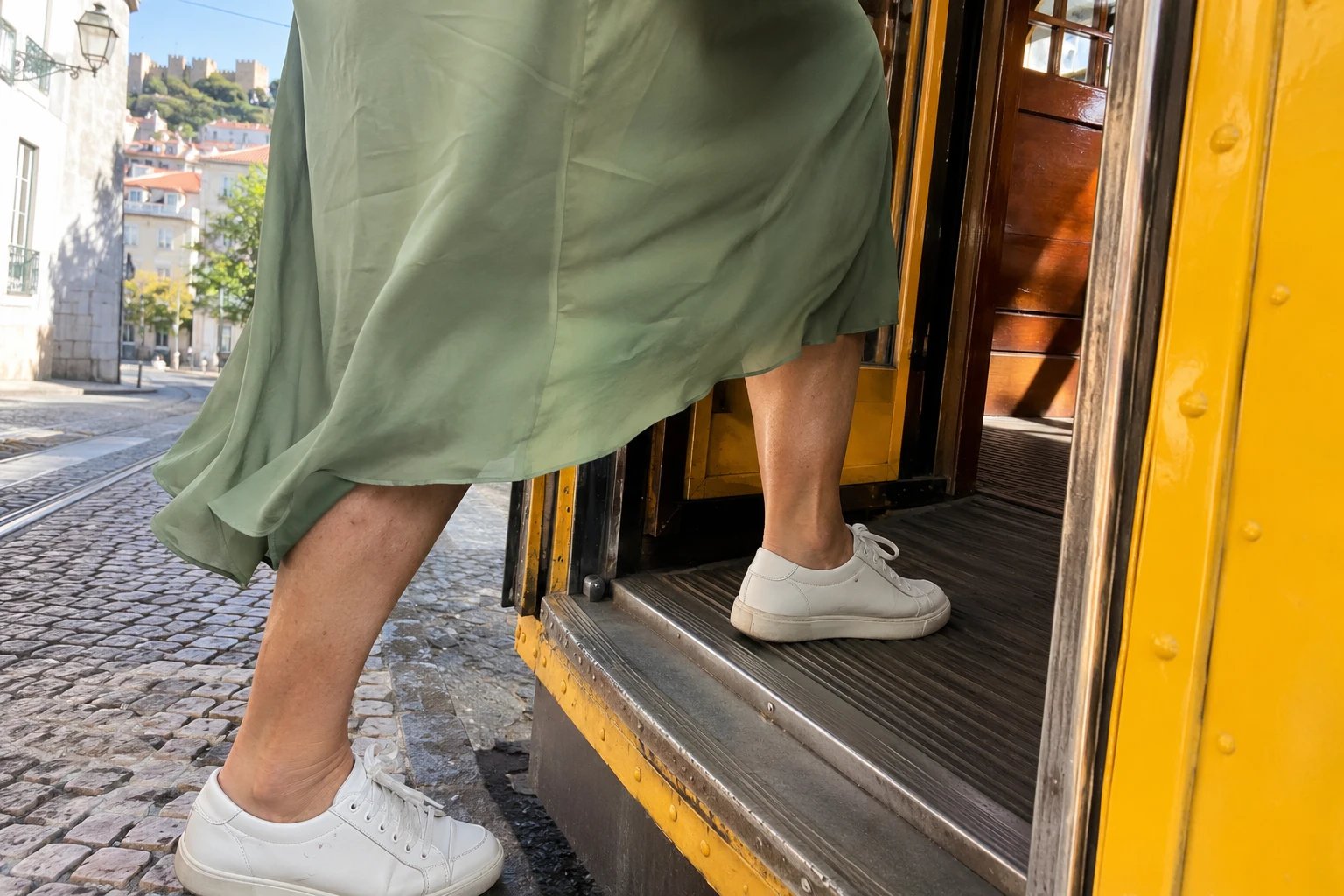
The tram doors fold open. The step is higher than any curb at home, a bag hangs off one shoulder, and a dress is swinging around your ankles.
A midi dress with sneakers is one of the most comfortable outfits you can pack, and that step is where you choose its length. Pick a hem that neither hand ever has to hold.
Dr. Samantha Ing, an internist at UChicago Medicine, tells people at home to "avoid long robes, baggy pants and any items with long threads or dangling cords that could catch on something and cause a fall." She wrote that about hallways and bedrooms, not bus steps. Using it for a travel dress is my own reasoning. If fabric can catch your toe at home, it can catch it on a tram.
Stylist Erin Busbee is a former TV news reporter and producer who founded her styling business in 2009. She says she lived in Spain for six months and has visited more than 30 countries. Her Italy sightseeing shoes are "platform sneakers, closed-toe espadrille sneakers, ballet flats, comfy walking sandals," and she saves platform sandals for nice dinners. Not one of those is a heel.
Before the dress goes in the case, sit down and stand up in it. Then lift one knee as high as a bus step. If your hand reaches for the fabric, keep that one for dinner.
15Covering shoulders and knees at churches
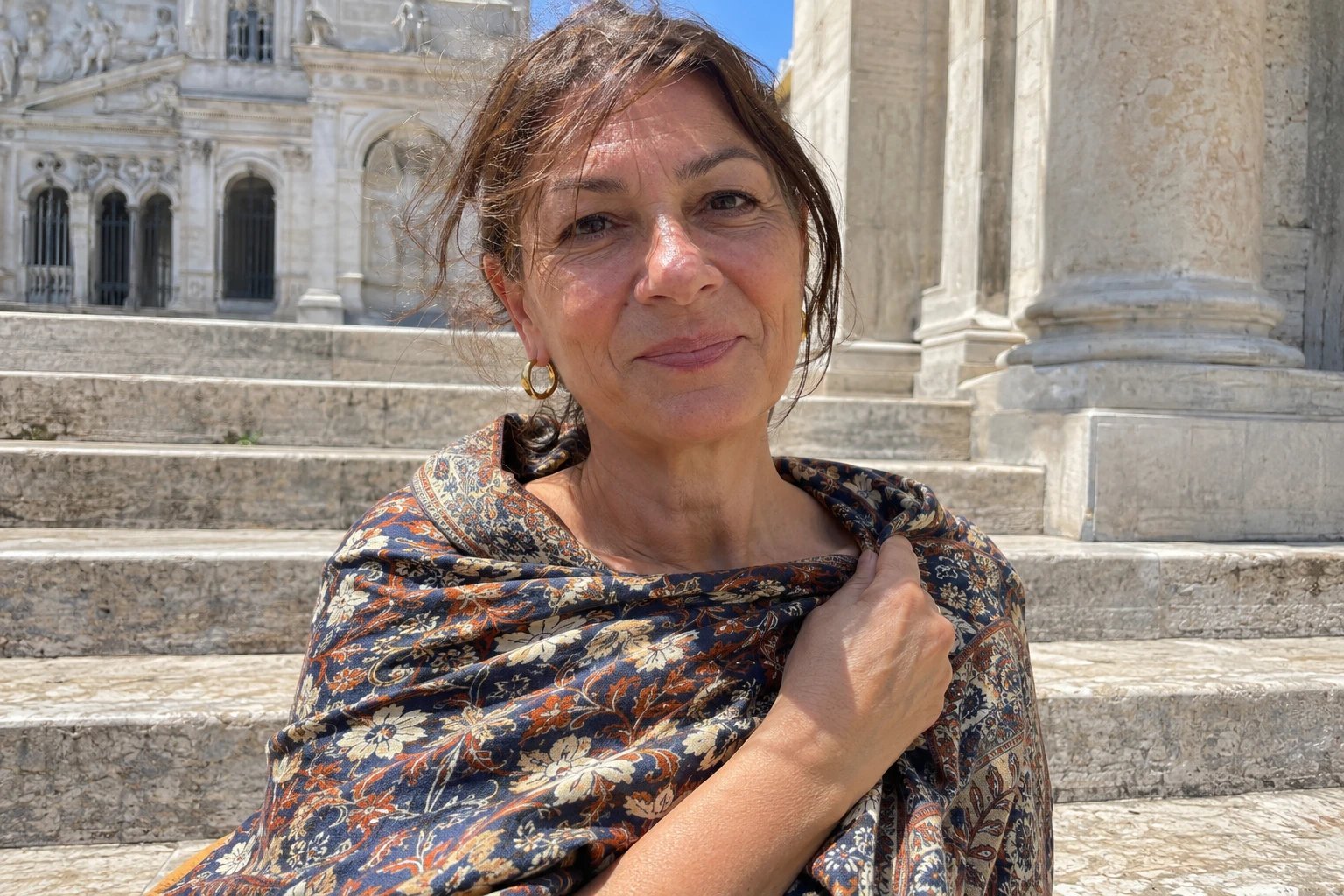
At St. Peter's Basilica in Rome, the rule fits on one line: "Shoulders and knees must be covered." It applies to the climb up the dome too.
The Rome guide for Americans says the rule is "strictly enforced" there and at the Vatican Museums and Sistine Chapel, where "guards turn people away at the entrance." You've stood in the sun for an hour by then, and you get turned back at the very end.
Not every church draws the line in the same place. Sagrada Família in Barcelona asks for less:
- Trousers and skirts reaching at least mid-thigh
- No see-through clothing
- No bare shoulders in the Chapel of the Holy Sacrament
- No hats in the nave or the museum, unless you wear one for religious, health or belief reasons
That last rule catches people. Your sun hat comes off at the door.
The easy answer is a big scarf. Travel writer Rick Steves says rules like these turn up "mostly in southern Europe." He adds that a shawl-size scarf can be "a sweater substitute, head wrap, skirt at a church, or even a blanket on a train."
In Italy or Spain, tie one to your bag strap every morning. Then a sleeveless top won't keep you from the ceiling you flew all that way to see.
14A trench coat and a small umbrella
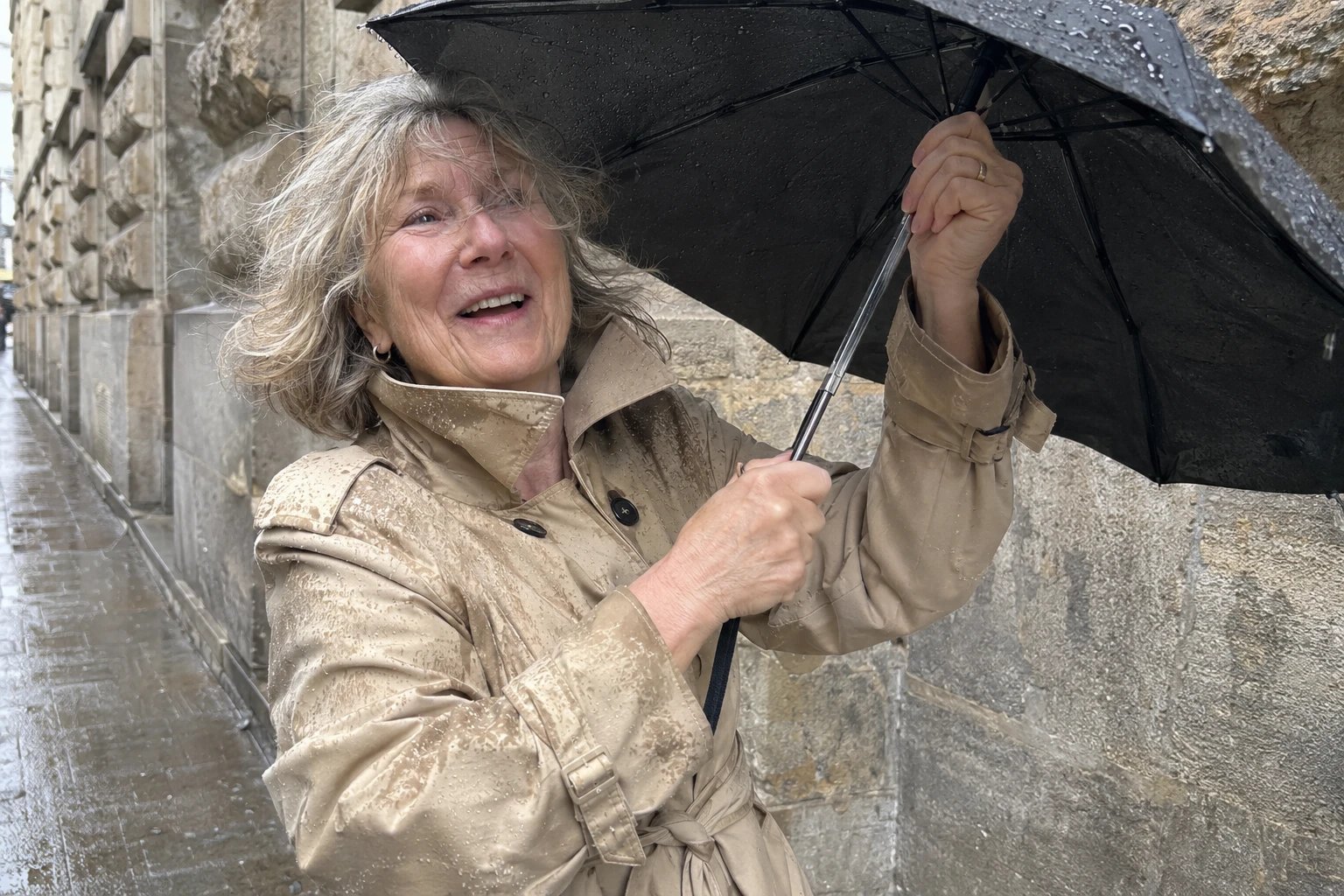
In Paris, spring isn't the dry choice. May brings more rain than October, about 2.7 inches against 2.2, on the same nine or ten wet days a month. London averages about 11 rain days in both October and November, and eight in May.
So in any of those months, expect rain on roughly one day in three or four.
That doesn't mean four jackets. Travelers on Reddit reviewed a 16-day spring packing list that held four jackets and three sweaters, and told its owner to cut back. They argued about whether May would be hot or cold. The most common fix: one light water-resistant layer, such as a trench, plus a small umbrella.
I'd pick a trench over a packable rain jacket for one reason: it can go to dinner. Busbee makes the same swap, trading sporty windbreakers for "an elegant blazer, lady jacket, trench, or cardigan." Add a light cardigan underneath and you have layers for a cold morning.
Pick an umbrella that folds small enough for your day bag, because one back at the hotel won't help you halfway across a bridge.
13Compression socks for swelling, dry socks for blisters
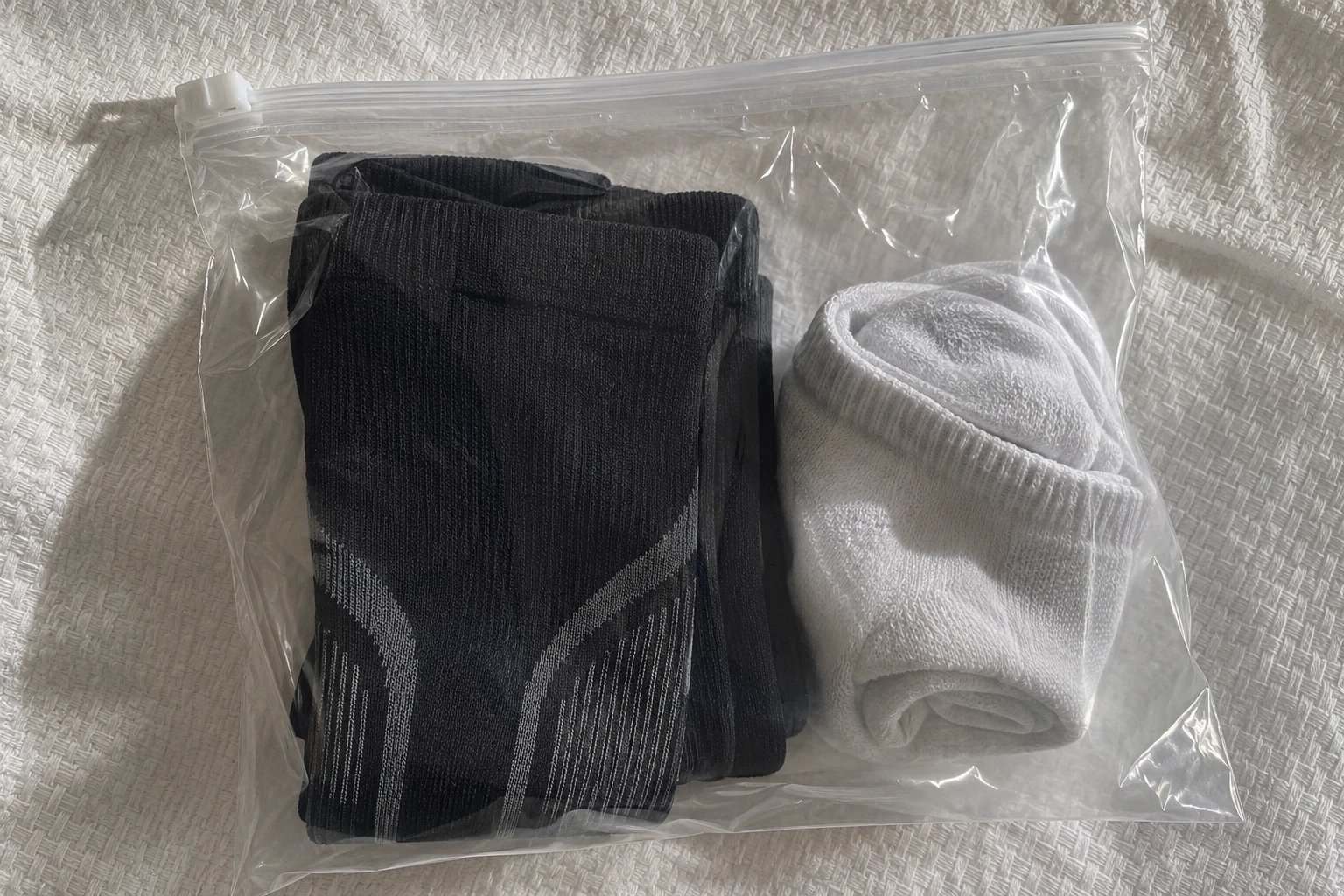
On a long walking day your socks have two separate jobs, and most packing advice blurs them. One is keeping your legs from feeling heavy and puffy by evening. The other is keeping blisters away. Each needs its own fix.
Blisters first, because the answer surprised me. In a study of 203 hikers on Spain's Camino de Santiago, walking in wet socks nearly doubled the risk of blisters. Whether the socks were natural or synthetic fiber made no difference. Being wet did, and the researchers advise changing socks during long stages. Those hikers were mostly younger and on trails, but a damp sock is damp on any pavement.
So carry a fresh pair in a zip bag and change at lunch. It takes two minutes on a café chair.
Swelling is the compression sock's job. Cleveland Clinic cardiovascular specialist Dr. Douglas Joseph sorts them by how hard they squeeze. That's measured in mmHg, the same unit as a blood pressure reading. He says to put them on in the morning, before swelling starts, not at four o'clock once you've noticed your ankles.
12A second pair of walking shoes

Pack two pairs you could walk in all day. One isn't enough, because shoes need time to dry. A podiatry practice puts it plainly: "podiatrists advise rotating pairs so each dries out for at least 24 hours."
Wet shoes dry slower than you'd hope. A shoemaker's drying guide says newspaper stuffed inside takes "a few hours." Even a cool fan half a meter away means "an hour or more."
It also rules out the two shortcuts you'll be tempted by in a hotel room:
- Keep shoes about a meter from the radiator. Too much heat can dry out leather and shrink it.
- Never use a tumble dryer, where "the glue can melt and remove the soles."
Travelers on Reddit who left the backup at home describe the same trip. One rainstorm, or a pair that started rubbing, and they were out of shoes. One one-bag traveler disagrees, saying a second pair is too much unless you're hiking. I side with the first group.
Make the second pair different from the first. If one is a light sneaker, the other can be a darker walker that also goes to dinner. Wear the bulkier pair on the plane and it takes up no room in your bag.
11Carry-on only for twelve to sixteen days
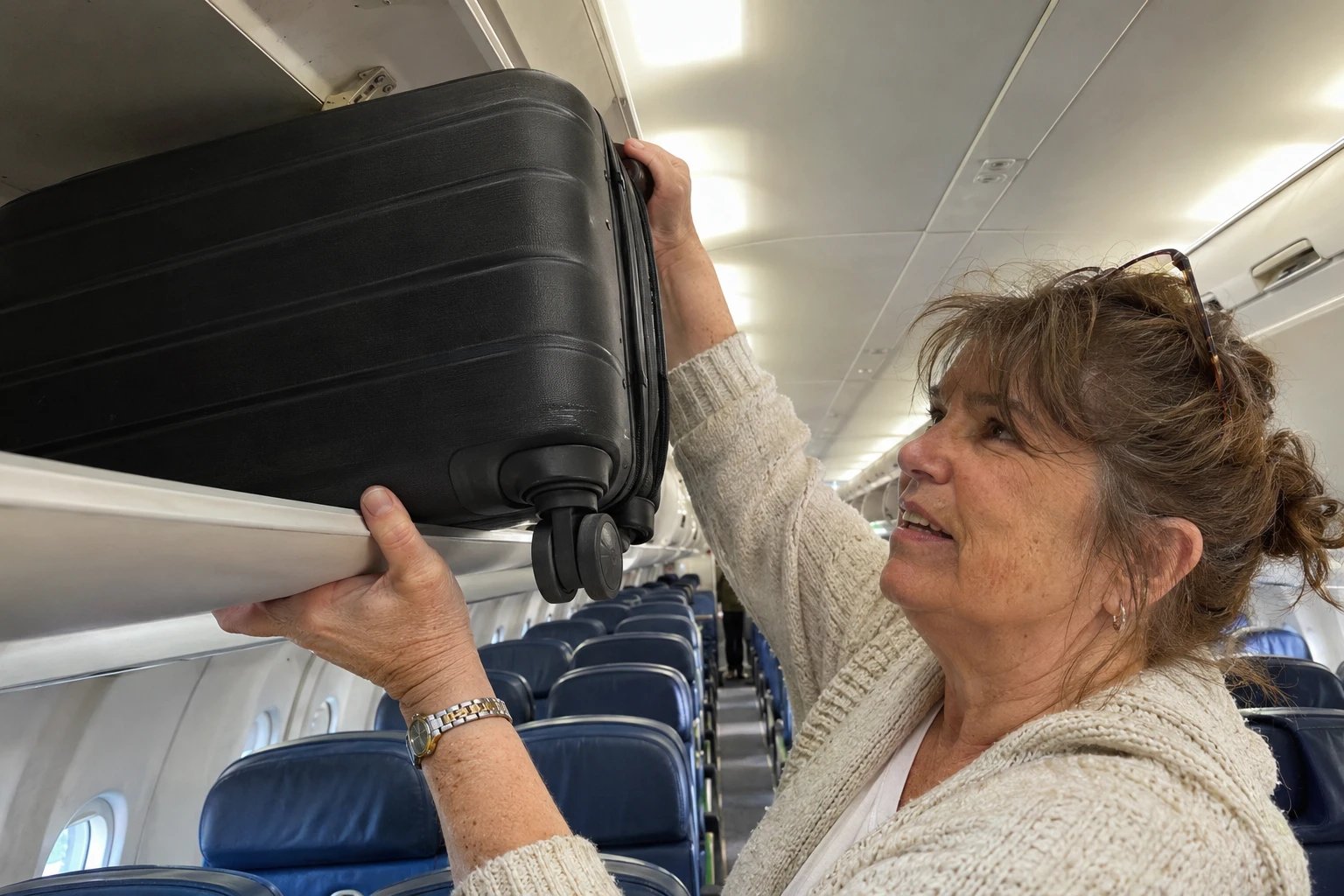
If any leg of your trip is on a European budget airline, check its free bag size before you plan anything else. Carry-on only gets tight there, not on the flight across the Atlantic.
A bag that flies free from New York can be too heavy for the short hop from Frankfurt to Rome, or too big for a budget flight to Lisbon. Here's how three airlines compared in 2026:
| Airline | Carry-on size | Weight limit |
|---|---|---|
| Delta | 22 x 14 x 9 in | None stated |
| Lufthansa economy | About 22 x 16 x 9 in | 8 kg, about 17.6 lb |
| Ryanair free bag | About 16 x 12 x 8 in | Bigger bags cost extra |
On Ryanair, a regular overhead-bin bag of up to 10 kg (22 lb) means buying its priority and two-bag option, which Ryanair says costs €8 to €32 per one-way flight, depending on route and date. Weigh your packed bag on your bathroom scale. Then you'll find out whether it clears 8 kg at home, not at the gate.
Twelve to sixteen days still works, because you aren't packing sixteen outfits. Rick Steves' plan is to "spend 10 minutes doing a little wash every few nights," because lightweight clothing should dry overnight in your hotel room.
So you're packing only a few days of socks and underthings. The rest of the bag is outfits.
See more: 17 Minimalist Outfits Over 50 for a Simple, Stylish Wardrobe →
10A travel-day outfit for landing and sightseeing
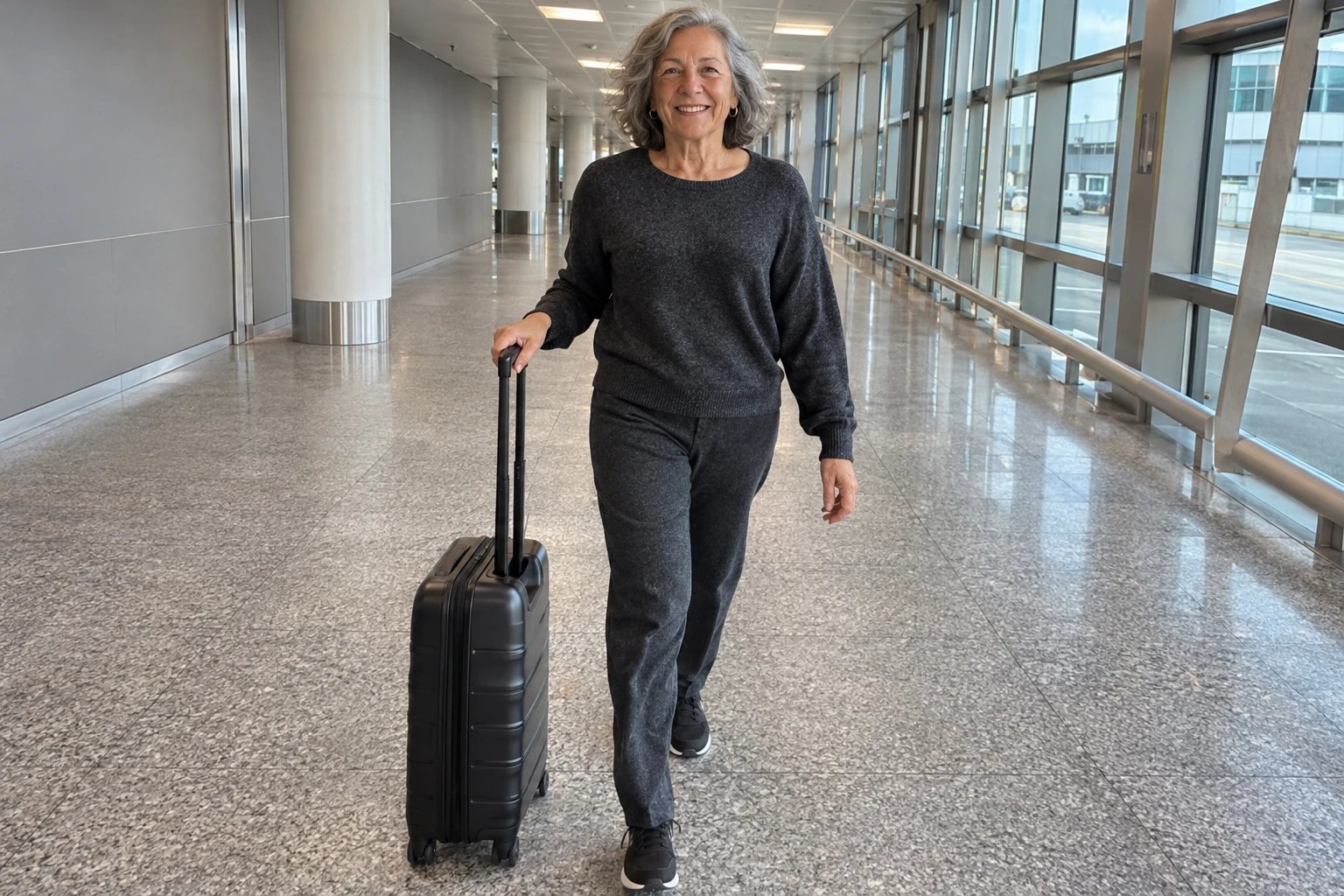
Busbee's travel-day formula fits in six words: "Monochromatic matching sets + sleek sneakers." The sneakers should be ones "that you can run through an airport in if need be."
In practice, that means a soft matching top and pants in one dark color, sneakers you could sightsee in, and the trench over your arm. You land, leave your bag at the hotel and walk straight out into the afternoon.
The long flight comes first, and it carries a risk worth two sentences. The CDC says anyone traveling more than four hours can be at risk for blood clots and lists age over 40 as a risk factor. It advises moving and flexing your calves, and says some people may benefit from graduated compression stockings.
That isn't a small effect. In a review of airline studies on flights of four hours or more, 50 passengers developed a silent clot deep in the leg. Only 3 of them had worn stockings.
A chest physicians' guideline draws the line: if you've had a clot before or are otherwise at higher risk, wear properly fitted, below-knee stockings at 15 to 30 mmHg on long trips, but at average risk it advises against wearing them as routine. Knee-high stockings disappear under wide pants. Check the list in #13 before you buy a pair, then point and flex your feet whenever the seatbelt sign keeps you sitting.
9A dark walking shoe that passes at dinner
You want one shoe that walks eight miles and then sits under a white tablecloth. Travelers on Reddit keep asking for exactly that: black walking shoes that don't read as sneakers. The same thread jokes that most of them look like Grandma's orthopedic shoes. That joke is the worry behind the question.
You can relax. The Rome guide says that at dinner, "Romans tend to look polished; smart-casual serves you well," and it's fine with clean, stylish sneakers. Rick Steves goes further: "I have never felt out of place at symphonies, operas, or plays wearing a decent pair of slacks and a good-looking sweater or collared shirt."
Polished and put together don't have to mean heels. Busbee says so plainly:
"Click clacking along in a stiletto heel would honestly just be a rookie mistake." Erin Busbee, stylist, on what to wear in Europe
A dark shoe helps, because it fades under dark trousers. If the dark pair you love is a loafer, Miami podiatrist Dr. Julie Schottenstein says she wouldn't recommend walking all day in one. If you do, her advice is to avoid flat soles, choose a style with a heel slightly higher than the front, and size and fit it carefully to avoid rubbing. Beyond the shoe, the change from day to dinner happens above the ankle. In my experience, people look at your face and hands long before they look at your feet. Change your earrings, add a scarf, put on lipstick if you wear it.
Keep the earrings in the zip pocket of your day bag, and you can change them in the restaurant's restroom.
8Soles that grip cobblestones and wet stairs
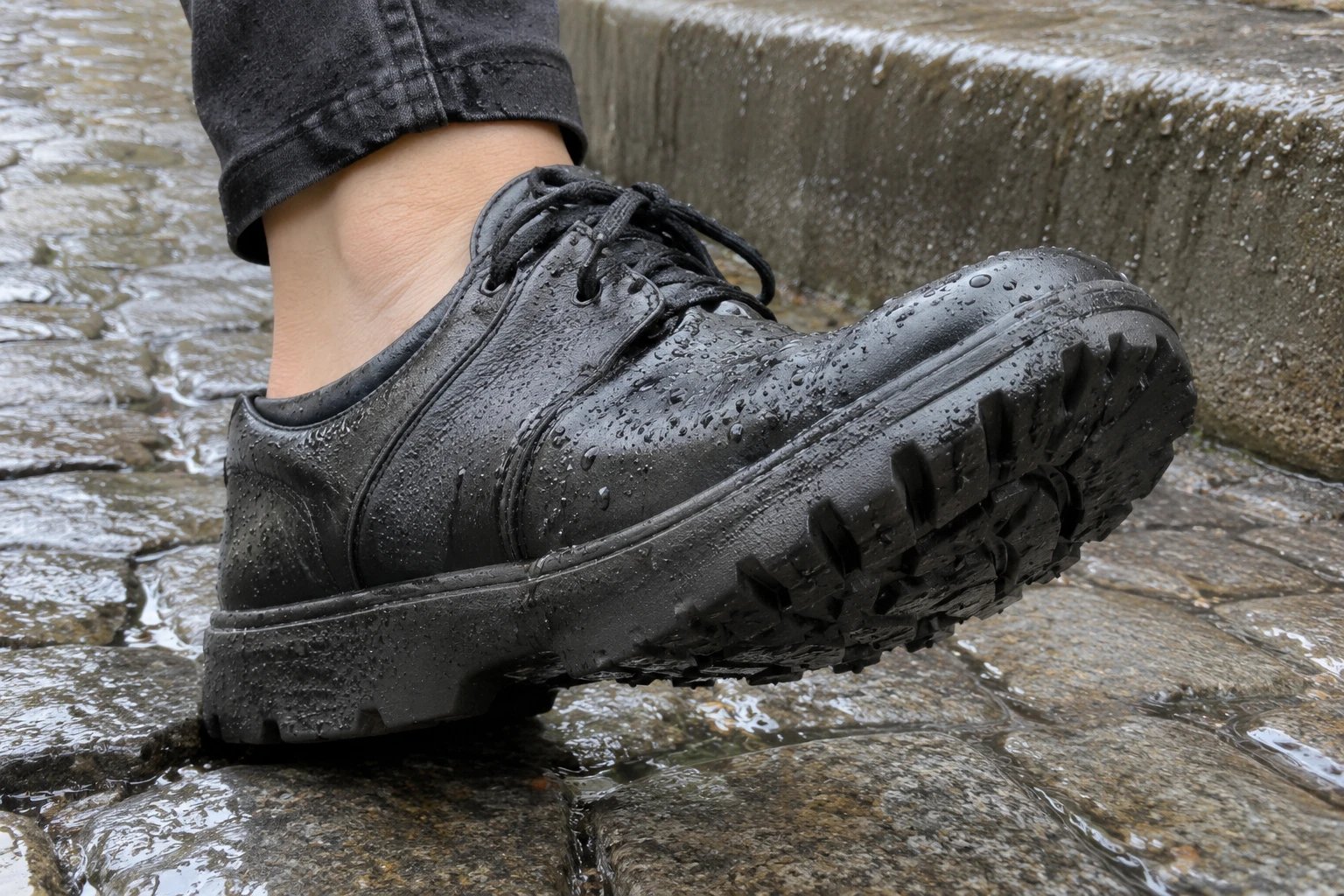
A comfortable shoe and a shoe that's safe on cobblestones aren't always the same shoe. Safety comes down to one place: the bottom of the shoe.
"The single highest-impact shoe feature for fall prevention is outsole grip." Dr. Kevin Lam, board-certified foot surgeon, on shoes that prevent falls
He goes on: a rubber outsole with "a lugged or textured tread pattern holds on tile, wet pavement, and boat decks far better than a smooth leather or foam sole." Lugged means covered in small raised blocks, like a hiking boot sole in miniature. Smooth leather soles look lovely and slide like skates on rain-wet church steps.
He also likes a heel under an inch and a firm heel counter, the stiff cup that wraps the back of your heel.
The part almost nobody checks: "Rubber tread compresses and smooths out from the inside long before the fabric shows wear." A pair with a year of errands in it can look new on top and have lost its grip underneath.
Keep that pair for home. Buy the trip pair early enough to break it in.
7Bike shorts under a skirt or dress
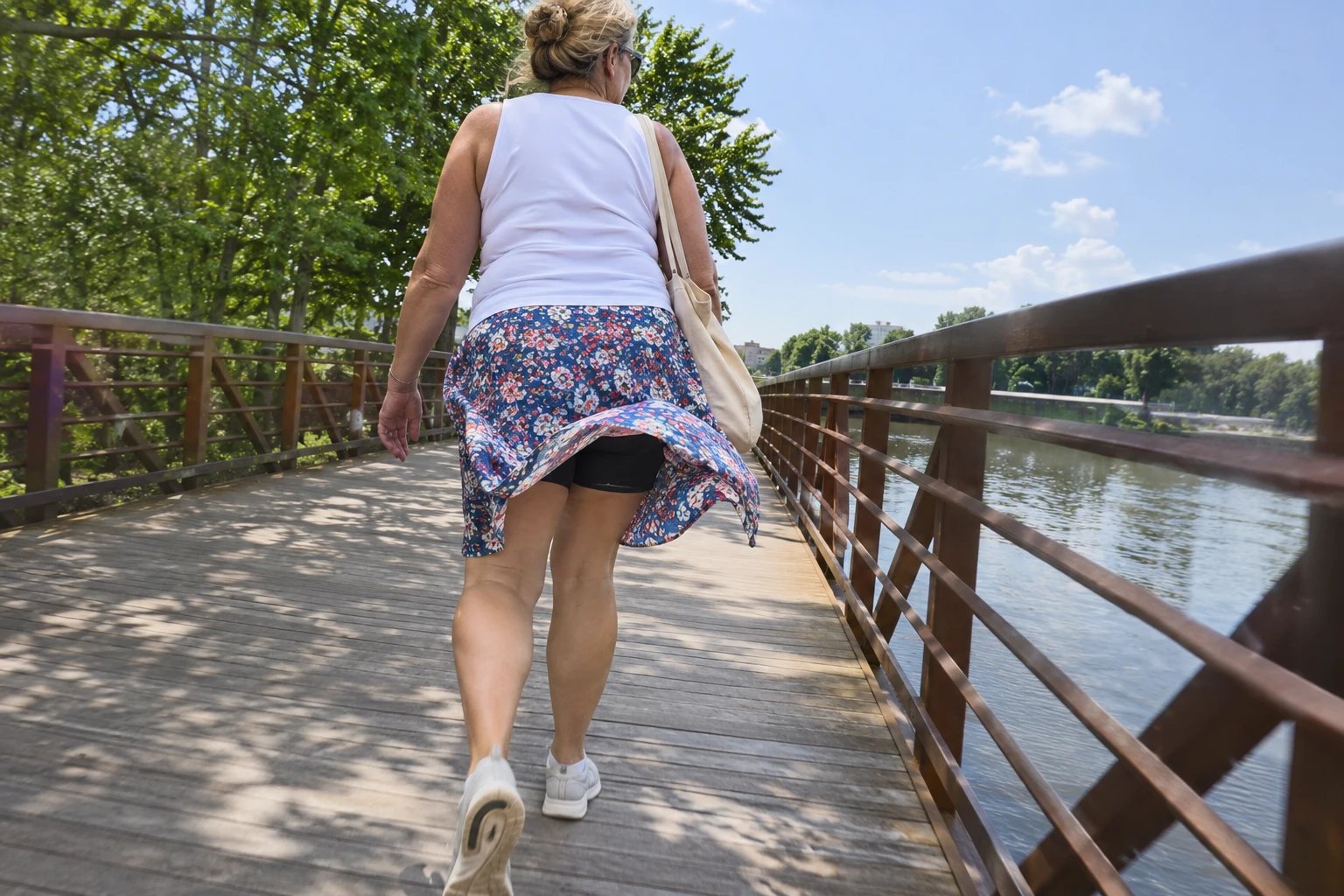
Let's talk about thighs. Chafing is the travel problem nobody puts on a packing list. In my experience, women mention it after the trip, not before. Thin bike shorts under your midi or skirt fix most of it.
Cleveland Clinic family medicine physician Dr. Cory Fisher explains why: "tighter-fitting clothes are less likely to move and rub against your skin." He prefers moisture-wicking fabric to cotton, which he calls a heavy, rough material.
The other fix is one ingredient. The American Academy of Dermatology says to "apply petroleum jelly to problem areas, such as the feet or thighs." Its travel advice says to put it where skin touches skin before long walks such as museum tours. A tub the size of a lip balm fits in your day bag.
Choose shorts that end a few inches above your hem, in black or close to your skin tone, and thin enough for July in Rome. Then a breeze on a bridge can lift your skirt and nobody sees anything but shorts.
6A matching co-ord set, not a jumpsuit
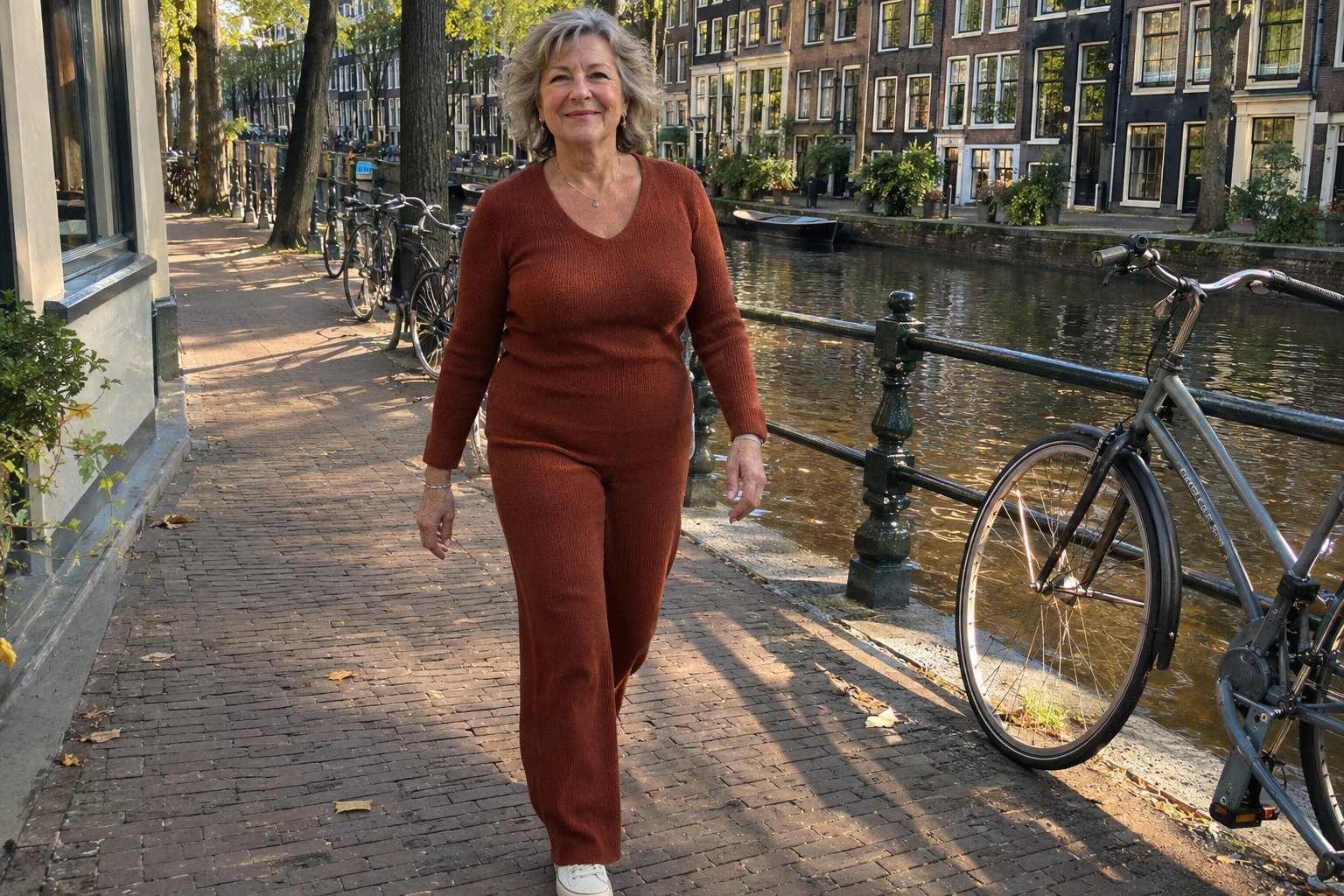
The coin drops, the turnstile clicks, and the stall is about the size of a phone booth. In a jumpsuit, you're about to take off most of your outfit, with your bag on the only hook.
That's my case for a co-ord set, a matching top and bottom in one color. It looks like a jumpsuit, but it comes in two pieces.
Paid public toilets are common in Europe. A 2026 guide puts the price between €0.50 and €1.50: about €0.50 to €0.60 in Madrid and Lisbon, and roughly €1 to €1.50 in Rome, Berlin and Amsterdam. Paris's public toilets have been free since 2009, and most of Vienna's are free too; only two are coin-operated. The jumpsuit point is my own reasoning, but I think you can picture it.
The set also splits up. Wear the top with your wide-leg trousers and the bottoms with a plain tee, and one set gives you three outfits.
Keep a few euro coins in a pocket you can reach without opening your bag.
5Cushioned, supportive soles for feet over fifty
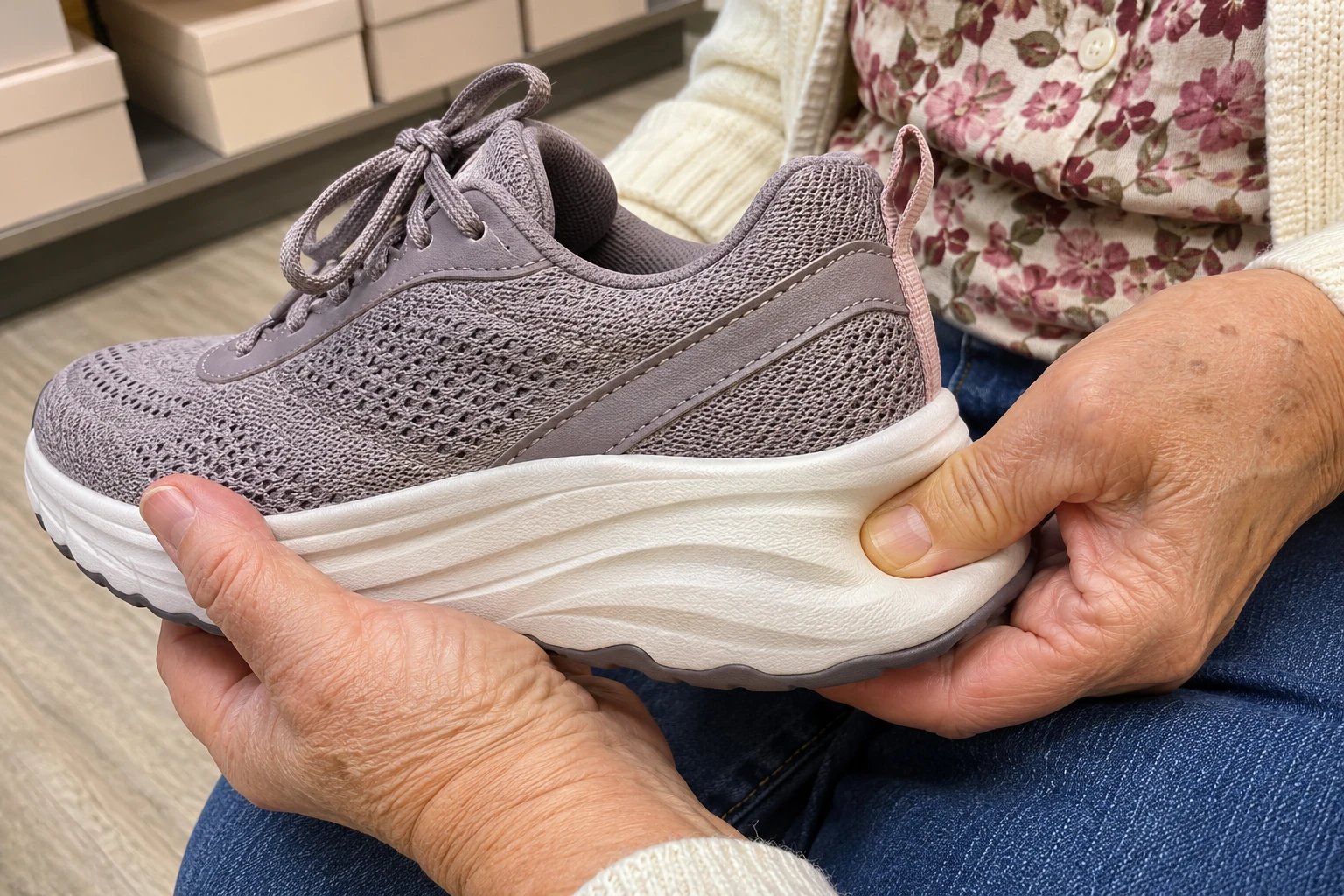
You've probably heard that the padding under your heel simply wears thin with the years. The real story is more interesting, and the sole you need depends on whether your heels hurt.
Kevin Kirby, a podiatrist who teaches at the California School of Podiatric Medicine, writes that a heel pad that has wasted away absorbs less of the impact each time your foot strikes the ground. For patients with painful heel pads, he recommends "'maximalist' running or walking shoes with thick, cushioned midsoles." The midsole is the foam layer between the insole and the tread.
But "thinner" may be the wrong word. A 2024 ultrasound study found heel pads were actually thicker in its middle-aged and older groups. A 2026 study of 140 people aged 18 to 89 found age showed up more reliably in how the pad is built inside than in how thick it is.
So the thickness of your heels tells you very little. What's under them is the part you control.
Cushion and grip are different layers of the same shoe. If you have painful heel pads, Kirby's advice is thick, soft foam in the midsole. If your feet are simply tired by evening, physical therapist Milica McDowell favors a less cushioned, more flexible sole, and says a thick, heavily cushioned one only "may seem more comfortable." Either way, check for textured rubber on the bottom for grip.
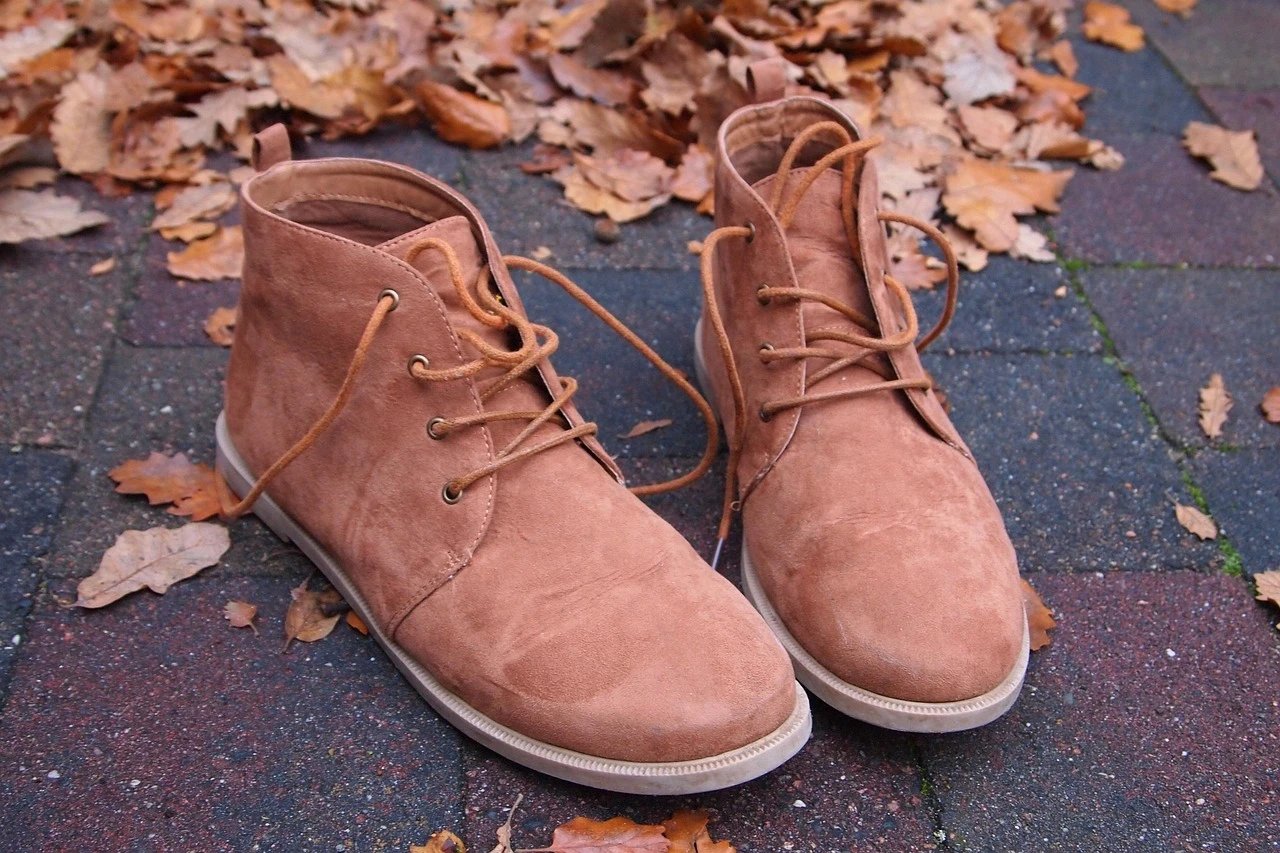
4Closed flats or ankle boots for fall
Fall is when plenty of people actually go. Under TikTok packing videos, women list their trips to Italy, Paris, Germany, Spain, Austria and London, again and again in October and November. One asks how to keep her feet warm in open flats.
Close the shoe. Here's November:
- Rome: about 62°F by afternoon, 47°F early
- Paris: about 52°F high, 43°F low
- Vienna: just under 47°F high, 38.5°F low
October is kinder, about 72°F by afternoon in Rome and near 60°F in Vienna. Your summer sneakers still work then.
On a 43°F Paris morning, I'd leave the open flats at home. An ankle boot with a low heel and a rubber tread goes under wide-leg trousers, walks all day and goes to dinner, so it does two jobs. A closed flat with real tread is the lighter choice for Rome, where you dress for 47°F at breakfast and carry the cardigan by lunch.
In Vienna in November, the low is 38.5°F. Pack the boot.
3Tailored stretch pants instead of leggings
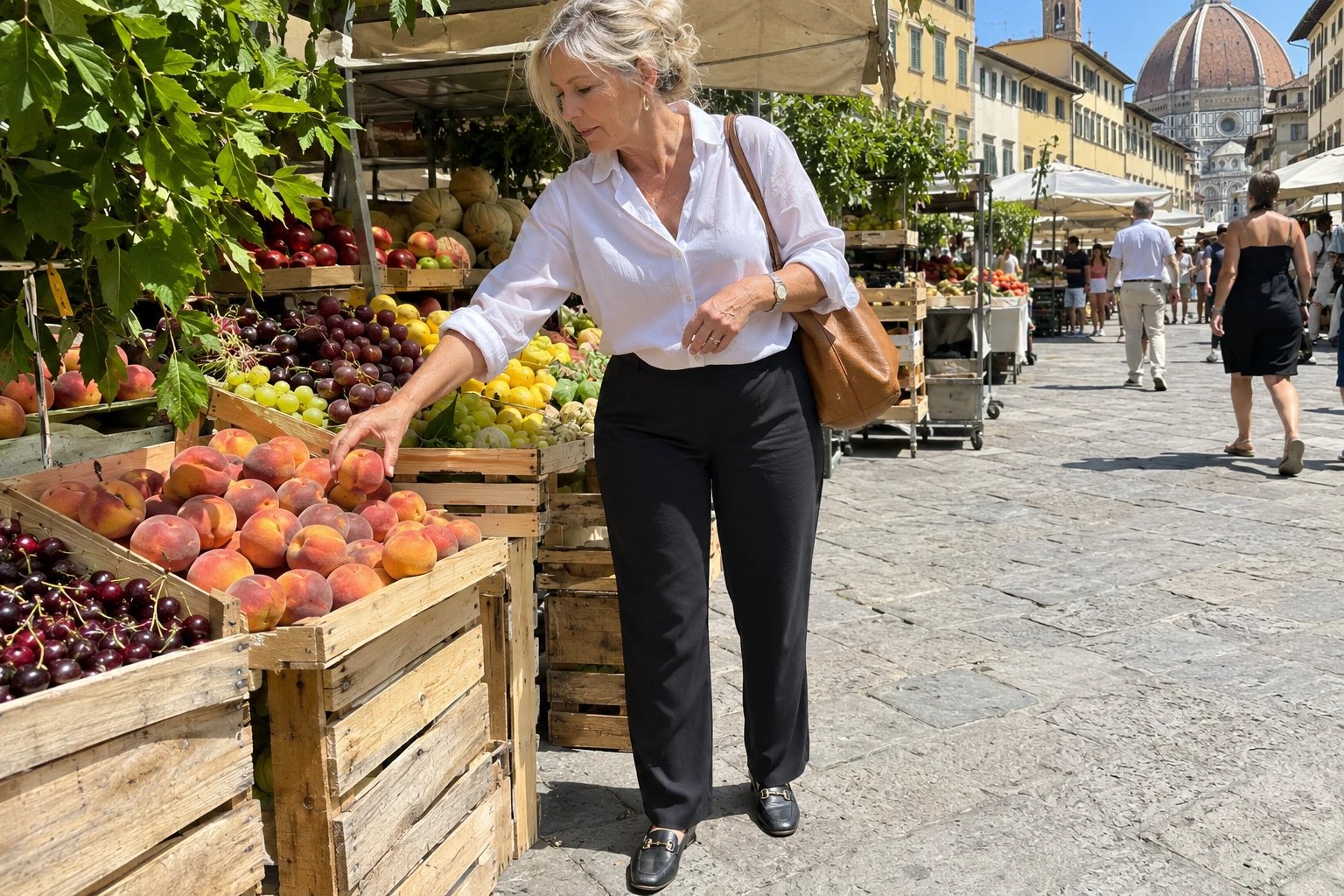
If you live in black leggings at home, you're in good company. Under a TikTok of a woman's Lake Como outfits, one commenter said it plainly:
"At 56 I'm stuck in black leggings. Need to change my whole wardrobe" A 56-year-old woman, commenting on a Lake Como outfit video
You don't need a whole new wardrobe. You need one pair of pants.
When Reddit users ask how locals spot a tourist, Europeans and Americans living in Europe keep naming gym leggings, sweats and hoodies, and they say sleek sneakers are fine. Busbee gives the same advice on her Europe page: keep leggings for hikes and sporty days, and pack lightweight trousers.
You can keep the stretch. Look for ponte, "a thick, double knit fabric" with a heavier structure than ordinary knits. Its edges "do not curl, unlike single knit fabrics." That weight is why it stretches like your leggings but hangs like a trouser. Look for it in a straight or slightly wide leg, in black or navy, with the pull-on waist you're used to.
Leggings still come along, rolled small, for the hike day or under a dress.
2A sunscreen schedule for a nine-to-seven day
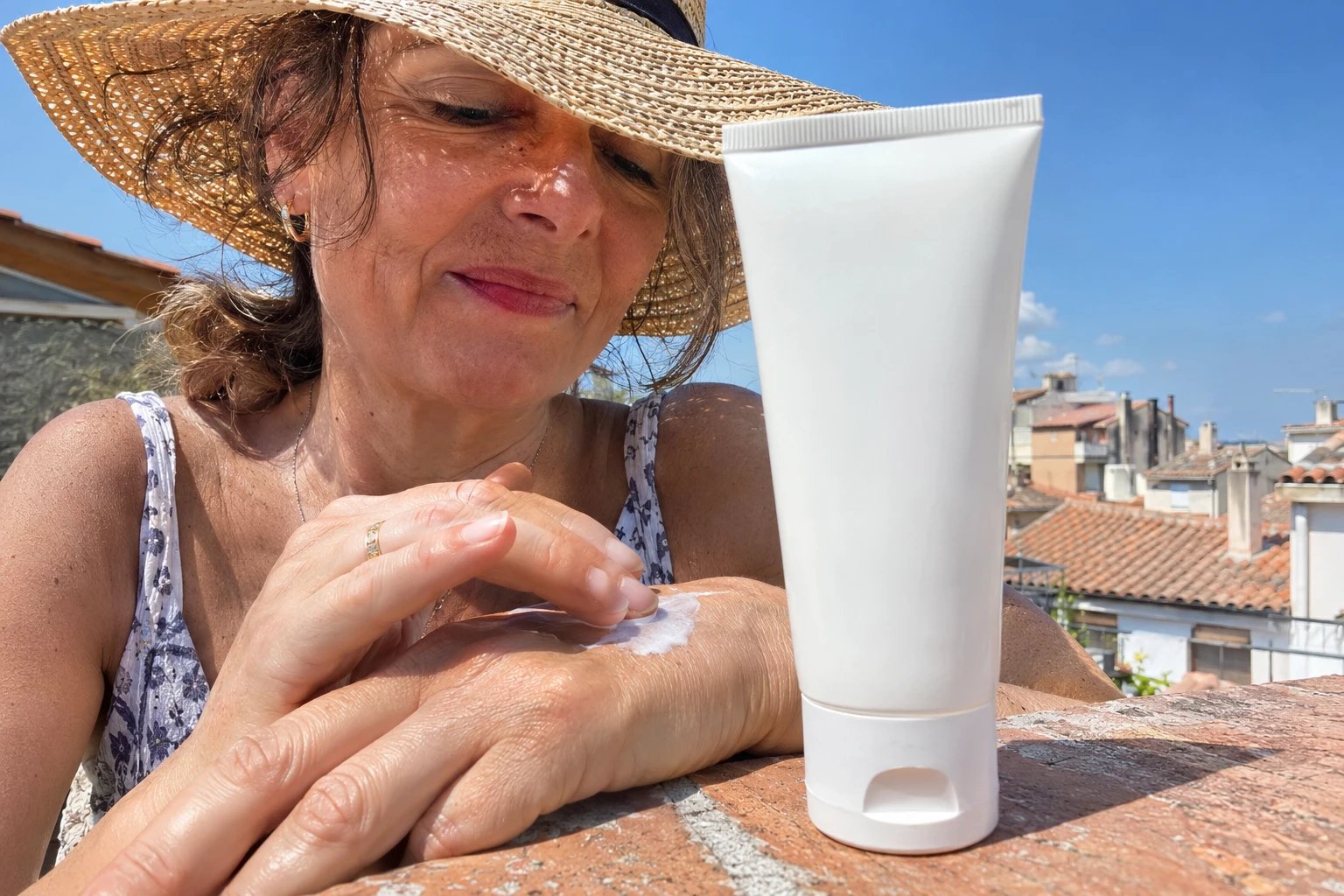
Sunscreen on a sightseeing day has a schedule, and almost nobody keeps it. The American Academy of Dermatology says to reapply "approximately every two hours, or after swimming or sweating." It says to use about an ounce, roughly a shot glass, on skin your clothes don't cover. Most people put on only 20 to 50 percent of that.
Spread over a full sightseeing day, that comes to five coats.
Over ten days, that's up to 50 ounces, which is where your clothes come in. The American Cancer Society says long sleeves, long pants and long skirts cover the most skin. It calls a hat with at least a 3-inch brim all around ideal. A baseball cap leaves your neck and ears bare, "where skin cancers commonly develop."
A wide-brim hat and a light long-sleeved shirt shrink that ounce to a dab on your face, neck and hands. The academy recommends broad-spectrum, water-resistant SPF 30 or higher, and notes the sun is strongest between 10 a.m. and 2 p.m.
Set four phone alarms before you leave the hotel: 10:45, 12:45, 2:45 and 4:45.
1Fit, not sneakers, is what gives tourists away, several travelers say
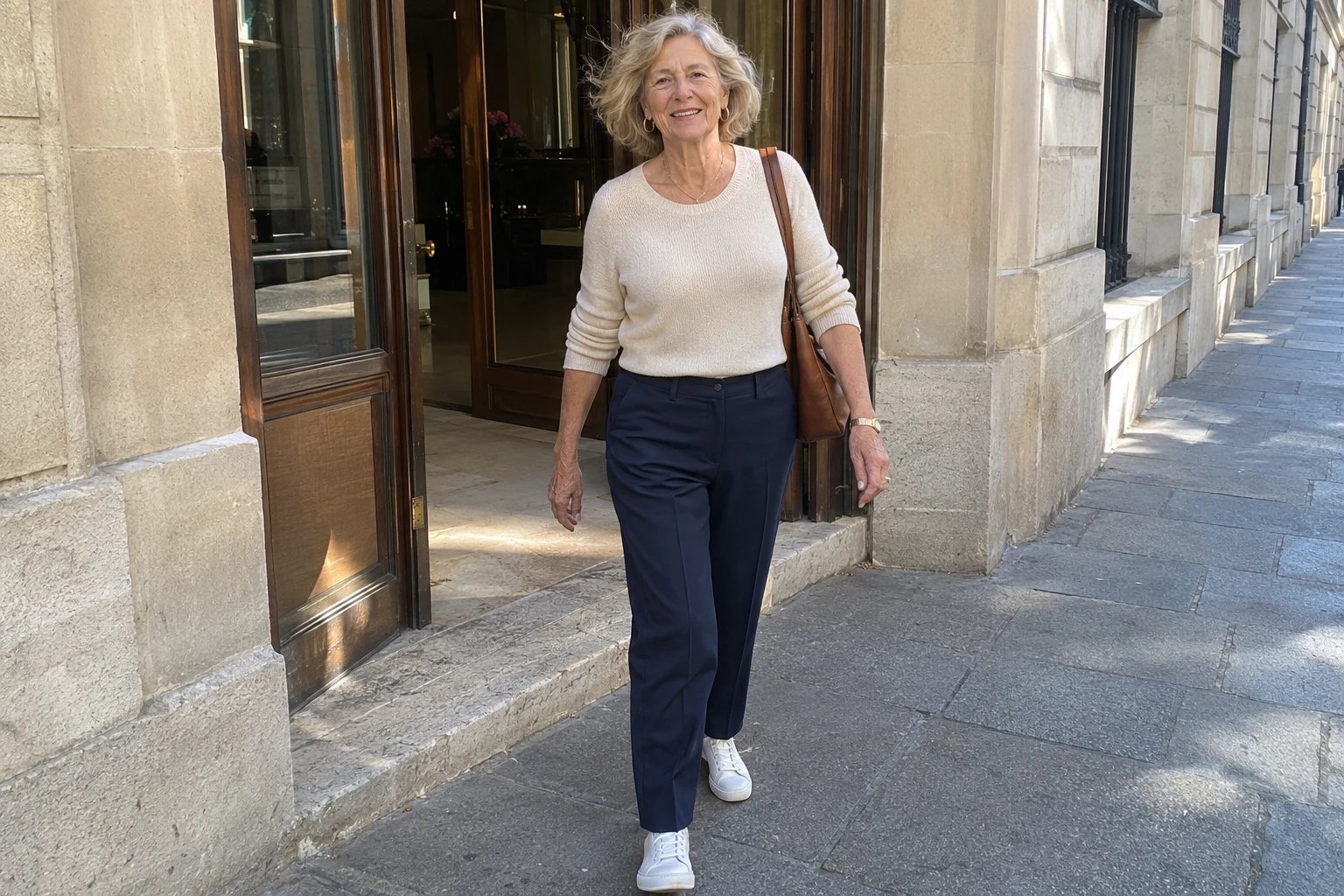
Ask Europeans how they spot an American tourist, and the shoes barely come up.
In Reddit threads on exactly that question, several people pointed to fit. They described American clothes that run shapeless and a size too big, next to locals in simple, good basics that fit. Others in those threads said Instagram outfits aren't real life, that you should wear what's comfortable, and that locals judge how you behave far more than what you wear.
That's the best news on the whole packing list. You can blend in wearing comfortable walking shoes. What looks like a tourist is the trouser puddling over the sneaker, the tee hanging like a tent and the jacket shoulders sitting past your own.
I spend my working days looking at people, and fit is the first thing I notice. Before a trip, try on everything you're packing. Anything that hangs or puddles stays home.
The bottom line
Think of one dinner you're already looking forward to. Maybe it's the trattoria, maybe a bistro, maybe a wine bar with a view. Now work backward through the day. What will you have walked through to get there, and what were you wearing when you started?
Get dressed for that day once at home, from the socks out, and spend a whole Saturday in it. Run your errands, have a long lunch, visit a museum if there's one nearby, and get home after dark.
By evening you'll know which piece you'd leave behind, and whether you'd still want to go out to eat.
Up next
13 Haircuts That Work With Your Glasses Over 50
From where your bangs should land to the bulge your glasses push out over your ears, here's what actually decides whether a haircut works with your frames.
Read the list →
Reader quiz
Did you catch the details?
5 questions from this article. Finish them all to unlock the editor's bonus tip.
According to the article, what should you carry and do at lunch to help prevent blisters?
Questions people also ask
What shoes are best for walking all day in Europe?
The best shoe for walking all day in Europe has arch support, a thicker, shock-absorbing sole and a rubber outsole with textured tread. Podiatrist Dr. Priya Parthasarathy names arch support, a thicker sole and shock absorption. Foot surgeon Dr. Kevin Lam says lugged rubber tread grips wet pavement far better than smooth leather or foam. Break them in at home before you go, because a 20,000-step day works out to roughly 8 to 10 miles.
How many pairs of shoes should I bring to Europe?
Bring at least two pairs you can walk in all day. Podiatrists advise rotating pairs so each dries for at least 24 hours. In a study of hikers on Spain's Camino, wet socks nearly doubled the risk of blisters. If one of the two is dark enough for dinner, you may not need a third.
Is it okay to wear leggings in Europe?
Yes, nothing bans leggings in Europe, but Europeans and Americans living there commonly name gym leggings as a tourist giveaway. A trouser in ponte, a thick double knit that stretches but holds its shape, gives you the same comfort with a tailored look. Leggings still work under a dress or on a hike day.
What should I wear in Europe in October or November?
Wear closed shoes or ankle boots, a warm layer and a water-resistant coat. November averages run about 62°F by day and 47°F at night in Rome, and about 47°F and 38.5°F in Vienna. London averages about 11 rain days in each of those months. October is milder, so summer sneakers still work then in Rome.
What should I wear on the plane to Europe?
Wear a matching set and sneakers you could sightsee in, the formula stylist Erin Busbee uses, so you can land and head straight out. The CDC says anyone flying more than four hours can be at risk for blood clots and lists age over 40 as a risk factor. It says some people benefit from graduated compression stockings. If you have open wounds, very fragile skin or circulation problems, check whether compression suits you before you buy.
Did any of these feel familiar?
Know someone who needs this?
 Prime Journal · Free printable
The Closet Fit and Color Checklist
- A clearer view of colors beside your face.
- Clothes that pass the sitting and walking test.
- Shoes and repairs checked before anything gets replaced.
Free printable: The Closet Fit and Color Checklist. Enter your email and it is yours.
Sources cited in this article
This article links to 50 outside sources, listed here so you can read them yourself.
- Clearly athletic trainers with shorts www.romeforamericans.com/article/what-to-wear-rome-dress-code
- Arch support, a thicker sole, and shock absorption www.smartertravel.com/shoes-that-are-good-for-your-feet
- Approach or exceed 20,000 steps smallgrouptours.com/Travel-Blog/how-much-walking-european-tour
- 2,000 to 2,500 steps a mile www.today.com/health/diet-fitness/how-many-steps-in-a-mile-rcna144282
- Avoid long robes, baggy pants and any items with long threads or dangling cords that could catch on something and cause a fall www.uchicagomedicine.org/forefront/prevention-and-screening-articles/2026/ja…
- Founded her styling business in 2009 busbeestyle.com/erin-busbee
- Platform sneakers, closed-toe espadrille sneakers, ballet flats, comfy walking sandals busbeestyle.com/what-to-wear-in-europe
- Shoulders and knees must be covered www.basilicasanpietro.va/en/faq/what-are-the-rules-of-conduct-to-be-respecte…
- Climb up the dome www.basilicasanpietro.va/en/faq/what-should-i-wear-to-visit-the-dome
- Asks for less sagradafamilia.org/en/faqs
- Mostly in southern Europe www.ricksteves.com/travel-tips/packing-light/packing-tips-clothes
- 2.7 inches against 2.2 donneesmeteo.fr/climat/paris
- About 11 rain days www.metoffice.gov.uk/research/climate/maps-and-data/location-specific-long-t…
- Told its owner to cut back www.reddit.com/comments/1cc9zmk
- Study of 203 hikers on Spain's Camino de Santiago doi.org/10.1016/j.jtv.2022.02.002
- Sorts them by how hard they squeeze health.clevelandclinic.org/what-you-should-know-about-compression-socks
- Rotating pairs so each dries out for at least 24 hours www.achillesfootandankle.com/daily-foot-care-routine
- Drying guide www.startriteshoes.com/blog/how-to-dry-shoes-quickly
- On Reddit www.reddit.com/comments/1h54x61
- Delta www.delta.com/us/en/baggage/carry-on-baggage
- Lufthansa carryonsizeguide.com/lufthansa-carry-on-size
- Ryanair www.kayak.co.uk/news/ryanair-hand-luggage
- €8 to €32 per one-way flight help.ryanair.com/hc/en-us/articles/360017825358
- Monochromatic matching sets + sleek sneakers busbeestyle.com/stylish-cozy-travel-day-outfits
- Can be at risk for blood clots www.cdc.gov/blood-clots/risk-factors/travel.html
- Review of airline studies doi.org/10.1002/14651858.cd004002.pub4
- Properly fitted, below-knee stockings at 15 to 30 mmHg journal.chestnet.org/article/S0012-3692%2812%2960124-X/fulltext
- Wouldn't recommend walking all day in one www.forbes.com/sites/forbes-personal-shopper/article/most-comfortable-loafer…
- On shoes that prevent falls www.naplespodiatrist.com/best-shoes-to-prevent-falls-in-seniors
- Tighter-fitting clothes are less likely to move and rub against your skin health.clevelandclinic.org/prevent-chafing
- Apply petroleum jelly to problem areas, such as the feet or thighs www.aad.org/public/everyday-care/skin-care-secrets/routine/petroleum-jelly
- Travel advice www.aad.org/public/everyday-care/skin-care-secrets/prevent-skin-problems/tra…
- Between €0.50 and €1.50 www.prettywildworld.com/how-to-find-toilets-in-europe
- Free since 2009 mairiepariscentre.paris.fr/pages/les-toilettes-publiques-a-paris-centre-18333
- Most of Vienna's www.wien.info/en/travel-info/tourist-info/public-restrooms-in-vienna-1067220
- Heel pad that has wasted away absorbs less of the impact www.hmpgloballearningnetwork.com/site/podiatry/new-outlook-aging-and-plantar…
- 2024 ultrasound study doi.org/10.1016/j.clinbiomech.2024.106294
- 2026 study of 140 people doi.org/10.7759/cureus.109907
- Milica McDowell www.today.com/health/diet-fitness/no-1-recommended-walking-shoe-physical-the…
- 47°F early www.climatestotravel.com/climate/italy/rome
- 38.5°F low www.weather-atlas.com/en/austria/vienna-climate
- Commenting on a Lake Como outfit video www.tiktok.com/@di_turner/video/7510707536719285526
- Keep naming gym leggings www.reddit.com/comments/1bl30cx
- A thick, double knit fabric en.wikipedia.org/wiki/Ponte_%28fabric%29
- Approximately every two hours www.aad.org/media/stats-sunscreen
- Cover the most skin www.cancer.org/cancer/risk-prevention/sun-and-uv/uv-protection.html
- Strongest between 10 a.m. and 2 p.m www.aad.org/public/everyday-care/sun-protection/shade-clothing-sunscreen/pra…
- Public transit and crowds around street performers www.planetware.com/2028724/rick-steves-essential-tips-outsmarting-pickpocket…
- About 68°F in 2020 to 2024 journal-buildingscities.org/articles/10.5334/bc.671
- Hottest June on record in 2025 www.france24.com/en/europe/20250709-western-europe-june-heatwave-climate

Irina Byalik
Style Editor
Irina Byalik is a hairdresser and the owner of New Image Hair Salon in East Brunswick, New Jersey, with more than 20 years of experience. She came to the United States from Ukraine.
More from Irina Byalik