



17 Work Outfits for Women Over 50 Who Stand All Day
Seventeen comfortable work outfits for women over 50 who stand all day, built from the shoes up, with the compression socks, waistbands and real pockets that get you to hour nine still looking polished.

By Irina Byalik, Style Editor
Updated · 24 min read
- Written by our style editor
- Cited 40 sources
- How we review

The piece in #1 goes on before your first coffee, and nobody at work will ever see it.
Hour nine. You catch yourself in the dark glass of the pastry case, or the window of the nurses' station, and honestly, you look fine. Hair's holding. Top's still tucked.
What the glass can't show is the red stripe your waistband has been pressing into you since lunch, or the shoes that felt roomy at seven and now feel borrowed. When you're on your feet all day, looking put-together is the easy half. Feeling it at hour nine is where most outfits give up.
17Black pull-on ponte pants with a tunic knit
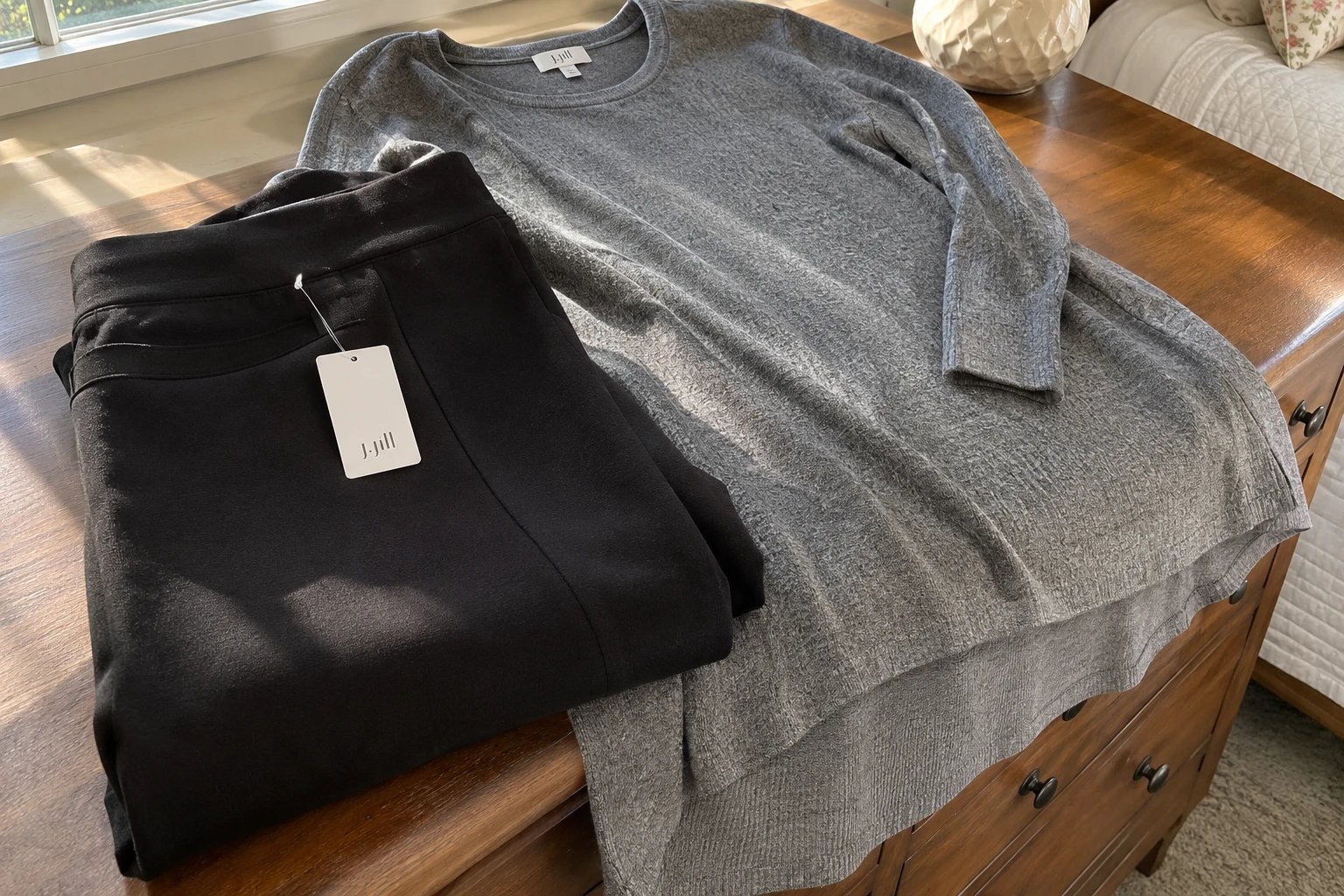
I've seen black pull-on ponte pants on more working women than any other piece of clothing. Teachers, pharmacists, women coming straight off a store floor. They keep buying them for a reason.
Ponte is a thick, double knit fabric: two layers knit together into one. It weighs over 300 grams per square meter, which is a lot for a knit, and its edges don't curl the way thin T-shirt knits do. It's also stronger and more durable than regular knits. In my experience, that body is why ponte hangs like a trouser instead of clinging like a legging.
Put a tunic-length knit top over it, long enough to cover the seat, and you have the closest thing to pajamas that still reads as work clothes.
Where to look: J.Jill's Wearever line uses what the brand calls "easy-care fabrics that don't wrinkle." The Smooth-Fit Classic Slim-Leg Pants run about $79 and the Polished-Knit Wide-Leg Trousers about $99.
Now the catch. Ponte is thick. In a summer stockroom with the doors propped open, it can feel like a wetsuit by two o'clock.
16Retail-floor sneakers that pass the dress code
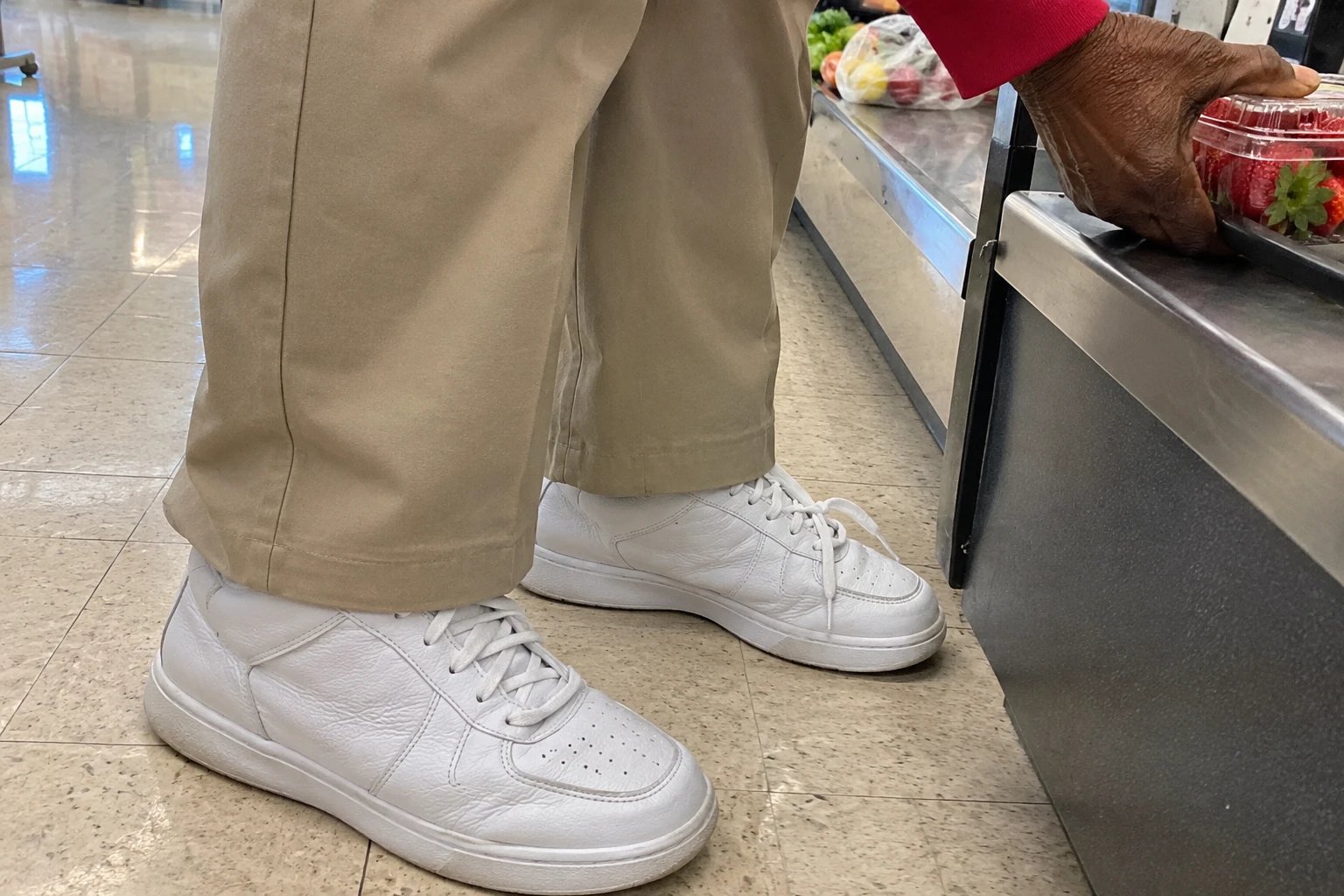
Sneakers on the sales floor stopped being a rule-break years ago. Walmart said so itself in 2019: "we changed our dress code to allow store associates to wear clothes they feel more comfortable in like jeans and sneakers." Target's code, effective July 2026, asks for any sleeved red shirt with blue denim or khaki bottoms, and nothing in it bans sneakers.
Good thing, too. Federal labor figures show retail salespeople spend about 83% of the workday standing, and only about 4% get to choose whether to sit or stand for their main tasks.
So which sneaker? James McCormack, a UK physiotherapist who specializes in knees, feet and ankles, made a point that surprised me. His video links to shoes on Amazon that he earns from, so weigh it the way you'd weigh any shop advice.
"When you're standing all day, what your feet actually need is a broad, level base." James McCormack, physiotherapist, Flawless Physio
A sole with a strong rocker curve, the bouncy kind built for running, tips you slightly forward and back while you stand still at a register. Your muscles keep correcting. "It's subtle, but over an 8- to 10-hour shift, that constant micro-adjustment can lead to fatigue," he says. He adds that "the shoes that feel most comfortable in the shop are usually the first to break down after a few hours."
And please don't retire your old running shoes to the floor. He calls it "probably the most common mistake that I see." The cushioned layer underneath has already worn down unevenly.
The outfit: dark jeans or khakis, your store's top, and a clean leather sneaker in white or black. Set the shoe on a flat counter before you buy it. If it rocks like a cradle, it was built to run.
15Scrubs with a fitted long-sleeve underlayer
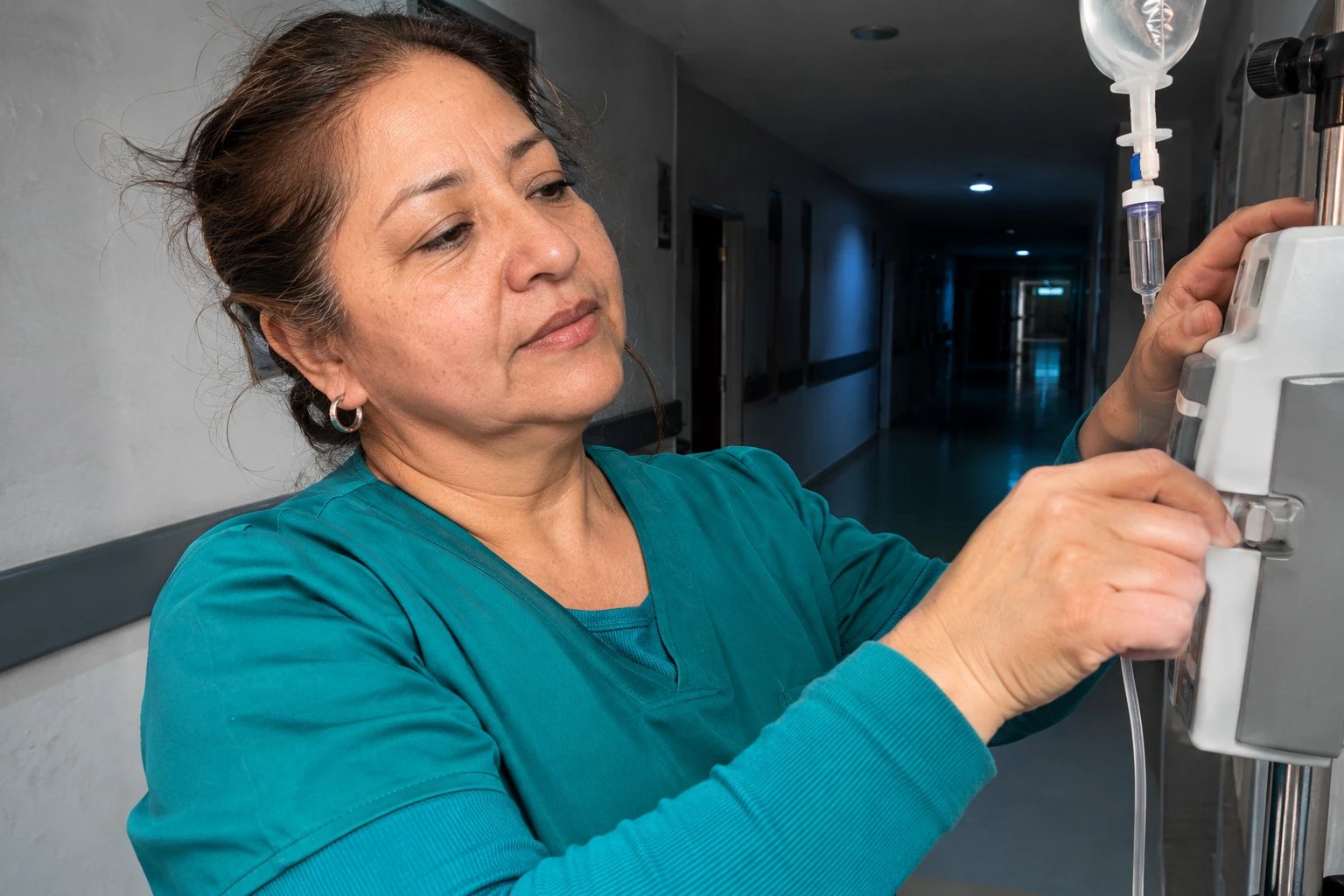
Hospitals set the thermostat for the people under the blankets, not the ones standing over them. A thin, fitted long-sleeve tee under your scrub top fixes that, if your hospital allows it.
That "if" is real. Some units ask staff to go "bare below the elbows," meaning nothing on the forearms, because sleeves can carry germs from bed to bed. But 2014 guidance from US hospital infection-control experts lists it as one of several optional measures. It says attire rules "should attempt to balance professional appearance, comfort, and practicality" with that germ risk.
So the answer lives in your own hospital's policy, and policies differ. Allina Health's dress code allows short- or long-sleeve shirts or turtlenecks under scrub tops "for modesty or warmth." Regions Hospital's code limits them to white, black or the color of your scrubs. Read yours before you buy five in navy.
It's worth getting right, because nursing is long hours upright. Licensed practical nurses spend about two-thirds of the workday standing.
Fitted is the whole point. A loose sleeve bunches at the wrist under gloves and trails through everything. A snug one in a thin knit stays put when you push it up to wash your hands. Buy it in the exact shade of your scrubs, so the sleeve reads as part of the uniform.
14A teacher's midi skirt and supportive flat
A teacher's day goes up and down more than any job I know. You're at the board, then crouched beside a small desk, then on the rug for story time, then out on bus duty. A midi skirt that falls below the knee, with enough swing to bend in, handles every one of those without a second thought about who's sitting on the floor in front of you.
Teachers are clear about what comes first. In a WeAreTeachers survey of more than 200 educators, 98% put comfort first and half singled out arch support. Forty-four percent said they're on their feet six or more hours a day, and one in five stands or walks for eight hours or more.
So pair the skirt with a knit top and a flat that has an actual arch built in, one you can feel when you press your thumb inside the shoe. A paper-thin ballet flat looks lovely with a midi and lasts until about second period.
Some teachers skip the flat entirely. One in that survey said of the Hoka Bondi sneaker: "Perfect for concrete floors!" With a denim midi on a casual Friday, nobody blinks.
13Restaurant black-on-black with slip-resistant shoes
Black pants, black top, black slip-resistant shoes. The classic restaurant uniform hides spills and looks sharp, and servers barely sit: waiters and waitresses spend 98.6% of the workday standing. The shoes are the part worth reading the label on.
OSHA, the federal workplace safety agency, tells servers to "wear non-slip shoes, and avoid wearing sandals or open toe shoes, high heels, or shoes made out of canvas." Canvas is the one that catches people out, since so many cheap black work sneakers are made of it.
US labs test slip resistance on the whole shoe, heel and front, on quarry tile. Two ratings matter:
- SR: the shoe grips to a set standard on dry and wet tile.
- SRO: everything SR does, plus a test on tile slicked with corn oil.
If your floor ever sees fryer grease, look for SRO. Since 2024, the rating standard covers all footwear, so you may find it on shoes that don't look like work shoes at all. A shoe that only says "non-slip" hasn't told you which test it passed, if any.
It's worth the hunt. In a US study that followed fast-food workers for 12 weeks, those in slip-resistant shoes had 54% fewer slips.
12A plus-size outfit built on a structured knit

If the size chart at your favorite store tops out at XL, the problem is the store. Researchers at Washington State University found the average American woman wears a size 16 to 18. Co-author Susan Dunn's message to retailers: "these women aren't going away... and they deserve to have clothing."
For a job on your feet, I'd build a plus-size outfit around a structured knit: a heavier knit top or soft jacket that holds its own shape instead of clinging, over pull-on pants cut for your real measurements. The structure does the polishing. The knit does the moving, every time you reach for a high shelf or lift a tray.
J.Jill's Wearever line runs regular sizes from XS to 4X. Read the fine print, though: its petite and tall sizes stop at XL, so if you're a 2X and 5'2", you'll still be hemming.
One more thing I see all the time. A knit that fits your hips but not your shoulders pulls across your back the moment you reach. Buy for your widest part, and let a tailor take in the rest.
11A hip-length cardigan over a cotton tee

You know this shift. The store's air conditioning is set for August in November, and an hour later you're unloading a delivery and roasting. WebMD's advice for those swings is simple: "Dress in layers so when your body temperature starts to rise, you can peel them off to cool down."
The layering cardigan that works best on a standing job buttons up and ends at your hip, over a plain cotton tee. Buttoned, it's warmth. Open, it's a jacket. Off, it hangs on a hook.
Good luck finding one. In a Reddit thread about work cardigans, women complained that everything is either cropped or tunic-length, when they need a normal length for warmth at work. I hear the same complaint in my chair.
A cropped one leaves a cold gap at the small of your back every time you bend. A tunic-length one catches on the cart handle.
So measure the cardigan you already love, from the top of the shoulder seam down to the hem. When a listing gives a body length in its size details, check it against your number before you look at anything else.
10A four-neutral mix-and-match work week
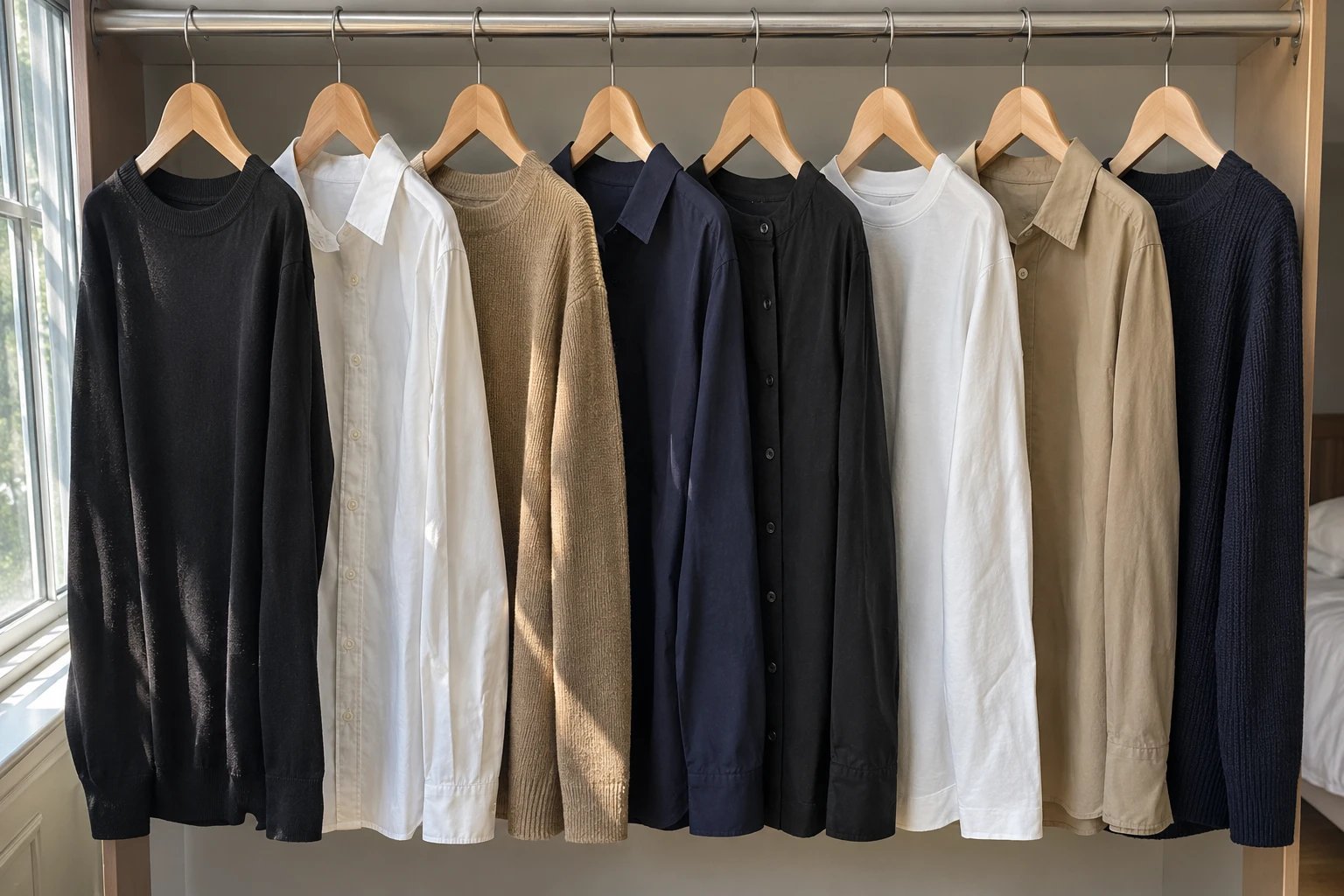
Pick four neutral colors and let them do the thinking at 6 a.m. A woman in r/AskWomenOver50 explained her whole system in two sentences: "Well, my strategy is that all my business clothes are black, white, tan, and navy. So everything mixes and matches."
That's all a capsule wardrobe really is, and the math is better than it sounds. Four tops and three pairs of pants that all go together give you 12 outfits. Add one cardigan you either wear or don't, and you're at 24. That's almost five work weeks before you repeat an exact outfit, from eight pieces.
The catch is the word "all." One top that only works with the black pants knocks the count down fast. Before anything new joins, it has to go with every bottom you own.
If your job hands you a uniform shirt, the same math still works on everything below and over it.
See more: 17 Minimalist Outfits Over 50 for a Simple, Stylish Wardrobe →
9A thrifted blazer with the tags still on
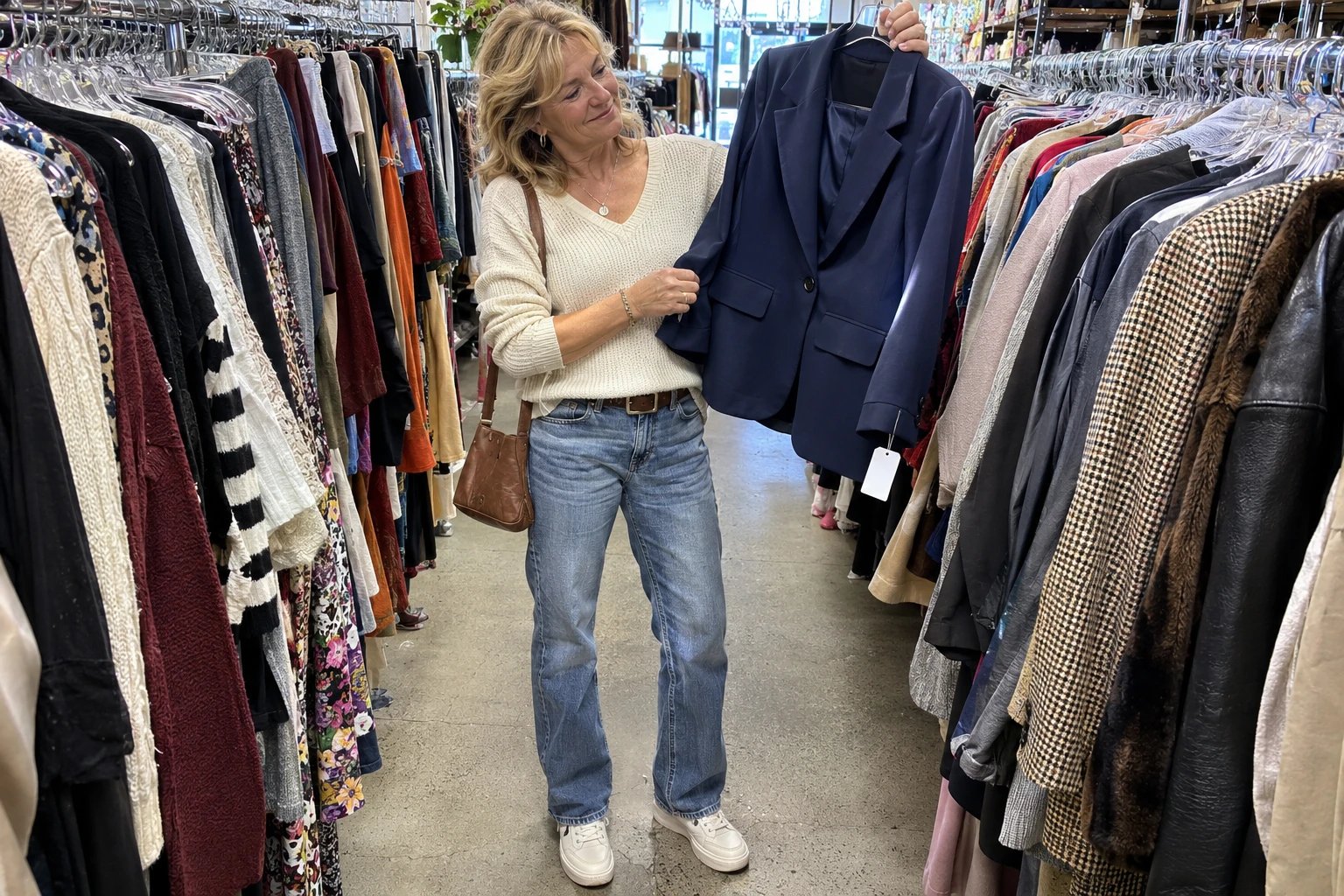
Some of the best blazers I've seen on clients came from thrift racks, with the original tags still hanging off the sleeve. A blazer is the fastest way to look polished at a host stand, a front desk or a store manager's post, and it's the easiest piece to find secondhand.
You'd be in good company. In an r/AskWomenOver50 thread about going back to in-person work, women rebuilding their wardrobes said they shop thrift stores and resale sites, and the find they brag about is the piece with the tags still on. ThredUp, one of the big resale sites, lists new-with-tags blazers at a discount off the estimated retail price. Then spend what you saved on good shoes. That's exactly the split I'd make.
In the fitting room, reach both arms forward as if you're handing a bag across a counter. If the back pulls tight across your shoulders, put it back, however good the price.
A commenter on a TikTok style account for women in midlife put the rest well: "Invest in making a few key pieces perfect...buy them bigger and then make them suit your body." A thrifted blazer that fits your shoulders and is roomy everywhere else is an easy job for a tailor.
Shopping online, you can't try it on. Compare the shoulder measurement in the listing to a jacket you already own before you click. If it still doesn't fit, thredUp gives you 14 days from delivery to send it back, charges a $3.99 restocking fee and offers a refund, not a swap for another size.
See more: 17 Quiet Luxury Secrets Over 50 That Look Expensive Without the Price →
8A 100% cotton shirt for hot-flash shifts

By hour nine, a polyester blouse has a smell you notice when you reach for a top shelf. That isn't your imagination.
Researchers at Ghent University in Belgium had people wear shirts through an hour of spin class, then had a trained panel smell them the next day. Polyester smelled worse, because the bacteria behind body odor grow better on it. "The micrococci are able to grow better on polyester," said lead author Chris Callewaert. That was a gym study, but your shirt doesn't know whether you're on a bike or a sales floor.
For hot flashes on a floor where you can't touch the thermostat, WebMD recommends cotton as more breathable than other fabrics. A woman in r/AskWomenOver50 agrees: she holds out for 100% cotton because it's breathable.
Some floors don't give you any break from the heat. A Target worker quoted about the 2026 dress code put it plainly: "It gets very hot during the summer, and there is no AC."
One caveat about breathable fabrics. Cotton soaks up sweat and dries slowly, so Cleveland Clinic suggests sweat-wicking fabric where skin rubs. Cotton on top, something wicking underneath where your thighs meet.
7Hemmed pants that don't drag on the floor
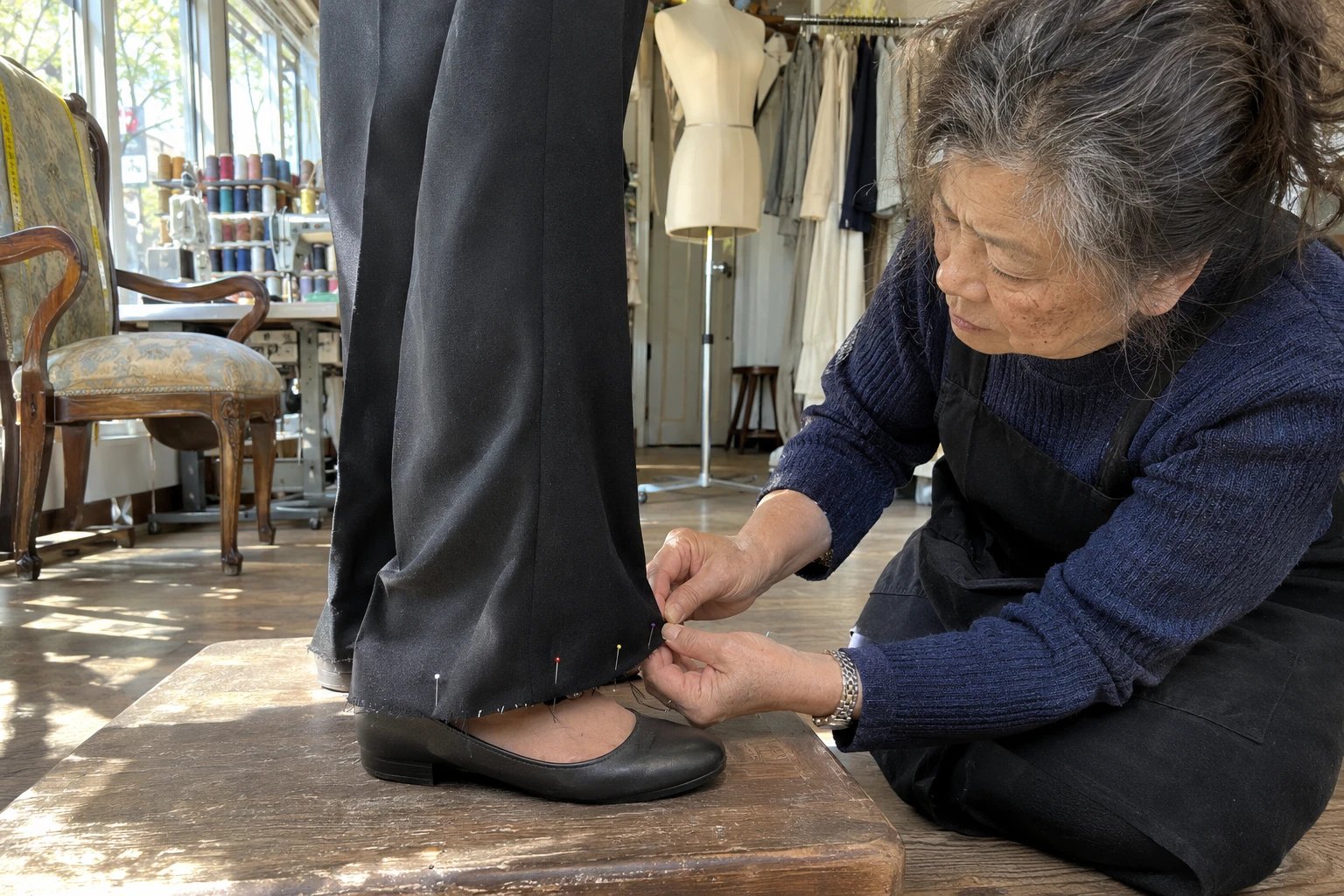
Buy pants by inseam, the measurement from crotch to hem, and stop trusting the word on the label. The average American woman is 5 feet 3½ inches tall by the CDC's latest measurements. On a typical height chart, that puts her in petite.
Here's how NYDJ's sizing guide breaks it down:
| Your height | Size to try | Inseam |
|---|---|---|
| Under 5'4" | Petite | 28 to 30 inches |
| 5'5" to 5'8" | Regular | 32 inches |
| 5'9" and up | Tall | 33 inches or more |
Right at 5'4"? Try both. The guide also notes that "petite jeans are scaled proportionally, not just shortened," so the knee and rise move up too, and the pants bend where you bend.
If you still need a hem, a tailor will usually charge about $15 to $45 or more, depending on lining, cuffs and whether you want the original hem kept.
Take your work shoes to the tailor. And if you switch between clogs and flats, hem for the flats. A black hem that drags on a mopped floor wicks water up to your ankle by noon.
See more: 13 Petite Jeans Over 50 That Finally Fit (No Hemming Needed) →
6Two pairs of work shoes, rotated
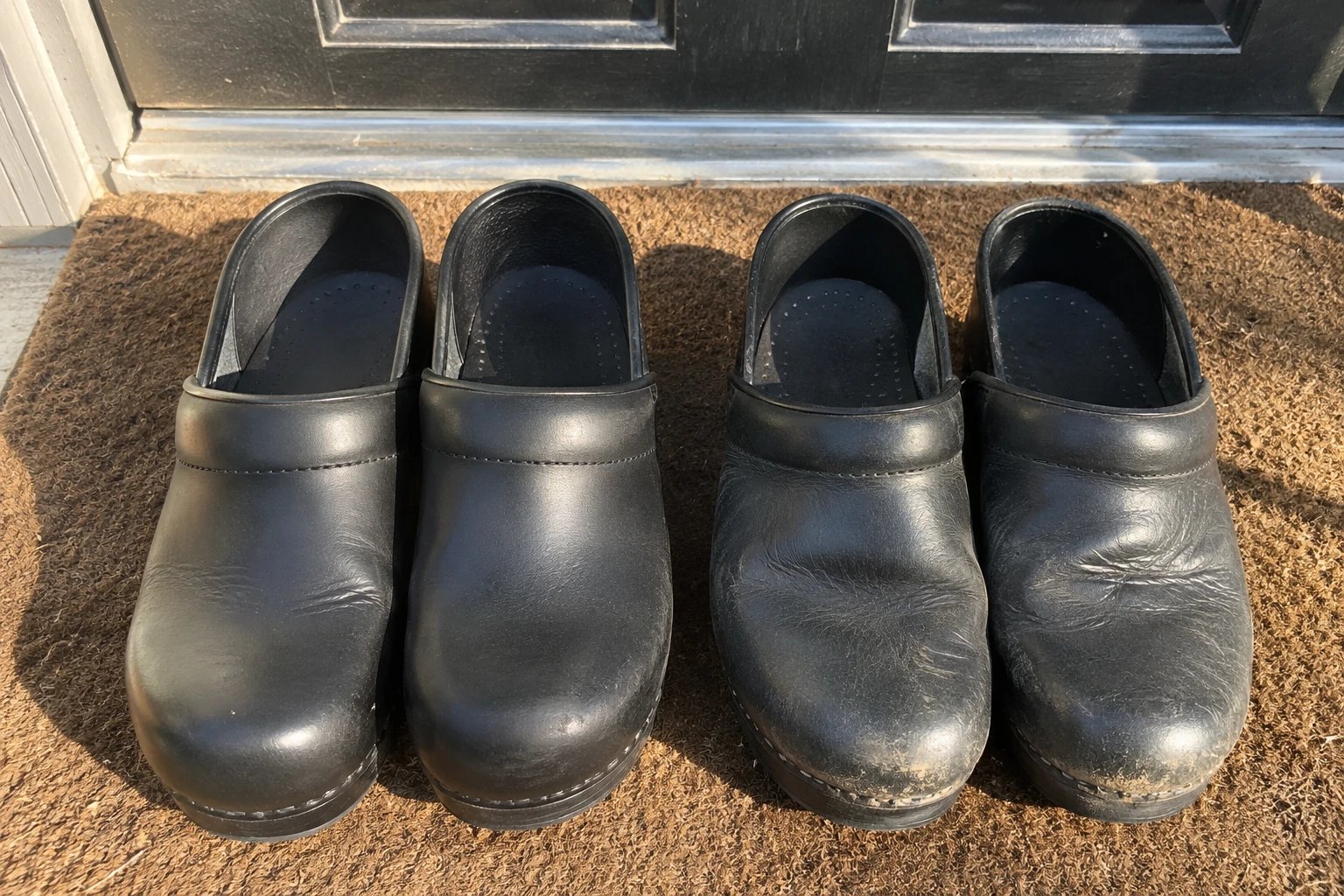
Two pairs of work shoes, worn on alternating days, sounds like an indulgence. Run the numbers and it isn't.
Podiatrist Kevin Lam says to replace nursing shoes every 300 to 500 miles, "roughly every six months for someone working full-time 12-hour shifts." A Dansko Professional clog lists at about $140 to $160 at Nordstrom. Replace one pair twice a year and you spend about $280 to $320.
Rotate two pairs and each one carries half the wear, so each lasts about a year. Your yearly cost stays about the same, and you're never stuck in the pair that's gone flat.
There's a hint it helps your feet, too. The Luxembourg Institute of Health followed 264 runners for 22 weeks, and those who switched between more than one pair had a lower injury risk. That was runners, not anyone behind a counter, so take it as a hint.
What stops people is the first bill: you pay for both pairs at once. If that's not possible this month, buy the second pair at the three-month mark. Write the start month inside each tongue with a marker.
5Pants with real pockets for your phone
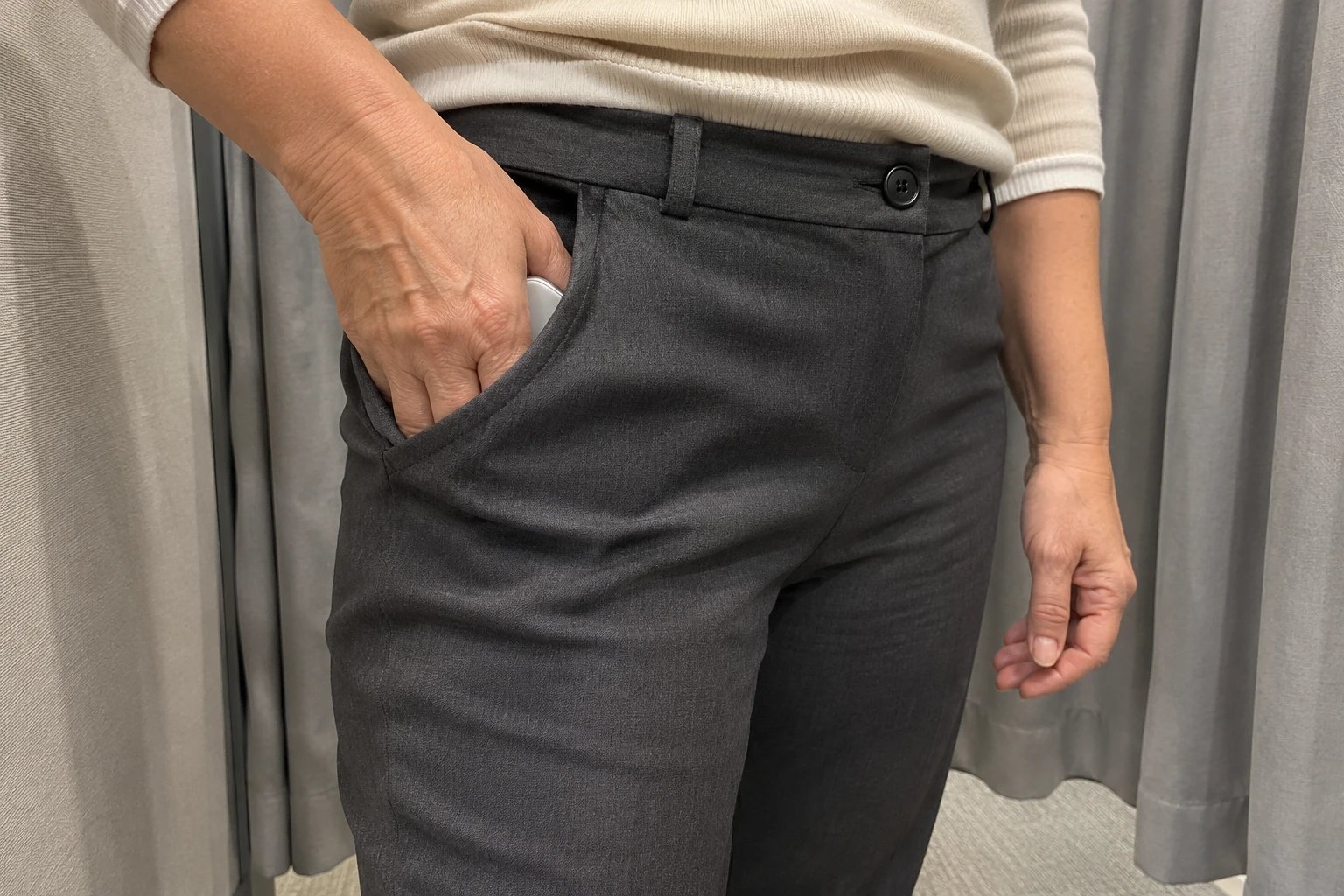
Pants with front pockets deep enough to swallow your phone are worth more on a standing job than any detail on the label. And if you've suspected for years that women's pockets are a joke, you were right.
When The Pudding measured 80 pairs of jeans from 20 popular US brands, women's front pockets came out 48% shorter and 6.5% narrower than men's. Only 40% could fully hold a phone from a leading smartphone brand.
So the phone goes in a back pocket. Then you bend to the bottom shelf and hear it hit the tile.
Pull-on pants are the worst offenders, in my experience. Lots of them have no pockets at all, or ones you can't fit two fingers into. Take your phone into the fitting room. Slide it in the front pocket and sit down. If it digs into your hip or pops out, so will your patience by noon.
4Wide, cushioned loafers bought at day's end
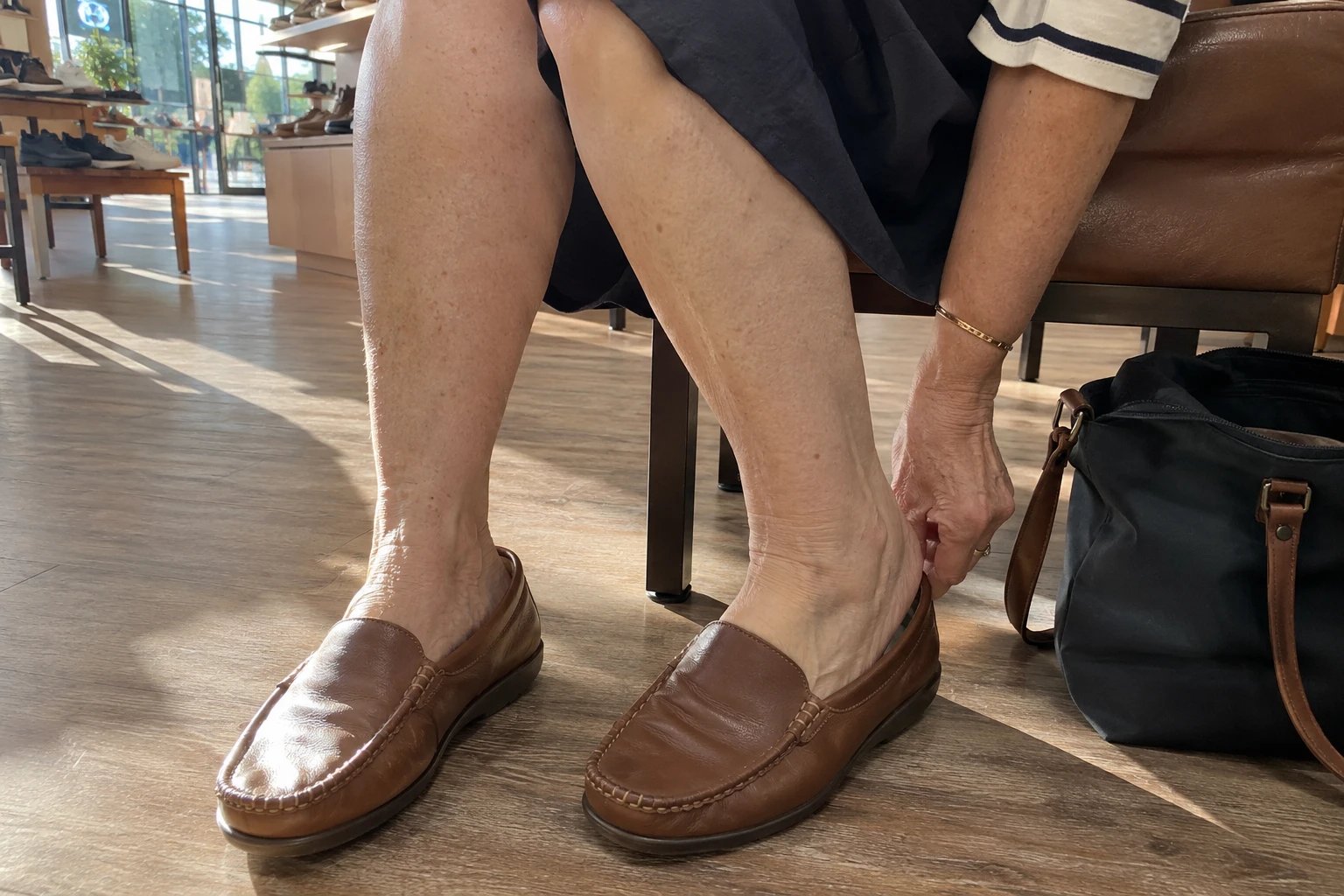
Buy your next work shoes on the way home from a shift, not on a fresh Saturday morning. The American Academy of Dermatology advises you to "shop for shoes at the end of the day, when your feet may be slightly swollen," and to ask a clerk to measure your foot.
Harvard Health goes further: have both feet measured every time and buy for the larger one, with a quarter to half an inch of space past your longest toe. Its best line: "Trust your own comfort level rather than a shoe's size or description."
Width is where a lot of us go wrong. "Interestingly, one of the biggest issues I see in clinic is people wearing shoes that are simply too narrow," says McCormack, the physiotherapist from #16. A wide toe box lets your weight spread across the front of your foot instead of piling onto a few spots.
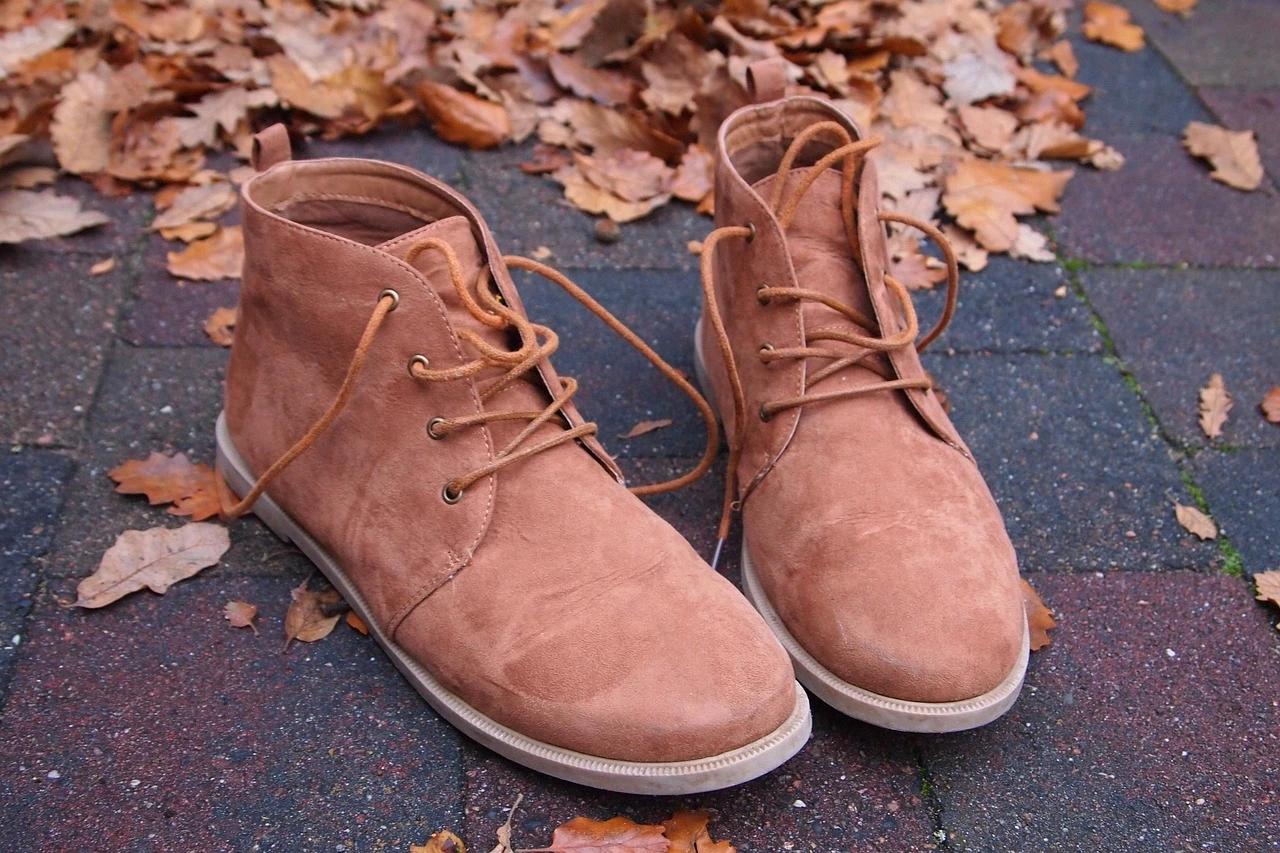
That's the case for comfortable flats or loafers in a wide width, with a cushioned footbed, for front-of-house work. In leather, they look like you're about to run the meeting.
3Clogs for salon and healthcare shifts
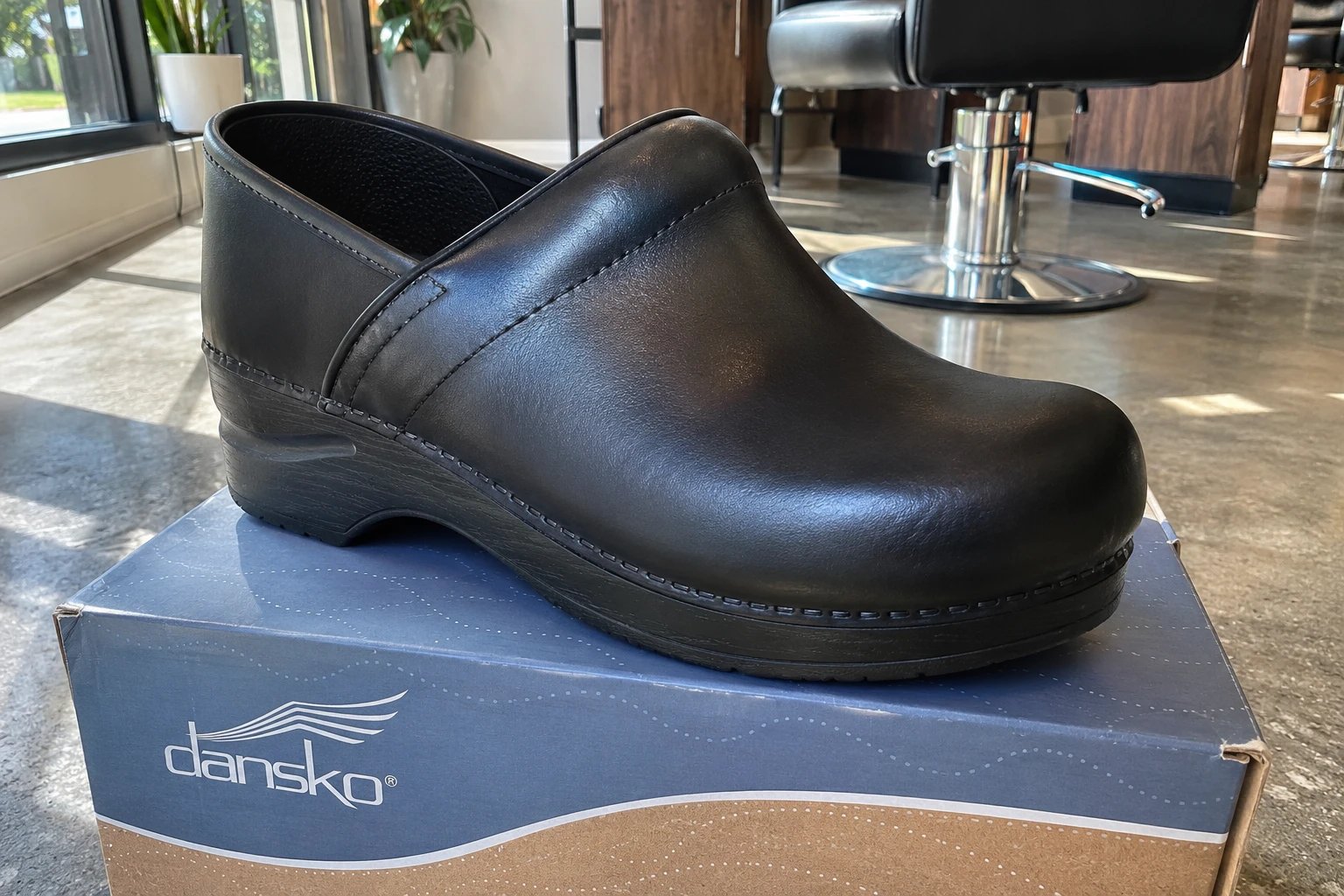
Walk into almost any salon and look down. A lot of us are in clogs, and so are a lot of the nurses I've done hair for. On hard floors, a good clog earns its place.
The Dansko Professional lists at about $140 to $160 at Nordstrom, with a heel of about 1½ inches on a ¾-inch platform and a roomy toe box.
Podiatrist Kevin Lam explains the curved sole: "The rocker-bottom sole does genuinely reduce forefoot pressure over a long shift." He adds a caveat. If you already have foot problems, a clog gives limited arch support without an insert.
Others swear by that arch.
"It's the arch support that really helps." Jan Sanko, an RN for 34 years, via TODAY
Both can be true. It depends on your foot, and on your floor. Podiatrist Emily Splichal, in the same piece, explains why the choice matters: long hours standing on unforgiving floors put stress on your feet, lower legs and back.
So how does that rocker square with #16? Pedorthist Rob Sobel, who fits shoes for a living, says a rocker sole still needs a flat spot so you can stand still. If you're parked at one chair for hours, check that the clog sits flat under the middle of your foot. La Trobe University professor Hylton Menz adds that with rocker soles "some will experience impaired balance." That's worth weighing before you choose a heavily curved clog.
The Dansko also carries a seal from the American Podiatric Medical Association, the foot doctors' group, which says plainly that "The Seal is not an endorsement, but a recognition granted to products." It's a good sign, but your own foot still gets the final say.
2A waistband that doesn't dig by hour six
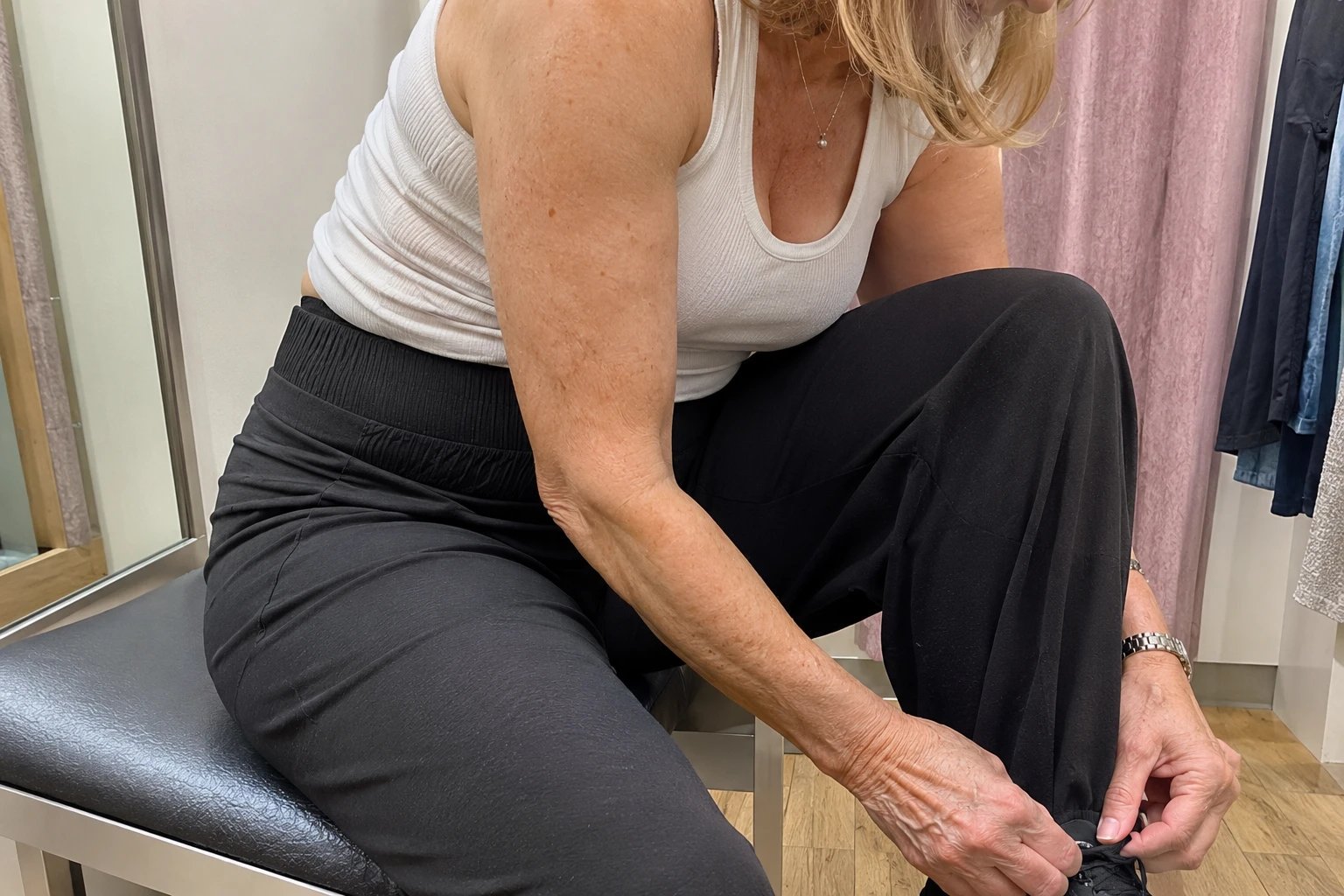
The first thing you take off when you get home tells you everything about your pants. In an over-50 Reddit thread, women admit the bottoms come off the minute they're through the door, and some have given up waistbands at home altogether.
There's a real reason a "standard" waistband bites by afternoon. Washington State University researchers found the average US woman's waist grew 2.6 inches over two decades, and the CDC's latest average is 38.5 inches. Plenty of waistbands are still cut for a body that isn't average anymore.
Sizing up in cheap stretch pants doesn't fix it. A woman in r/AskWomenOver50 described it perfectly: "Fast fashion, very tight or if you size up it looks like you're wearing a diaper with saggy crotch."
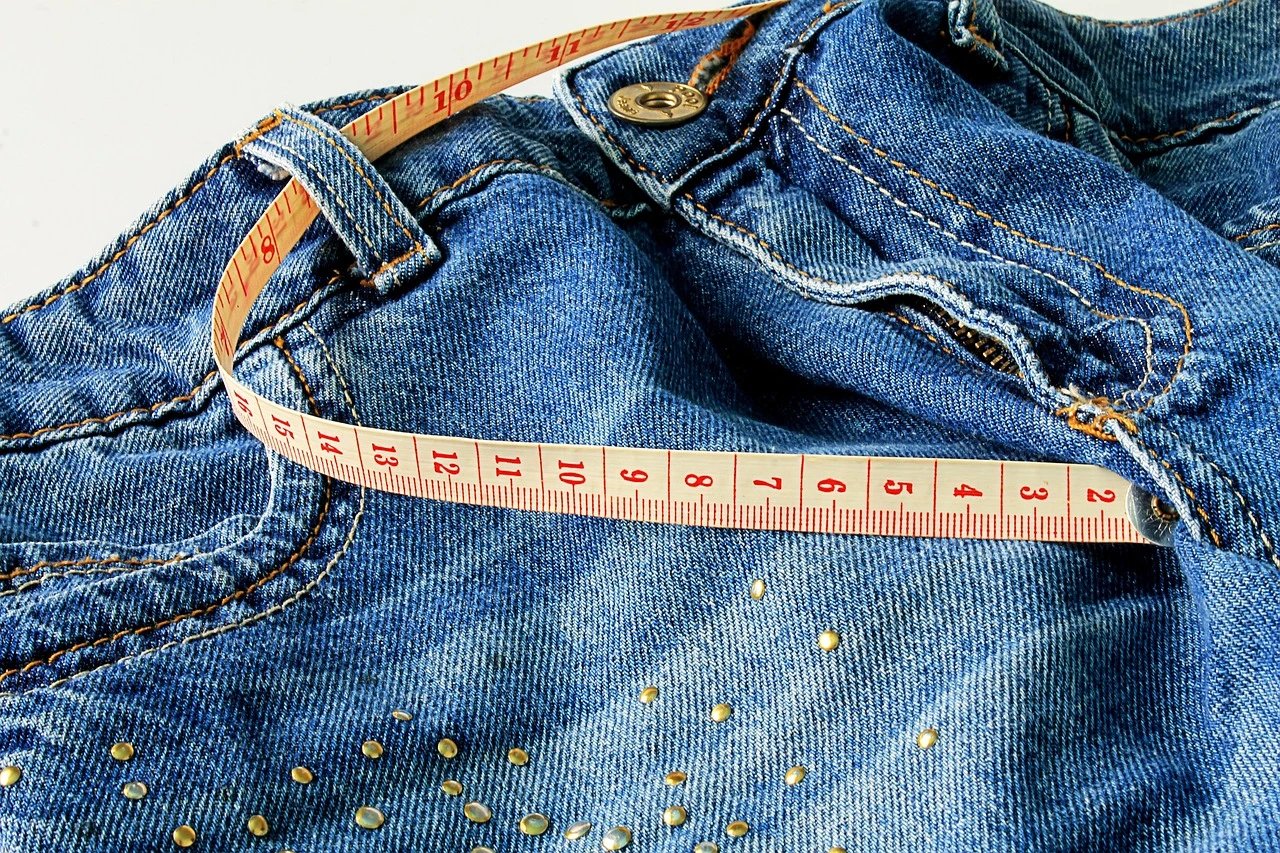
What I've seen work for clients: pull-on pants with a wide, flat elastic waistband in their true size, from a line that cuts for real measurements. A thin elastic band rolls and bites. A wide one spreads the pressure out.
Sit down in the fitting room and lean forward like you're tying a shoe. If the band bites in thirty seconds, it'll bite much harder at hour six.
1Compression socks under your trousers
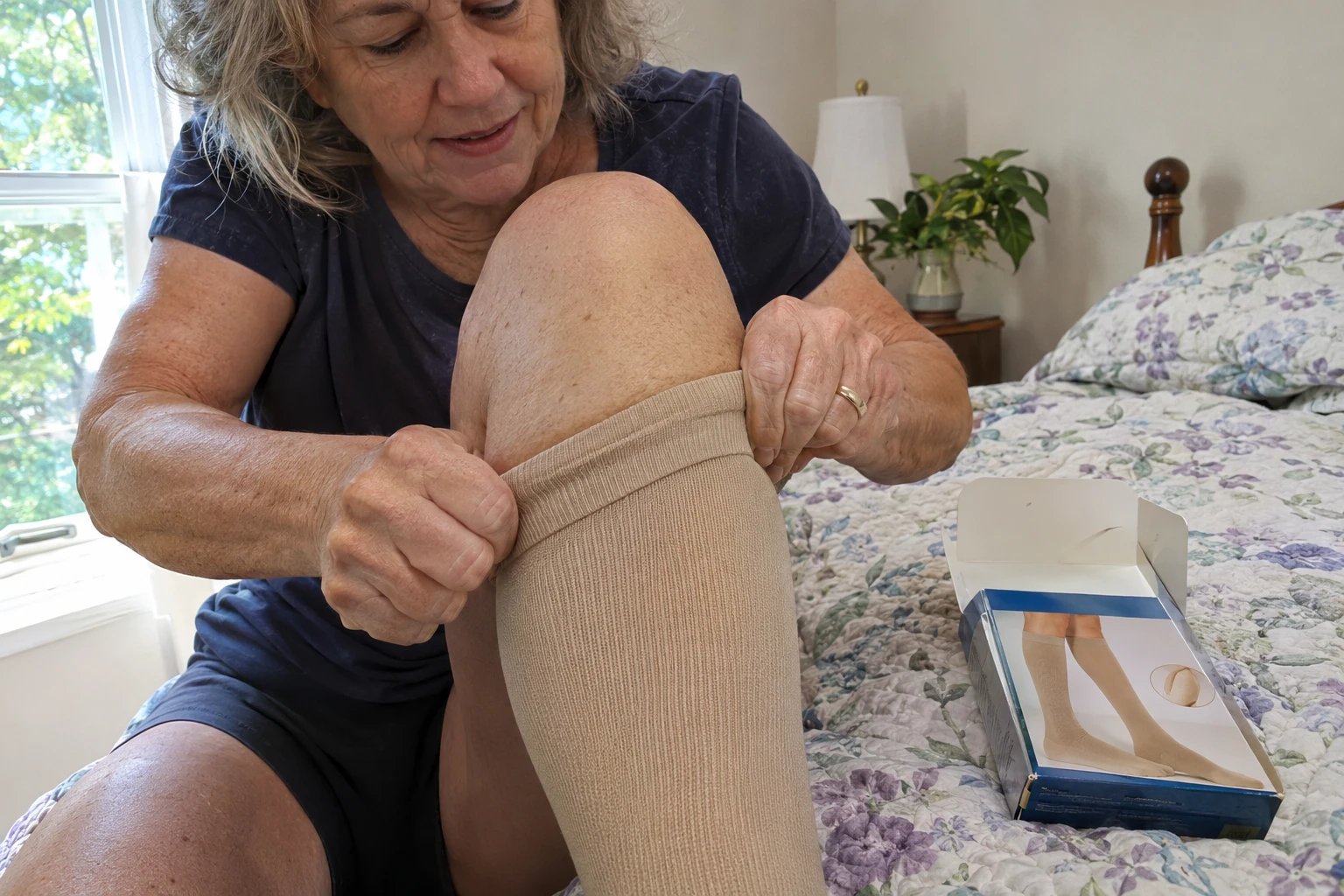
Knee-high compression socks under your trousers. Nobody at work will see them, and they're the one piece of standing-job gear the usual work-outfit lists skip.
They're snug elastic socks rated by how firmly they press on your leg, in mmHg (millimeters of mercury, the same unit as a blood pressure reading). Cleveland Clinic sorts them like this:
| Level | Pressure |
|---|---|
| Mild | 8 to 15 mmHg |
| Moderate | 15 to 20 mmHg |
| Firm | 20 to 30 mmHg |
| Extra-firm, medical grade | 30 to 40 mmHg, by prescription |
The evidence for a standing shift is real. A 2018 study in Brazil measured the lower legs of 58 healthy workers at 7 a.m. and 7 p.m., some standing all day, some sitting, some doing both. With knee-highs at either 15 to 20 or 20 to 30 mmHg, the swelling that built up over the workday dropped significantly, and the firmer pair cut it more. The volunteers were healthy and younger, mostly women.
Cleveland Clinic says to put them on in the morning, before swelling starts, and take them off before bed. Its cardiovascular specialist, Dr. Douglas Joseph, puts it simply: "Get measured to be sure you're getting the right size, and have your provider recommend a specific pressure level."
Before you buy, check with a provider if you have peripheral artery disease (narrowed leg arteries), reduced feeling in your legs, or severe or unexplained swelling, and skip them over open wounds, skin infections or very fragile skin. Cleveland Clinic's own pages don't agree on whether the 20 to 30 level needs a prescription, which is one more reason to ask before you order the firm ones. And don't count on Original Medicare for an everyday pair: it pays for compression items only when a practitioner prescribes them for diagnosed lymphedema, a lasting kind of swelling, or, separately, for an open venous ulcer on the leg that meets the program's wound criteria.
Tonight, lay tomorrow's pair on top of your work shoes, so they're the first thing your hand finds.
The bottom line
When you get home tonight, notice the first thing you take off. The shoes, the pants, the cardigan that turned out too short in the back. Whatever comes off first is the piece that lost today.
Then notice what you forgot you were wearing. That's the one to buy again, in another of your four colors.
Do that for one week and you'll know exactly where your next fifty dollars should go.
Up next
17 Secrets for Shoes That Look Good After 60 and Don't Hurt
A three-question store script, a phone test for wide-leg pants and the Medicare shoe benefit for diabetic feet: how to find the most comfortable shoes for women over 60 that still look like you.
Read the list →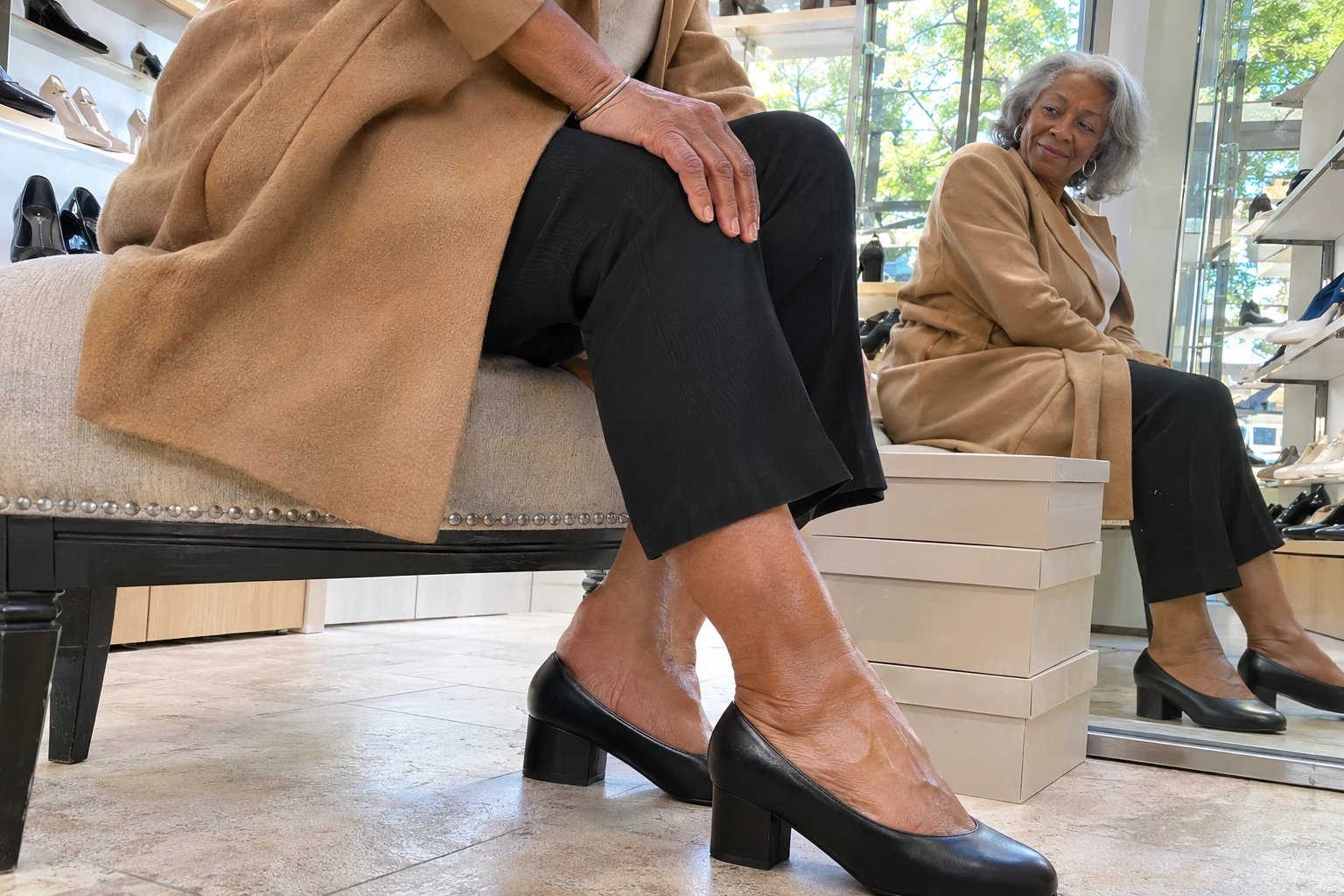

Reader quiz
Did you catch the details?
5 questions from this article. Finish them all to unlock the editor's bonus tip.
According to the sneaker item, what simple test tells you a shoe was built for running?
Questions people also ask
What shoes are best for standing all day on concrete floors?
Shoes with real arch and heel support, cushioning, and a stable, wide sole are the best bet on concrete. Canada's workplace safety agency calls hard floors like concrete the least comfortable surface to work on and recommends a shock-absorbing cushioned insole on cement. A 2025 review of 26 studies of standing workers found that firmer soles help keep you stable for mostly standing tasks, while softer soles suit jobs with more walking.
Are compression socks good for standing all day?
For healthy workers, knee-high compression socks at 15 to 20 or 20 to 30 mmHg significantly cut the leg swelling that built up over the workday in a 2018 study. The volunteers were healthy and younger, so the result doesn't automatically apply to everyone. Cleveland Clinic advises putting them on in the morning and checking with a provider first if you have peripheral artery disease, neuropathy, or severe or unexplained swelling.
How often should you replace shoes you stand in all day?
Replace them about every 300 to 500 miles of wear, which podiatrist Kevin Lam puts at roughly every six months for someone working full-time 12-hour shifts. Heavier wearers may get far fewer miles from a pair. New aches, such as heel or shin pain, are a sign to replace them sooner.
How do you dress for a job on your feet if you're over 50 and plus size?
Buy extended-size, pull-on pieces by your own measurements rather than by the size you used to wear. The average American woman wears a size 16 to 18 and measures 38.5 inches at the waist. Lines like J.Jill's Wearever run regular sizes to 4X, though its petite and tall sizes stop at XL.
Can you wear sneakers to work and still look professional?
Yes, at many workplaces, as long as your own employer's written code allows them. Walmart changed its dress code to allow jeans and sneakers, and Target's 2026 code sets a red top with denim or khaki bottoms without banning sneakers. Steven Cheung, D.P.T., P.T., a physical therapist quoted in a Prevention roundup, recommends a fit that's "snug but not tight, with enough room in the toe box to allow for slight toe movement."
What pants don't dig into your stomach when standing all day?
Pull-on ponte pants bought for your real waist measurement are the safest bet. Ponte is a thick double knit with more strength and durability than regular knits, and lines like J.Jill Wearever sell it in sizes up to 4X, though its petite and tall cuts stop at XL. The average US woman's waist grew about 2.6 inches in two decades, which is a big reason "standard" waistbands so often bite.
Did any of these feel familiar?
Know someone who needs this?
 Prime Journal · Free printable
The Closet Fit and Color Checklist
- A clearer view of colors beside your face.
- Clothes that pass the sitting and walking test.
- Shoes and repairs checked before anything gets replaced.
Free printable: The Closet Fit and Color Checklist. Enter your email and it is yours.
Sources cited in this article
This article links to 40 outside sources, listed here so you can read them yourself.
- Thick, double knit fabric en.wikipedia.org/wiki/Ponte_%28fabric%29
- Wearever line www.jjill.com/womens-clothing/wearever
- We changed our dress code to allow store associates to wear clothes they feel more comfortable in like jeans and sneakers corporate.walmart.com/news/2019/06/05/the-walmart-vest-gets-an-upgrade-with-…
- Effective July 2026 www.aol.com/articles/targets-updated-dress-code-policy-180935192.html
- About 83% of the workday standing www.bls.gov/ors/factsheet/retail-salespersons.htm
- Video www.youtube.com/watch?v=UfkbqjtKdbo
- One of several optional measures www.cambridge.org/core/journals/infection-control-and-hospital-epidemiology/…
- Dress code www.allinahealth.org/-/media/allina-health/files/careers/welcome-to-allina-h…
- Code www.healthpartners.com/content/dam/brand-identity/pdfs/corporate/dress-code.…
- About two-thirds of the workday standing www.bls.gov/ors/factsheet/licensed-practical-and-licensed-vocational-nurses.…
- WeAreTeachers survey of more than 200 educators www.weareteachers.com/teacher-shoes
- 98.6% of the workday standing www.bls.gov/ors/factsheet/waiters-and-waitresses.htm
- Wear non-slip shoes, and avoid wearing sandals or open toe shoes, high heels, or shoes made out of canvas www.osha.gov/etools/young-workers-restaurant-safety/serving
- The rating standard covers all footwear satra.com/bulletin/article.php?id=3377
- 54% fewer slips pmc.ncbi.nlm.nih.gov/articles/PMC6252757
- Average American woman wears a size 16 to 18 www.today.com/style/what-s-average-size-16-new-normal-us-women-t103315
- Dress in layers so when your body temperature starts to rise, you can peel them off to cool down www.webmd.com/menopause/ss/slideshow-minimize-vasomotor-triggers
- A Reddit thread www.reddit.com/comments/1b0jbbr
- Well, my strategy is that all my business clothes are black, white, tan, and navy. So everything mixes and matches www.reddit.com/comments/1w7amh9
- Invest in making a few key pieces perfect...buy them bigger and then make them suit your body www.tiktok.com/@over40andmidlife/video/7625434218759228703
- 14 days from delivery help.thredup.com/en_us/what-is-thredup-s-return-policy-HJjbVX1jn
- Grow better on it www.sciencedaily.com/releases/2014/09/140903163635.htm
- Holds out for 100% cotton www.reddit.com/comments/1n2ra90
- Sweat-wicking fabric where skin rubs my.clevelandclinic.org/health/diseases/23517-chafing
- The CDC's latest measurements www.cdc.gov/nchs/fastats/body-measurements.htm
- Sizing guide nydj.com/blogs/nydj-blog/how-to-tell-if-you-need-petite-regular-or-tall-jeans
- About $15 to $45 or more alterations-express.com/2026/05/27/2026-alterations-price-guide-average-cost…
- Every 300 to 500 miles www.naplespodiatrist.com/best-shoes-for-nurses-on-12-hour-shifts
- Nordstrom www.nordstrom.com/s/dansko-professional-clog/3358309
- Lower injury risk researchportal.lih.lu/en/publications/can-parallel-use-of-different-running-…
- 48% shorter and 6.5% narrower pudding.cool/2018/08/pockets
- Shop for shoes at the end of the day, when your feet may be slightly swollen www.aad.org/public/everyday-care/injured-skin/burns/treat-corns-calluses
- Have both feet measured every time www.harvardhealth.org/pain/8-tips-for-buying-shoes-that-are-good-to-your-feet
- TODAY www.today.com/shop/dansko-professional-clogs-nurse-review-t181204
- A flat spot so you can stand still lermagazine.com/article/rocker-bottom-footwear-effects-on-balance-gait
- The Seal is not an endorsement, but a recognition granted to products www.apma.org/patients-and-the-public/frequently-asked-questions-faq-about-th…
- The swelling that built up over the workday dropped significantly pmc.ncbi.nlm.nih.gov/articles/PMC6188858
- Put them on in the morning health.clevelandclinic.org/what-you-should-know-about-compression-socks
- A prescription my.clevelandclinic.org/health/treatments/23449-compression-therapy
- When a practitioner prescribes them www.cms.gov/files/document/mm13286-lymphedema-compression-treatment-items-im…

Irina Byalik
Style Editor
Irina Byalik is a hairdresser and the owner of New Image Hair Salon in East Brunswick, New Jersey, with more than 20 years of experience. She came to the United States from Ukraine.
More from Irina Byalik