













26 Things Nobody Tells You About Your Skin After Menopause
Lower estrogen changes the skin barrier and collagen. That helps explain why a familiar towel, cleanser, or bra strap suddenly feels wrong.
By Nora Bennett, Style Editor
Updated · 17 min read
- Written by our style editor
- Cited 6 sources
- How we review

Read to the end for #1: it’s the appointment that gets a changing spot examined, with dated photos almost nobody thinks to bring.
The towel catches on your shin as you step out of the shower. Yesterday's lotion is still on the counter, yet the skin beneath it feels tight again. Even the bra you've worn for years leaves a red mark.
It didn't all change in a single night, though it feels that way. Falling estrogen is part of the story, but sunlight, medications, indoor heat, and skin conditions leave their own marks. Treating every change as menopause means you risk missing the one that needs a doctor.
Here are 26 things to check, starting with what's against your skin today.
26The hot shower you still love

Hot water takes a toll on dry skin.
Long, hot showers wash away some of the oils that help skin hold water. After menopause, skin with less moisture to spare feels tight sooner. The towel rubbing over it adds another insult.
That familiar squeak-clean feeling isn't a test of healthy skin. If your shins itch before you've finished dressing, the shower deserves a look.
This week, turn the water down to warm and keep your shower to about 5 to 10 minutes. “Does my skin feel less tight when I get out?”
Don't put the moisturizer away afterward.
See more: 27 Things That Get Better After 60 That Nobody Mentions →
25The lotion sitting beside your sink
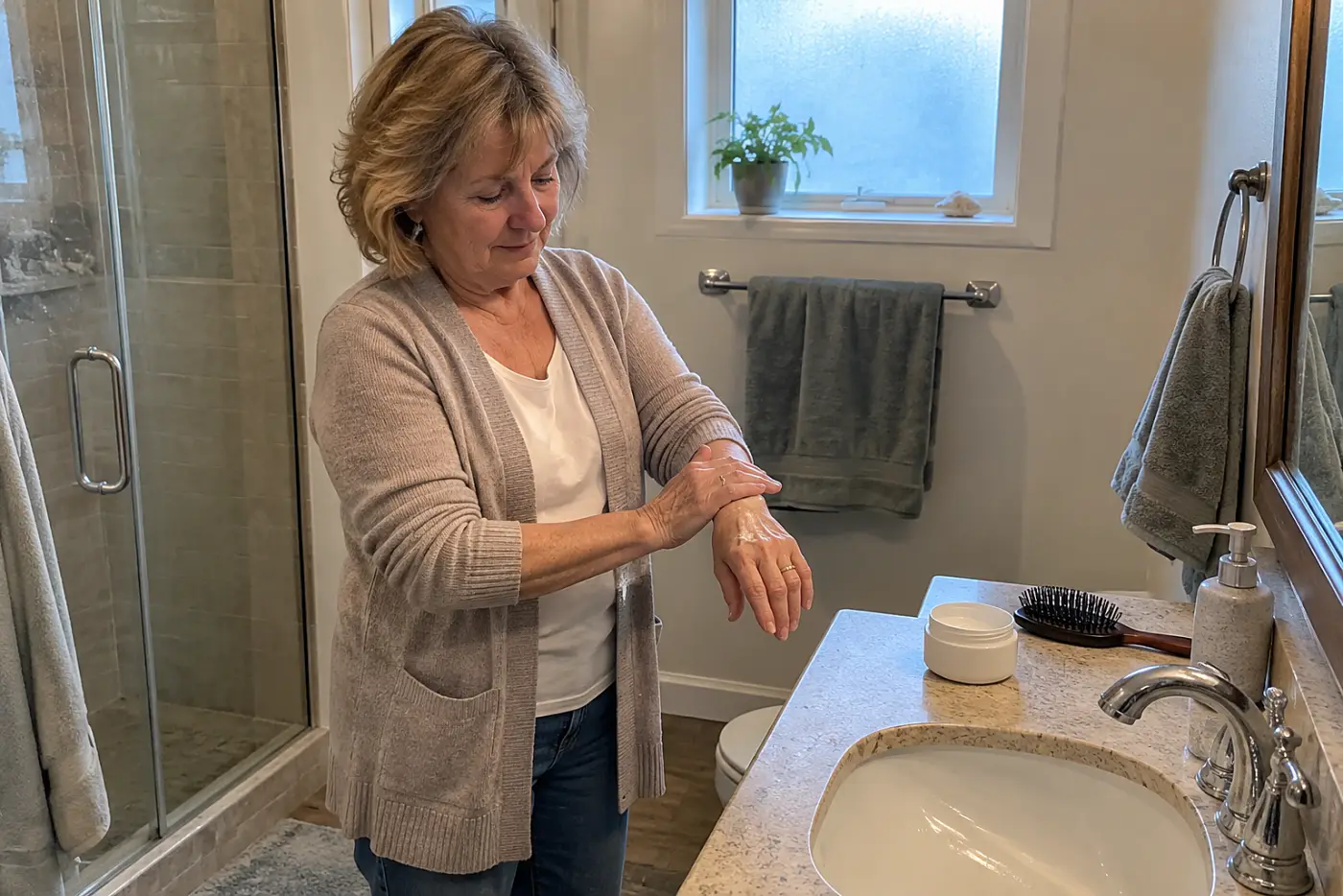
A bottle beside the sink won't help if its contents are too thin.
Moisturizer works best when you put it on damp skin. Creams and ointments contain more oil than lotions and do a better job of holding water in. The American Academy of Dermatology recommends looking for a fragrance-free product when dry skin is easily irritated.
A product you loved for years isn't owed a place on the shelf. If it leaves your legs tight an hour later, that result matters more than its label.
This week, set a fragrance-free cream beside your towel and use it right after bathing. “Can you show me which one here is a cream, not a lotion?”
Then check what happens each time you wash.
24The soap at every sink

Every handwashing removes more than dirt.
Soap and water remove oil from your hands along with whatever you came to wash off. With less moisture in your skin, the backs of your hands feel rough sooner than they used to. That roughness tells you the skin's outer barrier is losing water.
Cracks near the knuckles sting when you squeeze a lemon or turn a key. Repeated washing keeps reopening them, especially if you skip the cream until bedtime.
This week, put hand cream by the sink you use most. “Do my hands feel better if I use it after washing?”
Your face has its own washing problem.
23The foaming cleanser by your toothbrush

Your cleanser can make a dry face feel freshly washed and uncomfortable.
A cleanser that strips oil leaves skin tight before breakfast. Scrubbing longer doesn't restore the smoothness you remember. The American Academy of Dermatology advises a mild cleanser and lukewarm water for dry skin.
Watch what your face does ten minutes after washing, before you put anything else on. That gap tells you more about the cleanser than the foam does. Notice whether your cheeks sting before the next product touches them.
If washing leaves your cheeks burning, adding a stronger serum won't solve the first problem. You'll be paying to treat a reaction you keep creating.
This week, wash with lukewarm water and a mild cleanser, then wait before applying anything else. “Does the tight feeling start before my moisturizer goes on?”
The next surprise is how little weather it takes.
22The bedroom radiator overnight

The room keeping you warm can leave your skin parched.
Indoor heat dries the air. Dry air draws attention to skin already short on moisture, especially on your face, hands, and shins. A humidifier adds moisture back to the room, though its tank and parts need cleaning.
A room humidity level of about 30 to 50 percent gives you a target you can check with a hygrometer. Waking up itchy doesn't prove you need a new body wash. The trouble starts before you've touched the faucet.
This week, note whether your skin feels worse after a night with the heat on. “Is the bedroom air part of this?”
Your lips give you another clue.
21The lip balm in your coat pocket

The balm you keep applying can be part of the sting.
Flavored and fragranced lip products contain ingredients that irritate some lips. Licking them feels helpful for a moment, then saliva dries and the tightness returns. The American Academy of Dermatology advises stopping a lip product that burns or stings.
Check the tube before you buy another one. A tingling sensation isn't proof that a balm is working.
If a cracked lip keeps bleeding or a sore won't heal, don't keep rotating through flavors. A clinician needs to see a persistent sore, especially one on the lower lip.
This week, switch to a plain, fragrance-free lip product and stop licking when you catch yourself. “Would you check this sore if it doesn't heal?”
There's another familiar product worth examining.
20The perfume sprayed onto your neck

Perfume on a dry neck has a shorter path to irritation.
Fragrance touches skin directly when you spray your throat or wrists. Skin that's already dry and itchy gives you less reason to keep testing that contact. A red patch after spraying deserves attention, not another mist.
You don't have to give up the scent to find out whether contact matters. The location of the spray is the part to change. Check whether the patch matches the place the perfume lands.
This week, keep perfume off your skin and watch that patch. “Does the redness stop when I stop spraying here?”
Fabric is touching the same place all day.
19The bra strap rubbing one shoulder

A strap that never bothered you can start leaving a mark.
Friction from a tight strap wears on skin throughout the day. Sweat trapped beneath it adds irritation, particularly during a hot flash. A mark that fades after you undress tells a different story from a rash that stays.
Look at the exact place the strap sits. Redness under one shoulder strap points you toward fit or rubbing; redness that spreads beyond it needs more attention.
Don't scrub the mark to make it disappear. Broken skin beneath a strap gets rubbed again tomorrow, and a rash that persists deserves an exam.
This week, try a better-fitting strap and photograph the mark before bed. “Would you look at this if changing the strap doesn't clear it?”
The waistband below it has its own test.
18The waistband pressing on your belly

Pressure can leave your skin protesting long after you change clothes.
A tight waistband traps heat and rubs when you sit, bend, and walk. Red lines that appear exactly beneath the elastic point to contact. A rash that stays after the pressure is gone calls for a closer look.
Keeping your favorite pants isn't worth an open patch of skin. You need to know whether the mark fades or spreads.
This week, wear a looser waistband and check the area that evening. “Is the redness still here after a day without that elastic?”
Now look at what happens when you scratch.
17The itchy shins beneath your socks

Scratching dry shins feels good until it doesn't.
Dry skin itches, and scratching injures its surface. Once skin breaks, soap and clothing sting the spot, which sends your hand back to it. The National Institute on Aging notes that older skin becomes thinner and drier.
Pull down your socks and look before putting on cream. Fine flakes are different from an open scratch, a spreading red patch, or an area that feels hot.
If you only treat the itch, you miss the damage your nails leave behind. Increasing redness, warmth, swelling, or pain around broken skin deserves medical attention.
This week, trim your nails, moisturize after bathing, and check the scratched places in good light. “Would you look at this patch? I keep scratching it open.”
The backs of your hands tell a related story.
16The dishwater around your fingertips

Dishwater keeps finding the splits around your fingertips.
A long soak swells the skin around your nails. As your hands dry, that skin contracts; repeat the cycle around a split, and the edge opens again. Dish soap adds another irritant to skin that's already broken.
A cream used once at bedtime doesn't shield a fresh split during the dishes. Even opening a package hurts when the edge catches.
This week, wear gloves for wet chores and check the fingertip splits afterward. “These splits keep opening during the dishes. Do they need treatment?”
Your nails have their own response to that wet work.
15The nail polish remover in your drawer

Nails can split before you notice your hands have changed.
Repeated wetting and drying weakens nails. Polish remover adds another drying step, particularly when you scrub at stubborn color. A split nail catches on sheets, then tears farther before morning.
The American Academy of Dermatology advises keeping nails dry and wearing gloves for wet work. Notice whether the damage runs along several nails or starts with one.
One new dark streak, especially if it widens or reaches the skin beside the nail, needs a dermatologist's eyes. Don't cover it with polish while waiting to see whether it disappears.
This week, pause the remover, protect your hands during wet chores, and inspect each bare nail. “I found a new dark streak on this nail. Will you examine it?”
Take the same clear-eyed look at your hairline.
14The widening part in your hair

Your scalp shows changes before your hairbrush explains them.
Hair thinning after menopause leaves more scalp visible along the part. The exposed skin gets sunlight that your hair once blocked. Hair loss also has causes beyond menopause, including thyroid disease and low iron.
A widening part deserves more than a different hairstyle if shedding is new or marked. That bare strip needs sun protection now.
This week, photograph your part in the same light and ask about new hair loss. “Should we check why my part is widening?”
The sun reaches places you haven't counted.
13The ears above your collar

Your ears sit in daylight even when your face feels covered.
A hat brim shades the face unevenly, and hair doesn't always cover the tops of your ears. Ultraviolet light reaches exposed skin throughout the year. The American Academy of Dermatology recommends broad-spectrum sunscreen with SPF 30 or higher.
Don't mistake a rough, persistent patch on an ear for simple dryness. Sun-damaged areas need an exam when they change, bleed, or fail to heal.
Sunscreen matters, but a dab put on once doesn't reach skin you forgot. Think of ears when you're already protecting your face, rather than waiting to notice a burn.
This week, include your ears when applying sunscreen before you go out. “Would you examine this rough spot on my ear?”
Your chest has been keeping its own record.
12The V-neck left open to sunlight
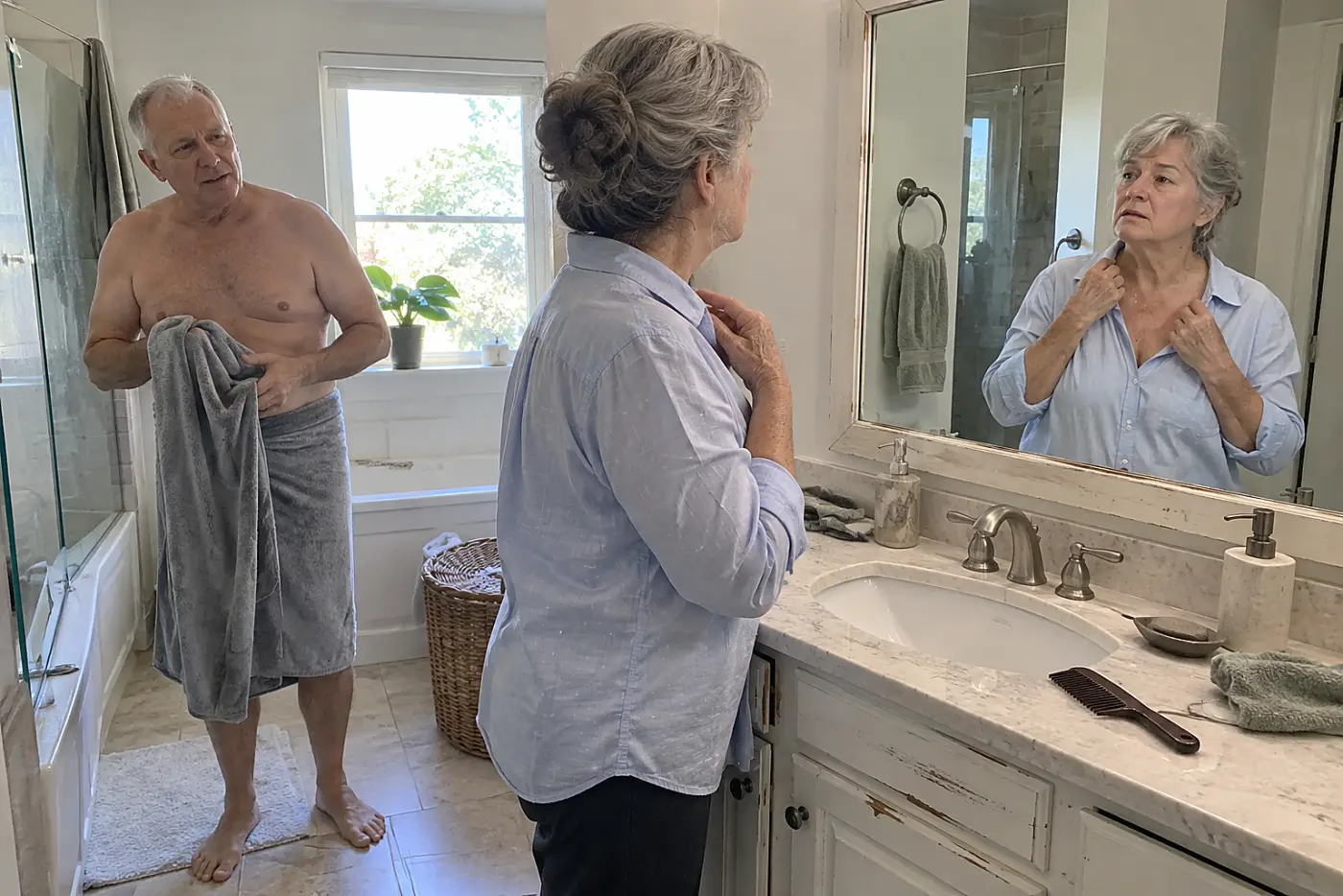
The skin below your throat has seen years of sun.
A V-neck leaves the same patch of chest exposed again and again. Sun exposure adds spots and changes texture, while menopause changes the skin around them. A new mark shouldn't vanish into the phrase “age spot.”
A spot that grows, bleeds, or changes color earns a closer look. Clothing hides it from everyone else, not from risk.
This week, check that area in daylight and cover it when you'll be outside. “This mark on my chest is new. Would you look at it?”
Another patch looks different under bathroom light.
See more: 29 Outfit Habits That Make You Look Older Than You Are →
11The red cheeks after face cream

A familiar face cream can suddenly leave your cheeks hot.
Dryer skin is more easily irritated by products you've used for years. But flushing has other causes too, and persistent redness with bumps deserves an exam. The National Rosacea Society describes flushing, lasting redness, and bumps among signs of rosacea.
Start with the timing. Redness that follows one product is a useful clue; redness that appears without it changes the question.
You can lose weeks trying new jars if you never stop the one that stings. Keep the package so a clinician can see its ingredients.
This week, pause the stinging cream and photograph your cheeks in daylight. “The redness starts after this cream. Does it look like irritation or rosacea?”
The little bumps nearby aren't automatically acne.
See more: 29 Colors That Wash You Out After 50, and the Ones That Don't →
10The breakout along your jaw

A new jawline bump doesn't need your old teen acne routine.
Hormone shifts change oil production, and breakouts still happen after menopause. Strong spot treatments and rough scrubs also irritate dry skin. That combination leaves you with a bump and a sore patch around it.
A bump that keeps returning in the same place deserves an exam. So does one that crusts or bleeds instead of healing.
This week, stop scrubbing the area and note when the bump appears. “This spot keeps coming back in exactly the same place. Will you check it?”
The next change feels less visible, but sharper.
9The burning after your vitamin C serum

A serum can sting once your skin barrier is irritated.
Products with active ingredients reach skin that's already dry from washing, weather, or another product. Layering several actives at once makes it hard to tell which one started the burning. More sting doesn't mean more benefit.
The American Academy of Dermatology advises testing new skin-care products on a small area twice a day for 7 to 10 days before putting them on your face. Stop using a product that causes a reaction; don't try to push through it.
If you change three products together, you lose the only useful clue: the order things happened. Keep the bottles while you sort it out.
This week, stop the serum that burns and write down what you applied before it. “Which product should I leave out while this heals?”
One popular nighttime product needs special care.
8The retinoid beside your nightstand

Retinoids don't excuse a face that stays raw.
Retinoids speed skin-cell turnover. Irritation and peeling follow when you use too much or apply them too frequently, especially alongside other active products. A sore face isn't the goal.
The label's directions matter more than an online routine. Persistent burning is a reason to stop and ask what to change. Check the instructions before adding another nighttime product to the same patch of skin.
This week, check the retinoid label and pause it if your skin feels raw. “How should I restart this without making my face sore?”
Not every new facial texture comes from a jar.
7The coarse hairs beneath your chin
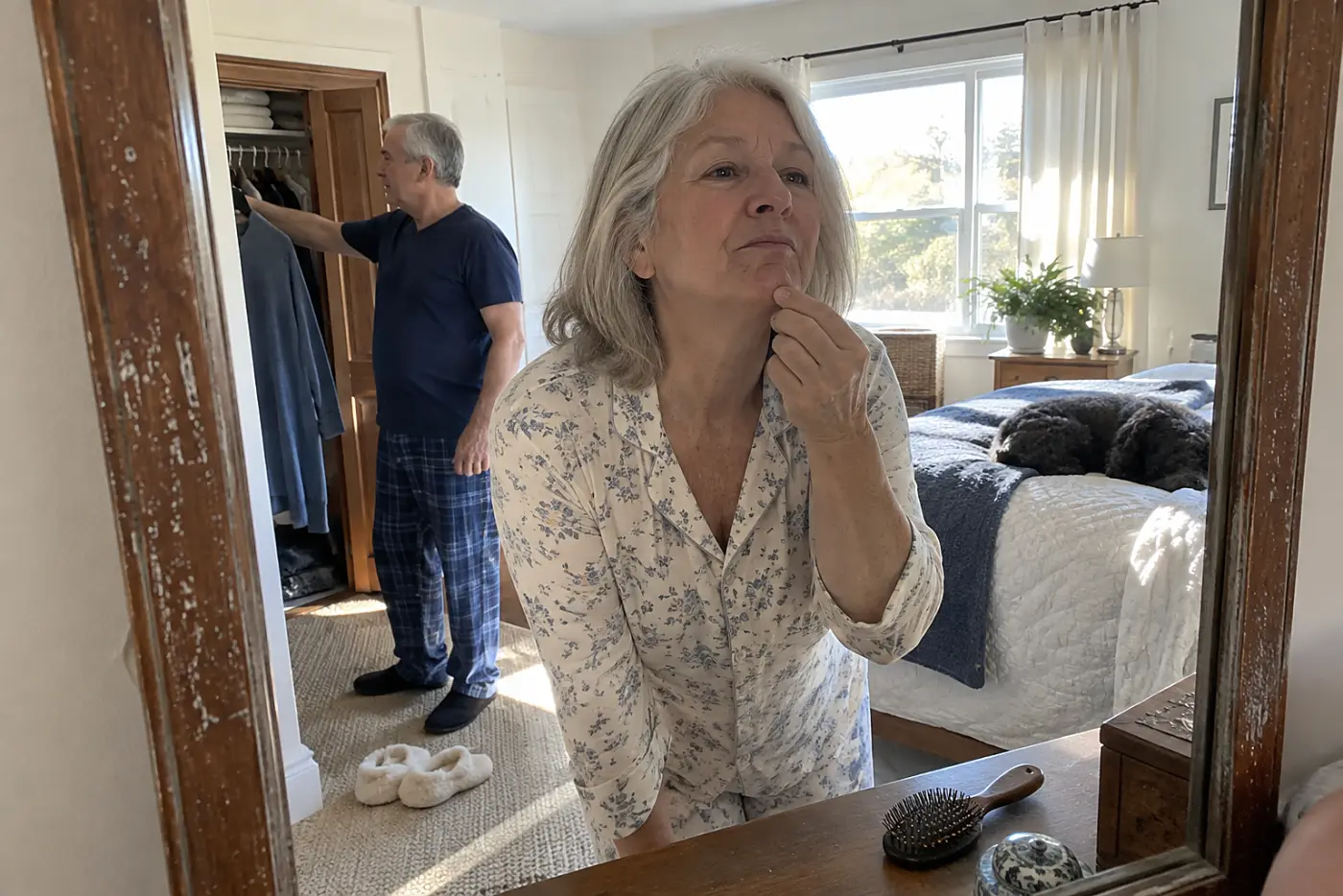
The mirror catches a chin hair before anything else changes.
After menopause, a shift in the balance between estrogen and androgens brings more noticeable facial hair for some women. Plucking removes the hair, but repeated plucking also irritates the skin around it. A red bump afterward isn't proof the hair was infected.
Sudden, rapid growth of coarse facial hair deserves medical attention, especially with voice changes or scalp hair loss. The Office on Women's Health lists facial hair among changes worth discussing with a clinician.
You get to decide whether to remove a few hairs. You don't have to accept inflamed skin as the price.
This week, note whether the hairs are appearing gradually or arriving fast. “These coarse hairs appeared quickly, and my scalp hair is thinning. Should we check why?”
The mirror isn't the only place skin changes hide.
6The toilet paper that suddenly stings

Vulvar skin changes don't announce themselves as skin changes.
Lower estrogen leaves vaginal and vulvar tissue thinner and drier. Wiping, sex, or fragranced products then bring stinging where you never had it before. The American College of Obstetricians and Gynecologists discusses these changes under genitourinary syndrome of menopause.
A yeast treatment won't fix every cause of burning. Guessing repeatedly delays an exam.
This week, stop scented products on the area and book a visit for persistent symptoms. “Wiping has started to sting. Could we talk about what changed?”
Another painful spot deserves its own look.
5The sore corner of your mouth

A split at your mouth's corner isn't always chapped lips.
Saliva collects in the crease, irritating skin that then cracks when you open your mouth. Yeast or bacteria can be involved. Lip balm across the whole mouth doesn't necessarily reach the cause.
If the corner keeps reopening, a clinician needs to see the exact spot. Treatment depends on what is behind the crack, not how much balm you own.
Notice whether dentures, drooling at night, or frequent lip licking keep that corner wet. Those details help more than saying your lips feel dry.
This week, take a clear photo before putting anything on the split. “This corner keeps cracking. Would you look at the cause?”
Your arms hold another easy-to-miss warning.
4The bruise beneath your sleeve
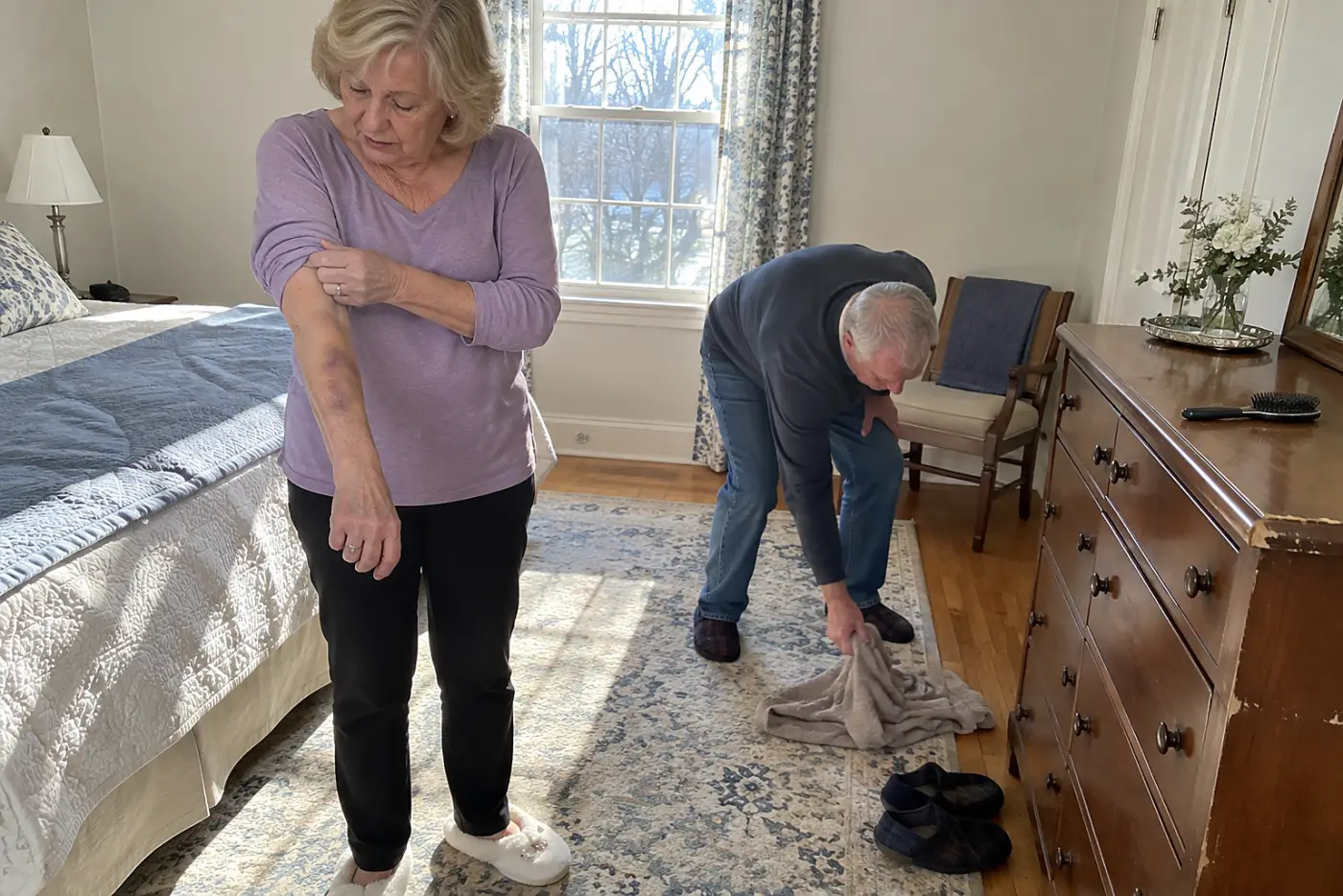
Thinner skin bruises more easily, but don't dismiss every bruise.
A bump against a drawer can leave a larger mark on thinner skin. Medicines that reduce clotting also make bruising more likely. Unexplained bruises, frequent bruises, or bleeding elsewhere need a medical review.
The National Institute on Aging describes thinner, more fragile skin with age. That doesn't tell you why a new bruise appeared.
This week, note where the bruise is and review your medicine list with a clinician. “I'm getting bruises I can't explain. Could we check my medications?”
There's a smaller mark with a different clock.
3The cut that keeps reopening
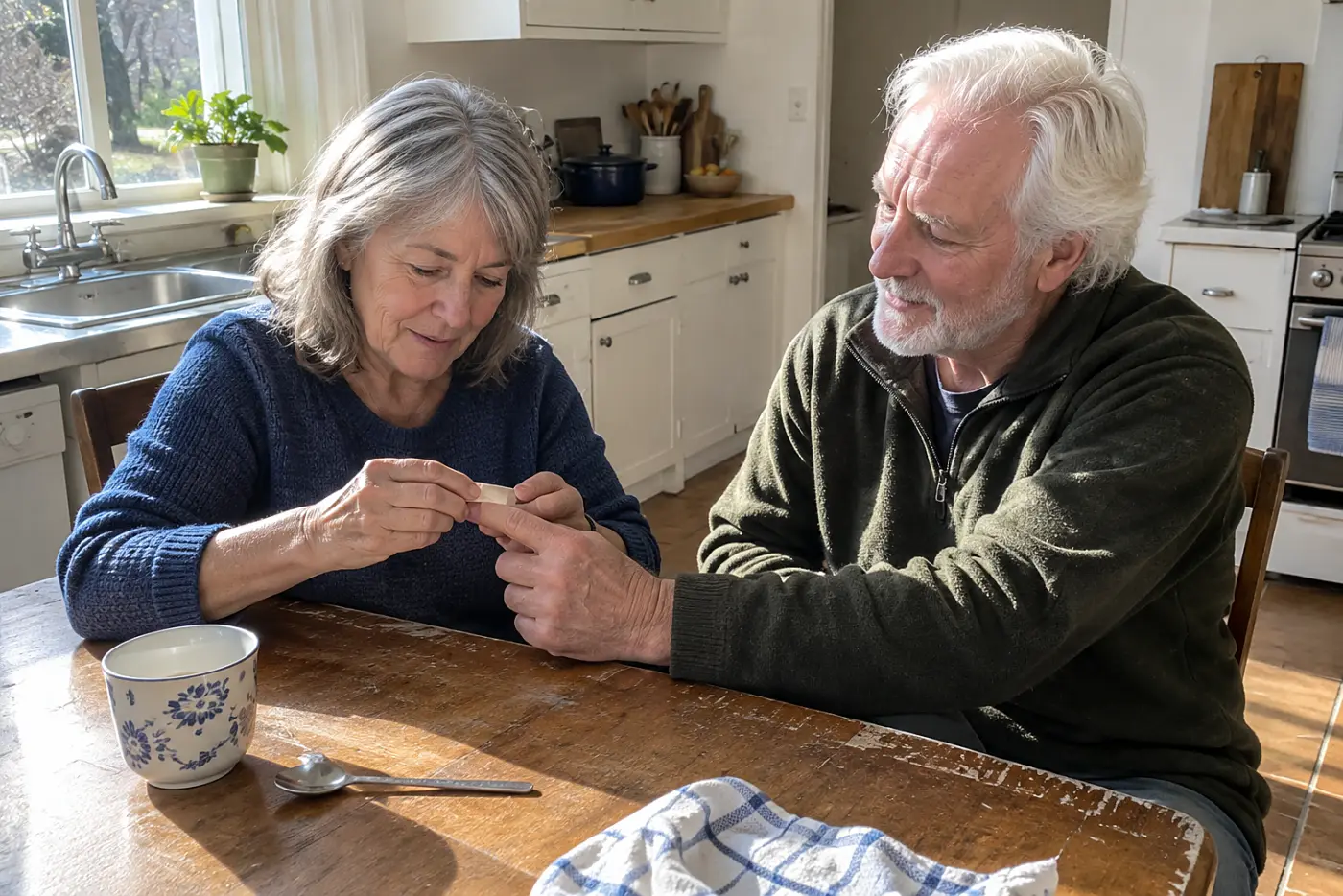
A small cut loses its chance to heal when it gets rubbed daily.
Skin repair takes time, and a shoe edge or watchband can tear a closing wound again. Covering the spot protects it from friction. Watch for increasing redness, warmth, swelling, pus, or worsening pain.
The American Academy of Dermatology advises cleaning minor wounds, keeping them moist with petroleum jelly, and covering them with a bandage. A wound that fails to heal needs a clinician's attention.
Don't pour alcohol onto it to prove you're taking it seriously. That stings, and it isn't the care the AAD recommends for a minor wound.
This week, identify what's rubbing the cut and protect it while it heals. “This cut keeps reopening even though I've covered it. Will you examine it?”
Now check the patch you can't blame on a scrape.
2The rough patch you keep scraping

A raised patch isn't something to file down.
A waxy, stuck-on-looking growth is one way seborrheic keratosis appears. These growths become more common with age. Scraping the surface irritates it and leaves you guessing about what was underneath.
Even a familiar growth deserves attention when it bleeds, changes, or keeps itching. The National Cancer Institute says changes in a skin growth or spot deserve an exam.
This week, leave the patch alone and photograph it in good light. “I've been treating this like dead skin. Would you look at what it is?”
That photo belongs beside any other change you've noticed.
1The appointment for a changing skin spot

A changing spot needs an exam, not another season of watching.
Skin cancer isn't a menopause symptom. A new or changing mark appearing after menopause still needs the same attention as one appearing earlier. The American Academy of Dermatology recommends checking for the ABCDE signs of melanoma: asymmetry, border, color, diameter, and evolving change.
“Evolving” is the word to keep. A spot that changes or bleeds needs attention even when it's smaller than a pencil eraser. A sore that doesn't heal belongs in the conversation too.
Your dated photos show what memory can't: where the spot was and how it changed. Take them to the appointment, but don't use the camera as a reason to postpone booking.
This week, make an appointment with a dermatologist or your primary care clinician for a new or changing spot. “This spot has changed since this photo. Will you examine it?”
Keep the pictures ready for the visit itself.
The bottom line
After menopause, less moisture and more irritation change how skin responds, but they don't explain every new mark.
You've already moved the cream beside the towel and stopped using what stings. You've booked an exam for the spot that changed.
Which of these has already happened to your skin?
Up next
23 Steps to a Simple Skin Care Routine for Women Over 60
Get the best skin care routine for women over 60 in the right morning and night order, with a sink-side table and no crowded shopping list.
Read the list →

Reader quiz
Did you catch the details?
5 questions from this article. Finish them all to unlock the editor's bonus tip.
What shower change does the article suggest trying this week?
Did any of these feel familiar?
Know someone who needs this?
Sources cited in this article
This article links to 6 outside sources, listed here so you can read them yourself.
- American Academy of Dermatology www.aad.org
- National Institute on Aging www.nia.nih.gov
- National Rosacea Society www.rosacea.org
- Office on Women's Health womenshealth.gov
- American College of Obstetricians and Gynecologists www.acog.org
- National Cancer Institute www.cancer.gov
Nora Bennett
Style Editor
Nora writes about hair, clothes and grooming for people who have stopped asking permission: what to keep, what to let go, and what reads as taken care of.
More from Nora Bennett