









How to Make Christmas Special for Grandkids Without Spending a Fortune
A plain plan for a Christmas that feels generous, from the first number on your notepad to the last box you mail in December.

By Irina Byalik, Style Editor
Updated · 13 min read
- Written by our style editor
- Cited 6 sources
- How we review
There's a notepad on the kitchen counter with every grandchild's name down the left side and a dollar figure beside each one. You've added it up three times. It still comes out the same.
If that column makes your stomach drop, you're in good company. In AARP's study of grandparents, 13% said gifts, travel and other costs made it hard to meet expectations.
The column leaves something out. What grandchildren carry into adulthood is mostly the hours, the rituals and the feeling of being wanted. Those cost far less than the toy aisle, and you already own most of what they take: a kitchen, a few recipes, a voice they know, and time.
Start with the number you can actually afford this year
Do this before you buy a single thing, ideally this week.
- Look at this year's money, not last year's list. A common mistake is setting the gift budget by what you spent in past years. Base it on what you can truly afford now, even if that number is smaller.
- Pick one total for the whole season. Gifts are only part of it. Count wrapping paper, tape, postage, baking supplies, the extra groceries when everyone comes over, and gas for the drive.
- Move that total somewhere separate. A savings account used only for gifts works. So does an envelope in a drawer. When it's empty, the season's spending is done.
- Then divide. Decide what goes to gifts, what goes to food and outings, and what goes to shipping.
The order matters. If you start with names and prices, the total grows to fit the list. If you start with the total, the list has to fit you.
If your household runs on Social Security or a pension, think about the year ahead too. A Christmas plan that only works on two incomes, or on savings you'd rather not touch, is a plan you'll dread repeating. Set a number you could keep for several years running.
Credit cards deserve a blunt word. If January has meant paying off December for a while now, this is the year to stop. Grandchildren can't tell a gift paid in cash from one still costing you interest in March, but you can.
A modest, steady budget also gives you something better than one big year: a pattern your family can count on. Write the number at the top of that notepad page and circle it.
What will they actually remember?
You've probably asked yourself this standing in a store, holding something that costs more than you meant to spend. Will it matter to them in ten years?
The honest answer is that the object usually won't, and the time usually will. In four studies, researchers Cindy Chan and Cassie Mogilner found that experience gifts strengthened relationships more than material ones.
An experience gift is something the person lives through, like an outing, a lesson or a day together, rather than something they keep on a shelf.
Those gifts also stirred more emotion and gratitude. The effect held even when the giver didn't take part in the experience. So a trip you plan but can't join still counts.
What each age tends to hold on to looks a little different.
Under 5: repetition. The same song while you decorate, the same cookie cutter shaped like a star, the same chair at your table. Little ones remember what happens every year.
School age: a job. Being trusted to crack the eggs, place the angel on the low branch, or read the Christmas story aloud. Being needed lands harder than being handed something.
Teenagers: being treated as someone. An outing with only them, no siblings, where you ask what they think and actually listen.
Grown grandchildren: being included. A call asking for their stuffing recipe, or an invitation to help with the meal, often means more than another sweater.
There's a reason this matters for you, not only for them. A Boston College study of grandparents and adult grandchildren found that emotional closeness meant fewer depressive symptoms in both generations.
The same study found that grandparents who received help but couldn't give any had the most depression. Giving is good for you. It just doesn't have to come from a store. Your time, your skills and your stories are gifts, and they're the ones the research says last.
Traditions that cost almost nothing
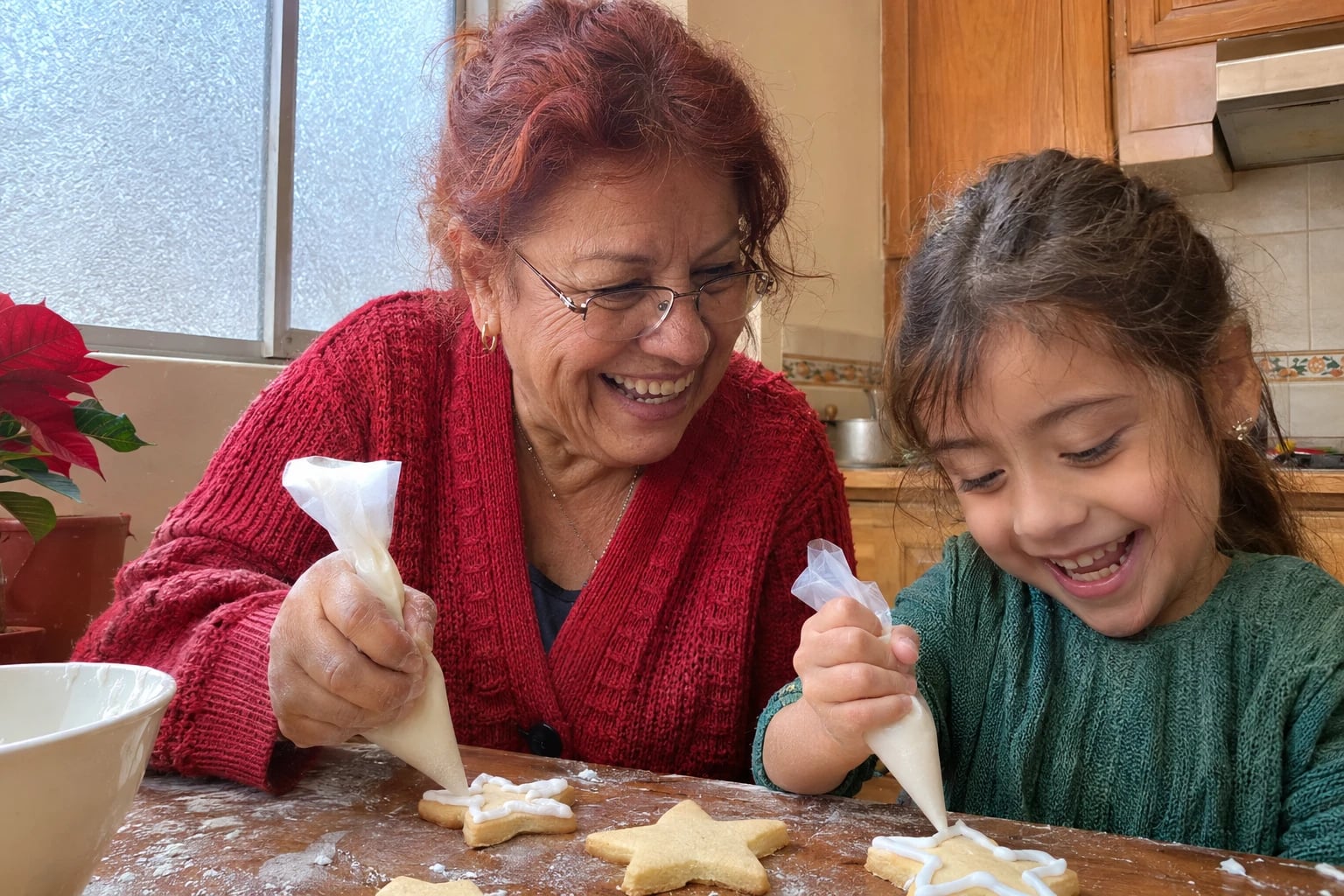
Picture a Saturday in mid-December, your mother's stained recipe card propped against the flour canister. Your granddaughter stands on a step stool beside you, leveling the flour with the back of a knife the way someone once showed you.
That's a baking day, and it's one of the ideas Utah State University Extension suggests for grandparents who want to give something lasting. Passing down a family recipe gives her a skill, a story about where it came from, and a reason to come back next year.
A few more from the same list, each cheap to run:
- An ornament every year, with a short note about why you chose it. By the time a grandchild has their own tree, they'll have a box of them.
- A holiday sleepover with matching pajamas and a movie on the couch. The pajamas don't have to be new or fancy. Matching is the point.
- Homemade coupons for outings with you: a walk to see the Christmas lights, a library afternoon, pancakes at your place.
Small numbers work in your favor here. If Christmas morning at a crowded house leaves you nodding along without catching much, that's common. Age-related hearing loss takes high pitches first, and children's voices are higher. Sounds like s, sh and th get lost in the noise.
So plan some traditions for one or two grandchildren at a time, at a kitchen table instead of a packed living room. You'll hear more of what they say, and they'll feel it. If you wear hearing aids, Christmas is the week to wear them all day.
Think about your footing, too. One in four adults 65 and older falls each year, and the holidays add cords, wrapping paper and excited pets darting underfoot. About 160 people a day are hurt decorating, nearly half of them in falls.
Let a grown-up handle the top of the tree and the lights along the roofline. Give the children the low branches and the job of gathering paper into a trash bag as gifts are opened. They like the task, and your floor stays clear.
Gifts that cost little and say a lot
Some years you'll still want something to wrap. Good. A small gift with a plan attached can do the work of a big one.
Pair a gift card with a promise. A small card for an ice cream shop, tucked into a note that says "for our next ice cream date," turns a few dollars into an afternoon together. The date is the gift. The card just pays for it.
Turn an object into an invitation. In the same research on experience gifts, framing a physical gift as an experience helped. A mug given as an invitation to a hot chocolate morning landed better than a mug alone, though a real outing did better still.
So a deck of cards becomes "Tuesday night rummy at my house." A paperback becomes "we'll read this together over video call, a chapter a week." A recipe card in your handwriting becomes "come make this with me in March."
Give toward the future. Some families already have several sets of grandparents buying toys. A small gift into savings may suit them better.
A 529 plan is a state-sponsored college savings account that a parent, grandparent or other adult can own for a child.
Ask the parents whether the child has one and how they'd like gifts to arrive. Put a note in the card saying what you gave and why, so the child has something to open.
Savings bonds are another route. Gift bonds, either Series EE or I, come only in electronic form through TreasuryDirect, starting at $25.
You'll need the child's full name, Social Security number and TreasuryDirect account number. You have to hold the bond for 5 business days before delivering it, so start by early December. TreasuryDirect offers printable gift announcements, which give a child something to unwrap.
For grown grandchildren, skip guessing. If you don't know what they'd like, a physical present has a real chance of ending up at the thrift store. A card with a check, a gift card for a place they love, or an invitation to lunch is kinder to both of you.
If a toy you love fails the noise test, put masking tape over the speaker or look for a volume switch. A phone sound-meter app will tell you where it stands.
Better still, choose toys that run on no batteries at all. Blocks, crayons and a cardboard box have never once needed a volume knob.
Many grandchildren, one fair rule
Children notice who got more. You already know this, and it's why fairness gets harder with every new baby, every marriage, every stepgrandchild who joins the family.
The fix is to stop deciding child by child. Pick one rule, apply it to everyone, and say it out loud before Christmas instead of after.
Some rules that work for families like yours:
- Same amount for every grandchild, whatever they're getting.
- A name draw among the cousins, with a spending cap, so each child gets one real gift and you give one too. Families also call this a Secret Santa.
- Small gifts at Christmas, bigger ones at milestones: graduations, weddings, new babies. Your budget goes further, and the big moments get your full weight.
- A switch at a set age. There's no correct age. Some grandparents choose 18, some 21, some the end of school. Choose one and tell everyone ahead of time.
If you have grandchildren in their twenties earning good money, it's not mean to stop sending them cash while you still give to the little ones. It's a rule, as long as it applies to all of them the same way. A card, a call and a seat at your table still say plenty.
Blended families need the rule most of all. If a stepgrandchild gets the same as everyone else, under the same rule, nobody has to wonder what a smaller gift meant.
When you need words, these are plain enough to say on the phone:
"I'm keeping things simpler this year. Every grandchild is getting the same, and I'd love a day with each of them."
"I can't spend what I used to. That's all it is."
You don't owe anyone a longer explanation than that last line. If it feels hard to say, write it down first and read it to the dog.
Keep a running list of who got what, and roughly what it cost. When a question of fairness comes up next November, you'll have the answer on paper instead of trying to remember.
When they live too far to hug
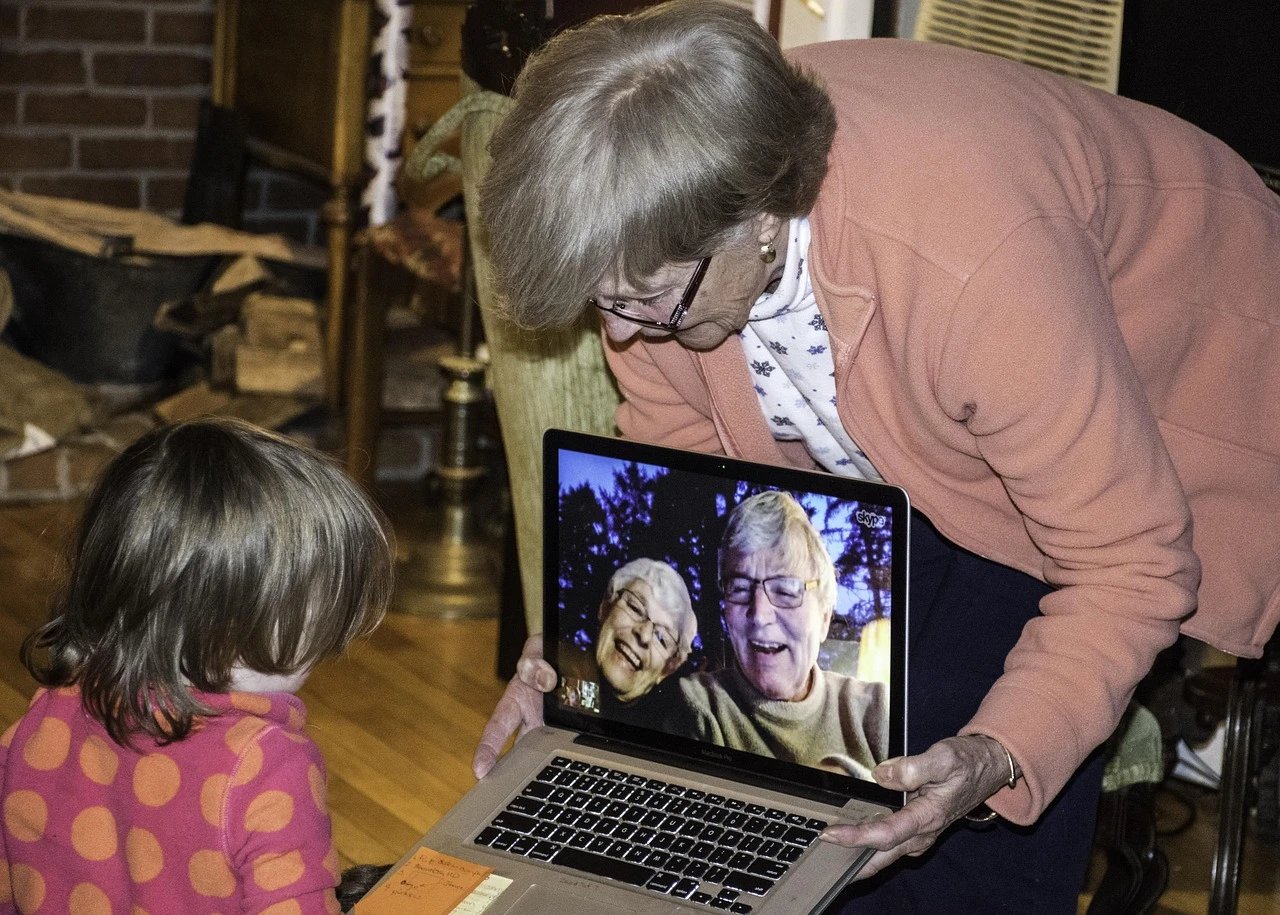
Distance changes the logistics, not the bond. Penn State Extension's aging specialist says you don't need everyday contact to be important to a grandchild.
Some of the best long-distance gifts weigh almost nothing.
Picture postcards arrive with your handwriting and a stamp, and a child gets mail with their own name on it. Send one in early December and another the week after Christmas.
Recorded letters. Send a short video or audio message a young child can replay. Read a picture book aloud on video. Sing the song you always sing. Show them the tree in your living room and point to the ornament they gave you.
A phone call that feels like an event. If calls are saved for special occasions, they stop being background and start being something to look forward to. Set a time on Christmas Eve and tell them the night before.
Shipping can eat a budget faster than the gifts themselves, especially with a big family. Send one box to each household instead of one per child. Better yet, send the boxes earlier and lighter.
One warning belongs here, because distance is what scammers count on. In a grandparent scam, someone calls or texts pretending to be a grandchild in trouble and asks for money or gift-card codes.
Gift cards are the payment older adults most often report in these family impersonation scams, and older adults are more likely than younger ones to report losing money to them this way.
If a "grandchild" asks you to read off gift-card codes, hang up and call that grandchild or their parent on the number you already have. A real grandchild will understand.
Next year, think about having a grandchild visit you instead. Invite one grandchild at a time, and keep first visits under a week. A single child at your house for four days, with no cousins competing for you, can become the Christmas they're still talking about at 40.
How to talk with their parents about gifts and rules
This is the conversation most grandparents put off, and the one that makes everything else easier. Early November is the right time. Gifts haven't been bought yet, and nobody is stressed.
Start by knowing what many parents say when grandparents aren't in the room. Plenty of them are pleading for no more toys, tired of the clutter, and wishing someone had saved for them when they were small. Your grown child may feel the same and not know how to say it.
So ask first. Call, don't text, and ask two things: what the kids actually need, and whether there's anything they'd rather you didn't buy.
Then listen. You may hear that one child needs snow boots, or that the family would love a contribution to a college fund, or that what they really want is for you to take the kids for an afternoon so they can wrap.
Bring up the rules while you're on the phone. Screen time, sugar, bedtimes at sleepovers, which movies are fine. Knowing beforehand saves you from a moment at the door where you feel corrected in front of the grandchildren.
If money has changed for you, this is the place to say so. You don't need to share figures. "My budget's tighter now that I'm retired" is enough, and most grown children are relieved to hear it said plainly.
Then there's the thank-you problem. Many grandparents know the feeling of a gift that's never acknowledged, with no call and no card. So does the small sting of seeing grown grandchildren's names simply signed onto their parents' gift.
Resentment won't fix either one. A request to the parents might. Try: "It would mean a lot to get a photo of Ella with her book, or a quick video. That's how I know it arrived." Most parents will happily help a child record twenty seconds on a phone.
For grown grandchildren, ask them directly and warmly to call you Christmas week and tell you what they're up to. It tells them what you'd value, without asking for a present.
Close the call by setting one date: the day you'll see the kids, or the day you'll call. Put it on the calendar on your fridge before you hang up.
The bottom line
Tonight, before anything else, write down the single dollar figure you can spend this season, including postage and food. Put that money somewhere separate. Every other choice gets easier once that number is fixed.
Up next
20 Last-Minute Christmas Gifts Over 50 You Can Still Get in Time
From merino hiking socks to a weekday matinee for two, these gifts can be picked up, emailed or booked in time, and none look rushed.
Read the list →


Reader quiz
Did you catch the details?
5 questions from this article. Finish them all to unlock the editor's bonus tip.
According to the article, what is a common mistake when setting a holiday gift budget?
Did any of these feel familiar?
Know someone who needs this?
Sources cited in this article
This article links to 6 outside sources, listed here so you can read them yourself.
- AARP's study of grandparents www.aarp.org/family-relationships/grandparents-money
- TreasuryDirect treasurydirect.gov/savings-bonds/gift-a-bond
- CPSC www.cpsc.gov/Safety-Education/Safety-Education-Centers/Holiday-Safety
- ASHA www.asha.org/news/2024/holiday-health-alert-noisy-toys-can-cause-hearing-loss
- Penn State Extension's aging specialist aese.psu.edu/outreach/intergenerational/articles/being-a-long-distance-grand…
- Check all dates at USPS www.usps.com/holiday/holiday-shipping-dates.htm

Irina Byalik
Style Editor
Irina Byalik is a hairdresser and the owner of New Image Hair Salon in East Brunswick, New Jersey, with more than 20 years of experience. She came to the United States from Ukraine.
More from Irina Byalik