


20 Mother of the Bride Dresses Over 50 for the Big Day
From a tea-length lace dress with elbow sleeves to a burgundy column gown, twenty dresses that look like you, dressed for your child's wedding.

By Irina Byalik, Style Editor
Updated · 18 min read
- Written by our style editor
- Cited 2 sources
- How we review
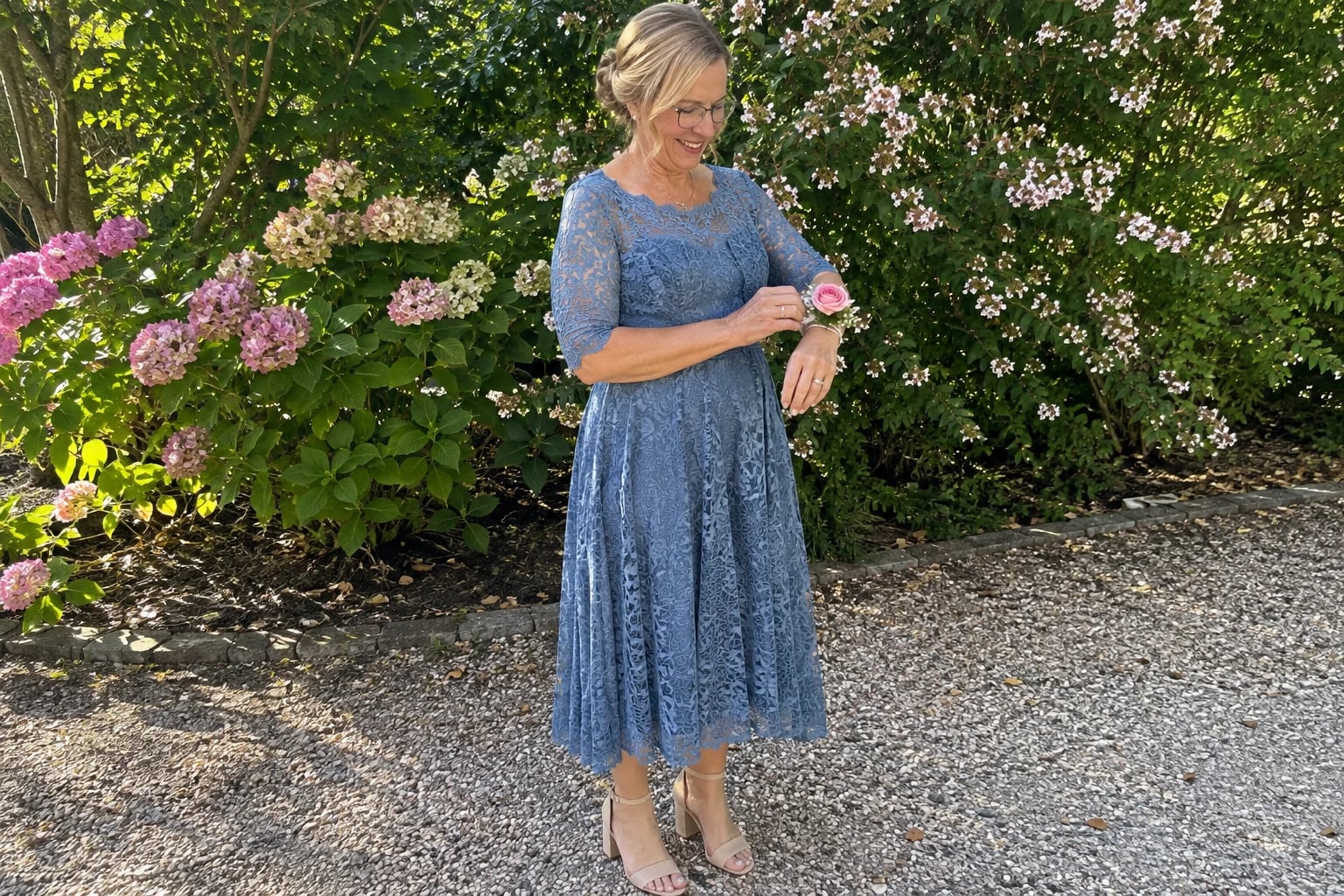
The dress at #1 covers your arms with no jacket and works from a church at noon to a reception that runs past dark.
The couple's colors came by text: three paint chips, eucalyptus, cream and a gray-blue with a name like fog.
Then you went shopping. The mother-of-the-bride rack offered stiff coral taffeta, sequined jackets and a coat dress that seemed to want a hat. You aren't that woman, and you don't want to be her in forty years of framed photos.
You also don't want to stand beside the couple looking as if you'd dressed for your own big night. The dress you want exists. It just rarely hangs under that sign.
Evening and black-tie
If the invitation says black-tie or the reception starts after dark, you can go long. These five carry a floor-length hem without looking like a costume.
20A Burgundy Crepe Column Gown
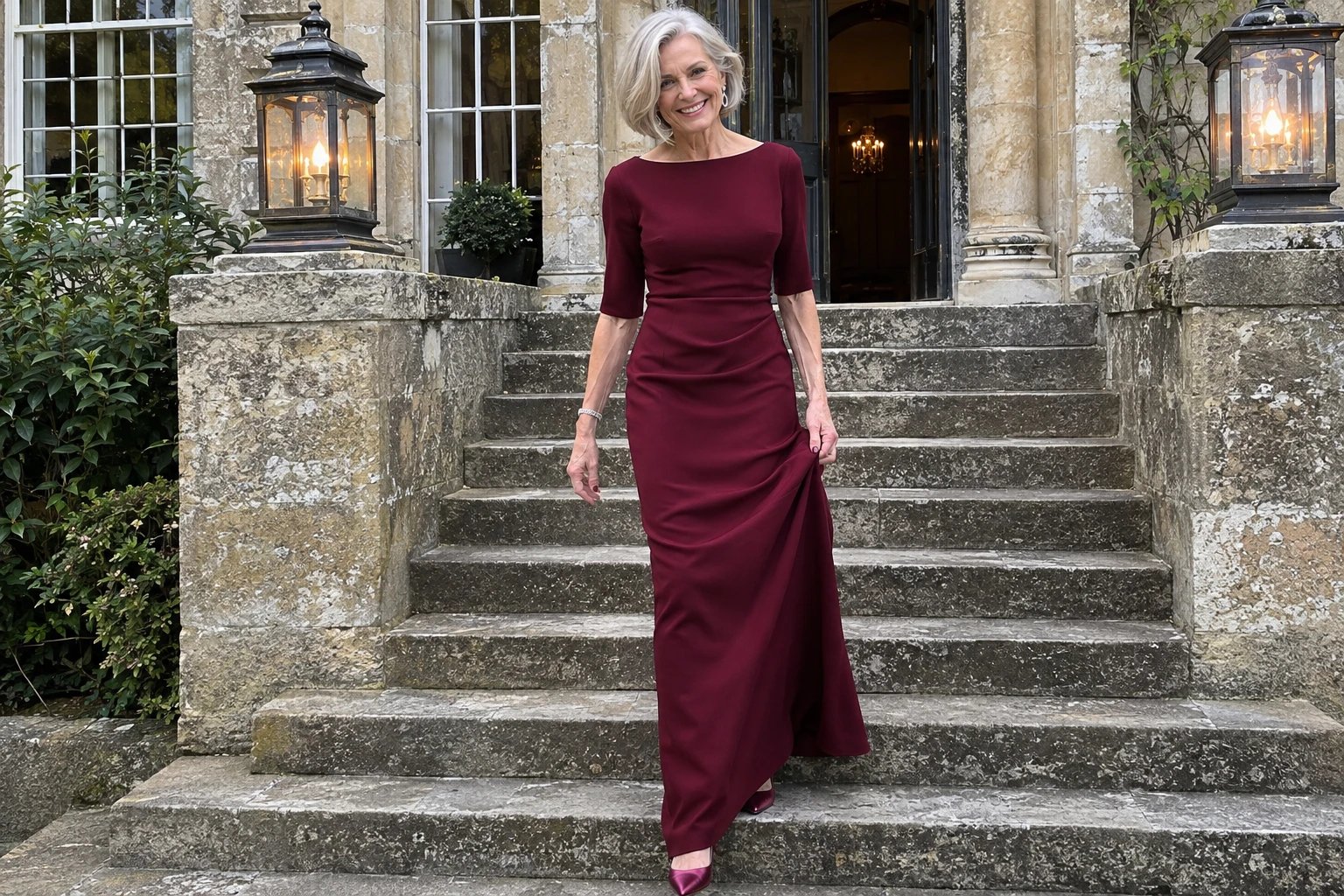
One deep color from collarbone to floor, no seam at the waist, and crepe heavy enough to fall in a straight line. That's the whole idea of a column gown, and it's why it suits so many women at a black-tie reception.
The missing waist seam matters more than it used to. As estrogen drops, fat tends to move from the hips and thighs toward the belly, as Cleveland Clinic explains.
A seam that once sat at your narrowest point may now land somewhere else. A column skips the question entirely.
Ask for a bateau or soft V neckline and a sleeve to the elbow or wrist. If you're under about 5'4", keep any slit low and at the side. Crepe is matte, so let your earrings bring the shine.
Burgundy is the safe deep red. Bright red is out at a traditional Western wedding, but burgundy, maroon and wine look rich and stay well clear of the bride.
19A Beaded Chiffon Gown With Illusion Sleeves
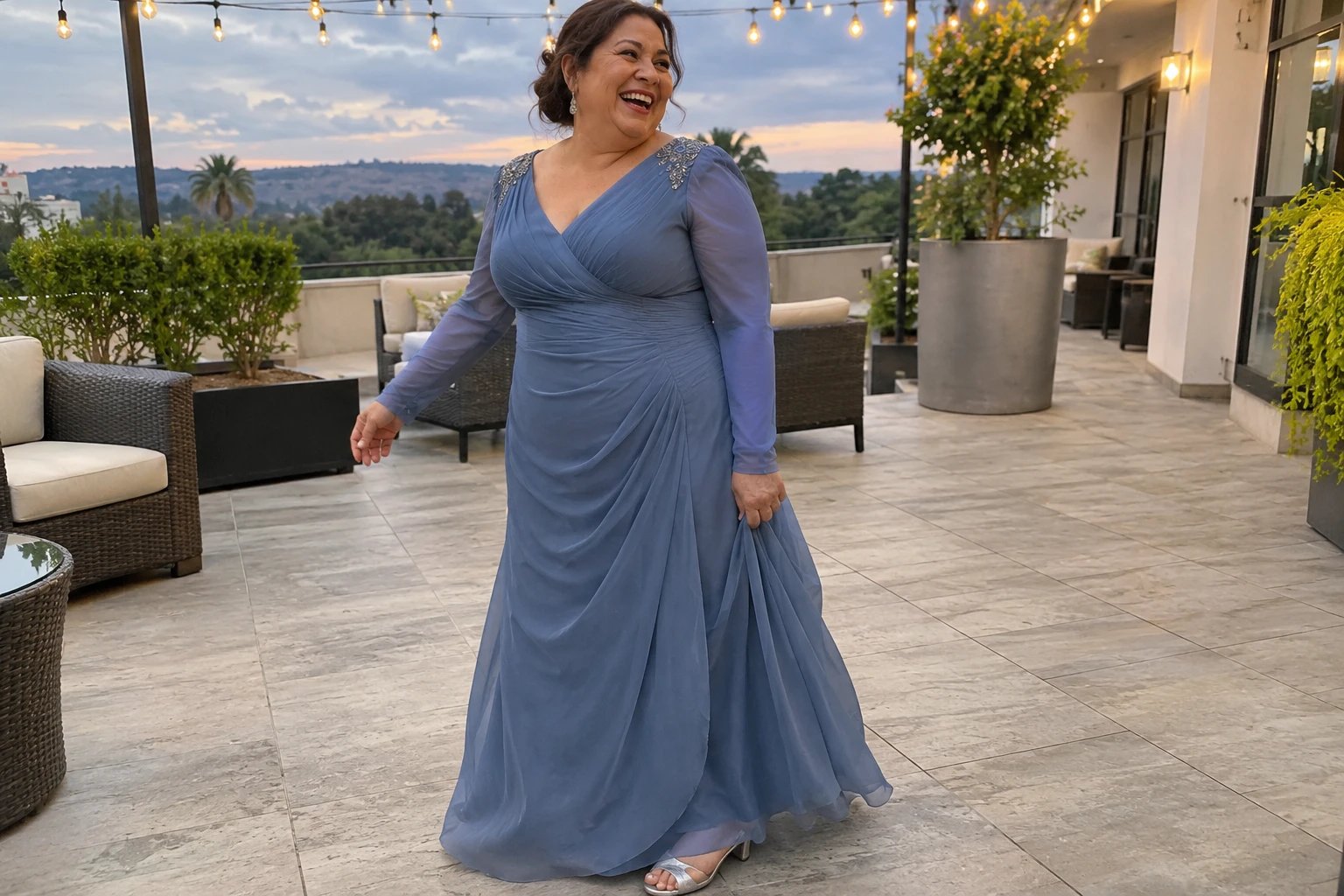
From across the room it looks like bare arms under a scatter of beads. Up close, there's a fine layer of mesh from shoulder to wrist. That's an illusion sleeve, sheer fabric over skin, and it covers your upper arms with no jacket at all.
It suits you if you want coverage but hate the weight of fabric on your arms. It's less kind when heavy beading sits at the hip, where it adds bulk in photos and scratches when you sit.
Before you buy, sit down in it for a full minute, then hug someone. Mesh with no stretch pulls at the underarm.
Plan the tailor early. Chiffon and beaded lace need someone who has worked with delicate fabric. Anything with beading or sleeves should go in about six weeks before the wedding.
Steer the color away from champagne and pale gold, which can read as bridal beside a white gown. Pewter beads on dusty blue or slate photograph like frost on a window, with none of that risk.
18A Black Satin Gown for Black-Tie Nights
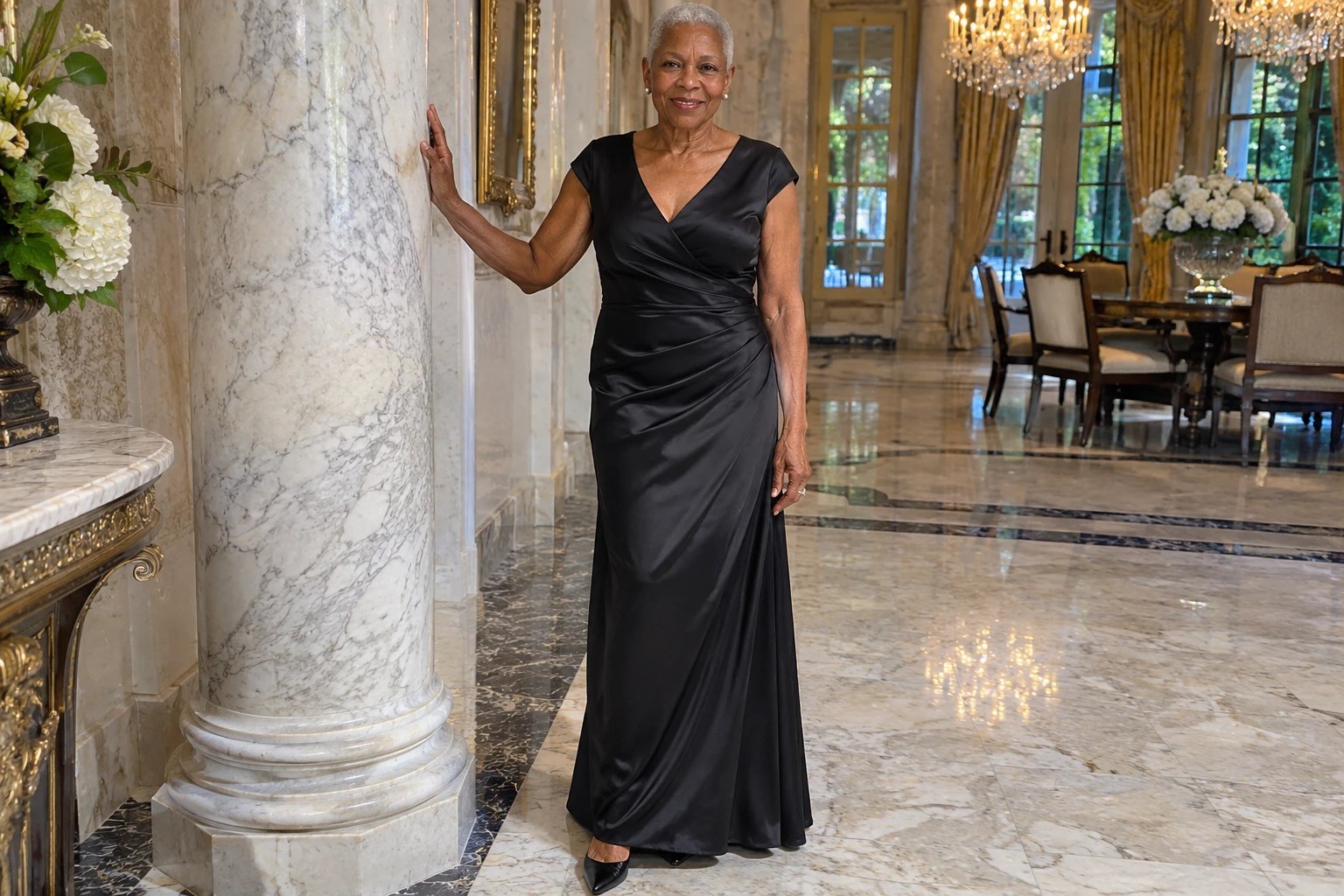
Long black satin, a clean neckline, and a line of light running down every fold. If the invitation says black-tie and the party runs after dark, this is the black dress that fits the rules. At a daytime or garden wedding, skip black altogether.
Satin is the right black for photos. Very dark dresses lose their detail in dim light and turn into a flat shape. A fabric with sheen gives the camera an edge to find.
That same shine shows every line underneath. Choose your shapewear before the first fitting and wear the same pieces every time, or the tailor's work won't hold.
Is it worth the money? If your calendar has galas, symphony nights or a cruise formal ahead, a well-cut black gown is the one you'll actually wear again. If not, spend it on a color.
17A Long-Sleeve Velvet Sheath for Winter
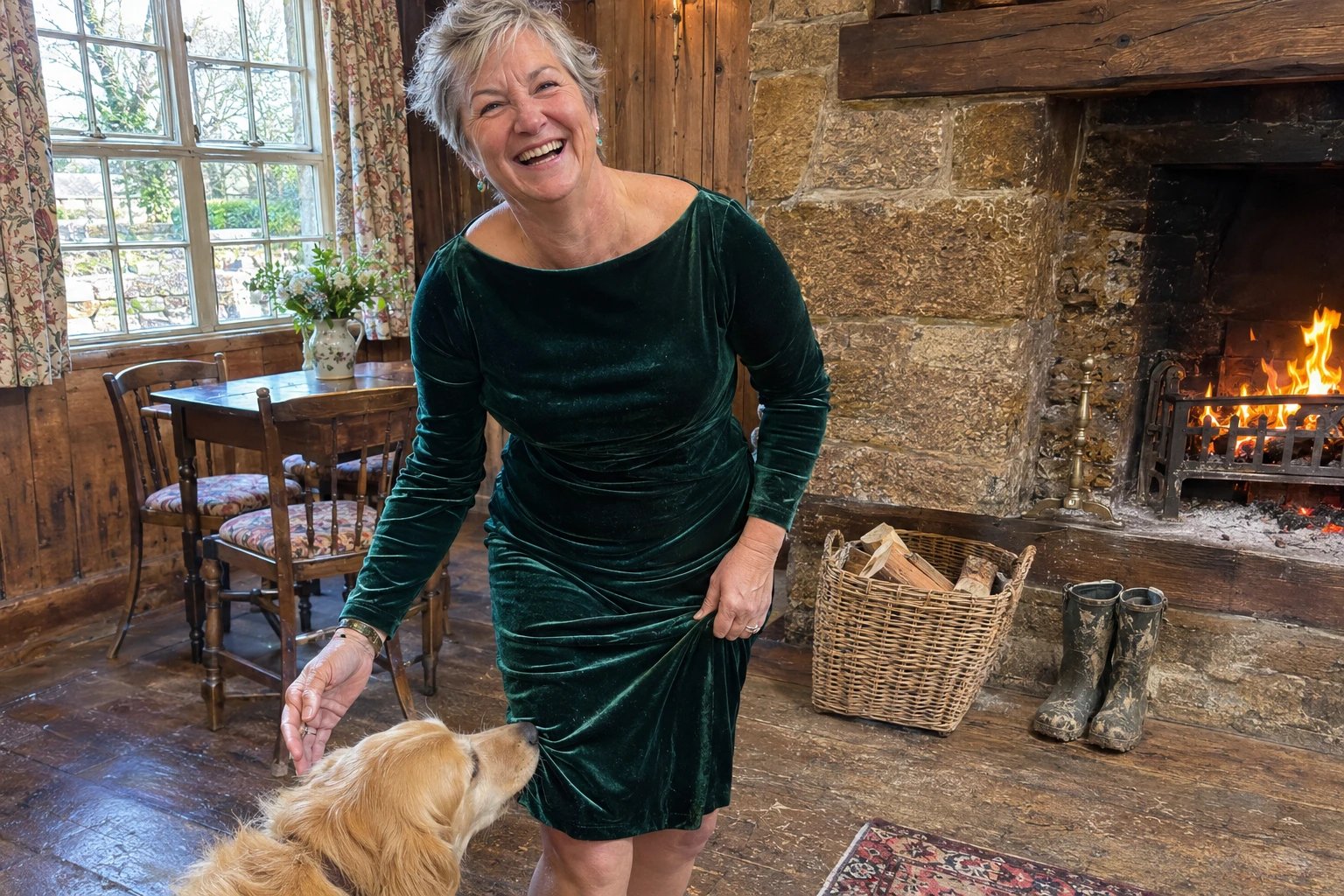
Deep emerald velvet, long sleeves, a bateau neckline and a hem just below the knee. At a December wedding in a hotel or stone church, velvet catches candlelight and photographs with real depth, because the pile holds light and shadow at once.
Now the catch. The menopause transition averages seven to nine years and can run into the 60s, according to Yale Medicine. Each hot flash lasts one to five minutes and centers on the chest, neck and face.
Long sleeves, velvet and a closed neck give that heat nowhere to go. If you still get flashes, look for velvet with a V or scoop neck. Or choose a sleeveless velvet sheath with a chiffon wrap you can drop on a chair.
Check the pile in daylight before you buy: patchy or crushed velvet looks tired in close-up photos. Good sapphire, garnet or plum velvet glows the same way the emerald does.
16A Floor-Length Jersey Wrap Dress
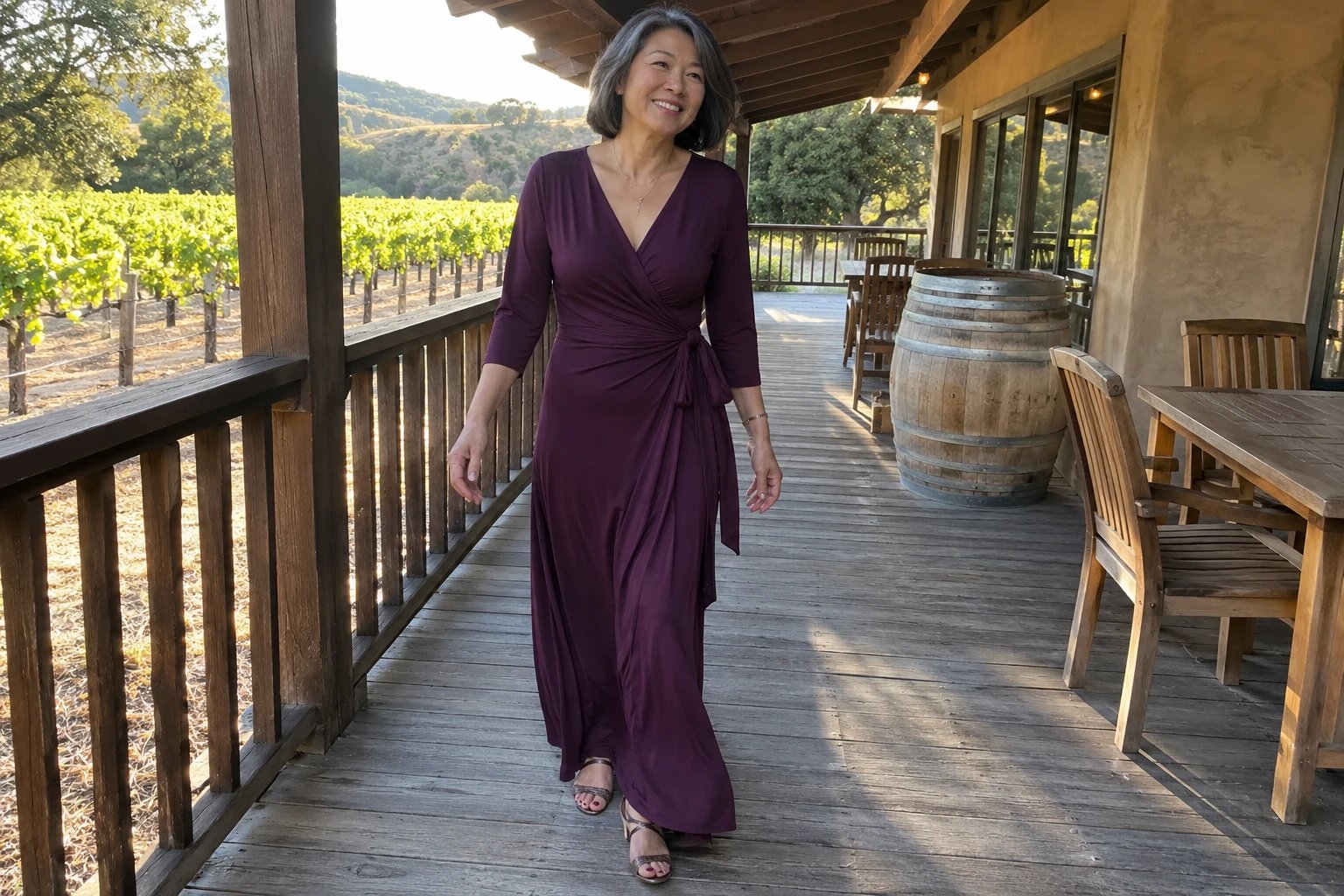
Soft matte jersey, a V that crosses at the front, a tie at the hip, and a skirt to the floor. A wrap is the most adjustable dress you can own, because you decide where the waist sits every time you put it on.
That helps if your middle has changed shape, or if you're between sizes. It also rolls into a carry-on for a destination wedding and comes out without wrinkles.
The fabric decides everything. Thin jersey clings to every seam of your underwear and looks like loungewear in pictures. Hold it up to a window: if you can see your hand through a single layer, put it back.
Have the V tacked at the depth you like, so you aren't checking it all night. Take your dancing shoes to the fitting, because a floor-length hem is right at only one heel height.
Church and formal daytime
A morning or afternoon ceremony in a church wants a hem at the knee or below and something for your arms during the service. These five handle both.
15A Sheath Dress With a Matching Bolero
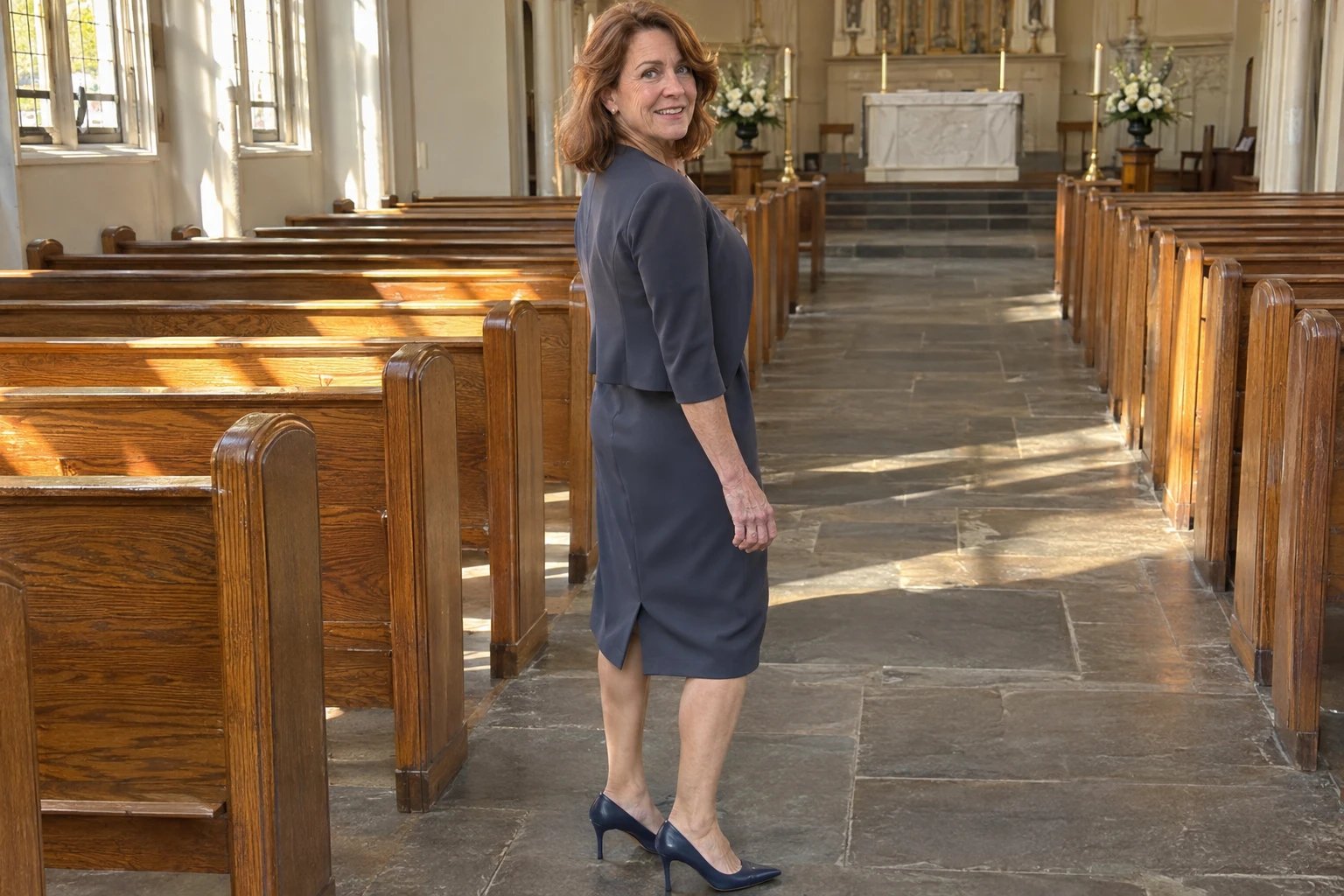
A crepe sheath to just below the knee, with a short jacket in exactly the same fabric, collarless, ending just under the bust.
A bolero is a jacket that stops above the waist, and that's its advantage: your arms are covered and your waist still shows.
Women split hard on whether boleros look elegant or dated, and the difference is in the details. Matching fabric, a clean edge and a three-quarter sleeve look current. Contrast lace and ruffled trim look like 1995.
A shrug, which covers only the arms and shoulders, can look sharp in the same fabric. It does read more like a cover-up than a finished outfit, though.
Test any jacket before the shop wraps it. Reach both arms forward as if you're hugging your child. If it pulls across your back, it needs a size up or a tailor.
14A Midi Dress Under a Long Duster Coat
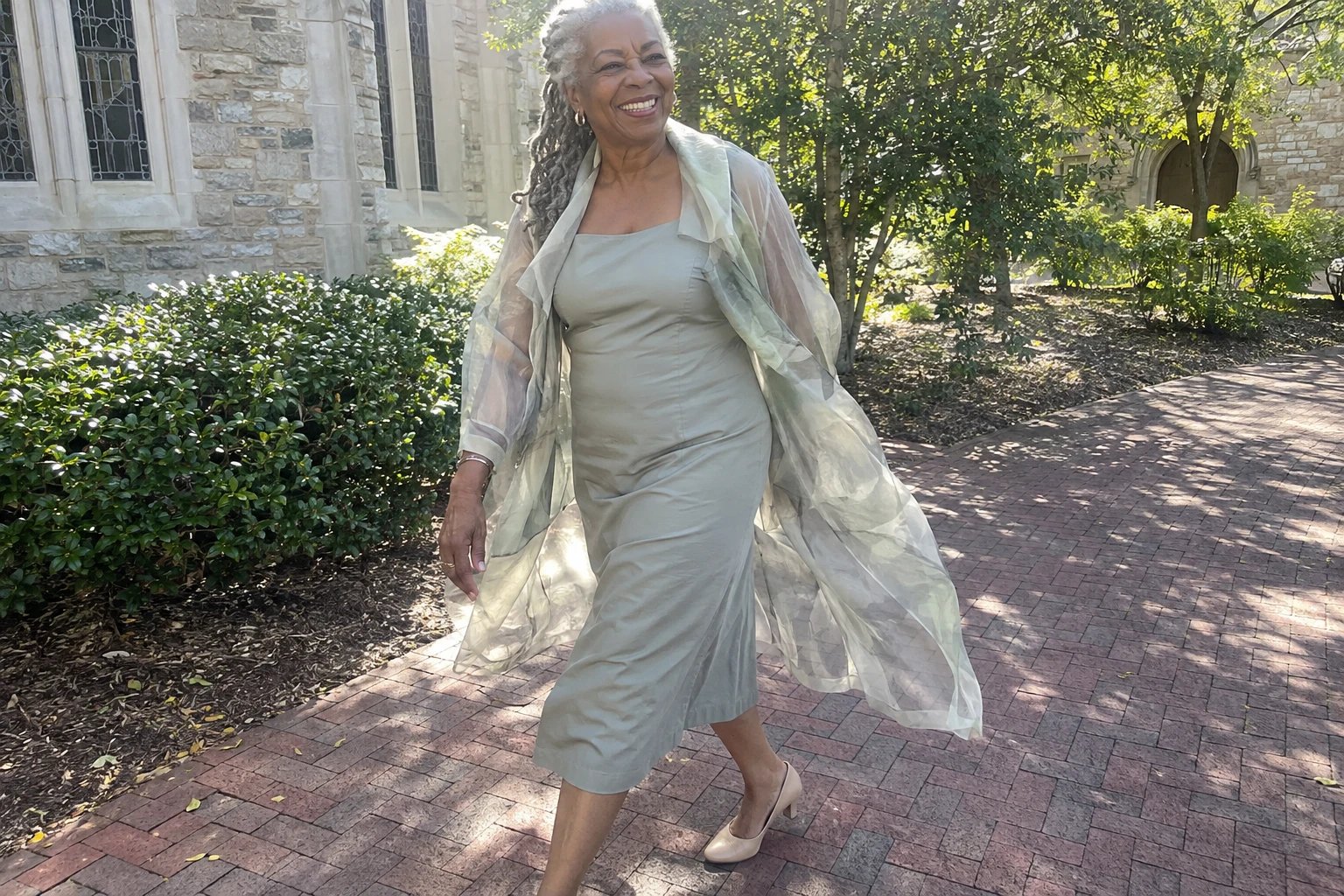
A sleeveless midi in pale gray-green, and over it a long sheer organza coat that hangs open and moves when you walk.
A duster coat is long, light and unlined. It gives you the polish of a coat dress without the stiffness that makes the traditional one feel like armor.
It solves three things. Churches run cold, and this covers your arms. Receptions run hot, and it comes off in a second. If you still get hot flashes, that second counts.
The risk is length. Most women lose about two inches of height between 30 and 70, and a duster that hangs past the dress swamps a smaller frame.
Have the coat end at the dress hem or an inch or two above it.
Ask for the two pieces in different weights: chiffon over crepe, organza over satin. Two layers of the same heavy fabric start looking like the old coat dress again.
13A Navy Crepe Midi With a Soft Neckline
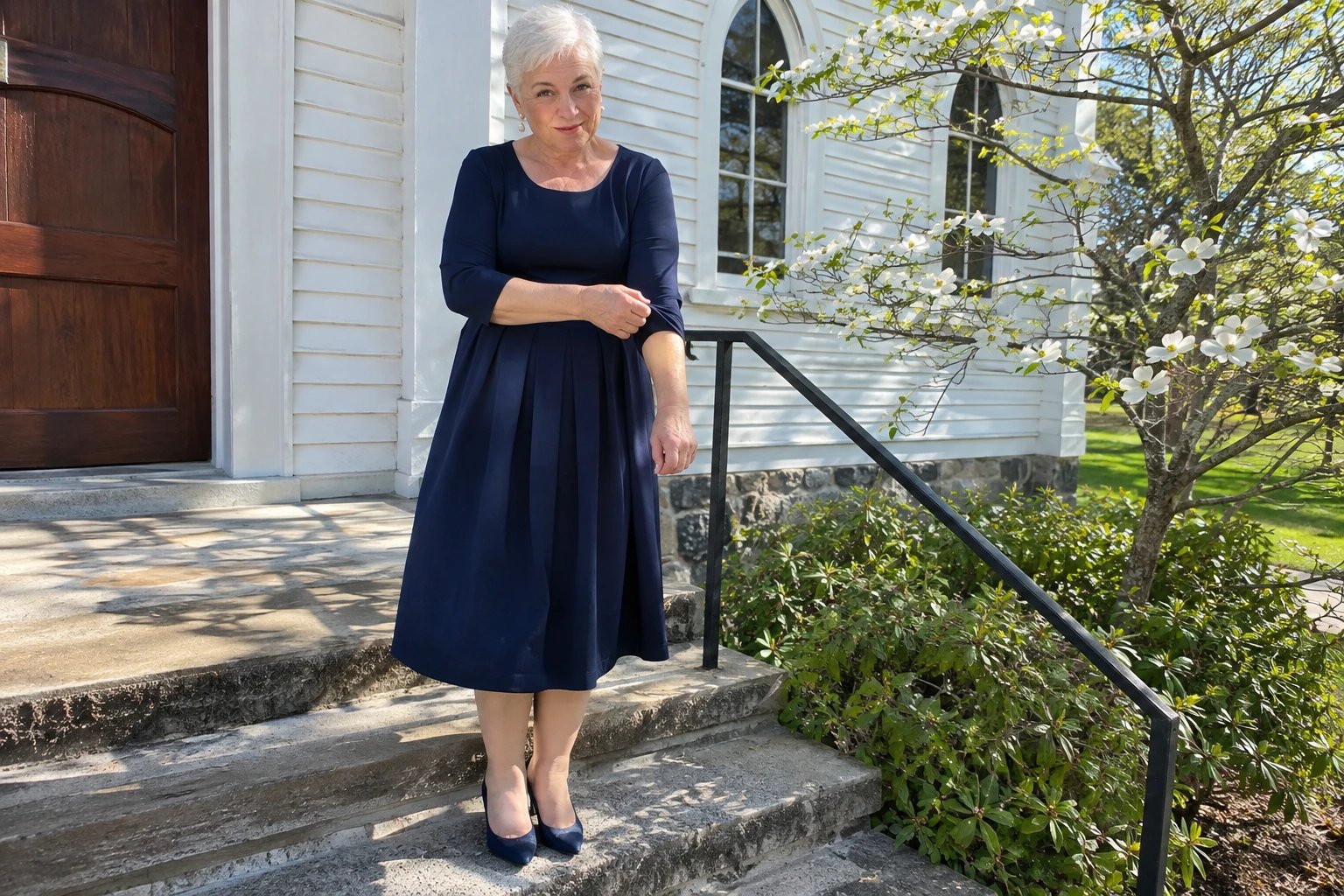
Navy with a soft scoop neck, a few gentle pleats at the waist and a midi hem. It's a favorite for good reasons. It's also the dress families most often call too dark, too somber, almost funereal.
Navy can work, even in spring. For an April or May wedding, look for a brighter navy, closer to ink than to midnight.
Three things make it look mournful: dead matte fabric, a loose fit through the middle and shoulders, and nothing light near the face.
Fix the fabric first. Navy has the same dim-light problem as black, so choose crepe with a faint sheen, or navy lace.
Then fix the fit. A tailor can shape the bodice at the bust, ribs and waist. That takes the sag out of the shoulders too.
Finally, bring light to your face with pearls, silver, or a pale wrap in one of the couple's colors.
12A Plain Crepe Sheath With Room for Sparkle
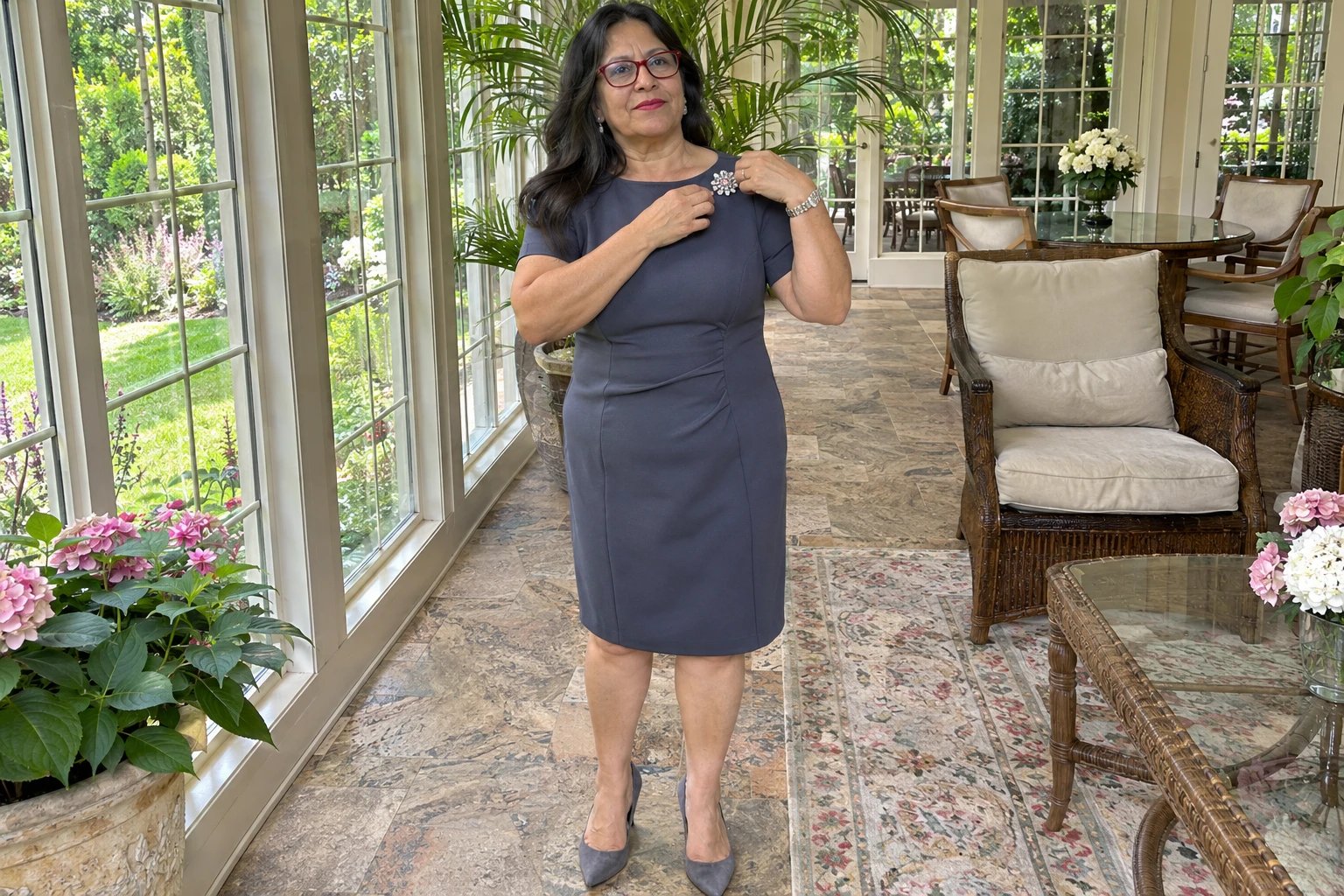
A slate crepe sheath, knee length, short sleeves, round neck, and nothing on it at all. On the hanger it looks almost too simple. Many women worry it will look underdressed next to the other family.
Plain is the best place to start, as long as you add one thing. A sparkly jacket, a beaded shawl, a statement necklace or a brooch can each carry it. Pick one and put it near your face, where the camera looks. Two start competing.
Wait to buy that piece until the dress is in your hands. Jewelry and shoes should be matched to the real fabric, and a slate that looked gray online can arrive bluer or greener.
This is where money is well spent. A well-cut plain dress plus one good piece will outlast any beaded dress, and you'll wear both again at the next anniversary dinner.
11A Fit-and-Flare With Three-Quarter Sleeves
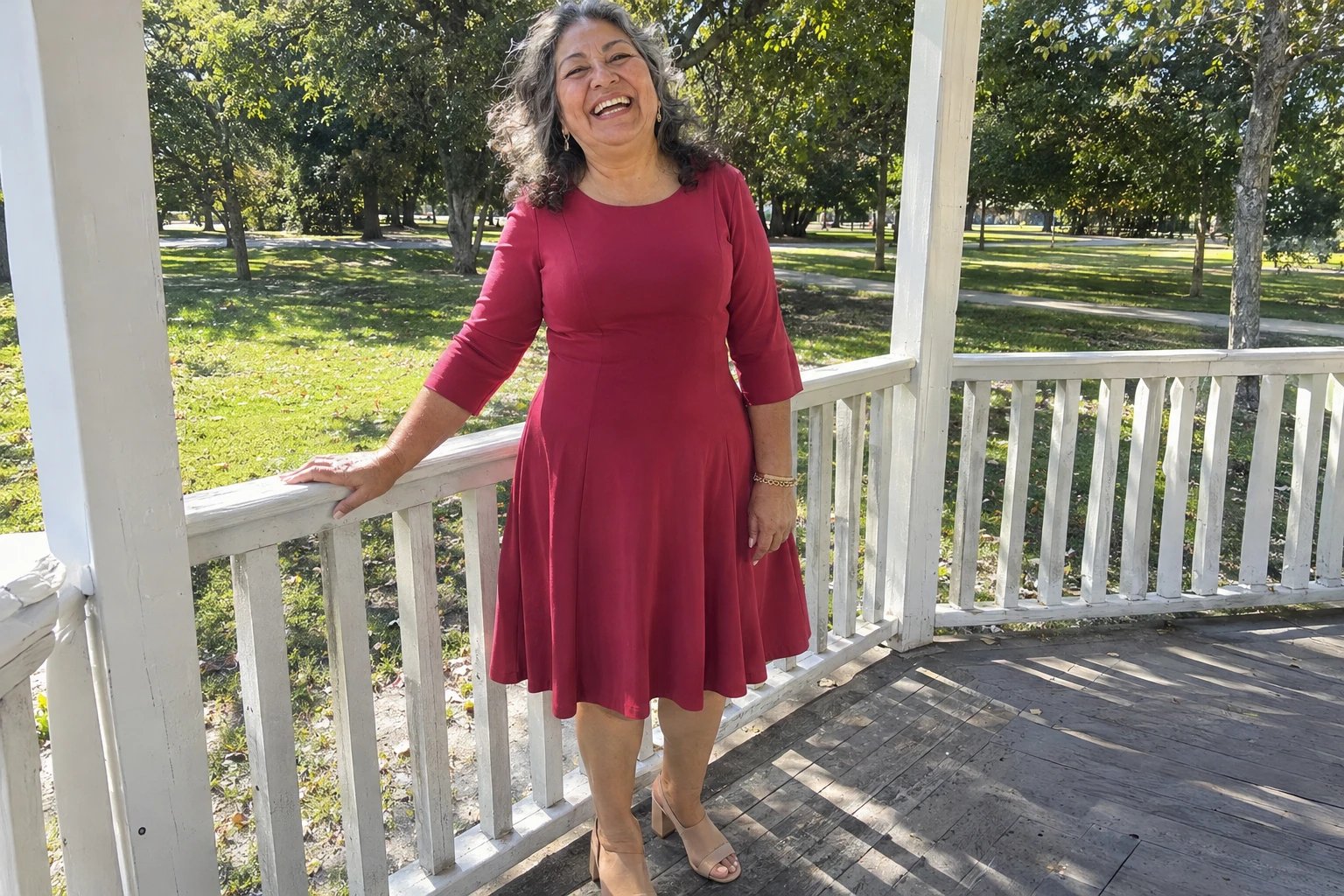
A fitted bodice, a skirt that swings out from the waist, and sleeves that stop between elbow and wrist. Three-quarter sleeves cover the whole upper arm but leave the wrist bare, the slimmest part of most arms and the place a bracelet looks best.
Fit-and-flare depends on your waist. If yours is still your narrowest point, this shape shows it off.
If your middle has filled in, look for a waist seam set an inch or so higher, just under the ribs, so the skirt flares before your belly does.
Watch the hem while you stand the way you really stand. With age the spine tends to tilt forward, which can make a hem dip in front and ride up behind.
A good tailor will level it on your body, in your wedding shoes, with you relaxed rather than stretched tall.
Beach, backyard and courthouse
Smaller and more casual weddings still put you in the front row of every picture. You want a dress a notch above the guests and easy to stand in all day.
10A Knee-Length Cocktail Dress for the Courthouse
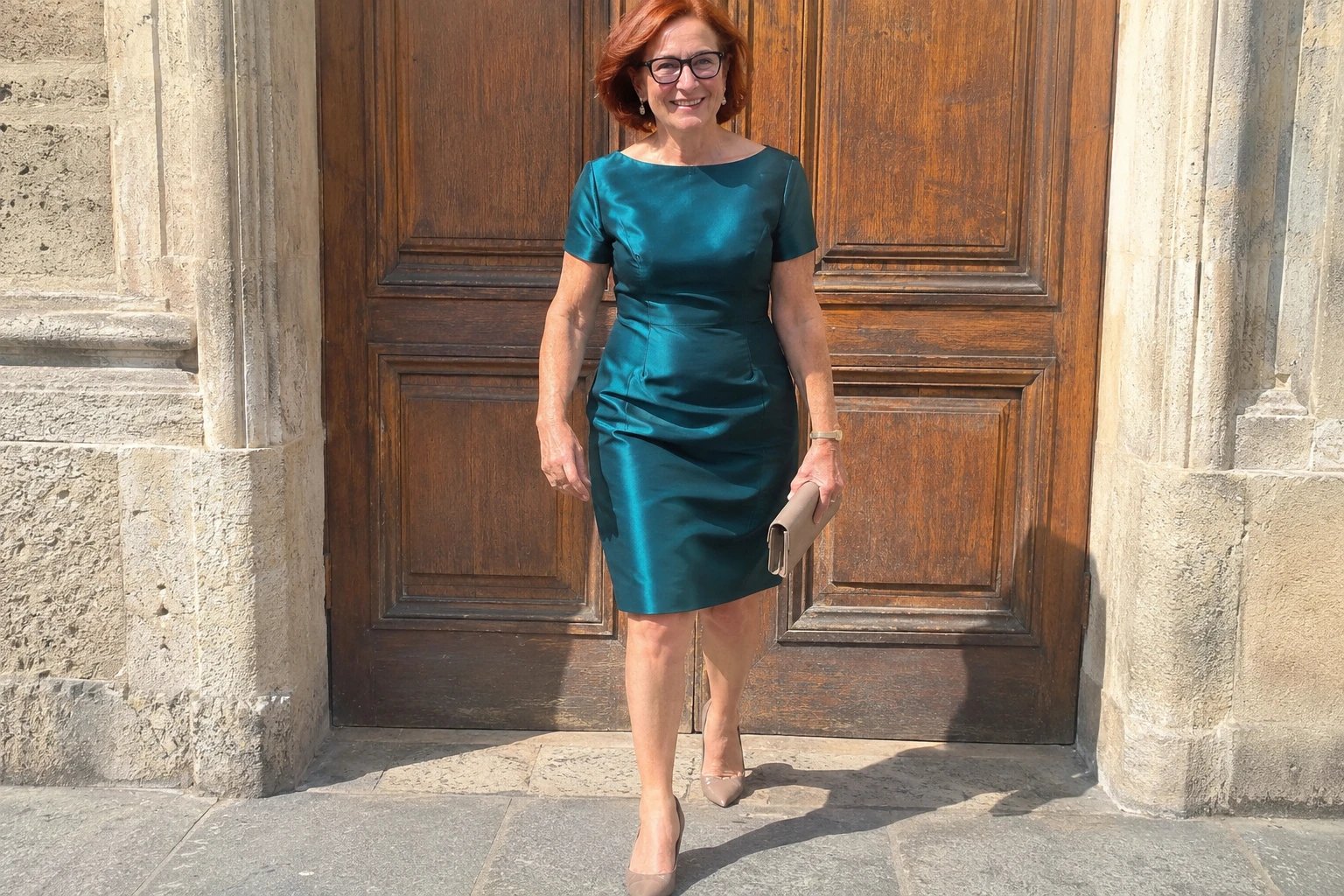
A knee-length sheath in deep teal silk faille, short sleeves, a neat boat neck. For a courthouse ceremony and a lunch afterward, this is as formal as you need to be.
You don't need a gown for twelve people in a clerk's office. You do need to look like the mother of someone getting married, a step above the friends in sundresses. A solid color, good fabric and a tidy fit do that.
Small rooms mean close-up photos, so neckline and fabric matter more than length. Silk, crepe or fine brocade looks finished at arm's length. Cotton shows every crease from the car.
Skip the hat. Hats and fascinators are mostly a British custom, and nobody expects one at an American wedding. If you want something in your hair, a jeweled clip is enough.
9A Tiered Chiffon Maxi for the Beach
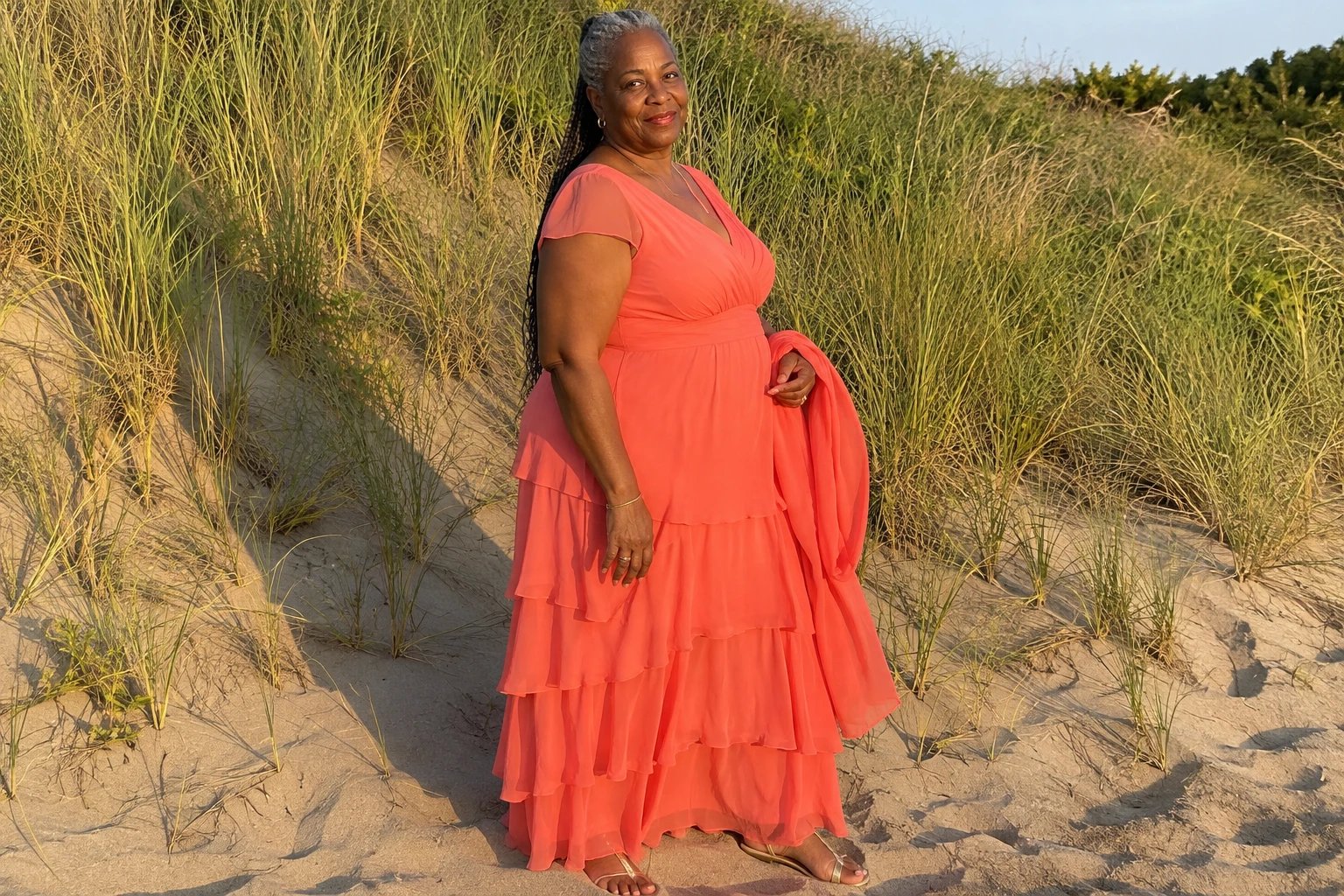
Coral chiffon in soft tiers from bust to ankle, with little cap sleeves and a V-neck. On a beach it moves with the wind instead of fighting it, and the tiers give the skirt fullness without a waist seam to fit.
Hem it at the ankle. A hem that just grazes a ballroom floor drags through damp sand on a slope, and you'll spend the vows holding your skirt. Have it hemmed in the sandals you'll actually wear.
Those sandals should be flat or a low wedge. Stilettos sink.
Go for mid-depth color here. Pale pastels can wash out under flash once the sun goes down, so coral, sea glass or soft turquoise holds up better than baby blue.
Bring a chiffon wrap in the same shade. The breeze off the water turns cool fast after dark.
8A Silky Shirtdress for a Backyard Wedding
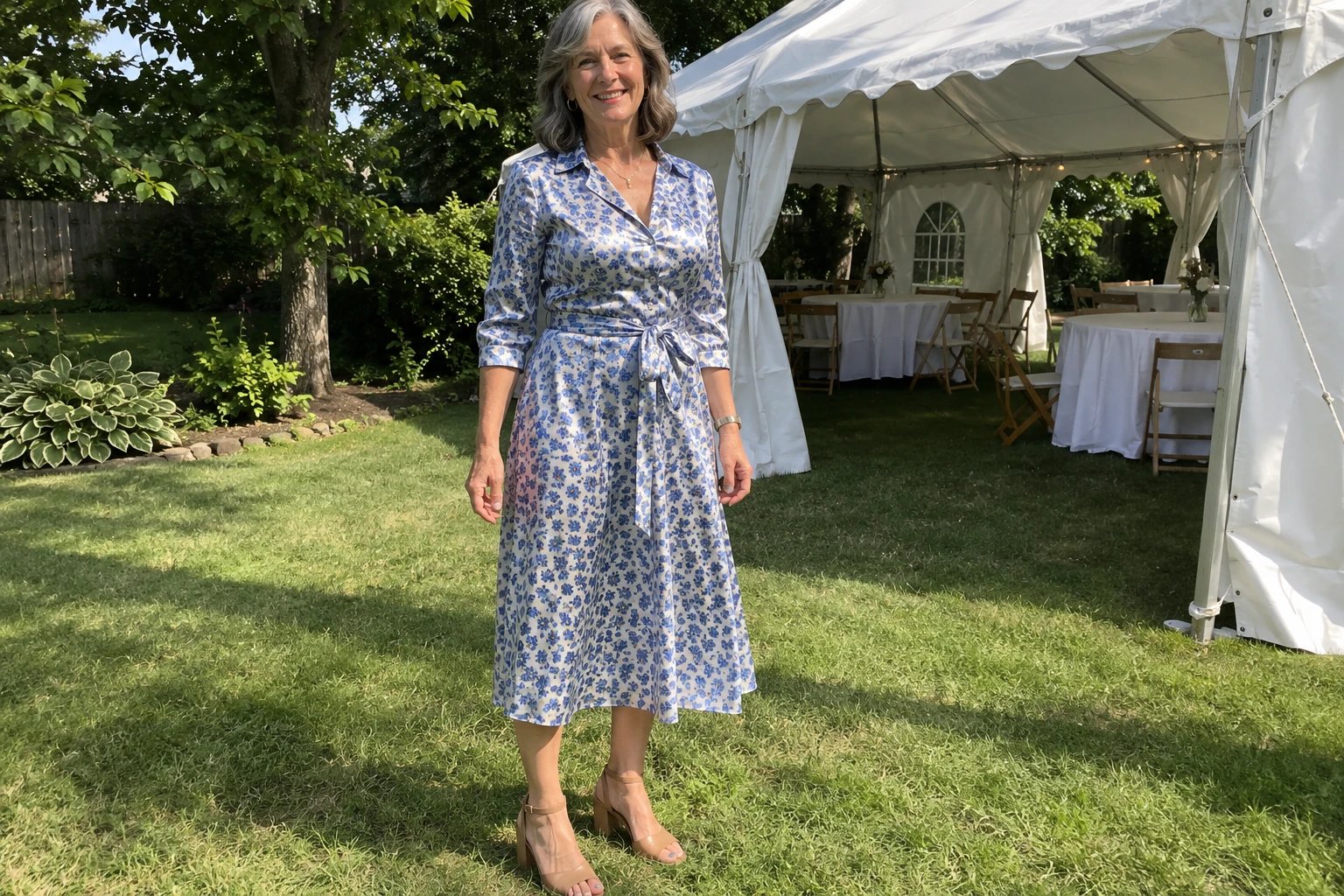
A satin-finish shirtdress in a small cornflower print, collar open, buttons to the waist, a sash belt and a full midi skirt. At a backyard wedding with a tent and a buffet, it looks dressed up and feels like your own clothes.
It suits you if you like sleeves, a collar framing your face, and maybe pockets for a tissue. It's harder on a fuller bust, because buttons gape.
Test it in the fitting room. Sit down, then reach for something on a high shelf, and look at the gaps between buttons. If you see skin or bra, size up or ask the tailor for a hidden snap between the worst two.
A belted shirtdress forgives a lot through the middle. A pulling button band forgives nothing.
Wear a block heel. Grass swallows a stiletto by the second toast.
7A Knee-Length Dress With Flutter Sleeves
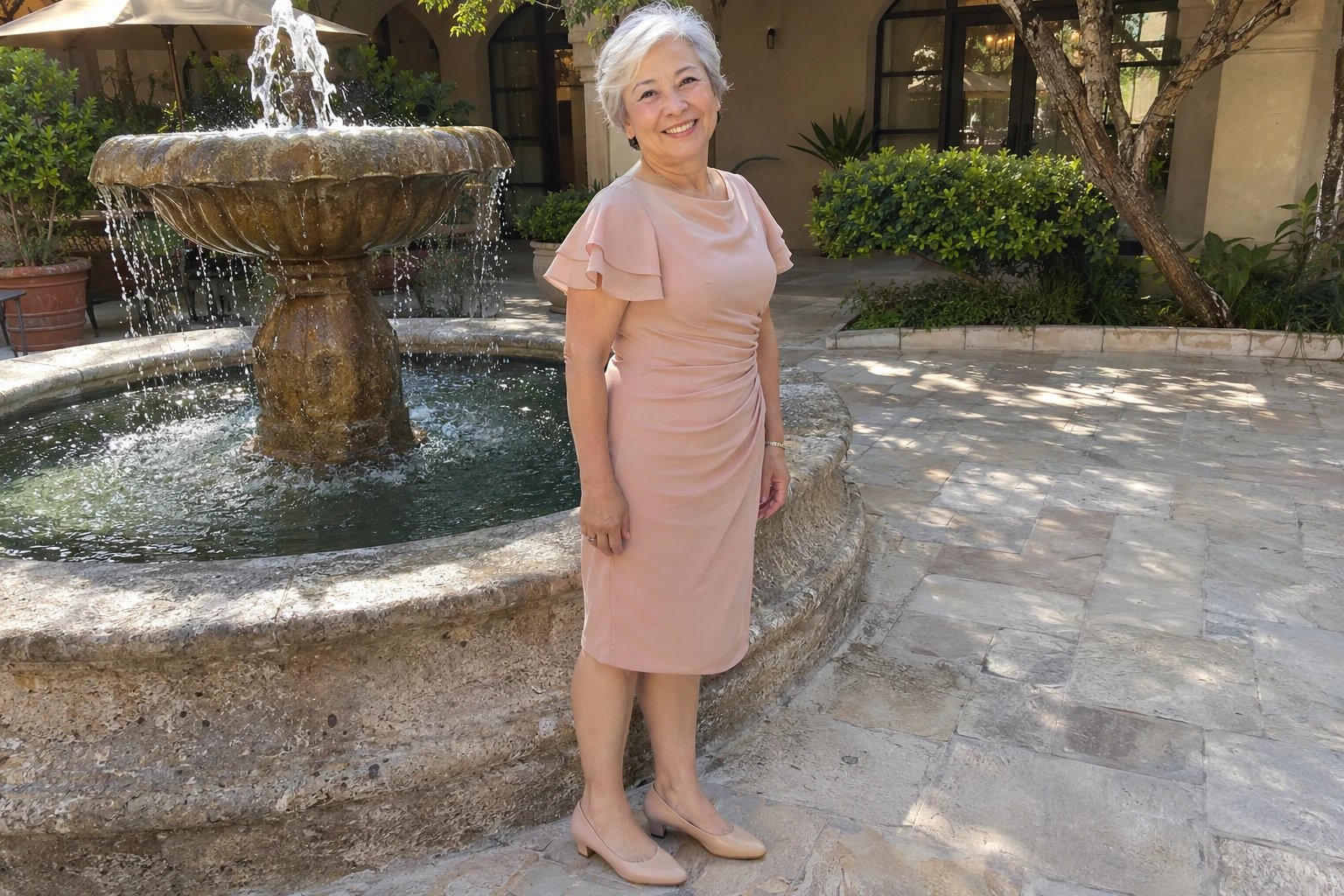
Blush crepe to the knee, with flutter sleeves: short, loose and soft, covering the top of the arm without gripping it. If you're petite, this pairing of knee hem and real sleeve can be the hardest thing in the store to find.
The knee is your length if you're under about 5'3". A midi that hits mid-calf on a tall model can land near your ankle and shorten your whole line.
For a tummy you'd rather not feature, look for ruching across the middle or a crossover bodice. Both pull the eye on a diagonal instead of straight across.
If your bust is uneven after surgery, a draped or ruched front hides a difference that smooth satin shows. Tell the tailor which side needs help.
Adding built-in cups and shaping the bodice are both routine alterations on these dresses. You won't be the first to ask.
6A Floral Print Midi With a V-Neck
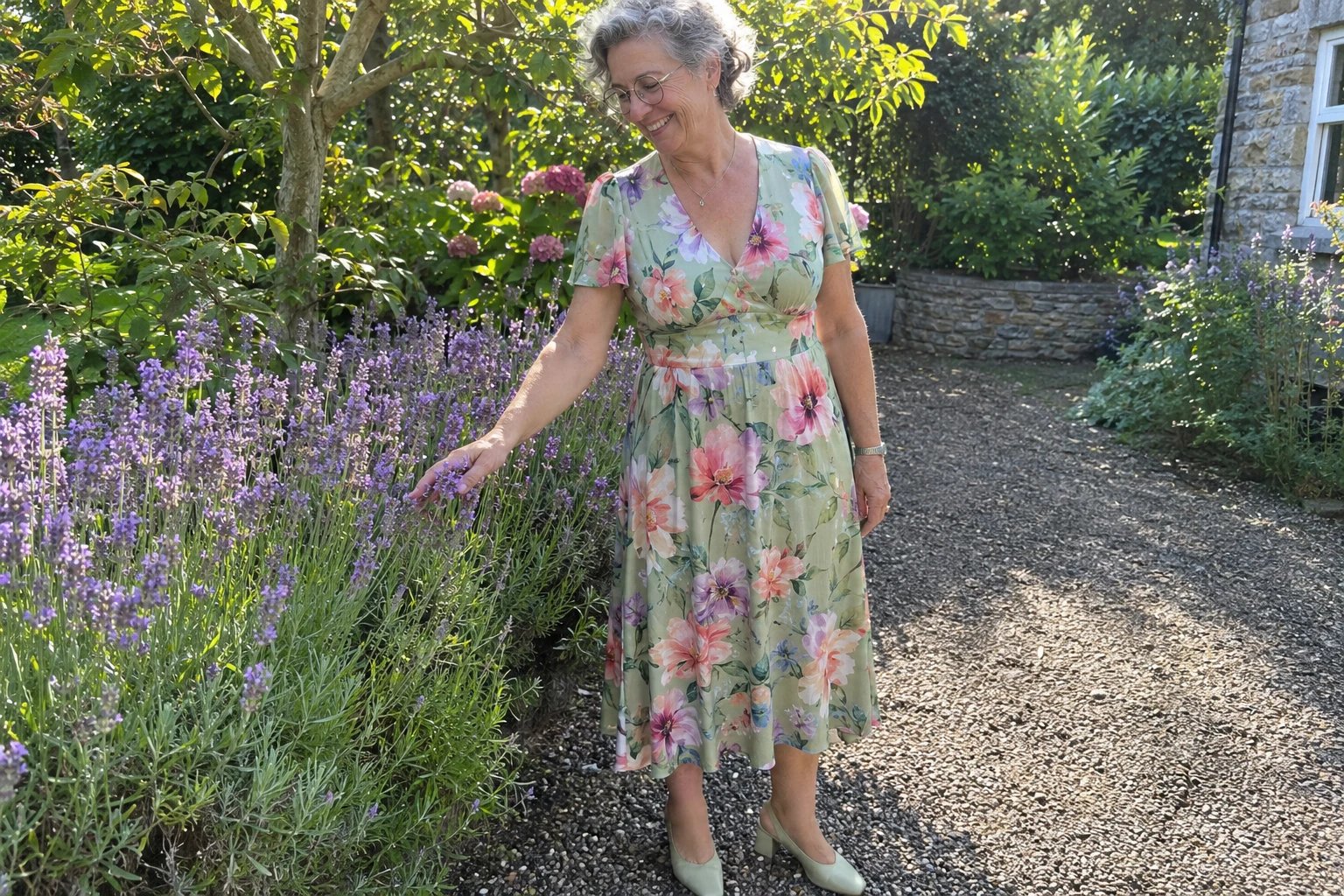
A midi in a watercolor floral, blooms about palm-size on a soft green ground, with a V-neck and short sleeves. At a garden or backyard wedding, a print says daytime and celebration in a way a solid can't.
Scale decides whether it works in photos. Tiny flowers blur into texture from ten feet away, and huge ones swallow a smaller woman. Palm-size blooms read clearly in a group shot.
Pull the print toward the couple's colors. If their palette is sage and dusty blue, a print carrying both looks like part of the day.
If their colors are bold, a busy print can clash in every family photo, so find out what the bridesmaids are wearing first.
The V-neck also answers the heat problem from the velvet sheath. An open neckline lets heat escape from your chest and neck, and you don't need a necklace sitting on damp skin.
Garden and afternoon
Daylight outdoors is honest light, and it shows color and fabric exactly as they are. Sun, grass and a long receiving line all get a vote here.
5A Dusty Rose Midi With a Sheer Capelet
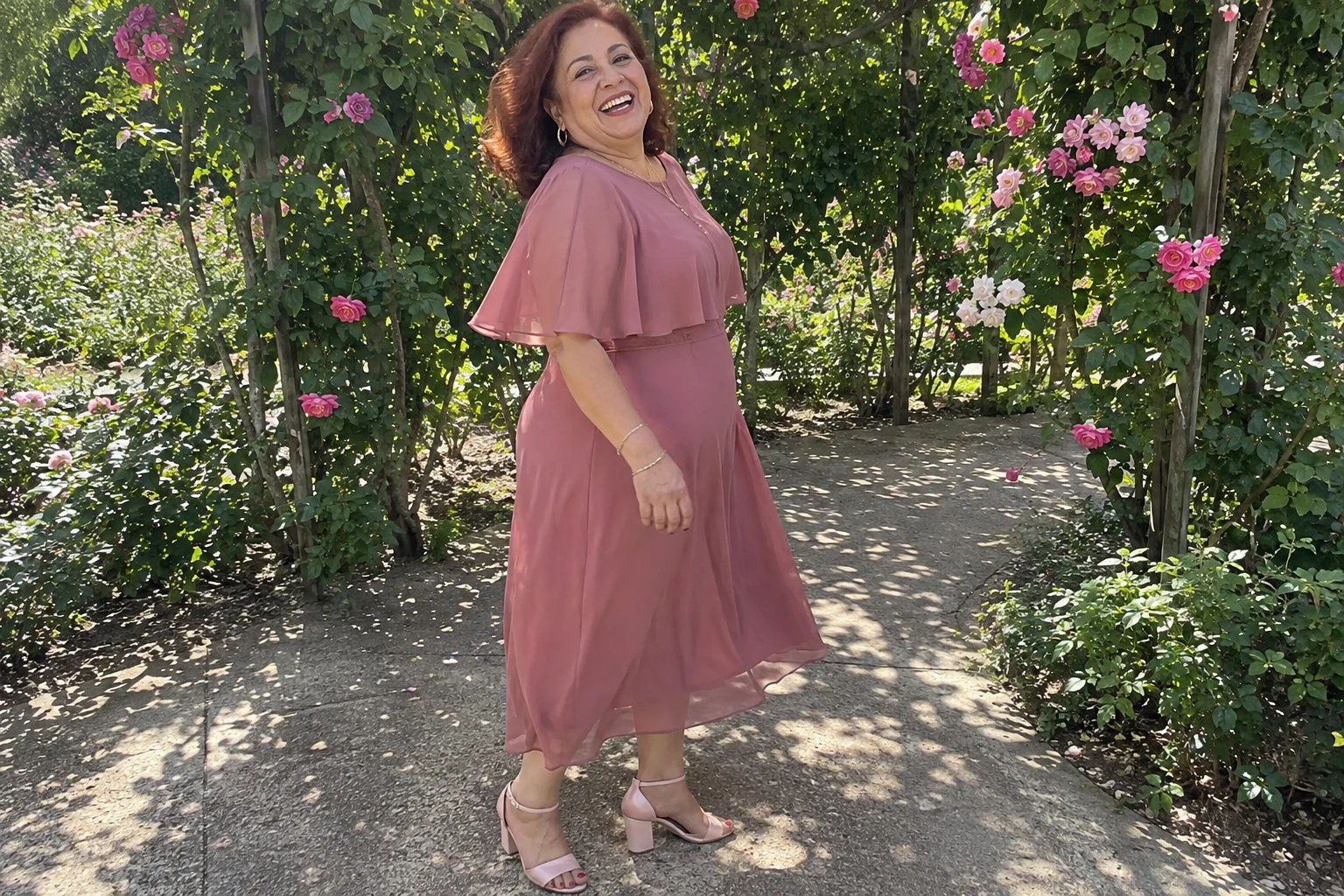
A dusty rose midi with a sheer chiffon cape falling from the shoulders to just above the elbow. A capelet covers your upper arms but leaves the dress underneath alone, so the line of the bodice and waist stays clean.
Look at your shoulders before anything else. A capelet adds a little width across the top. If your shoulders are narrow and your hips wider, that balances you.
If your shoulders are broad, choose a very sheer cape that falls nearer the elbow, or go to a real sleeve instead.
Ask whether the cape is sewn in or detachable. Detachable means you can take it off for dancing, and it's one less layer to sweat through in July.
Choose a muted, slightly grayed pink over the palest one. The palest pinks have the same flash problem as baby blue at the beach, and you'll look fainter than you are.
4A Pleated A-Line in a Sister Shade
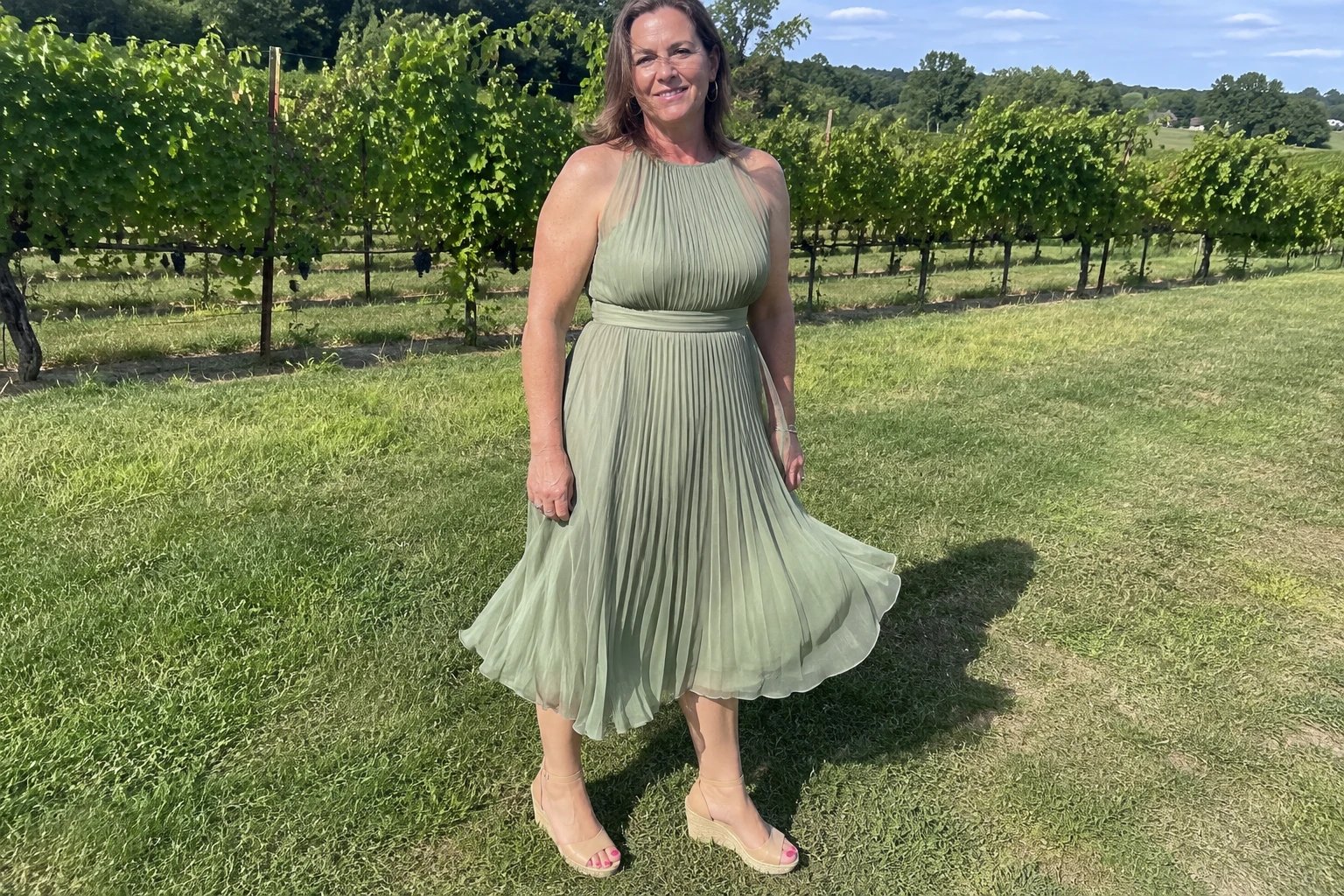
A pleated chiffon midi in sage, sleeveless, with a soft A-line skirt. On the groom's mother, perhaps, the same idea in slate or eucalyptus. That's sister shades: related colors that sit well together without matching.
Traditionally, the bride's mother chooses first and sends the groom's mother a photo or a fabric swatch. Either works, but a swatch is a safe backup if a photo's color looks off on screen.
A short message does it: "I found mine, and here's the color. Anything in the gray-green or soft blue family would look lovely next to it."
If she ends up in a near-twin of your dress anyway, let it go. Set yourselves apart with different jewelry, different hair, and a wrap on one of you with bare arms on the other.
See more: 29 Conversations Families Keep Putting Off Until It's Too Late →
3A Princess-Seam Midi That Follows Your Curves
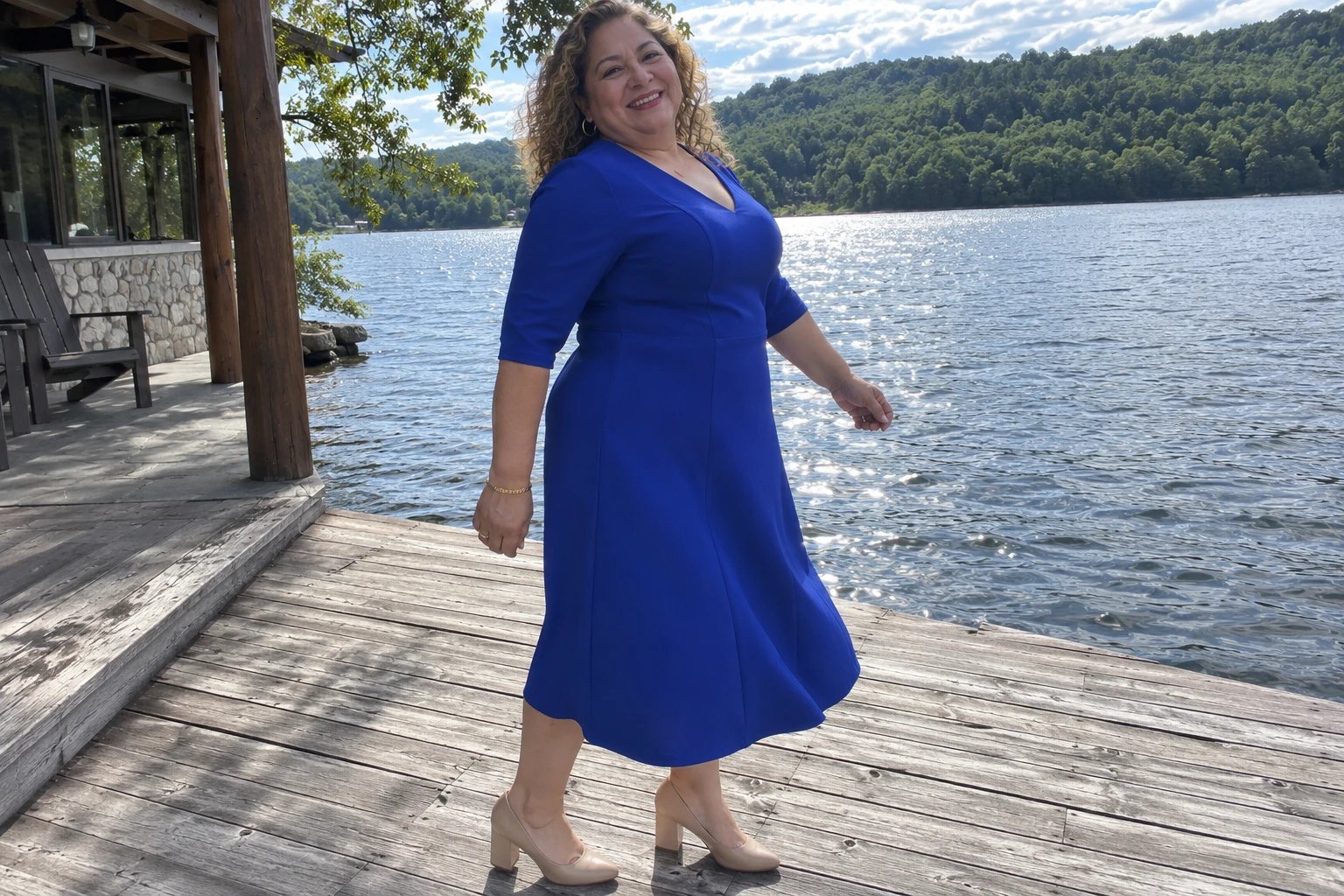
Cobalt crepe to mid-calf, with long curved seams running from the shoulder over the bust and down to the hem, plus a V-neck and elbow sleeves. Those are princess seams, and they make a dress follow your body instead of hanging off it.
If you wear a plus size, you've probably been handed a lot of tents: loose chiffon tiers, boxy shifts, jackets that stop mid-hip. They cover you, and they hide your shape along with everything else.
Princess seams shape the dress through the bust and in at the waist without one seam across your middle. Look for sleeves set at your real shoulder line, not dropped down the arm, and a V or scoop that gives your face room.
Pinch the fabric at your side when you try it on. An inch or more to spare means the tailor can take it in along those seams, which is easy work. A dress that already pulls is a much harder fix.
2A Textured Jacquard Midi in a Mid-Tone
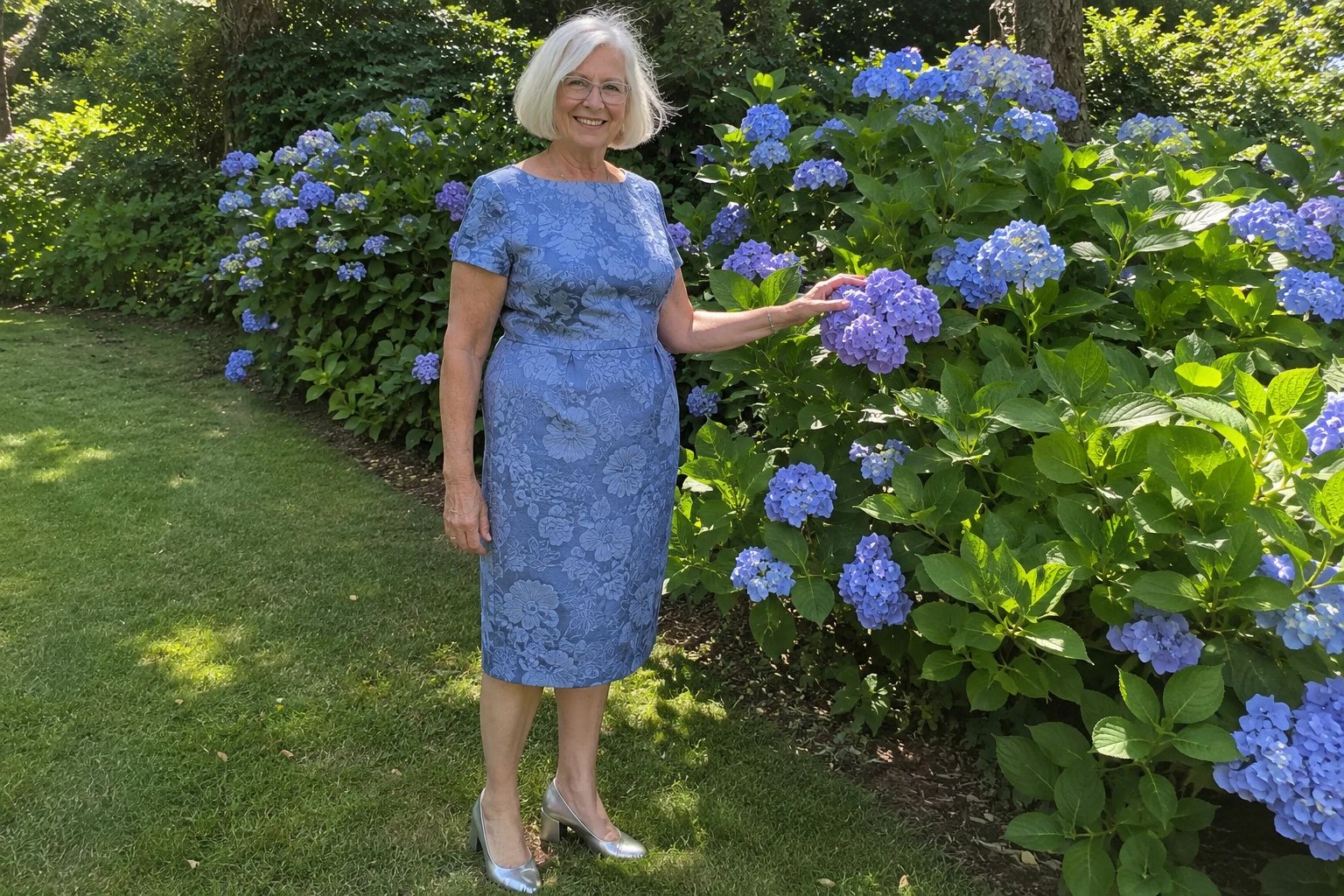
Hydrangea-blue jacquard with a tone-on-tone pattern woven in, a bateau neckline, short sleeves and a hem just below the knee. Jacquard's pattern is woven into the cloth, not printed on top, so every fold catches light differently.
That's what you want in photos. Fabric with some sheen or texture gives the camera detail to hold, and a mid-tone dodges both flash problems from earlier: the flat black and the washed-out pastel.
Mid-tones are your safe zone: hydrangea blue, lilac, soft teal, dusty plum. They're deep enough to register in pictures and light enough to stay cheerful in daylight.
Some jacquards are stiff as cardboard, and that's how you end up in the 1980s taffeta look you've been dodging.
Crush a corner in your fist for five seconds. Soft jacquard springs back and drapes; stiff stuff holds the crease and stands off you like a lampshade.
A jacquard with a little body does help a changing waist. It skims your middle without clinging, which matters if you'd rather not wear shapewear for ten hours.
1A Tea-Length Lace Dress With Elbow Sleeves
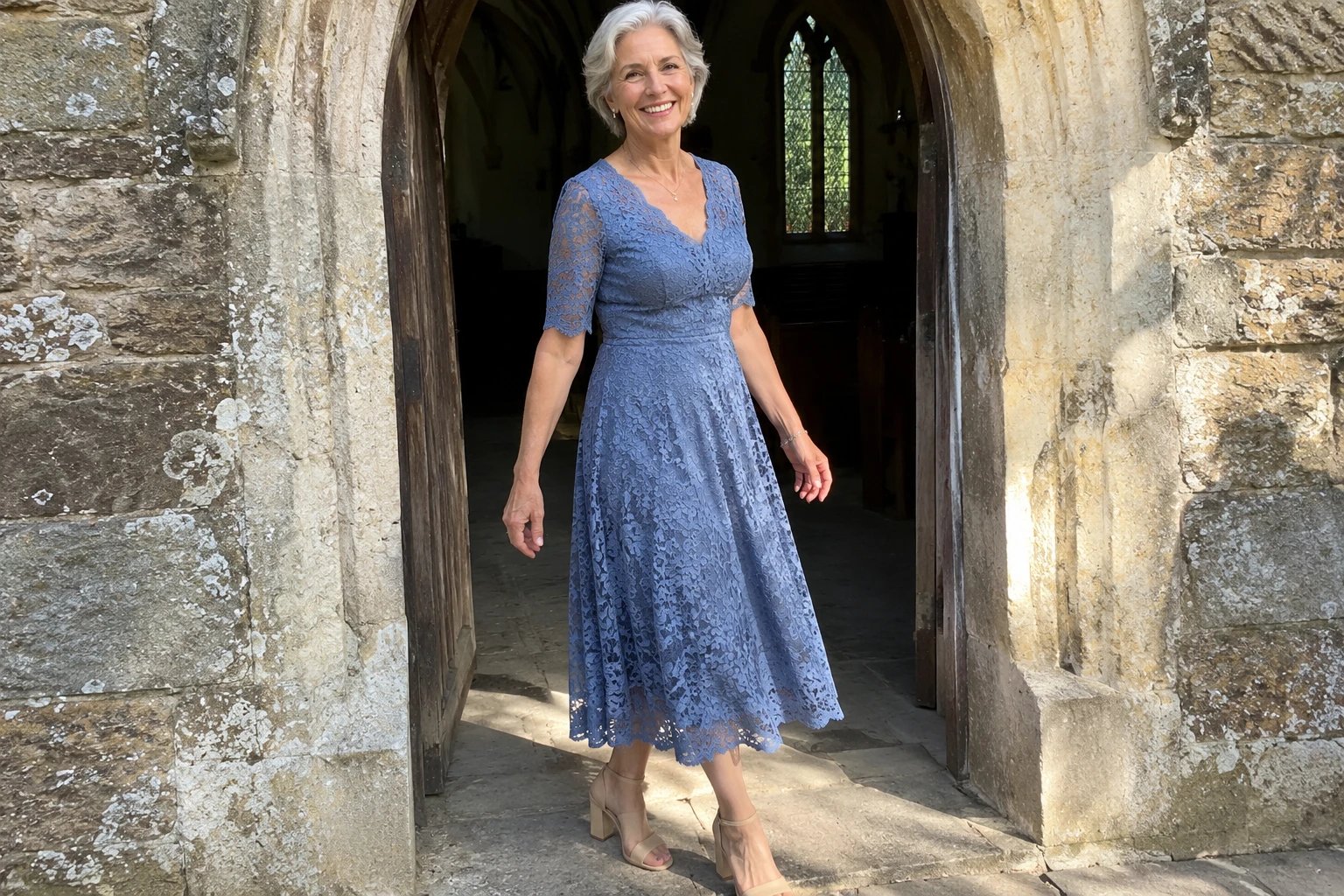
Dusty blue lace, sleeves to the elbow, a modest V-neck, and a lining in the same blue. The hem falls at mid-calf, between knee and ankle.
It's the one to try first, because the same dress carries you through the ceremony, the photos and the last dance.
The elbow sleeve covers your whole upper arm, so there's no bolero or wrap to manage. The lace has the texture that photographs well.
The tea length is formal enough for church and still lets your shoes show, so choose them with care. For a black-tie evening, though, go to the floor.
Choose lace lined in its own color or a near skin tone. Lace over a contrasting lining is the look that dates fastest.
The hem is where this dress goes right or wrong. On most women the best spot is just below the widest part of the calf, where the leg starts to narrow. Set it with your shoes on.
Go by your height now, not an old measurement; the inch or two you may have lost shows up right here. Lace with a scalloped edge needs a tailor who can move the scallop, so allow six weeks.
Dusty blue is one choice. Sage, mink, soft lavender and deep teal all work in the same cut.
The bottom line
If none of these twenty fits your budget, start with a plain, well-cut dress and spend on one good piece near your face. A tailor does more for you than beading does.
If the wedding is close, skip made-to-order. Look for off-the-rack dresses or styles with expedited shipping, and book the tailor the day the dress arrives.
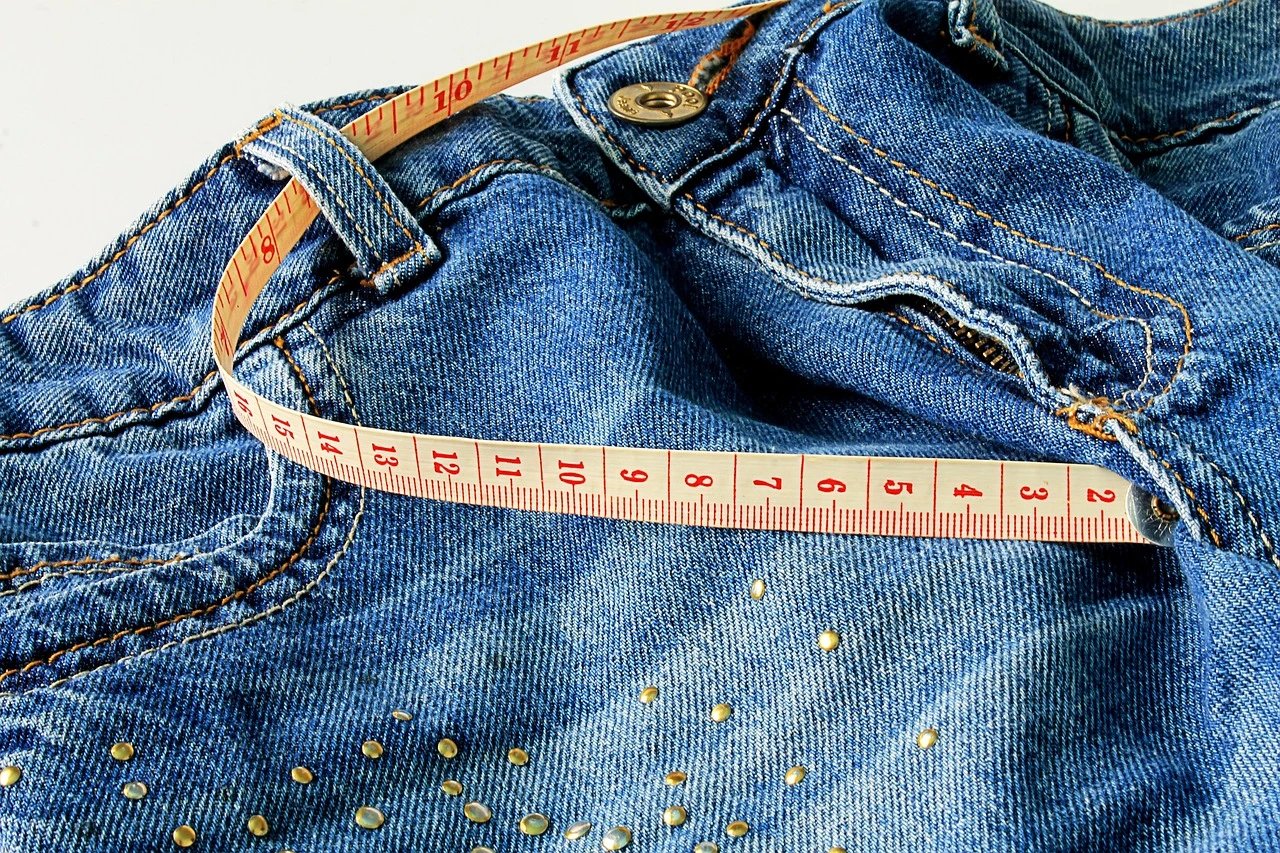
If your body has changed since you last shopped, go by a tape measure and order by your largest measurement. Taking a dress in is easy work; letting one out often isn't.
If the venue or season changes late, keep the dress and change the layer. A wrap, a duster or a capelet can carry the same dress from a cold church to a hot reception.
Up next
17 Secrets for Shoes That Look Good After 60 and Don't Hurt
A three-question store script, a phone test for wide-leg pants and the Medicare shoe benefit for diabetic feet: how to find the most comfortable shoes for women over 60 that still look like you.
Read the list →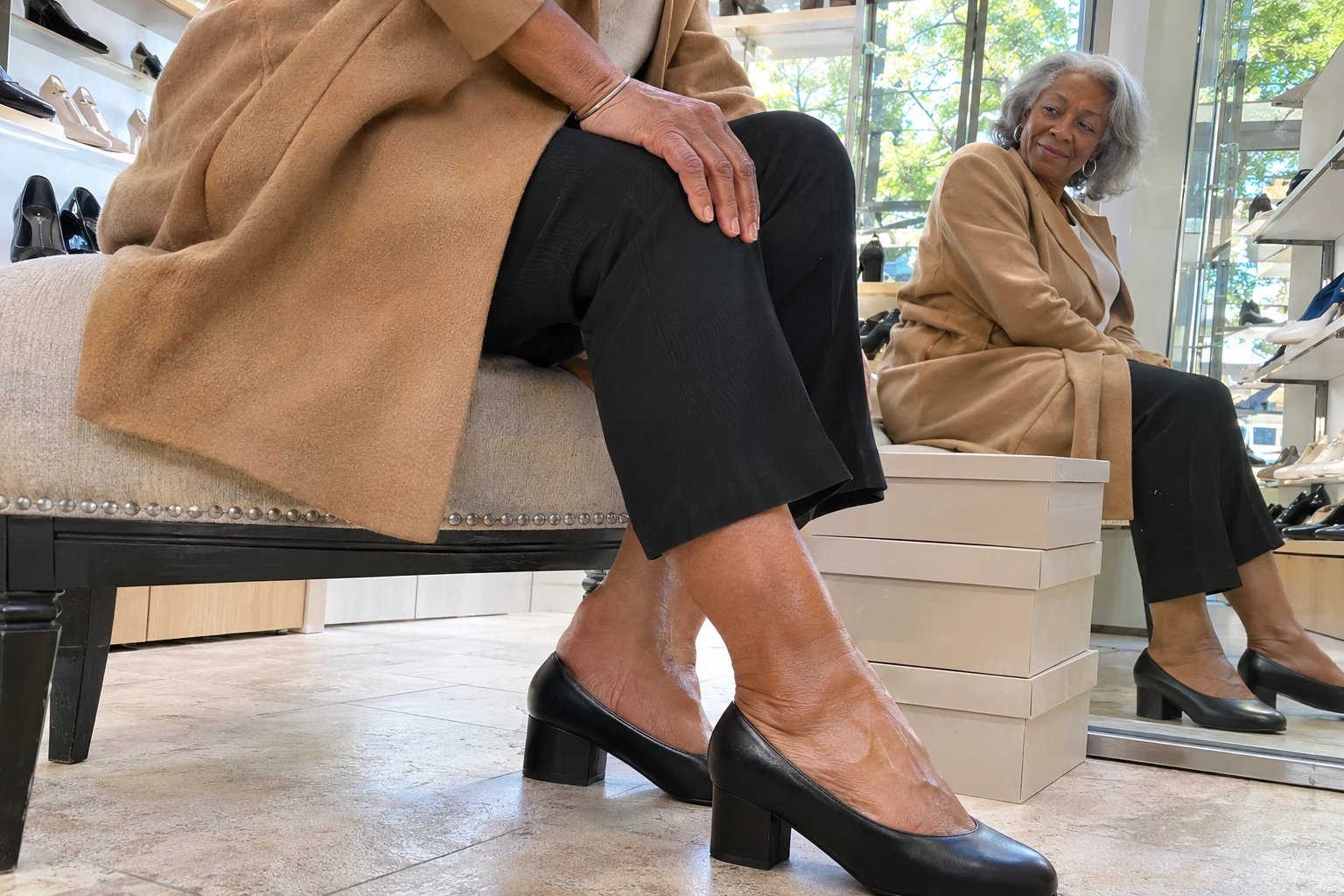
Reader quiz
Did you catch the details?
5 questions from this article. Finish them all to unlock the editor's bonus tip.
In the jersey wrap dress item, how does the article suggest checking whether the jersey is too thin?
Did any of these feel familiar?
Know someone who needs this?
Sources cited in this article
This article links to 2 outside sources, listed here so you can read them yourself.
- Cleveland Clinic explains health.clevelandclinic.org/menopause-belly
- According to Yale Medicine www.yalemedicine.org/news/hot-flashes

Irina Byalik
Style Editor
Irina Byalik is a hairdresser and the owner of New Image Hair Salon in East Brunswick, New Jersey, with more than 20 years of experience. She came to the United States from Ukraine.
More from Irina Byalik