










How to Wear Leggings Over 50 Without Looking Sloppy
The fabric, fit, top and shoes that make leggings look like an outfit.
By Nora Bennett, Style Editor
Updated · 14 min read
- Written by our style editor
- Cited 8 sources
- How we review

Between 30 and 70, most women lose about 2 inches of height. It starts around 40, and the most common cause is wear on the discs in the spine.
Nobody mentions what that does to your clothes. The leggings you buy in your usual length now gather in soft rings at the ankle. The tunic lands somewhere new. Then a friend posts a photo from lunch, and the word that comes to mind is "sloppy."
The leggings usually aren't the problem. The fabric, the length, the top and the shoes are, and each one has a fix.
Is there an age when you should stop wearing leggings?
No. Women ask this at 60, at 66, and on behalf of their mothers at 80, and the honest answer is the same every time. No birthday turns leggings wrong. Some pairs and some outfits look careless, and they look careless at 30 too.
What you're really worried about has an old British name: mutton dressed as lamb. It means an older woman in clothes cut for someone much younger. That look comes from what surrounds the leggings, not from the leggings themselves.
A top that stops at the waist. Shiny gym fabric with a logo on the waistband. Neon trim down the side. Running shoes on a trip to the bank. Those are the details that read as trying too hard.
Change them and the same leggings say something else. Matte fabric, a top that covers your rear, real shoes, one or two colors. Nobody looks at that and thinks you're dressing young. They see a woman who's comfortable and dressed.
If someone has made a remark about how you look in leggings, it probably stayed with you longer than it deserved. You don't owe anyone a defense of your clothes. If you'd like a line ready, "They're comfortable, and I like them" closes the subject without a fight.
One honest caution, because you'd want to know. The stretch that makes leggings so easy also means nothing ever pinches. A few pounds can arrive with no waistband to mention it. Keep one pair of pants with a real button and zipper in your week, and notice how they fit each month.
Which fabric makes leggings look like real clothes
Choose thick, matte, double-knit fabric, and pass on anything thin, shiny or mostly cotton. That single choice fixes most of what makes leggings look sloppy: the see-through seat, the outline of your underwear, every lump showing through.
The fabric to know by name is ponte. It's a double knit, which means two layers knitted together into one cloth. The full name, Ponte di Roma, comes from loops said to look like the arches of a Roman bridge.
Ponte is medium to heavy in weight. It doesn't curl at the edges, keeps its shape and springs back after stretching. It's usually a blend of polyester, viscose (also called rayon) and elastane. It's used for trousers too, which tells you how well it holds its shape.
Elastane is another name for spandex, and the percentage on the tag is worth checking. One legging maker calls 15 to 18 percent the sweet spot for leggings that stretch without going sheer. Below about 12 percent, the fabric can pull out of shape. Above about 20 percent, it tends to bunch.
Weight counts as much as stretch, because heavier fabric stays opaque when you bend and walk. The tag gives it as GSM, though not every tag lists it. Online, look in the product details. In a store, stretch one layer across your hand and see how much skin shows.
Thin cotton leggings are the ones that let you down. They cling where you don't want them to, wrinkle behind the knee and lose their shape by afternoon. Keep a cotton pair for under a long nightshirt or around the house. For going out, they aren't worth buying at any price.
Thick fabric also answers the worries about your legs. A dense knit skims over knees and thin calves instead of outlining them. It covers spider veins and varicose veins far better than anything sheer.
Veins do become more likely with age. They lose elasticity, and the hormone shifts around menopause can let vein walls stretch, as Cleveland Clinic explains. If yours ache, ask your doctor about compression stockings, one treatment option, and ask which pressure suits you rather than picking a box off the pharmacy shelf.
How to test a pair before you buy
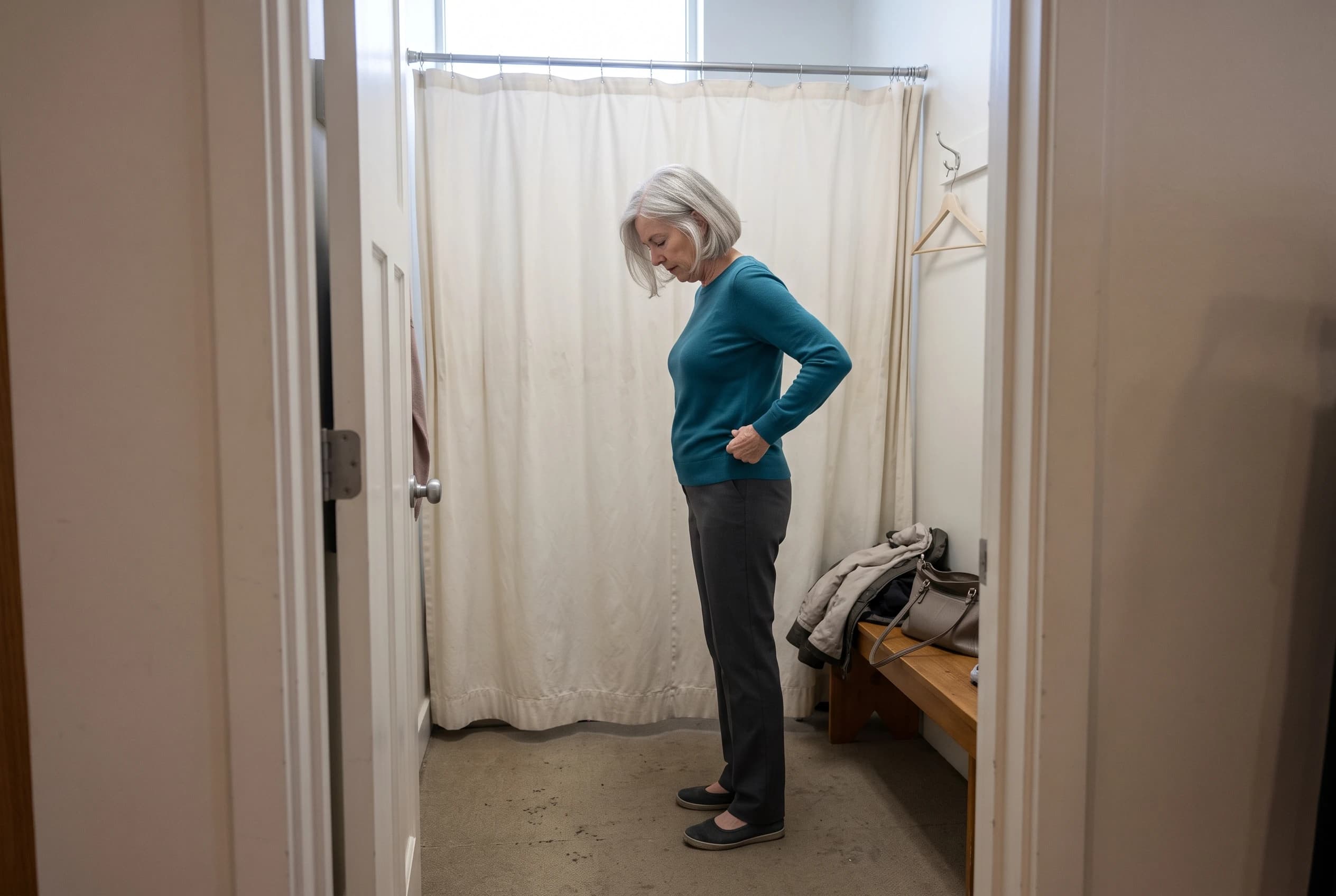
Do these five things in the fitting room, in this order. They take a couple of minutes and save you a return trip.
- The squat test. Turn your back to the brightest light in the room. Prop your phone on the bench, set a three-second timer, and squat until your thighs are parallel to the floor. Look at the photo. If you can see skin or the pattern of your underwear, they'll be sheer every time you bend.
- Walk and sit. Walk a few steps, sit on the bench, stand up. If the waistband has slid down and you're reaching to hitch it up, you'll be doing that all day.
- The waistband roll. Bend forward as if you're loading the dishwasher. The top edge should stay flat. If it folds over or cuts into your middle, that's what makes a muffin top.
- The front fit. Look down at the front. The fabric should lie smooth at the crotch. If it pulls into a crease (the "camel toe" problem), the rise is too short for you. Try a different cut rather than a bigger size.
- The knee. Bend one knee deeply, hold it while you count to ten, then straighten. The fabric should spring back flat. A bump that stays now will be a pouch by lunchtime.
The squat needs to be a real one. A shallow bend in the fitting room won't show sheerness, which is why so many pairs pass in the store and fail on the floor of the garden center. The light behind you does the rest.
How to get the length and rise right
Start by measuring the pair you already love. Lay them flat on the bed and smooth them out. Run a tape measure along the inside of one leg, from the crotch seam to the hem. That number is the inseam, and it tells you more than any label.
Labels don't agree with each other. "Full length" means the hem covers your ankle. "7/8" means it stops above the ankle bone. But each brand cuts these differently, so compare the inseam listed online with your own number instead.
Don't buy a smaller size to get a shorter leg. It changes the fit at the waist and hips too, and tight leggings show more of what you're trying to smooth.
If you've lost an inch or two since your forties, your old inseam may be too long now. The extra fabric gathers at the ankle in rings, and nothing looks sloppy faster. Petite cuts or a 7/8 length often land where a full-length pair used to.
Which length looks best depends on where you're headed:
- Full length that just meets the top of your foot gives one long, clean line. It's the one for boots and cold weather.
- 7/8 length shows a sliver of ankle. It looks neat with ballet flats and loafers, and it suits petite women because there's nothing left to bunch.
- Mid-calf lengths cut the leg at its widest point and read as gym clothes. Skip them for anything but exercise.
For the rise, the distance from crotch to waistband, go high. A high-rise pair sits at or just below your natural waist.
Look for a wide, flat waistband rather than a thin strip of elastic. It smooths your tummy, stays put when you bend, and lies flat under a tunic instead of showing a ridge.
What to wear over leggings
The rule that does the most work: fitted on the bottom, looser on top.
On a Tuesday of errands and lunch with a friend, the leggings are the easy part. The top is where the outfit is won or lost.
The most common mistake after 50 is a clingy top over clingy leggings. The hug of leggings can turn unflattering when both top and body cling.
The fix is a looser top: a tunic, a roomy button-down shirt, a slouchy knit. Each one gives your shape some air while the leggings keep the line below neat.
Then check the length. The hem should land at least at mid-thigh and cover your rear completely. Side slits help a long top move with you when you walk or climb into the car.
Loose isn't the same as shapeless. A big boxy top with no structure turns you into what one woman called a mushroom: wide on top, narrow stem below.
Look for a top with some shape in it. That can be a seam under the bust, soft drape at the hem, a defined shoulder or a curved hem that dips at the back.
A long open layer is often better than a single heavy tunic. Try a fitted T-shirt with a long cardigan or vest over it. The open front draws two long lines down your body, and you can take it off.
Being able to take a layer off is a relief if you get hot flashes. Up to 3 in 4 people get them in the years before menopause, each lasting one to five minutes, sometimes for years. Cleveland Clinic suggests dressing in layers. A cardigan comes off in the car. A thick tunic doesn't.
The open layer helps with another feeling too: being undressed in leggings even when you're covered. Something long and open over your top makes the outfit feel finished. It's the same reason a blazer makes a T-shirt look ready for an appointment.
Wearing one color from shoulder to ankle makes you look longer and leaner. A navy tunic over navy leggings, or charcoal over charcoal, reads as one piece. Add a scarf or a long necklace if you want color near your face.
A dress or skirt over leggings works best at knee length or longer. Shorter than that, it starts to look like a teenage trend, and every bit of leggings that shows has to be thick enough to pass the squat test on its own.
Shoes that finish the outfit
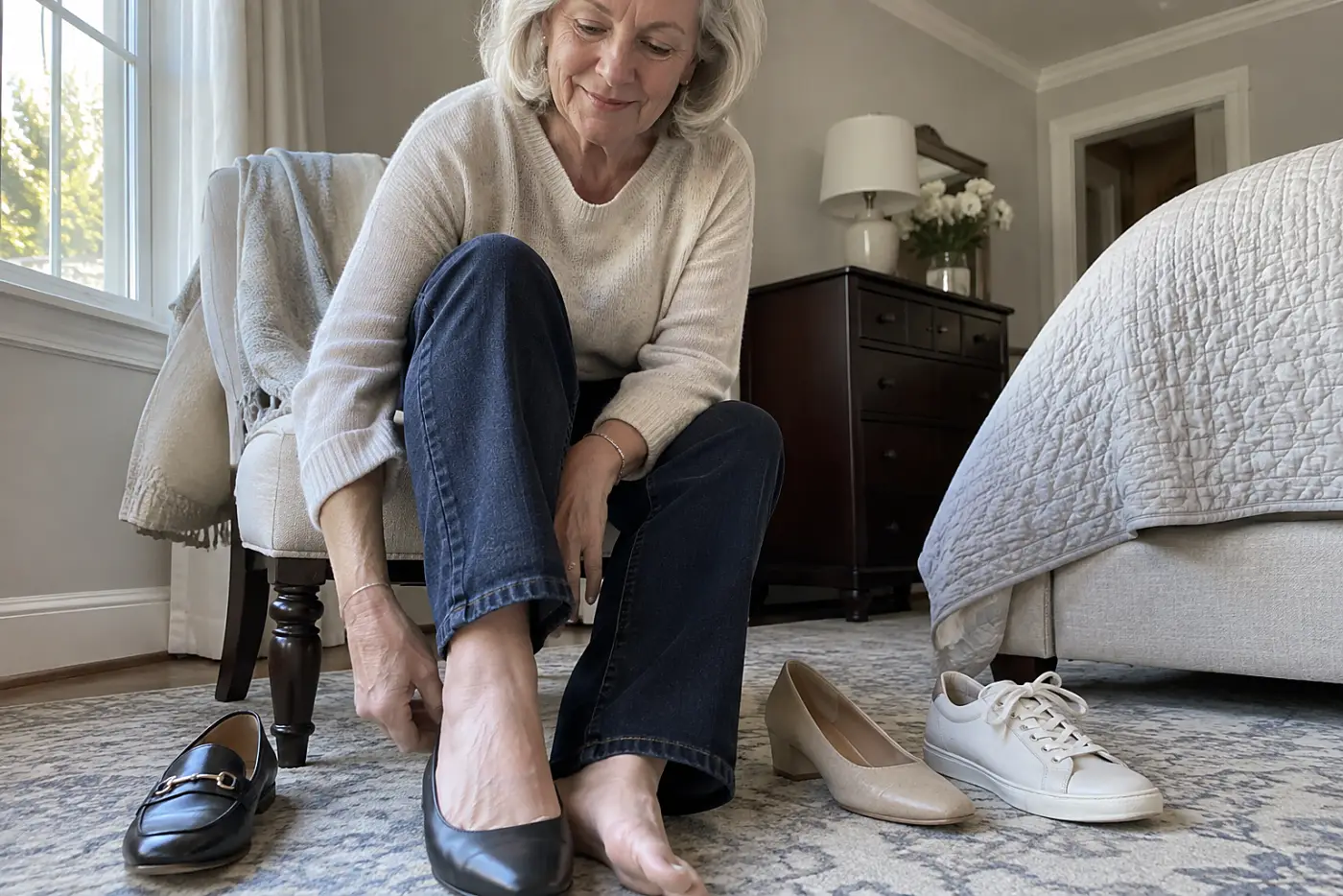
Shoes decide whether leggings look like an outfit or like you dashed out between loads of laundry. Before you buy new ones, get your feet measured.
Feet change with age. The arch slowly settles, so the foot gets a bit longer or wider, and Cleveland Clinic advises getting fitted every so often instead of assuming your old size still fits. A boot that pinches gets left in the closet.
Here's what works with leggings, and how:
- Ankle boots. The easiest choice. The legging hem should meet the boot or tuck inside it, with no stripe of bare skin between.
- Riding boots. Tuck full-length leggings inside, and wear a tunic that reaches mid-thigh. Leggings, long top and tall boots make a complete fall outfit.
- Ballet flats and loafers. Best with 7/8 or ankle length, so the hem stops neatly instead of bunching over the shoe. Choose a rounded or almond toe, and skip pointed flats that pinch.
- Clean leather sneakers. Fine for errands and walking, in white, black or a neutral. Bulky running shoes say "on the way to the gym."
- Heels. A low, stable heel works for evening. Skip very high heels, because with leggings a tall heel quickly looks like a costume.
Shoes in the same color as your leggings stretch the line of your leg. Black flats with black leggings, brown boots with brown leggings.
Colors, prints and faux leather: what's worth it
With the shoes settled, the leggings themselves are left. Their color and finish decide how dressed they look, and some are worth more of your money than others.
Black matte leggings: worth owning two pairs. They go with almost every tunic, every boot and every season. When one pair is in the wash, you still have the other.
Navy, charcoal, chocolate brown and olive: worth it once you have black. These shine when you match them to a top in the same shade. They look softer than black near gray or silver hair, and less like a uniform.
Prints: worth it if they're small and quiet. A tiny houndstooth, a subtle check or a muted tone-on-tone pattern looks like real pants from a few feet away. The same legging maker notes that printing adds density to the surface, so a printed pair can be more opaque than solid black of the same weight.
Bold, large prints pull all the attention to your legs. If you love your legs, go ahead. If you'd rather people looked at your face, keep the loud prints for your scarf.
Faux leather: worth it for evenings and cold days. With a long soft sweater or a silk-look blouse, it's dressy enough for a holiday dinner. It also doesn't collect pet hair, a real gift if you share your sofa with a dog.
Faux leather looks cheap when it's thin and very glossy. Look for a matte or soft sheen, fabric thick enough that it doesn't crease into lines at the knee, and a waistband that stays flat. Pair it with a top that covers your rear, as with any leggings.
Shiny athletic fabric: not worth wearing outside the gym. The sheen catches light on every curve and makes any outfit look like workout gear. It belongs in your exercise drawer.
Where leggings work, and where pants serve you better
Think through a normal week. The grocery store, the pharmacy, a long drive to visit family, the airport, walking the dog, coffee with a friend, a shift volunteering at the library, a Saturday matinee. Leggings with a good tunic and real shoes look right at all of them.
Some days call for pants. A job interview. A funeral. A meeting with a lawyer or the bank about something that matters. A wedding, a dressy dinner, most offices. On those days, leggings can look like you didn't take the occasion seriously, even when you did.
You've heard the line "leggings are not pants." You don't need to win that argument. You only need an outfit that settles it before anyone raises it.
The bridge between the two is a pull-on pant in ponte. It has the same stretch and the same elastic waist, but it's cut with a little room through the lower leg. That small amount of ease makes it pass for regular pants at the lawyer's office, and you'll be just as comfortable.
Summer is the other time to reach for something else. Thick knit leggings can feel hot around the seat on a humid July afternoon. A lighter, looser pant or a skirt will be more comfortable, and the leggings will still be in the drawer in October.
How to keep leggings from bagging and pilling
Heat and friction wear out leggings faster than wearing them does. Follow these steps and a good pair keeps its shape for much longer:
- Wash them less often. For light wear, every 3 to 4 wears is enough, according to one maker's care guide.
- Use cold water and the gentle cycle. Wash at 86°F (30°C) or cooler. Heat damages spandex, and spandex is what makes them spring back at the knee.
- Use a mild detergent, and nothing else. Skip fabric softener, which coats the fabric and makes it less breathable. Skip bleach, which breaks down spandex.
- Wash them apart from rough things. Denim and anything with a zipper rubs against knit and causes pilling (those little fuzz balls) and snags.
- Never use the dryer. Lay them flat on a towel to dry, out of direct sun.
The dryer is where most good leggings go downhill. The heat loosens the stretch a little at a time, and one day the knees won't spring back.
When a pair does go shiny at the seat or baggy at the knee, it's done for public. Move it to the drawer for gardening, painting the guest room and lazy Sundays.
The bottom line
Start with what you already own. Pull every pair of leggings out of the drawer this week and do the squat test on each one with the light behind you. Keep the ones that pass for going out. Move the rest to home and exercise.
If nothing passes, buy one pair of thick, matte black leggings, ideally ponte, in a high rise with a wide waistband and an inseam that matches your measurement.
Then add one top that reaches mid-thigh with some shape to it. Those two pieces and a pair of ankle boots make an outfit you can wear three days a week.
If you run warm, make that top a fitted T-shirt with a long open cardigan, not a heavy tunic. If you're petite, try 7/8 length before you try full.
Up next
29 Outfit Habits That Make You Look Older Than You Are
A jacket that once looked sharp now hangs past your knuckles. Before replacing it, check where the shoulder seam sits.
Read the list →

Reader quiz
Did you catch the details?
5 questions from this article. Finish them all to unlock the editor's bonus tip.
In the squat test, where should you stand in relation to the brightest light in the fitting room?
Did any of these feel familiar?
Know someone who needs this?
Sources cited in this article
This article links to 8 outside sources, listed here so you can read them yourself.
- Wear on the discs in the spine www.uhhospitals.org/blog/articles/2024/10/why-do-people-get-shorter-as-they-…
- Keeps its shape and springs back after stretching www.croftmill.co.uk/blogs/newsroom/a-guide-to-ponte-roma-fabric
- One legging maker loonylegs.com/blogs/advice/black-leggings-that-arent-see-through
- Cleveland Clinic explains my.clevelandclinic.org/health/diseases/4722-varicose-veins
- Each brand cuts these differently www.locionne.com/blogs/journal/7-8-leggings-vs-full-length
- Up to 3 in 4 people get them my.clevelandclinic.org/health/symptoms/15223-hot-flashes
- A bit longer or wider health.clevelandclinic.org/shoes-getting-tight-feet-change-size-time
- According to one maker's care guide www.felina.com/blogs/felina-intimate-thoughts/the-dos-and-donts-of-how-to-wa…
Nora Bennett
Style Editor
Nora writes about hair, clothes and grooming for people who have stopped asking permission: what to keep, what to let go, and what reads as taken care of.
More from Nora Bennett