


20 Low-Impact Workouts for Women Over 50 With Bad Knees
From walking backward in a pool to a wall sit that stops at 45 degrees, these moves build strength without punishing sore knees.

By Peter Byalik, Food & Home Editor
Updated · 18 min read
- Written by our food & home editor
- Cited 8 sources
- How we review
At ten in the morning, with your coffee cooling on the bottom step, you stand at the foot of the stairs and plan the climb. Coming down was fine. Going up, the right leg won't lift you, and the ache sits under the kneecap.
In 2019 the American College of Rheumatology and the Arthritis Foundation strongly recommended exercise for knee osteoarthritis, the slow wear of cartilage in the joint. They came out strongly against TENS units, the stick-on electrical pain gadgets.
So moving is the treatment. What's left is picking the moves your knees will put up with.
In the water
Water takes part of your weight, so a stiff knee often bends further in the pool than it will on the sidewalk. Start here if land walking already hurts.
20Backward Water Walking in the Shallow End
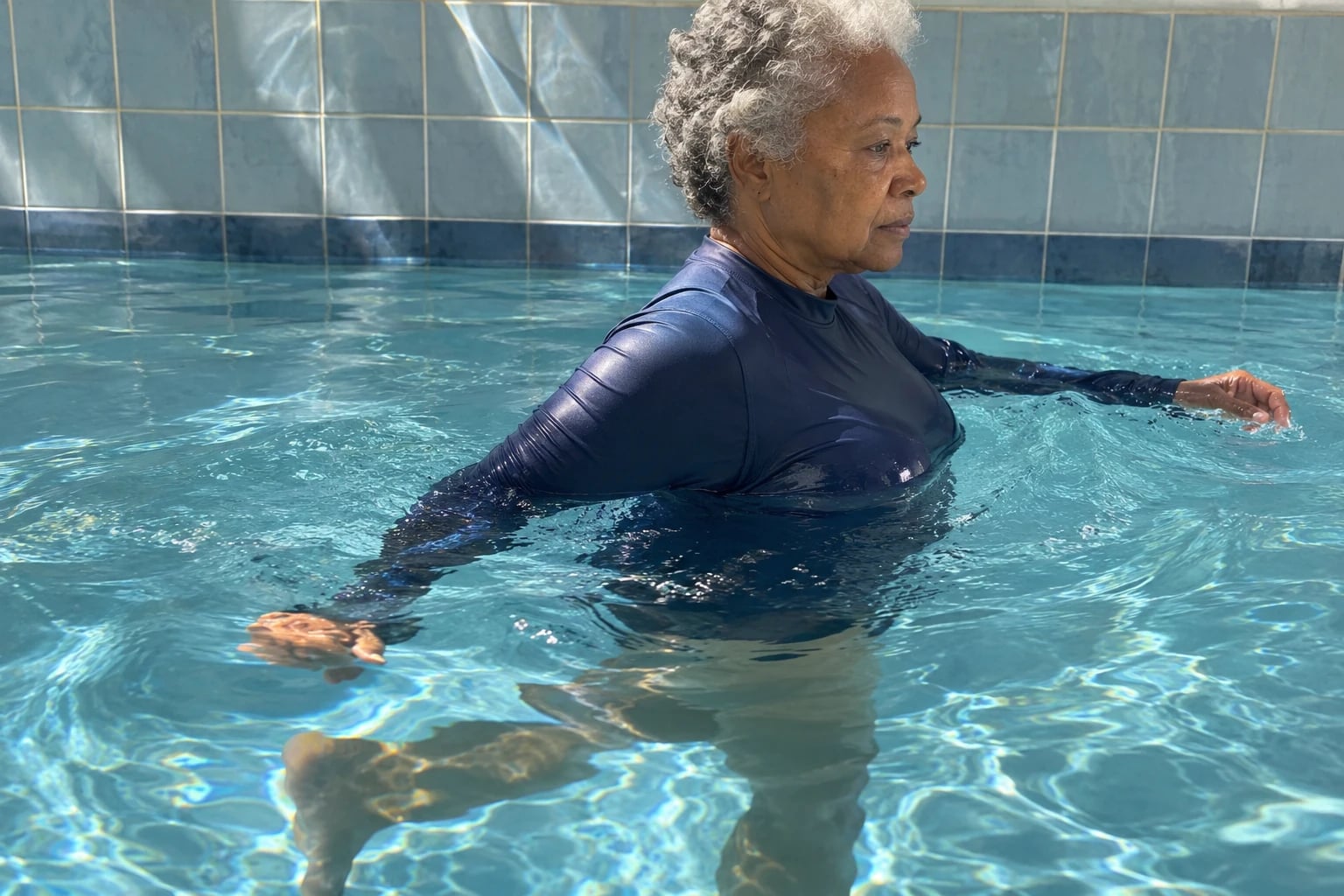
She's moving backward through chest-deep water, arms swinging, one heel reaching behind her. That's the whole exercise, and it's harder than it looks.
Walking forward in water is your warm-up. Walking backward is where the work is. The Arthritis Foundation says it works the quads, the muscles on the front of your thigh, along with the shins, and that it might help with balance.
Start along the pool wall so a hand can find it if you wobble. Ten minutes covers the first week. To make it harder, lengthen your stride, speed up, or cup your hands and push water with each step.
Wear water shoes. Pool floors are slick, and a fall costs more than any workout gives.
Check the water before you sign up. The foundation suggests 83 to 90°F, warmer if you'll move slowly. Pools kept for lap swimmers often run cooler, so ask the front desk which pool and which hours are warmest.
19A Water Aerobics Class in Webbed Gloves
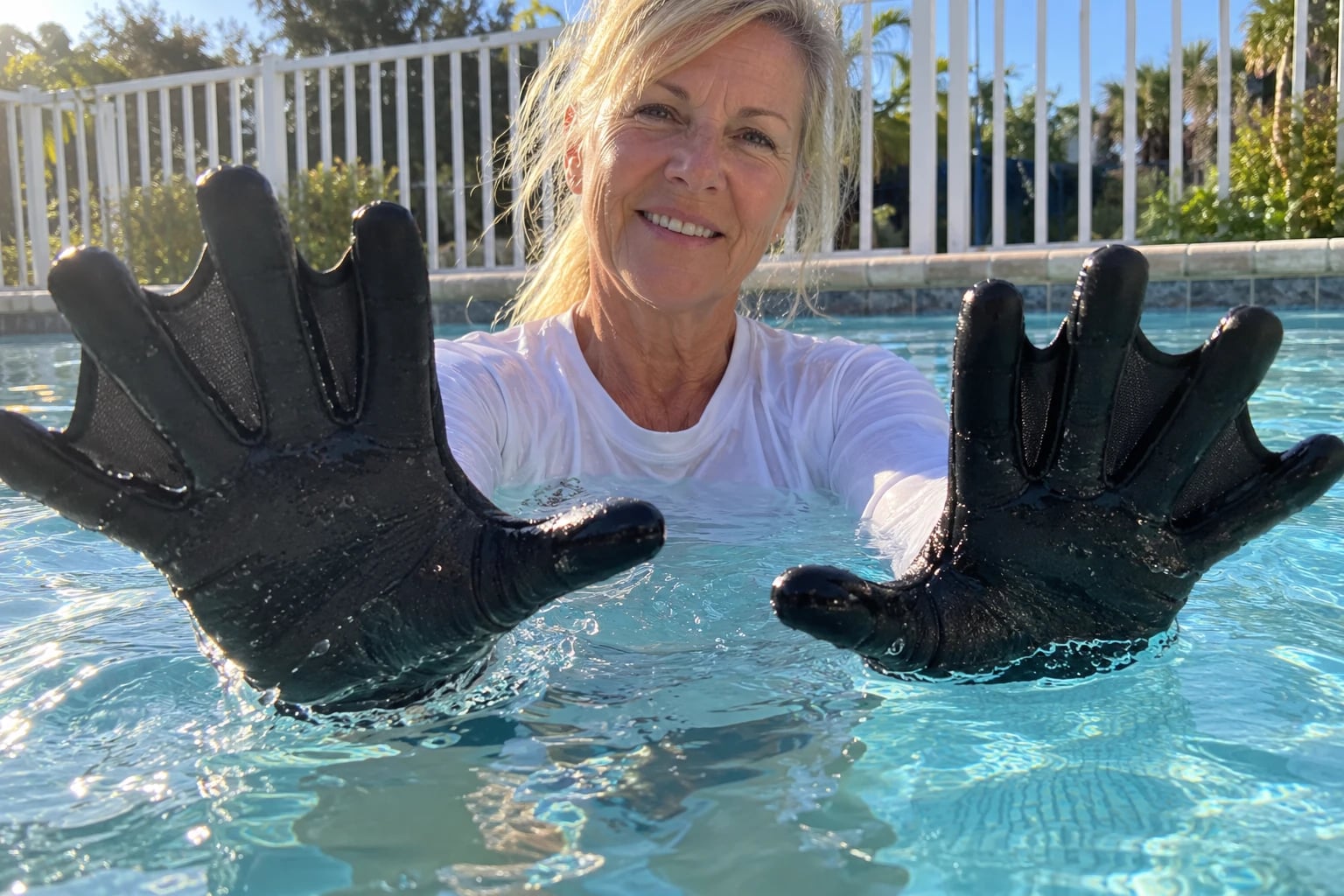
Look at her hands. The gloves have webbing between the fingers, so every push through the water meets more resistance, the way a paddle does.
Arthritis may have taken your pickleball or your hikes, and with them the pleasure of moving to a beat with other people. A class gives that back: the pace and the company without the pounding.
Watch for the jumping. Some instructors run in-water jumping jacks and tuck jumps. Water softens the landing but doesn't erase it. March or step in place instead, and nobody will notice.
Watch for twisting, too. When a move asks you to turn, turn your whole body and let your feet follow. Swiveling on a planted foot is the motion a sore knee likes least.
Ask whether the pool runs a class meant for arthritis. Those are usually slower, and a stiff knee likes slow.
18A Foam Belt Run in the Deep End
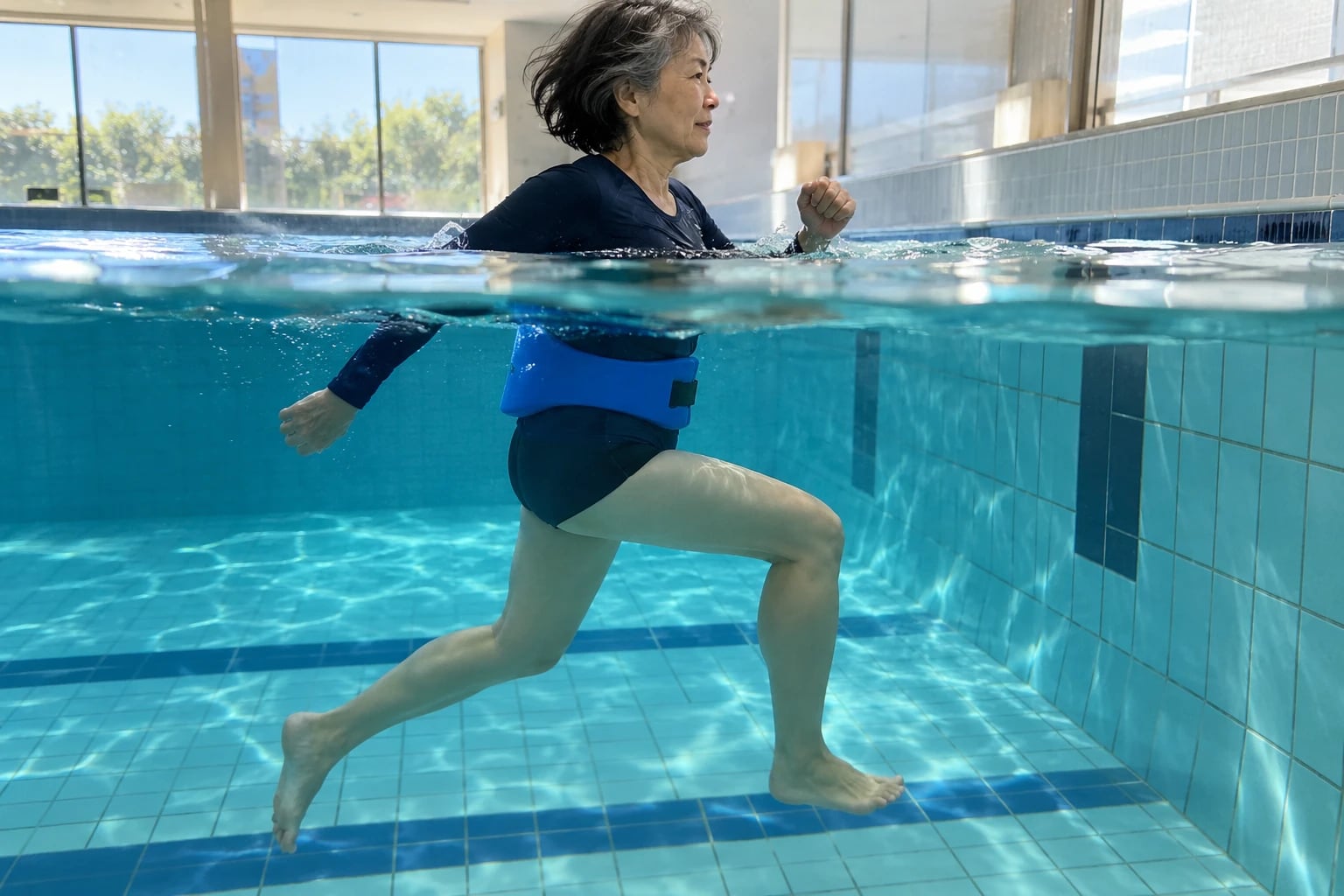
For days when even the shallow end hurts, this is the pick, because nothing lands.
A foam belt around your waist keeps you upright in the deep end, feet nowhere near the bottom, legs running in slow motion. The belt does the floating so your legs can do the running.
Skip it if you aren't at ease in deep water. Plenty of strong women aren't, and the shallow end will serve you fine.
The trap is how good it feels. With no pain to slow you down, it's easy to go from ten minutes to forty in a week.
Orthopedic surgeon Vonda Wright notes that after menopause, tendons and ligaments grow more prone to tendinitis and tears. A sudden jump in effort carries more risk than it did at 40.
Start at ten minutes and add five a week. Pump your arms, keep your body tall and drive each knee forward rather than kicking out.
17Freestyle Laps With a Small, Easy Kick
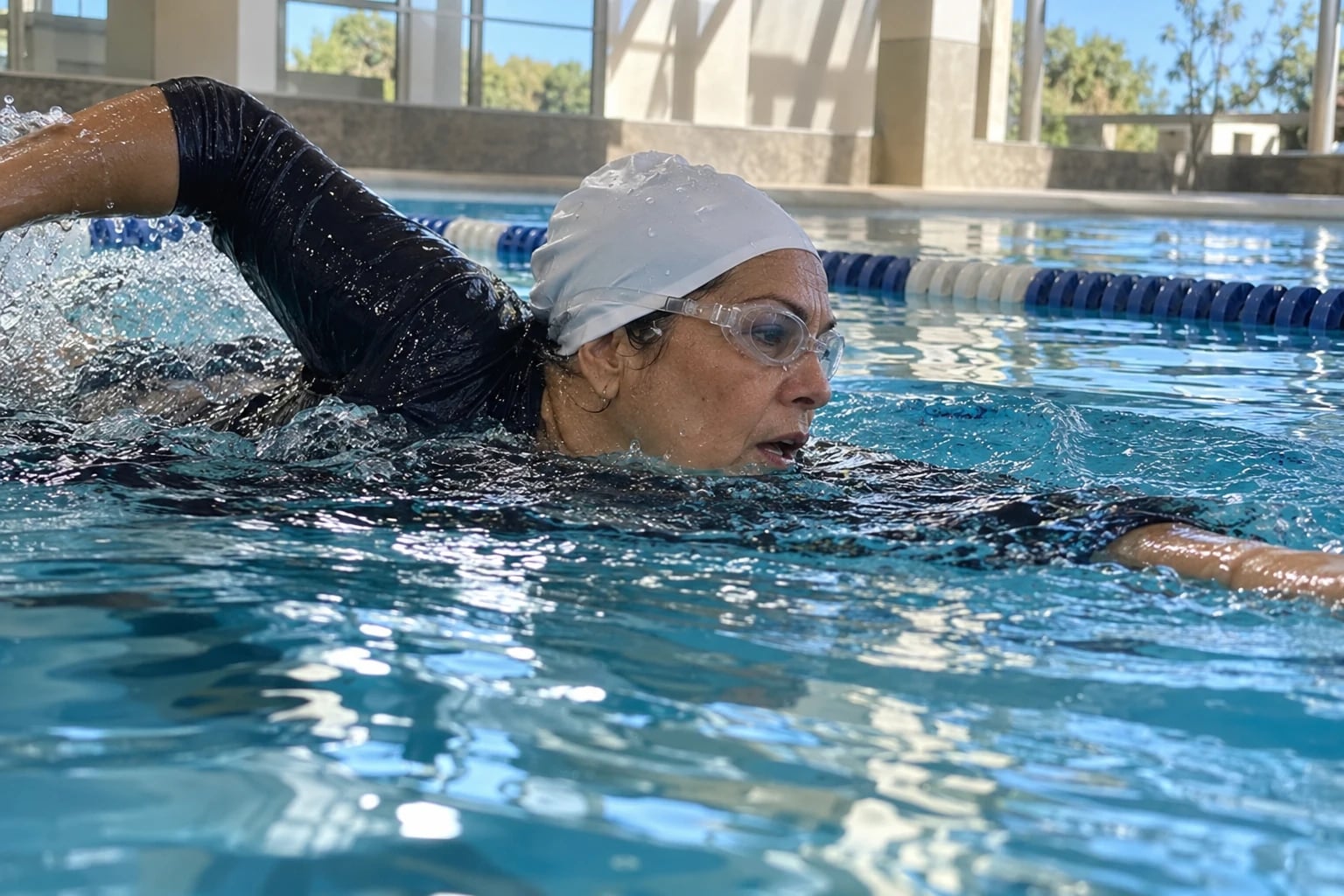
Face down, one arm reaching, the kick barely breaking the surface. In freestyle the legs flutter from the hip and the knee stays loose, so most of the work lands in your shoulders and back.
Breaststroke is the stroke to question. Its frog kick swings the lower leg out and around, and a sore knee often complains about exactly that. If yours does, swim freestyle or backstroke and leave the frog kick alone.
On a bad day, tuck a pull buoy, the figure-eight foam float, between your thighs and swim with your arms alone. Your knees get a day off and your heart still works.
Skip fins for now. They make every kick heavier, and the knee takes part of that load.
If you never learned to breathe to the side, a few adult lessons are worth the money. Community pools and the Y often run them.
On a machine
A bike and an elliptical keep your feet on the pedals, so the knee bends and straightens without anything landing on it. You can also turn the load up slowly, a notch at a time.
16An Upright Stationary Bike, Seat at Hip Height
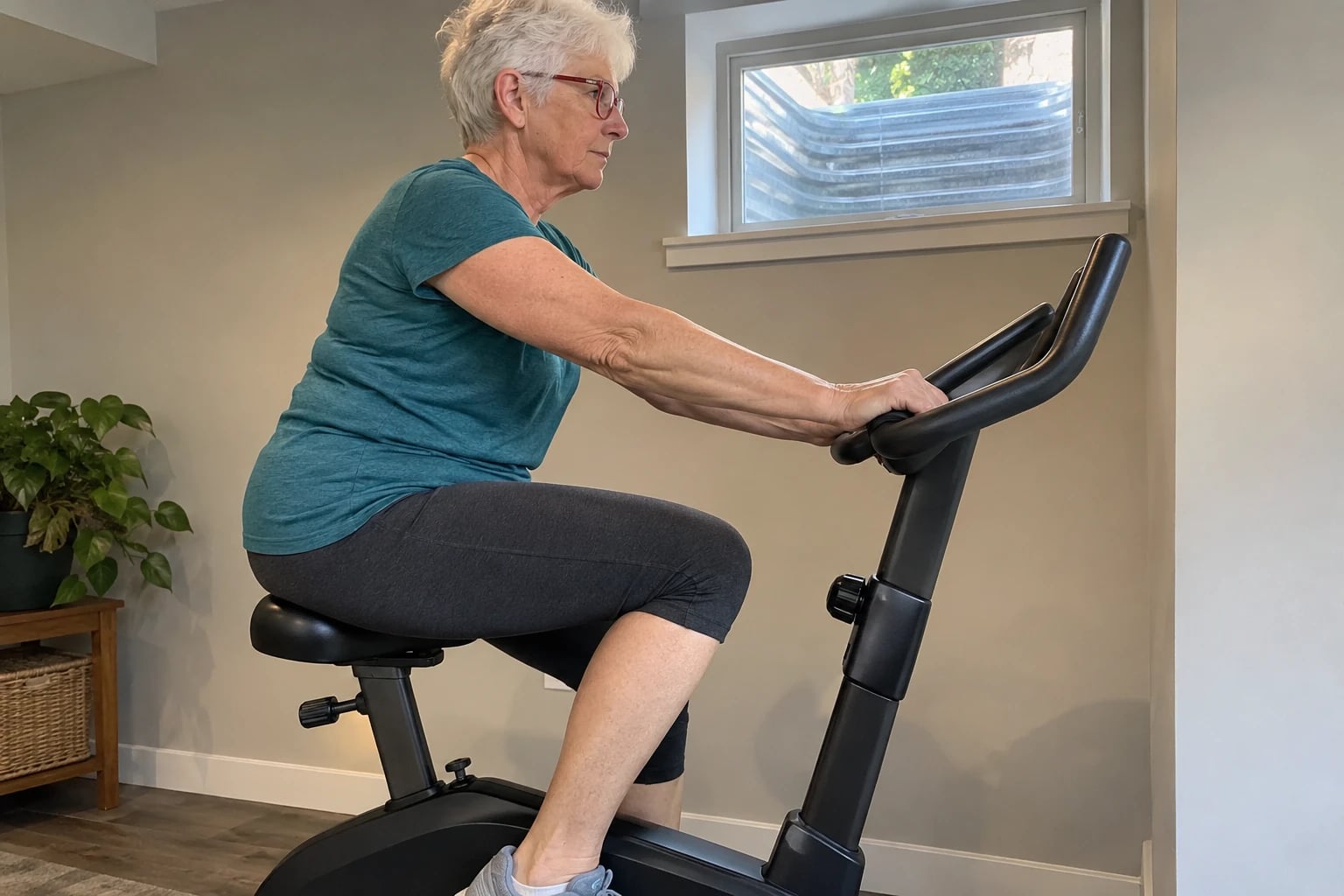
Near the bottom of the pedal stroke, her knee still has a slight bend. That bend is the setup, and getting it right matters more than anything you do once you're riding.
Stand next to the bike and raise the seat to about hip height. Sit and pedal. At the bottom, your knee should stop just short of straight.
A seat that's too low makes the knee fold sharply at the top, and the front of the knee feels it.
The Arthritis Foundation says to start with no resistance, adding speed first and resistance after. Aim for 20 minutes, three to five days a week. Five-minute rides count too.
It also offers a rule worth keeping, and it's the one scoring system you'll meet again in this list. Score your pain from 0 to 10 before you ride and again after.
If the number rises more than 2 points, cut your effort in half next time and take two days to recover. Sharp or shooting pain means stop right then.
15A Recumbent Bike With a Backrest
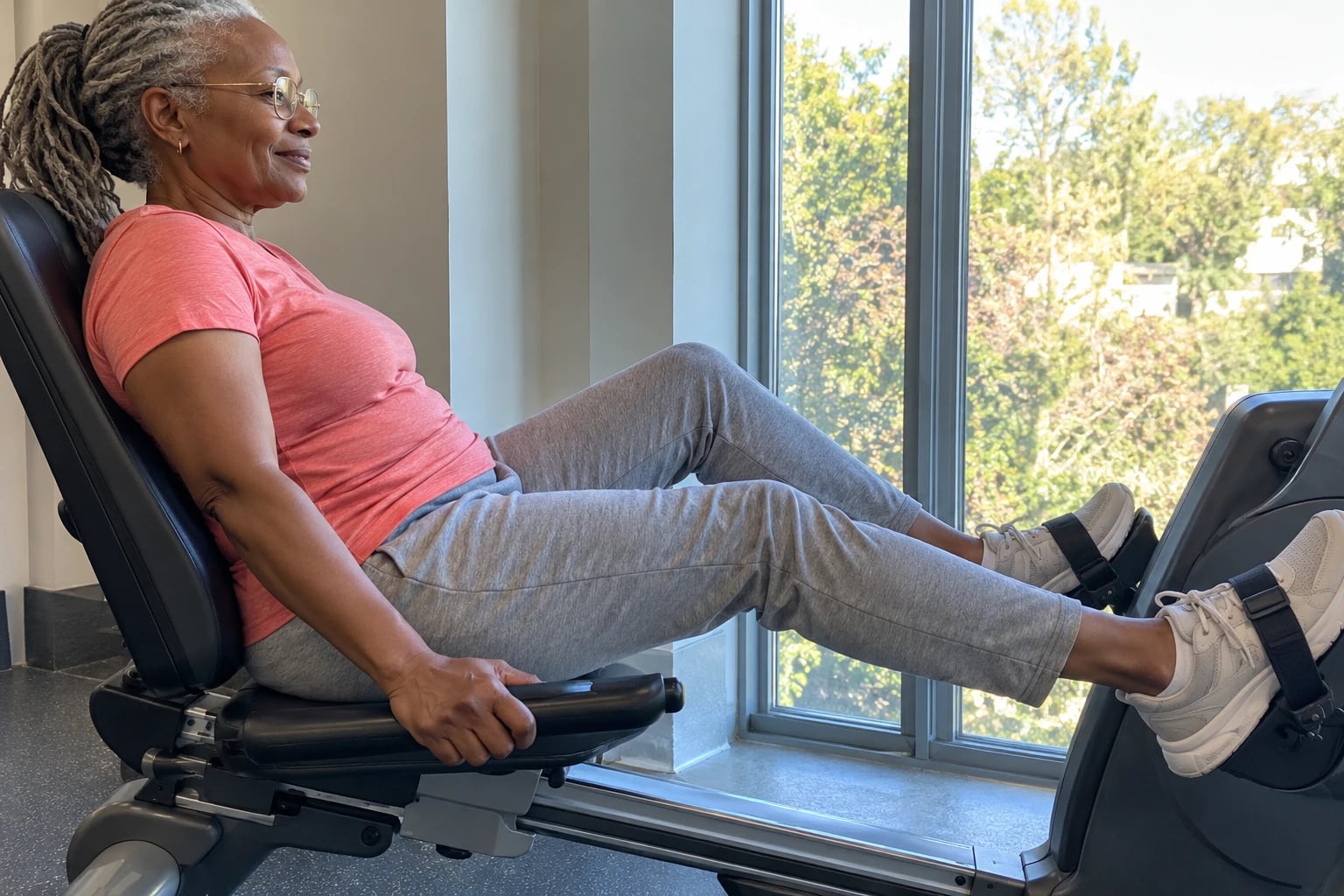
A recumbent bike suits the woman whose balance isn't what it was, or whose low back aches on an upright bike. The seat is shaped more like a chair, with the pedals out in front of you instead of underneath.
The seat is wider, the backrest takes your weight, and tipping off is hard to do. The foundation suggests one for people with balance problems.
Set it by sliding the seat until your leg is nearly straight at the far point of the stroke, with the same small bend in the knee.
If your knee rises toward your chest at the near point, the seat is too close. Move it back a notch.
This is how a longtime road cyclist whose knees started hurting in perimenopause keeps pedaling while she rebuilds. It won't feel like the open road. Your legs will still know what to do.
14An Elliptical, Feet Flat on the Pedals
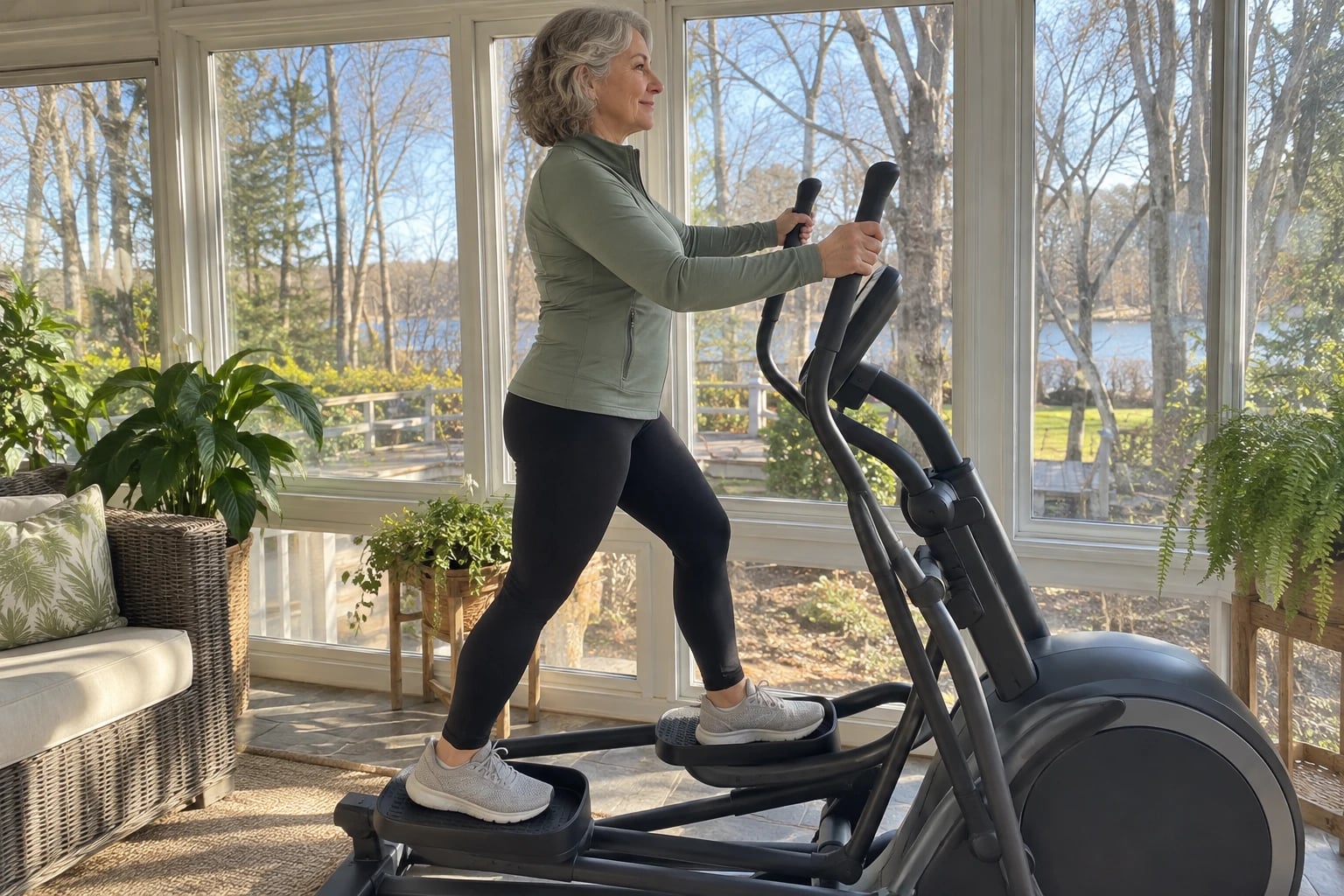
Running means landing. An elliptical doesn't: you stand upright with a light grip on the moving handles, and your feet stay flat on the pedals the whole time.
That makes it the machine for longer sessions, which matters if losing weight is one of your goals. Weight isn't the answer for everyone, and plenty of slim women have bad knees. But the knee is where a loss shows.
In a Wake Forest University study of 142 older adults, each pound lost took 4 pounds of load off the knee. Lose 10 pounds and each knee carries 48,000 pounds less for every mile you walk.
Stand tall. Leaning your weight on the rails takes the work out of your legs. Keep your knees pointing straight ahead and start at 10 minutes on the lowest setting.
If the stride feels too long, so you're reaching and twisting to keep up, try another model. Some let you shorten it.
13A Leg Press That Stops Short of Straight
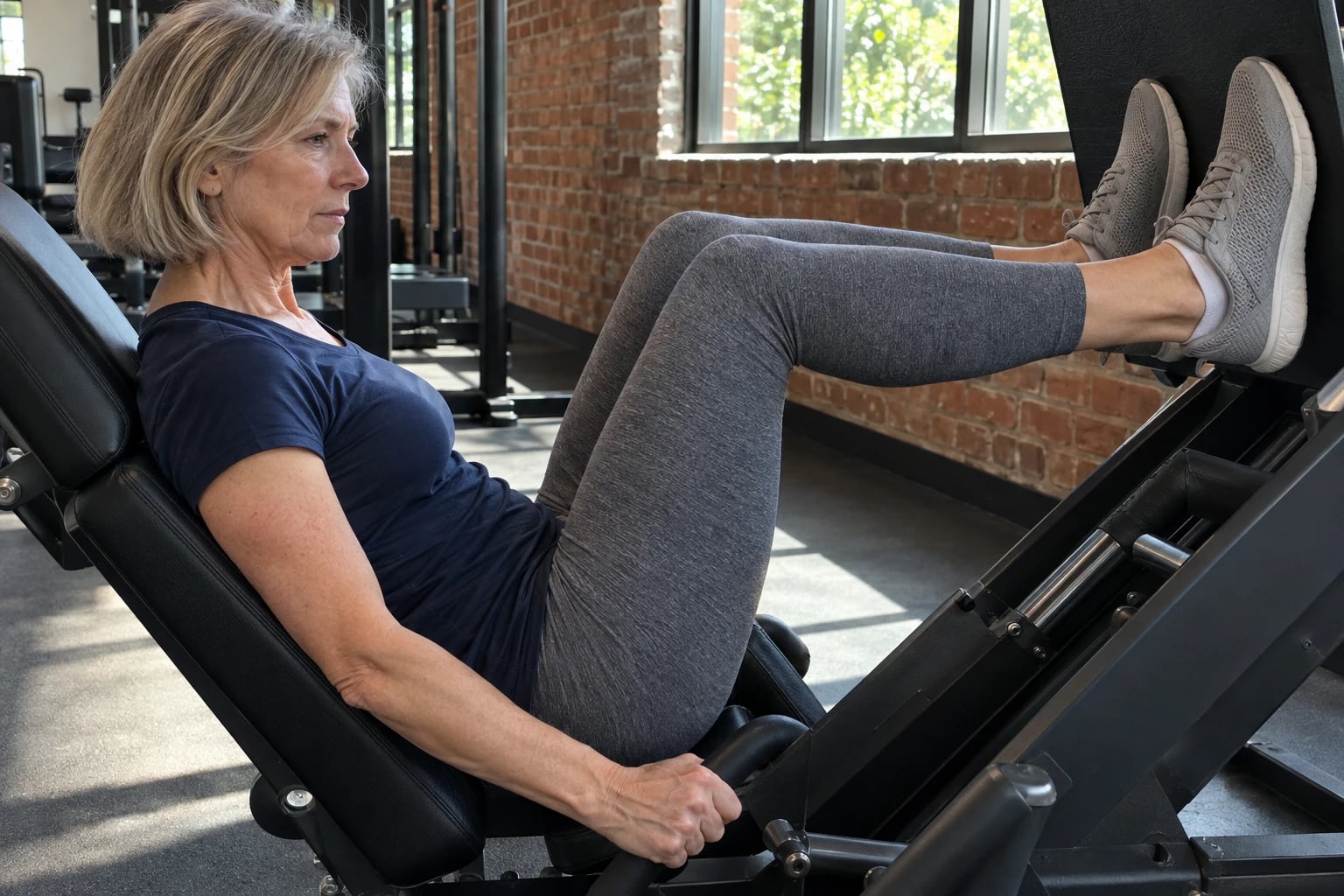
The rule on the leg press: at the top of the push, your knees stay soft, never snapped straight.
That last inch is where some knees catch or feel as if they lock. Stop the push just before the knee goes fully straight. The work stays in your thigh and you skip the inch that bothers the joint.
Lower the platform only until your knees reach about a right angle. Deeper asks more of the joint than you need to give.
Put your whole foot on the platform, hip-width apart, knees in line with your toes. Start light enough for 15 slow reps. You can add weight later. You can't take back a sore week.
Skip any machine that twists the knee while your foot is pinned, and anything that asks you to kneel. If the gym is new to you, ask a trainer to set the seat the first time.
On a chair, the floor or the bed
None of these needs a gym or a moment on your knees. Several can be done before you get out of bed.
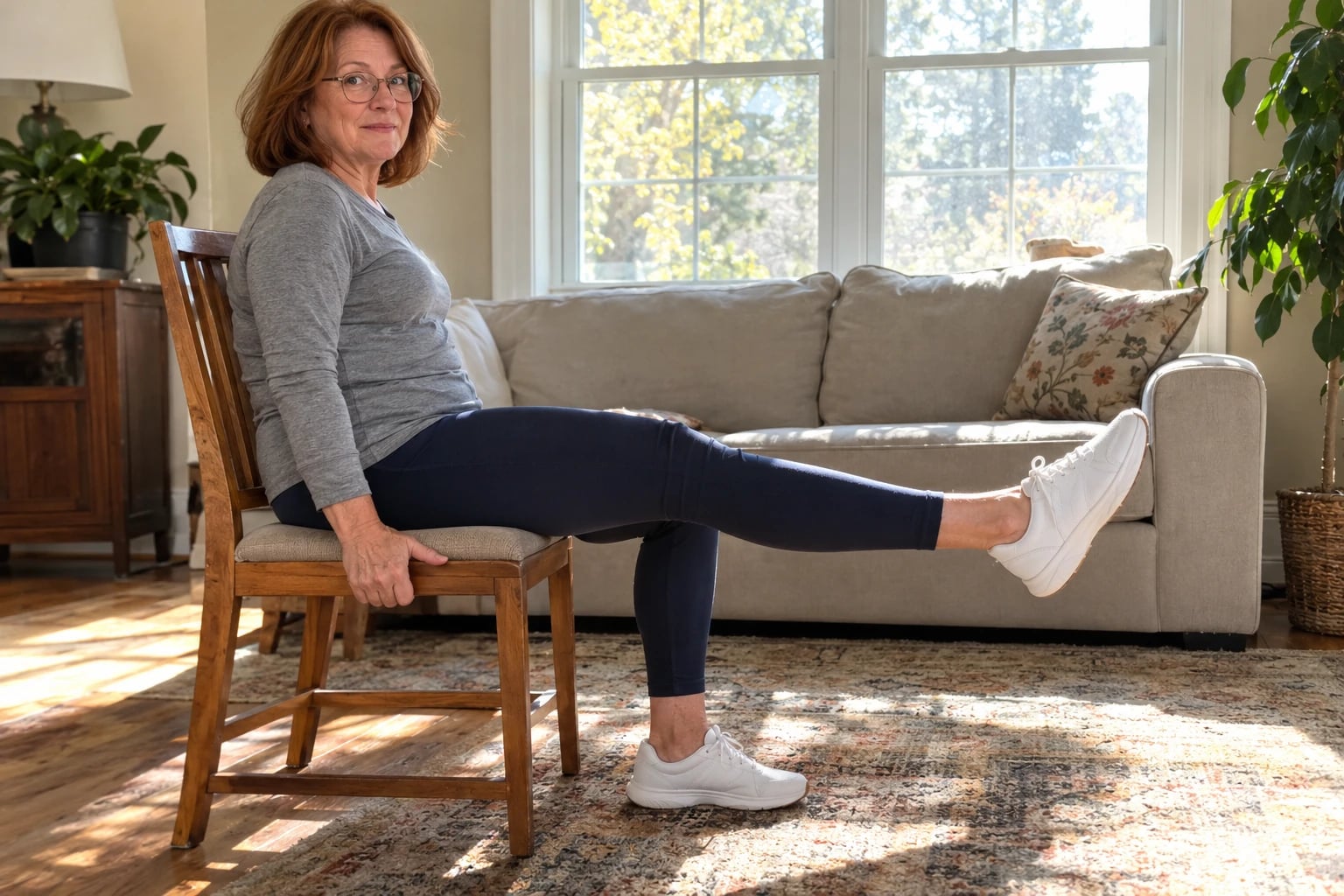
12A Seated Leg Extension on a Wooden Chair
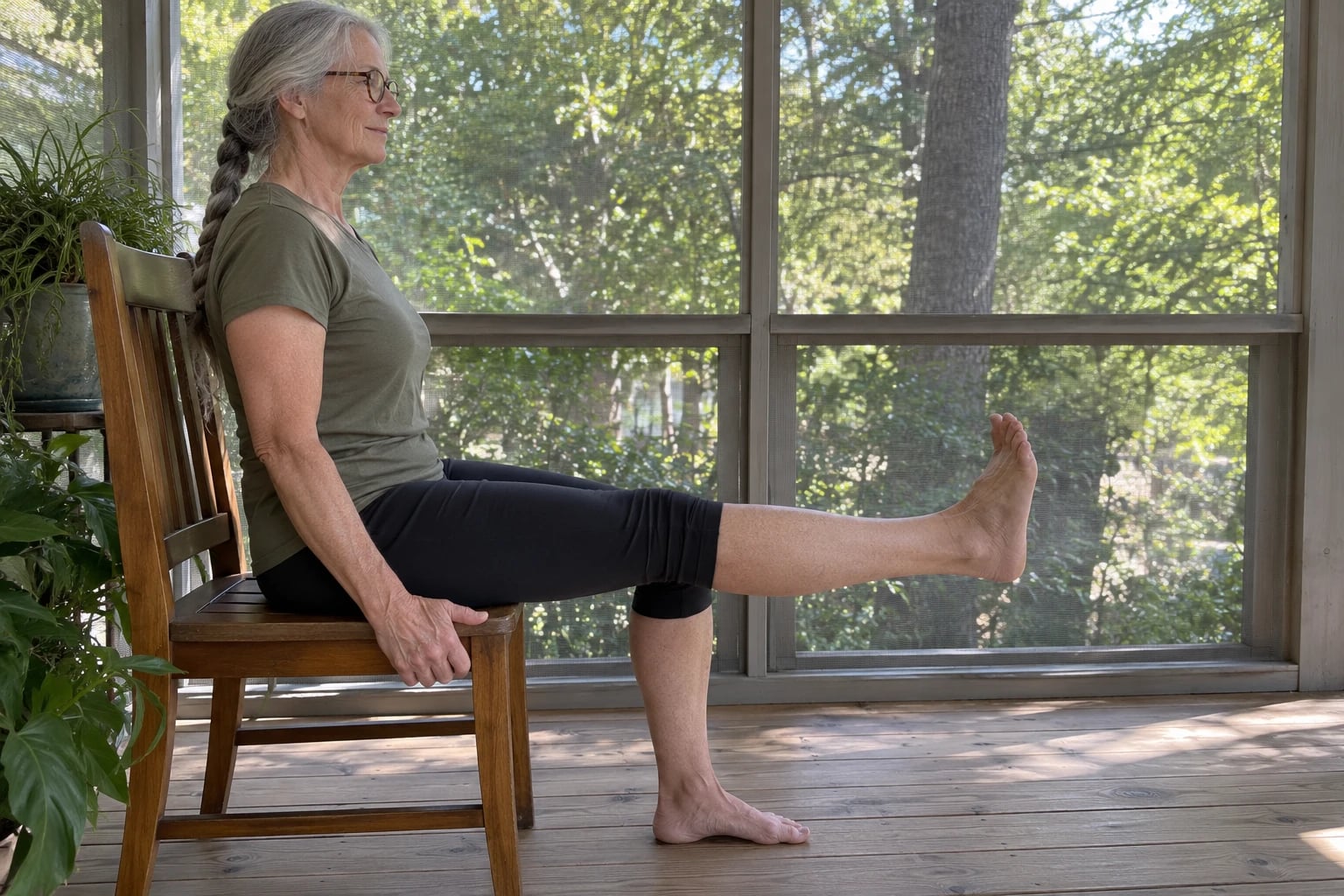
The pause at the top is the exercise: one leg straight out in front, toes pulled back toward your shin, while you sit tall on a wooden chair.
Sit back so your thighs are fully supported. Straighten one knee slowly, squeeze the front of the thigh, hold for 3 to 5 seconds, then lower over a slow count of three. Ten on each leg.
Too much? Straighten only partway. Too easy? Add a 1 or 2 pound ankle weight, or hold for ten seconds.
If your knees started hurting around the time your periods stopped, and a doctor shrugged it off, you weren't imagining it.
Lower estrogen can speed the breakdown of cartilage. Rheumatologist Candace Feldman at Mass General Brigham says losing estrogen raises inflammation, which feeds joint and muscle pain. More than 2 in 5 women, she says, have muscle or joint pain around menopause.
Strong quads can't regrow cartilage. What they can do is share the load around the joint.
11A Quad Set Over a Rolled Towel
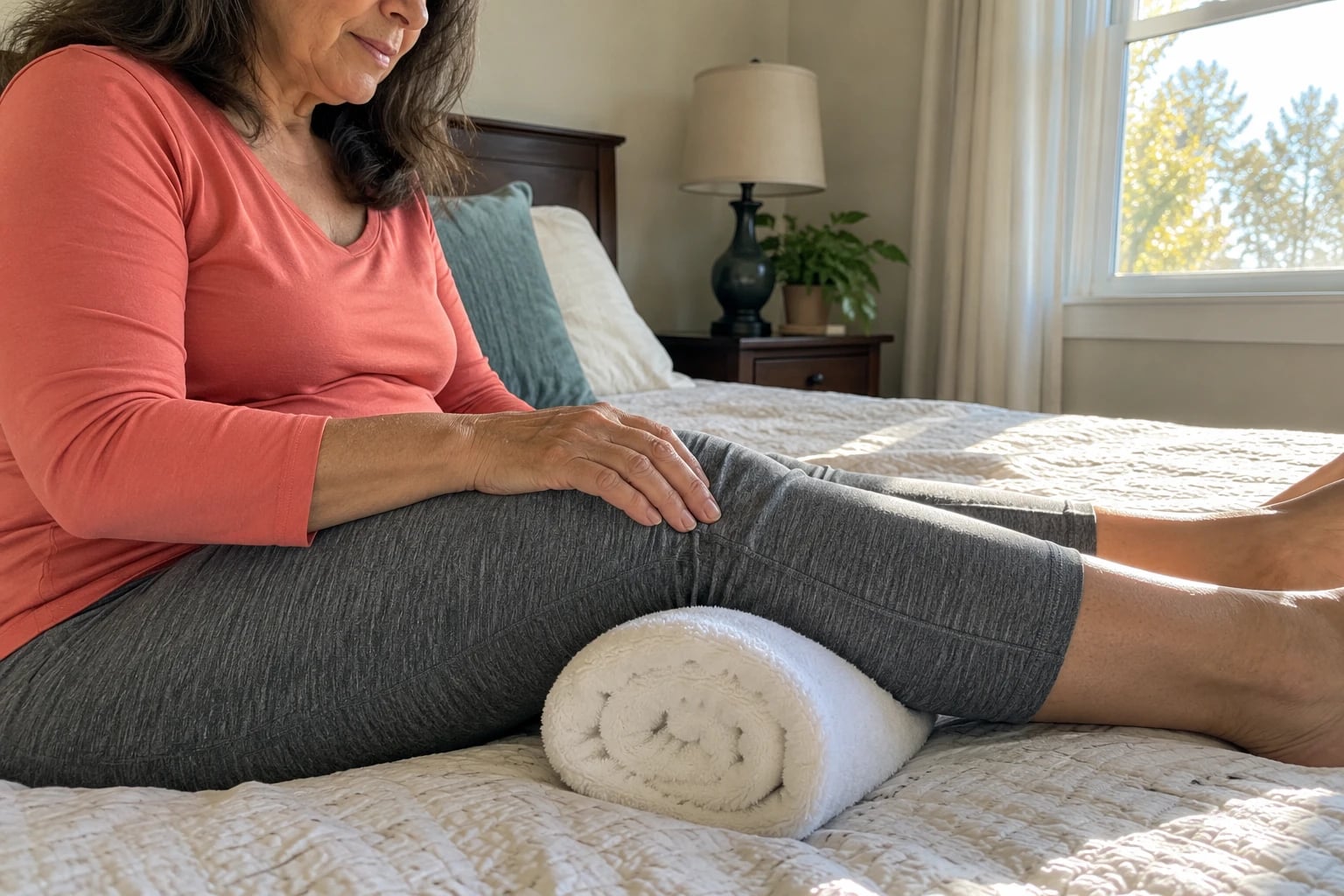
On the worst days, when bending feels like a bad idea, this is the one to reach for. It's an isometric exercise, which means the muscle tightens while the joint stays still.
Sit with your legs out straight, a rolled bath towel under one knee, and press the back of that knee down into it. If the kneecap slides up a little, it's working.
Press down, tighten the front of the thigh, hold for 5 seconds, relax. Ten in a row, a few times a day. Rest your fingertips on your thigh and feel it go hard. If it doesn't, press harder.
If a total knee replacement, often shortened to TKR, is on your calendar, ask your surgeon or physical therapist which exercises to do before the date. Ask about this one by name.
10A Straight-Leg Raise on the Bed
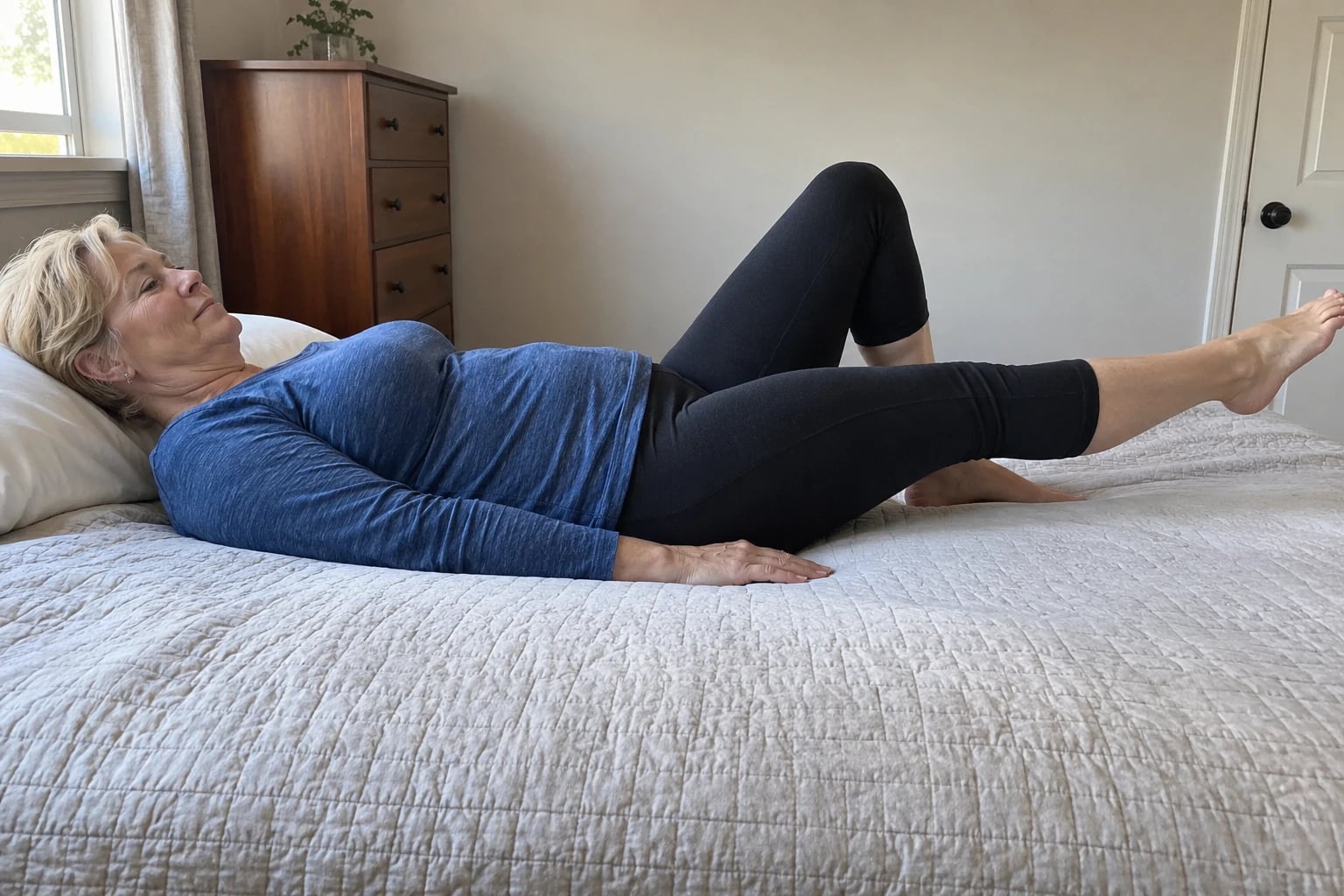
Lie on your back on the bed with one knee bent and the foot flat. The other leg stays straight and lifts to the height of that bent knee.
Order makes it work. Tighten the straight leg first, so the knee is firmly straight. Then lift slowly, hold for a breath and lower slowly. The bent knee keeps your low back from arching.
Ten on each side. A light ankle weight makes it harder. If even this pinches your back, go back to quad sets for a week.
Why bother with a move this plain? Falling estrogen means your body builds less new muscle protein and breaks down more of what it has.
Muscle you used to keep without trying now needs regular work. This one asks nothing of a sore knee except that it stay still.
9Side-Lying Clamshells With Feet Together
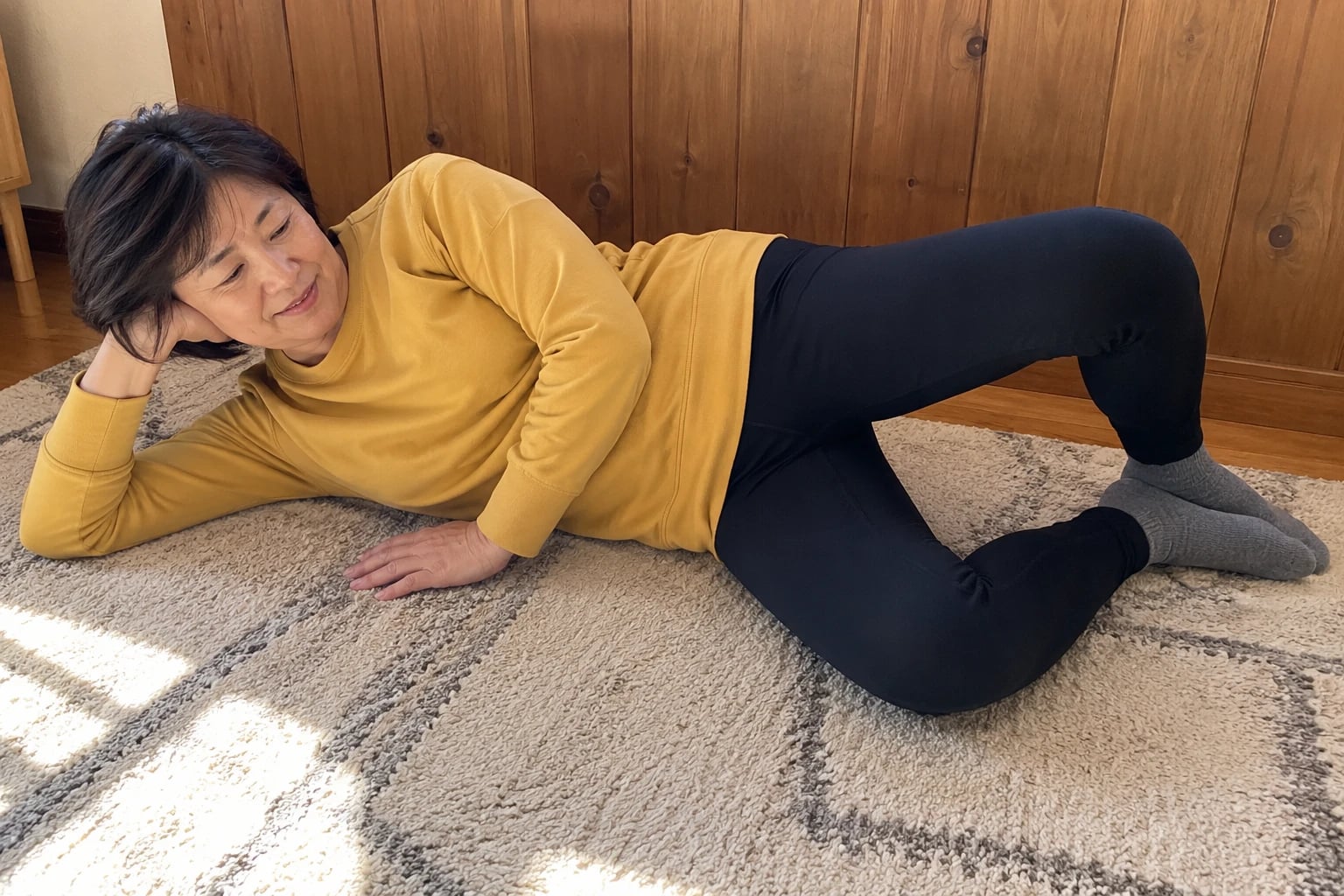
Lie on your side, knees bent and heels touching, and open the top knee like a shell while your feet stay together. That's a clamshell.
It works the glutes, the muscles of your buttocks, especially the ones on the side of the hip. Physical therapists often look there when a knee hurts, because a weak hip can let the knee drift inward on stairs and curbs.
Ten on each side is a sensible start, even on a flare day.
The common mistake is rolling backward as the knee opens. Lie with your back against a wall or the headboard. If your shoulders or hips lose touch with it, you've rolled. Open the knee less.
Once ten feels easy, loop a light resistance band just above your knees.
8A Bridge With a Ball Between the Knees
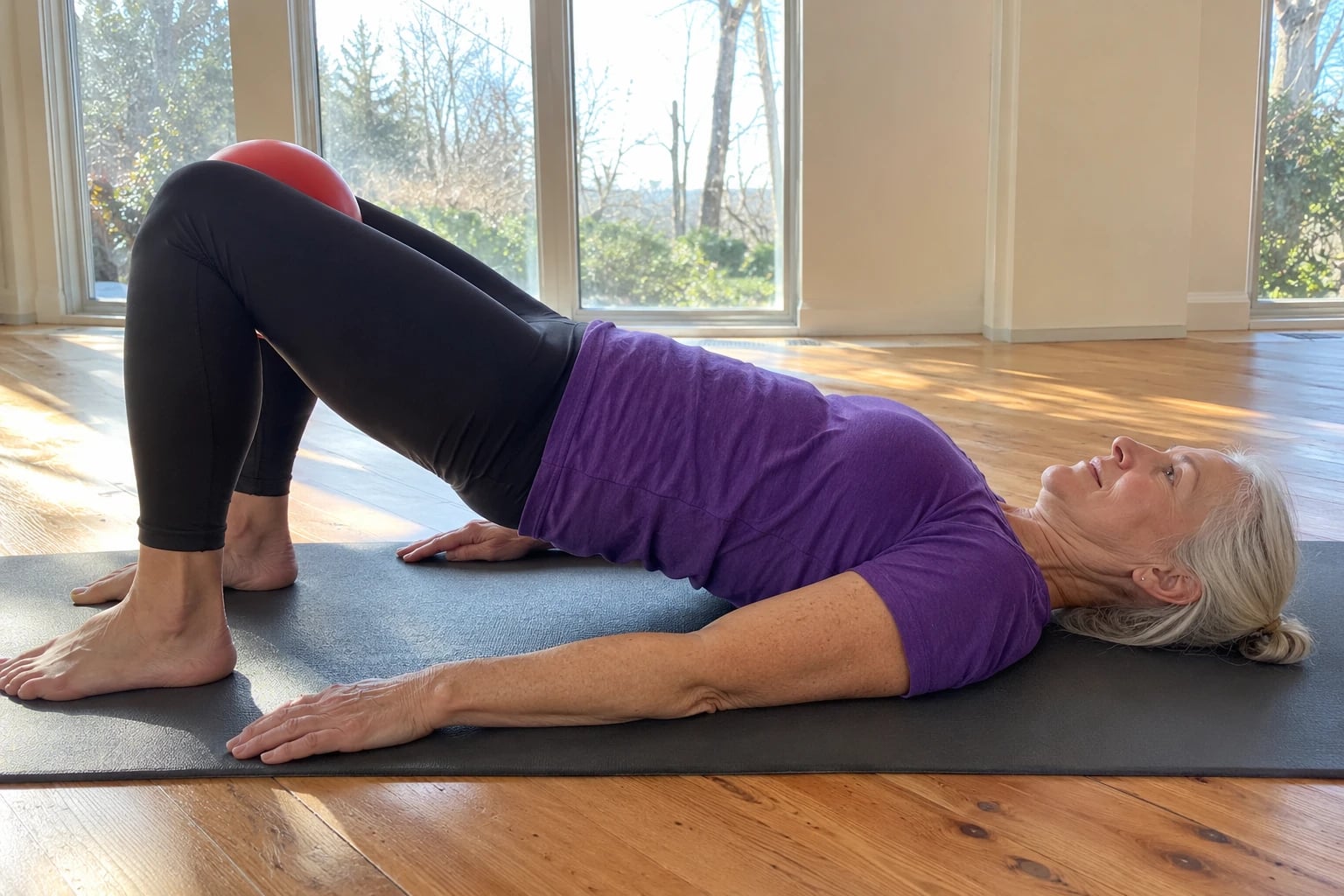
On her back, feet flat, hips lifted so there's a straight line from her shoulders to her knees, and a small ball pinned between them.
The lift works your glutes and hamstrings, the backs of your thighs. The squeeze works your inner thighs. Both are on the Hospital for Special Surgery's list of muscles to strengthen for sore knees.
Squeeze the ball, lift, pause for three counts and lower slowly. Ten. No ball? A firm pillow folded in half works.
If the backs of your thighs cramp, walk your feet a little closer to your hips.
If getting down to the floor and back up means kneeling, skip the floor. A firm mattress does the job.
To make it harder, hold the top for 20 seconds and keep squeezing the whole time.
7Chair Pilates With Both Feet Down
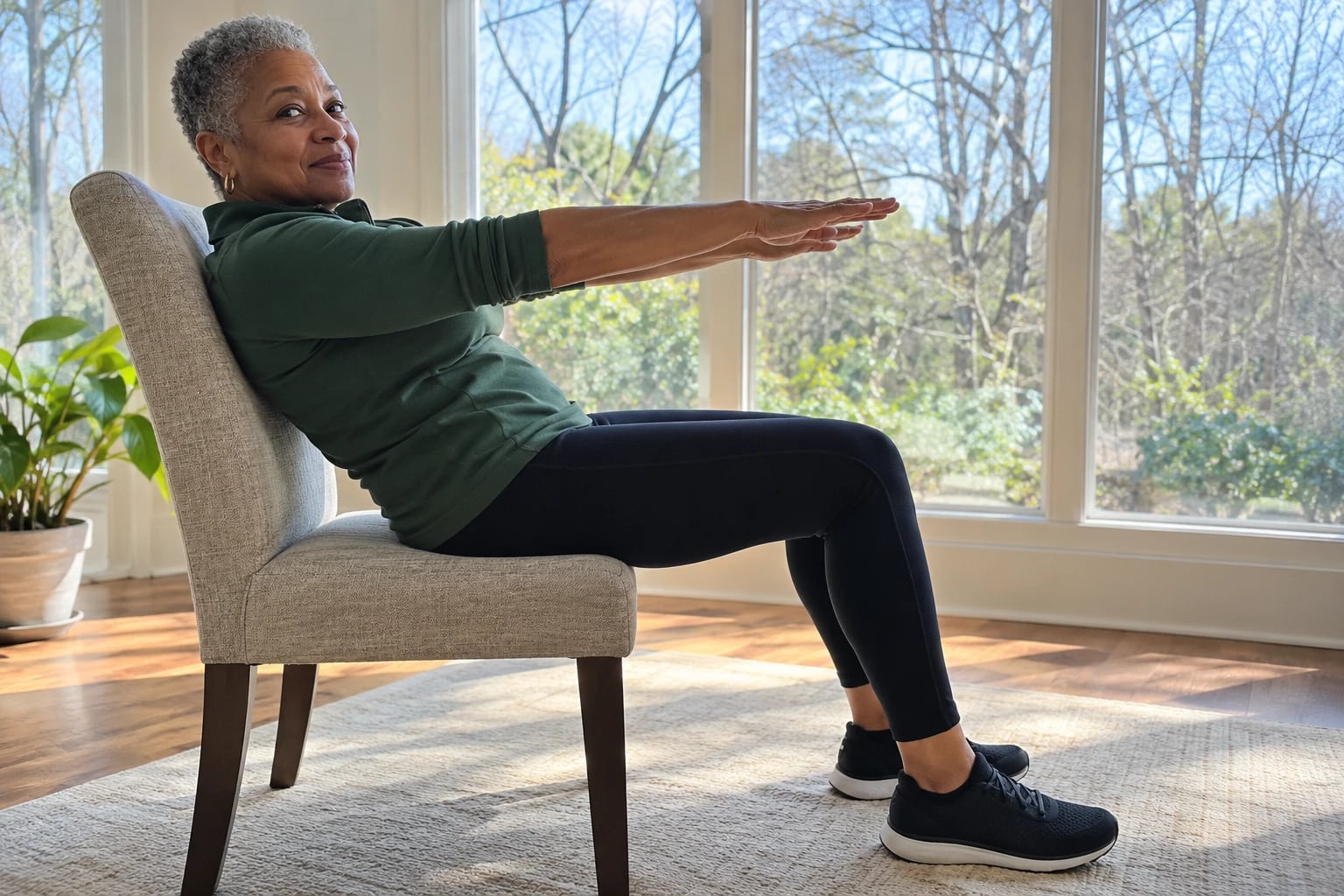
No mat here, and your knees never touch the floor. Perch near the front of a chair, spine long, and reach your arms forward as you curl slowly back.
If kneeling is out, this is the usual stand-in for mat Pilates, where a good share of the moves happen on hands and knees. From the chair you still get the core work: seated roll-backs, leg lifts, slow marching, side bends.
Look for classes listed as chair or seated Pilates at senior centers, the Y or Pilates studios.
If you'd rather try a mat class, ask before it starts what you can do when everyone goes to all fours. A good instructor will have an answer ready.
If you tend to overdo it and pay in your back or your hands, go at half range for the first week. Pilates looks gentle, and the soreness tends to show up a day later.
Standing, for stairs and chairs
These are the ones that get you up the staircase and out of a low sofa. Do them beside something sturdy to hold.
6Heel Raises at the Kitchen Counter
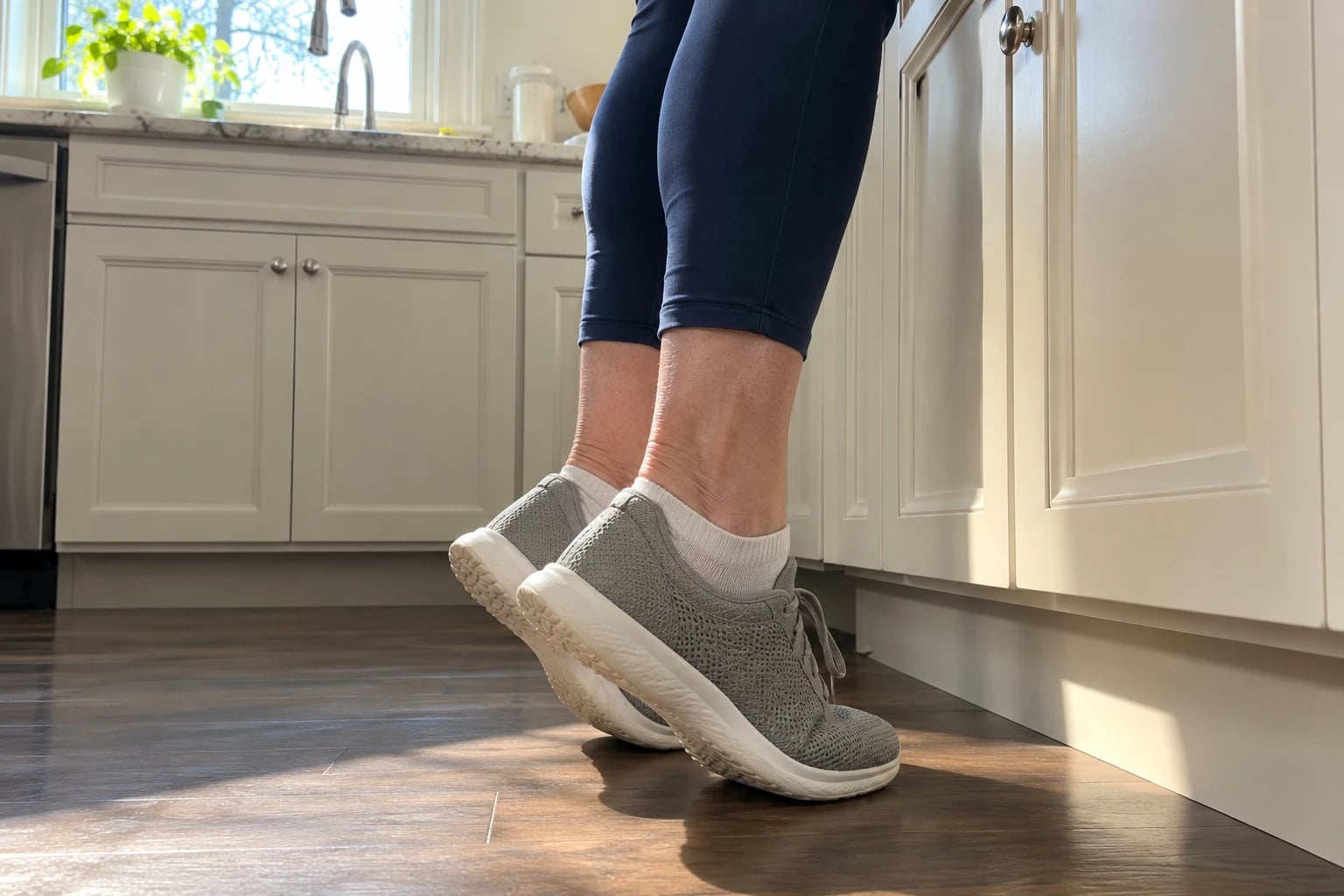
Fingertips on the kitchen counter, she's risen onto the balls of both feet, heels high. That's the whole move.
It strengthens your calves, one of the muscle groups physical therapists work on for sore knees. It also puts weight through your bones, which the pool and the bike can't do.
That matters now. The Bone Health & Osteoporosis Foundation says a woman can lose up to 20% of her bone density in the 5 to 7 years after menopause. About 1 in 2 women over 50 will break a bone because of osteoporosis.
Rise for a count of two, hold, lower for a count of three. Fifteen. Use both hands if your balance is shaky. When that's easy, rise on one foot at a time.
While you're thinking about bones, ask your doctor whether you're due for a bone density scan.
5A Wall Sit at a Shallow Bend
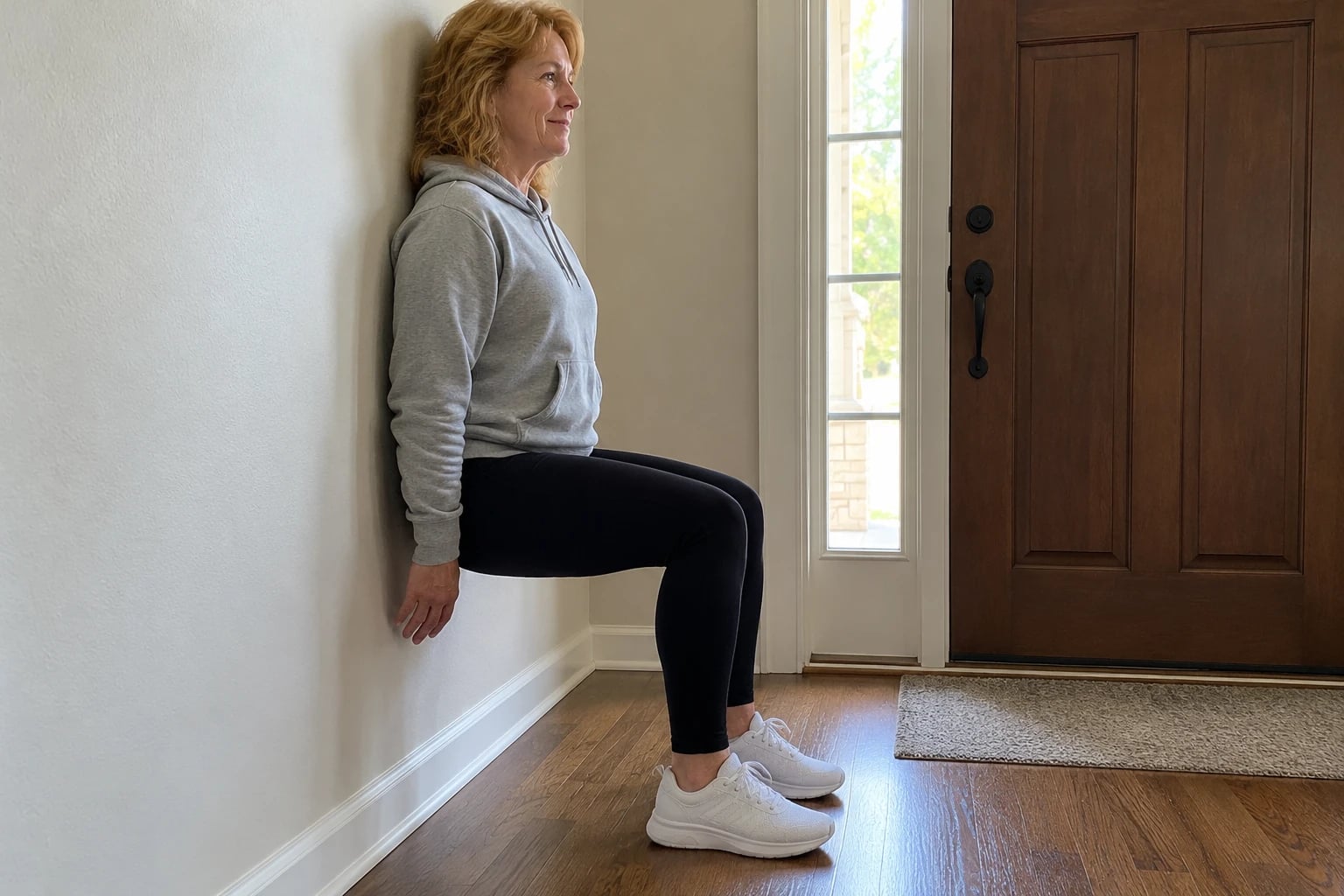
For sore knees, the wall sit stays shallow. Put your back flat against the hallway wall, feet out in front, and bend your knees only partway, about halfway to sitting.
The usual wall sit goes down to a right angle, thighs level with the floor. Skip that. Start at about 45 degrees.
Hold for 20 seconds. Rest for 30. Do three rounds, three or four times a week. It's isometric, like a quad set, so the joint holds still while the muscle does the work.
The test is your feet. Look down. If your knees are out past your toes, walk your feet farther from the wall.
Over the weeks, hold longer before you go lower. If the front of the knee hurts even at 45 degrees, slide up a few inches and see whether it settles.
4Sit-to-Stand From a Firm Chair
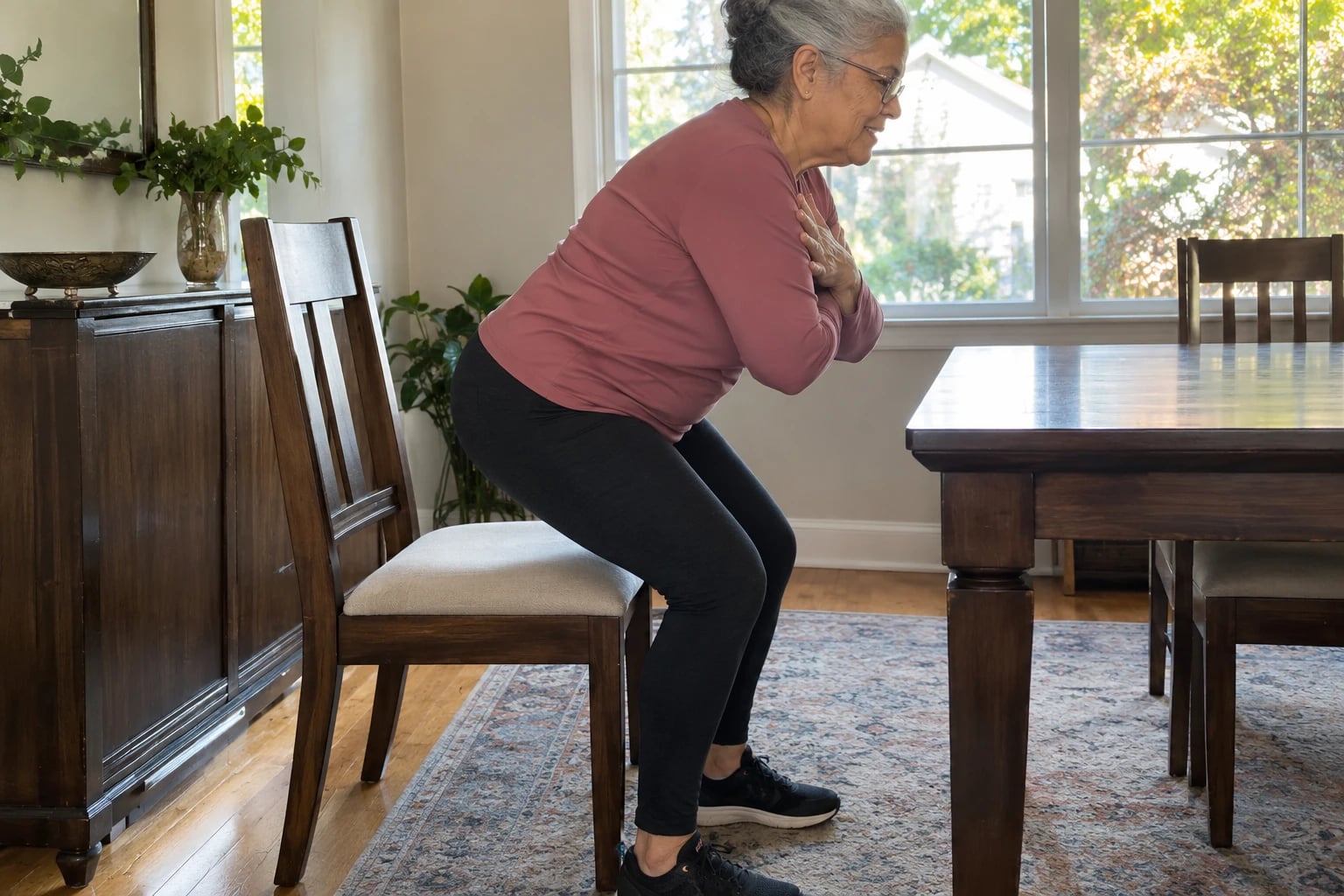
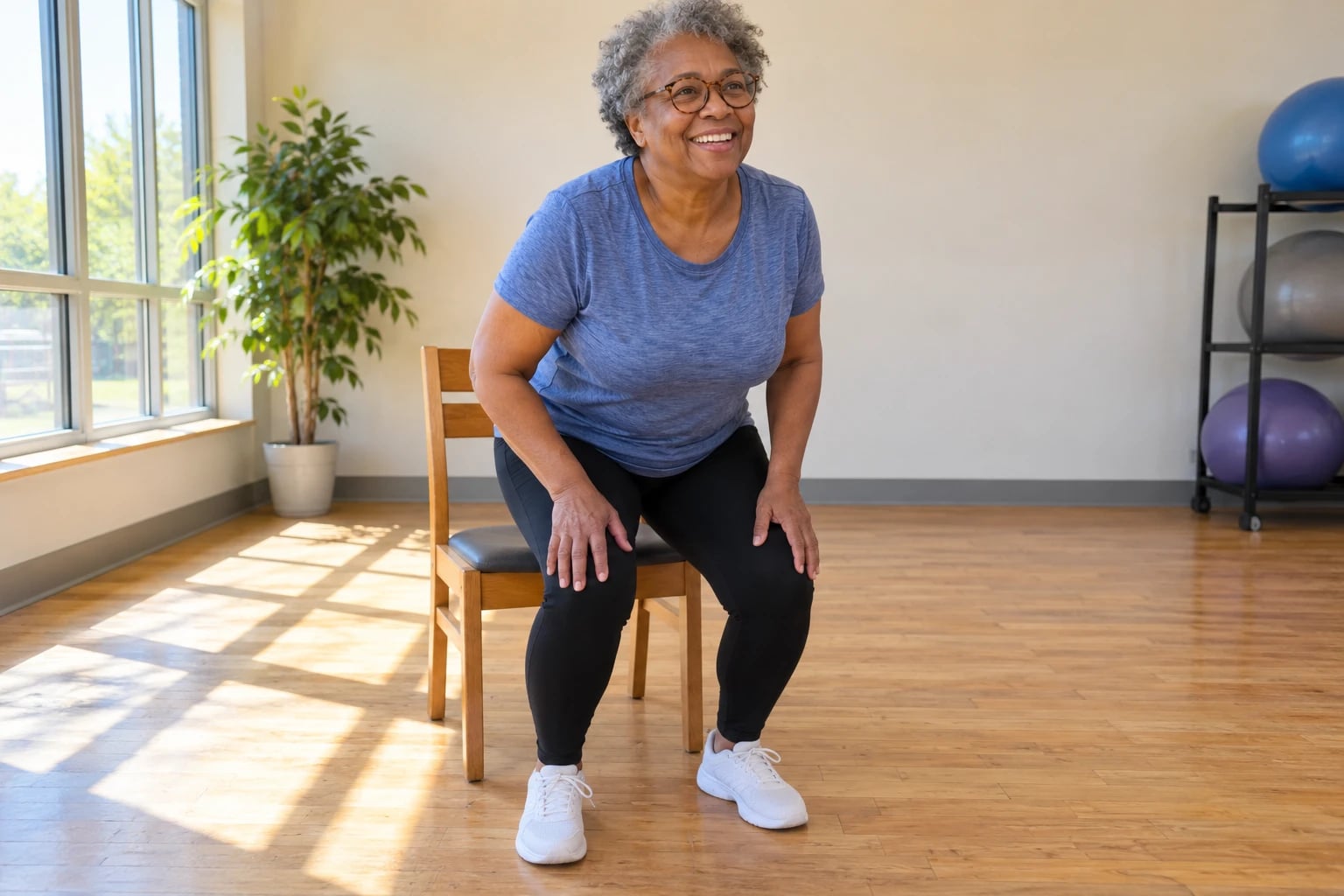
You stand up from a chair a dozen times a day already. Now you do it on purpose: arms crossed over your chest, leaning forward from the hips with your weight over your feet.
Two worries come up with squats. The first is where your knees go. Let them point the same way as your toes, in line with your big toe, never caving inward. Keep your shins fairly upright rather than letting your knees travel far forward.
The second is the low back. If chair squats strain it, you're probably leaning back or dropping onto the seat. Lean forward, nose over toes, and lower yourself slowly. Still sore? Put a firm cushion on the chair so you don't go as deep.
Start with five. Build to ten. When it's easy, take the cushion away.
In Denmark's GLA:D program, about 10,000 people with knee or hip osteoarthritis exercised twice a week for six weeks. Their pain fell by about a quarter on average.
3A Step-Up Onto a Low Step
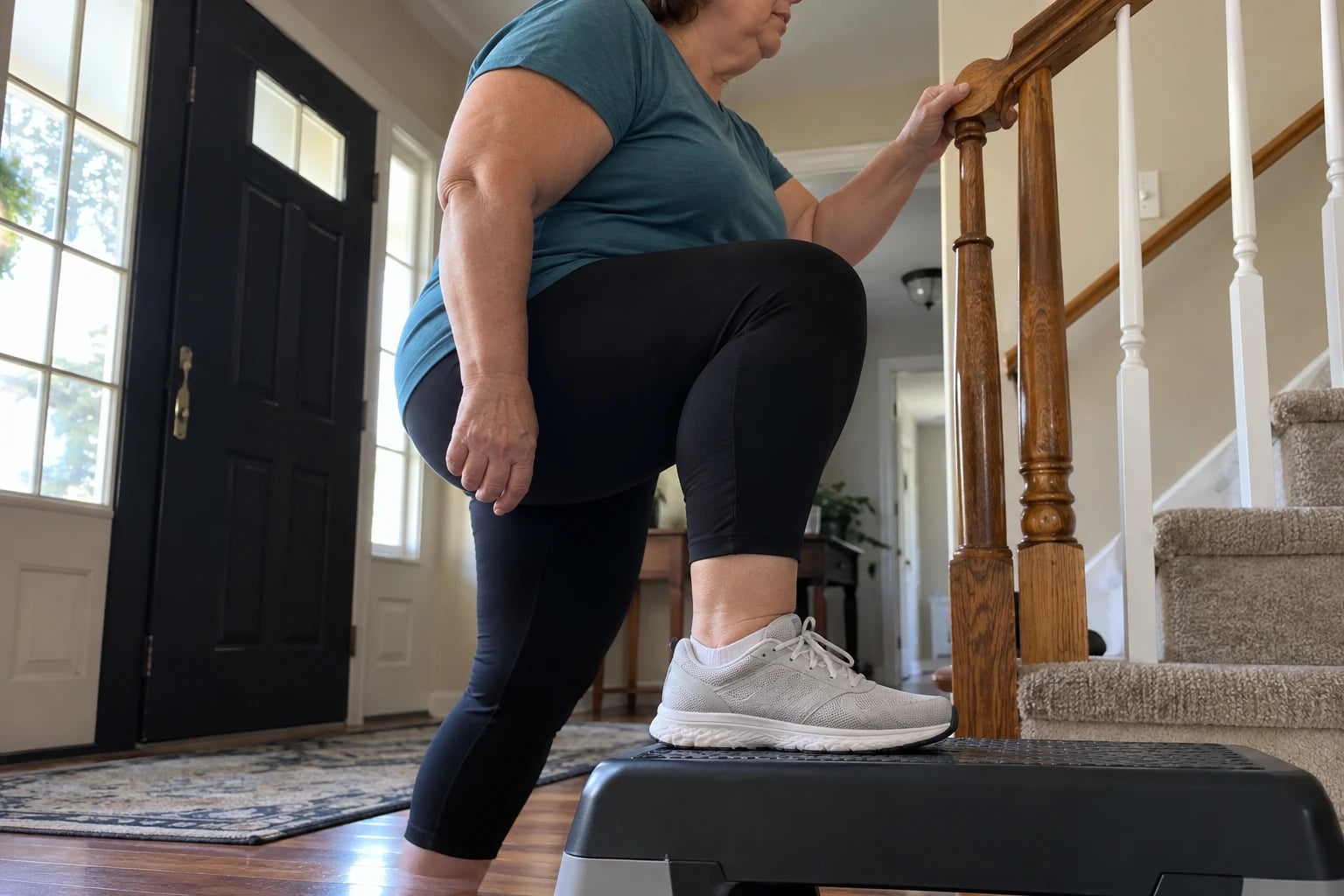
One sneaker planted flat on a low step, the whole foot on it, and she's rising with her weight pressed down through her heel.
This is the starting point for anyone who walks downstairs fine but feels the leg won't lift her going up. Climbing asks your thighs and buttocks to raise your whole weight, and this trains exactly that.
Use a step 3 to 4 inches high, like an exercise step, not a full stair. Hold a rail or touch the wall.
Put the whole foot down and push up through the heel, not the toes. Ten on each leg, three or four times a week.
Once that's easy, step up sideways onto the same low step. Then try a regular stair.
On real stairs, until things improve, lead with the good leg going up and the sore one coming down.
Out the door
Both of these get you outdoors, and neither needs more than a pair of sneakers.
2Tai Chi in the Park
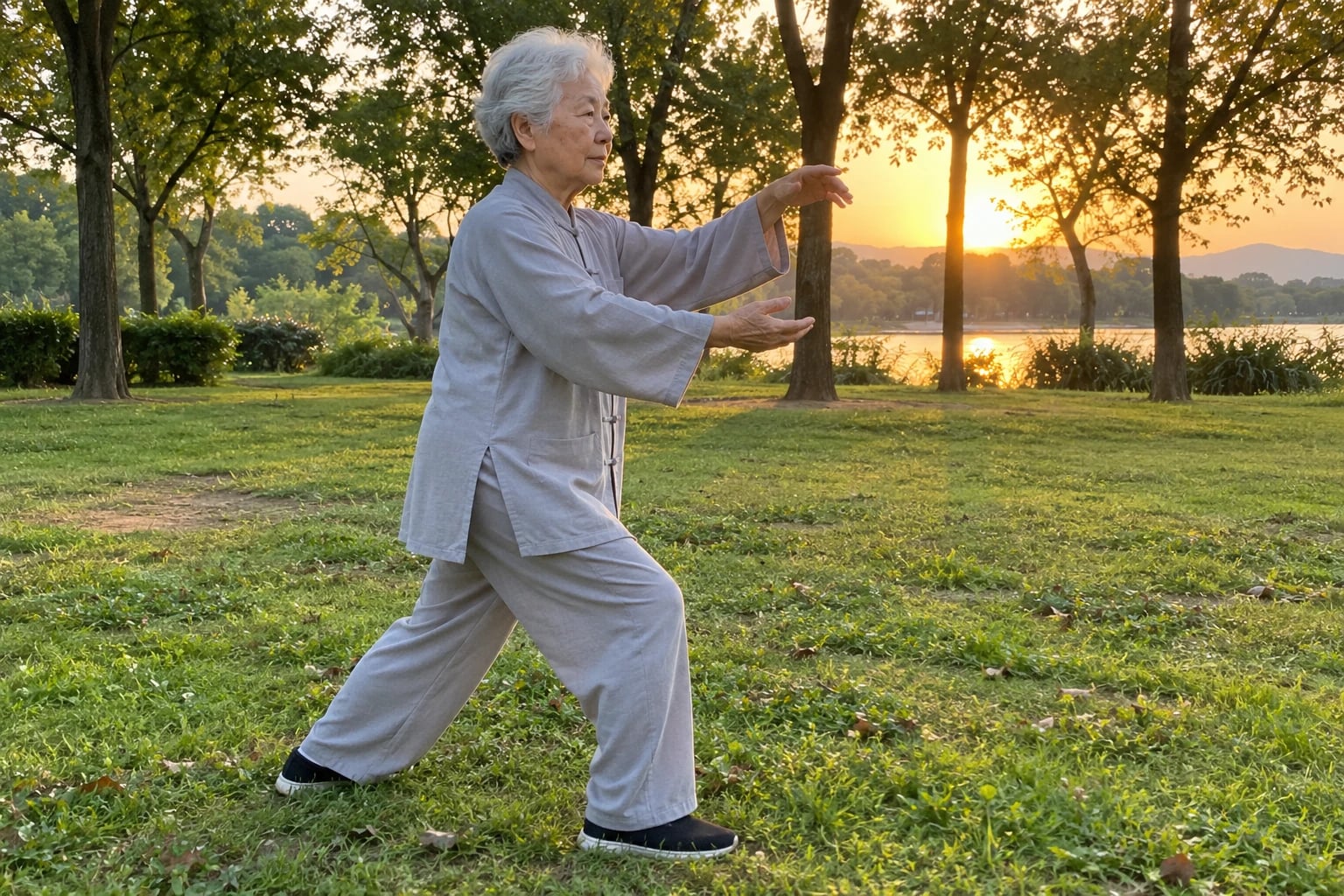
In the park, knees softly bent, she's shifting her weight from one foot to the other while her arms trace a slow arc in front of her. That's tai chi, a practice of slow, flowing movement.
It comes with unusual backing. The 2019 rheumatology guideline that endorsed exercise for knee osteoarthritis strongly recommended tai chi by name.
Watch your depth. Some forms sink into deep bent-knee stances. Stay high.
When a move turns you, lift the foot and place it, or pivot on your heel. Don't twist the knee over a planted foot.
Look for beginner classes through your parks department, a senior center or the Y. Classes called Tai Chi for Arthritis teach a shorter, gentler form built for joints like yours.
1A Ten-Minute Walk on Flat Ground
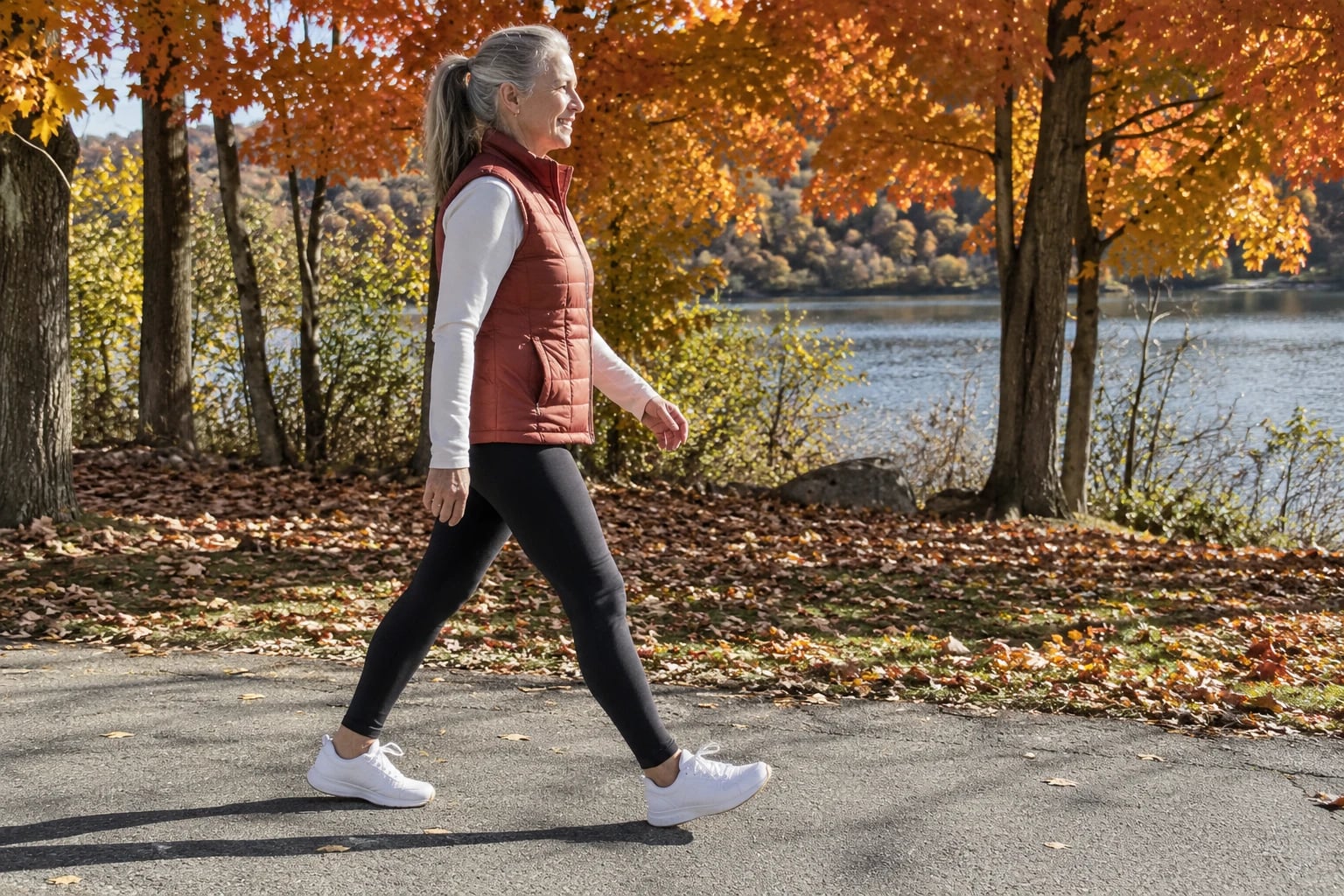
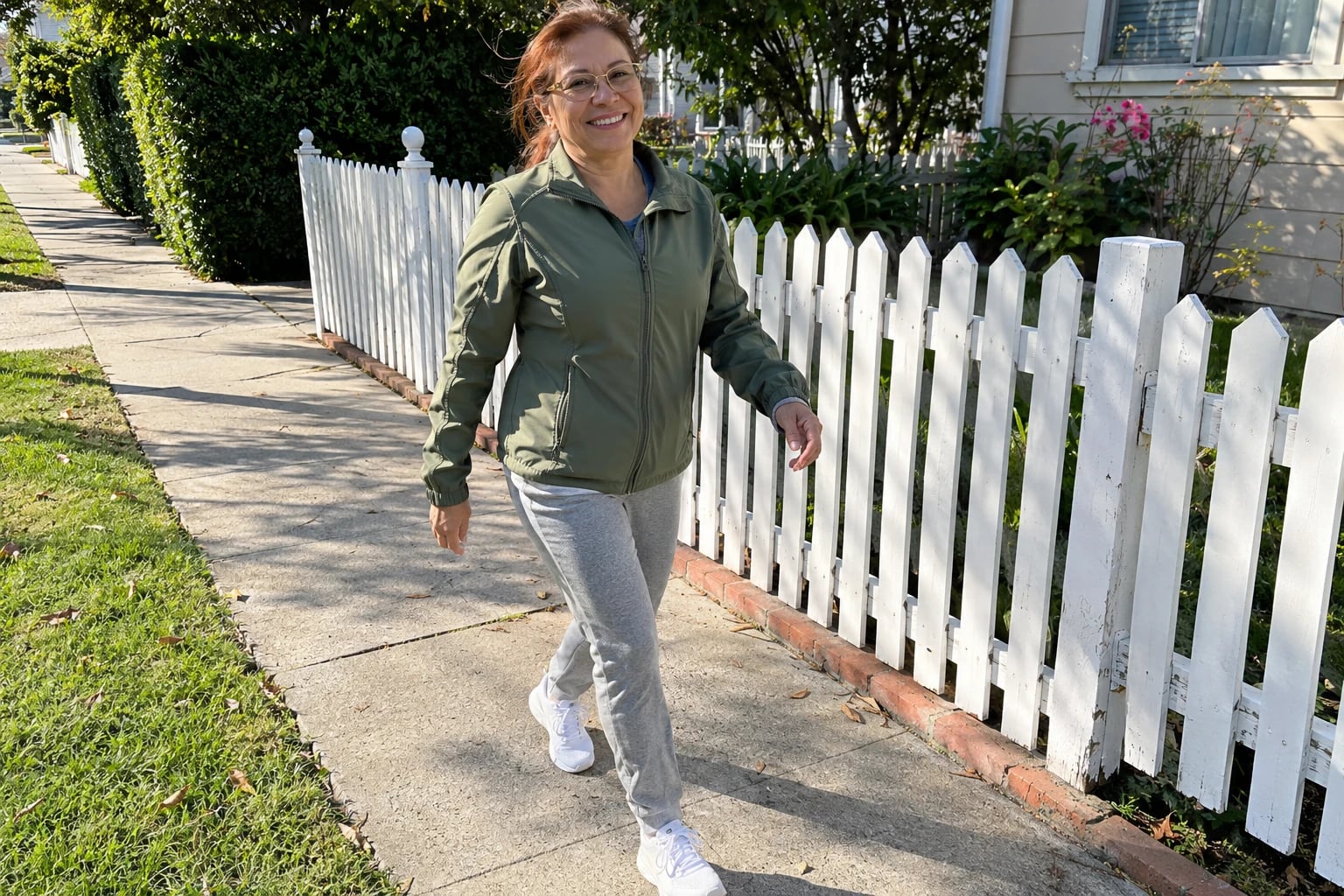
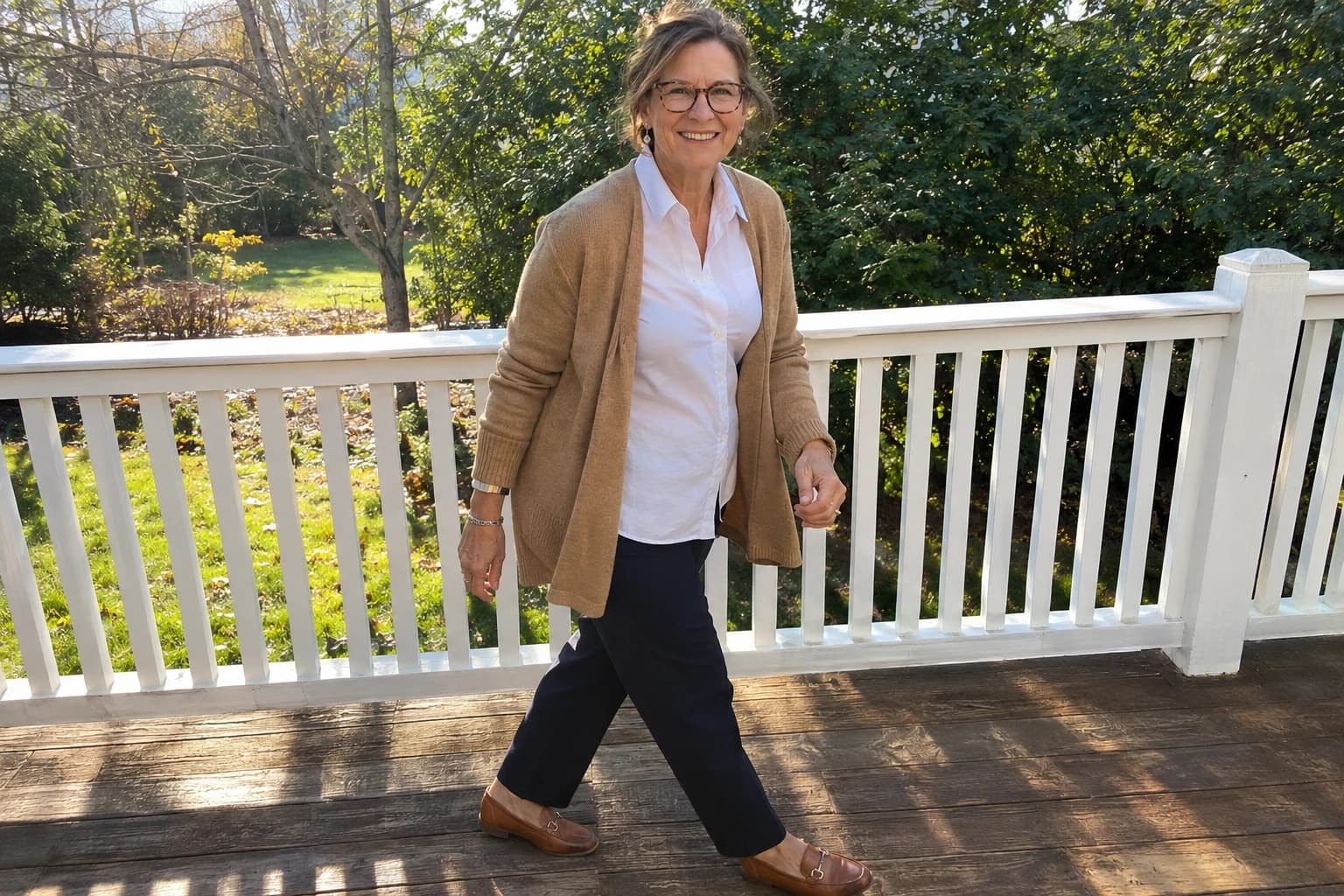
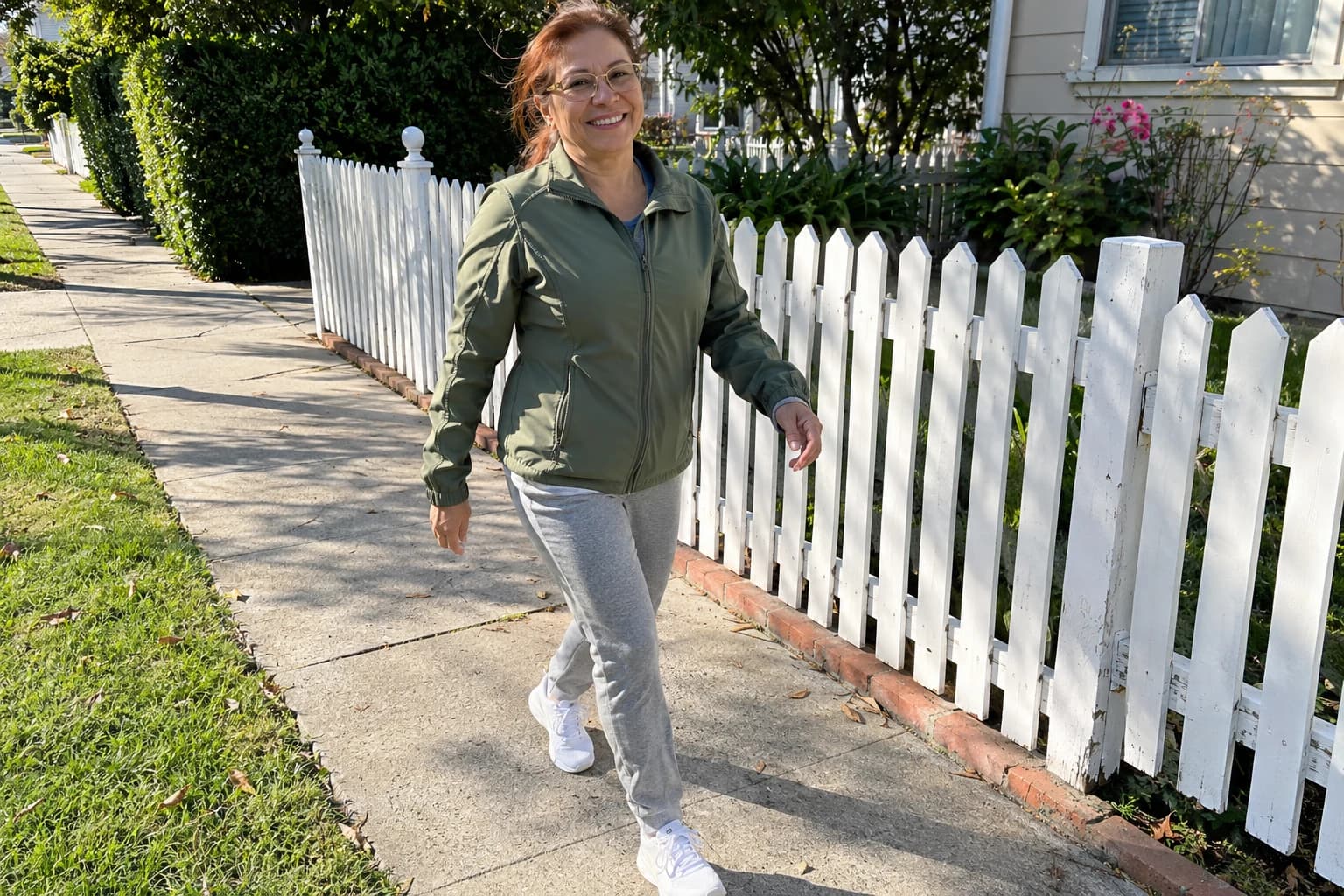
Sneakers, a flat paved path, an easy pace and nothing in her hands. She looks like she's going nowhere in particular. That's right for now.
If you're afraid walking will wear out the knee, and you can't imagine giving it up because it keeps your spirits level, keep walking. Walking on flat ground is also among the better choices even in a flare. Hills, curbs and trails come later.
The foundation's Walk With Ease program gives it a shape: 18 sessions, done three times a week for six weeks or twice a week for nine. Walks run 10 to 35 minutes.
The only requirement is being able to stand for 10 minutes without more pain.
Start at ten minutes, or two fives with a bench in between. Score the knee on the same scale you used on the bike, that evening and again the next morning. If the number holds, add five minutes next week.
On a bad day, change the walk instead of canceling it. Shorter, flatter and slower is still a walk.
The bottom line
If ten minutes of walking already makes things worse, start in a warm pool or on a recumbent bike this week. Add quad sets and heel raises at home on the days between.
If you can walk ten minutes without the knee complaining, start with the walk and the sit-to-stand, three days a week.
After two weeks, add one move for stairs and one for the hips. Keep your before, after and next-morning scores, and let those numbers, rather than how brave you feel that day, decide when you add five minutes or a pound.
Up next
17 Plus-Size Office Outfits Over 50 That Actually Look Polished
Seventeen office outfits for a real plus-size body, each with the one fit detail that makes it work, from where a blazer button lands to what a tailor charges.
Read the list →
Reader quiz
Did you catch the details?
5 questions from this article. Finish them all to unlock the editor's bonus tip.
On the stationary bike, what should you do if your pain score rises more than 2 points?
Did any of these feel familiar?
Know someone who needs this?
Sources cited in this article
This article links to 8 outside sources, listed here so you can read them yourself.
- American College of Rheumatology and the Arthritis Foundation rheumatology.org/press-releases/american-college-of-rheumatology-arthritis-f…
- Arthritis Foundation www.arthritis.org/health-wellness/healthy-living/physical-activity/other-act…
- Arthritis Foundation www.arthritis.org/health-wellness/healthy-living/physical-activity/other-act…
- Wake Forest University study news.wfu.edu/2005/07/06/wfu-study-moderate-weight-loss-takes-major-pressure-…
- Mass General Brigham www.massgeneralbrigham.org/en/about/newsroom/articles/menopause-and-joint-pain
- Bone Health & Osteoporosis Foundation www.bonehealthandosteoporosis.org/preventing-fractures/general-facts/what-wo…
- Walk With Ease extension.oregonstate.edu/walk-ease/frequently-asked-questions
- Harvard Health www.health.harvard.edu/pain/exercising-with-a-flare-up-of-knee-arthritis

Peter Byalik
Food & Home Editor
Peter Byalik is a professional chef with more than 20 years of experience, including years running his own business. He came to the United States from Ukraine.
More from Peter Byalik