



How to Start Exercising After 50 After Years of Doing Nothing
A safe start built around a dining chair, a short daily walk and a few honest checks on how your body is answering.

By Peter Byalik, Food & Home Editor
Updated · 14 min read
- Written by our food & home editor
- Cited 8 sources
- How we review
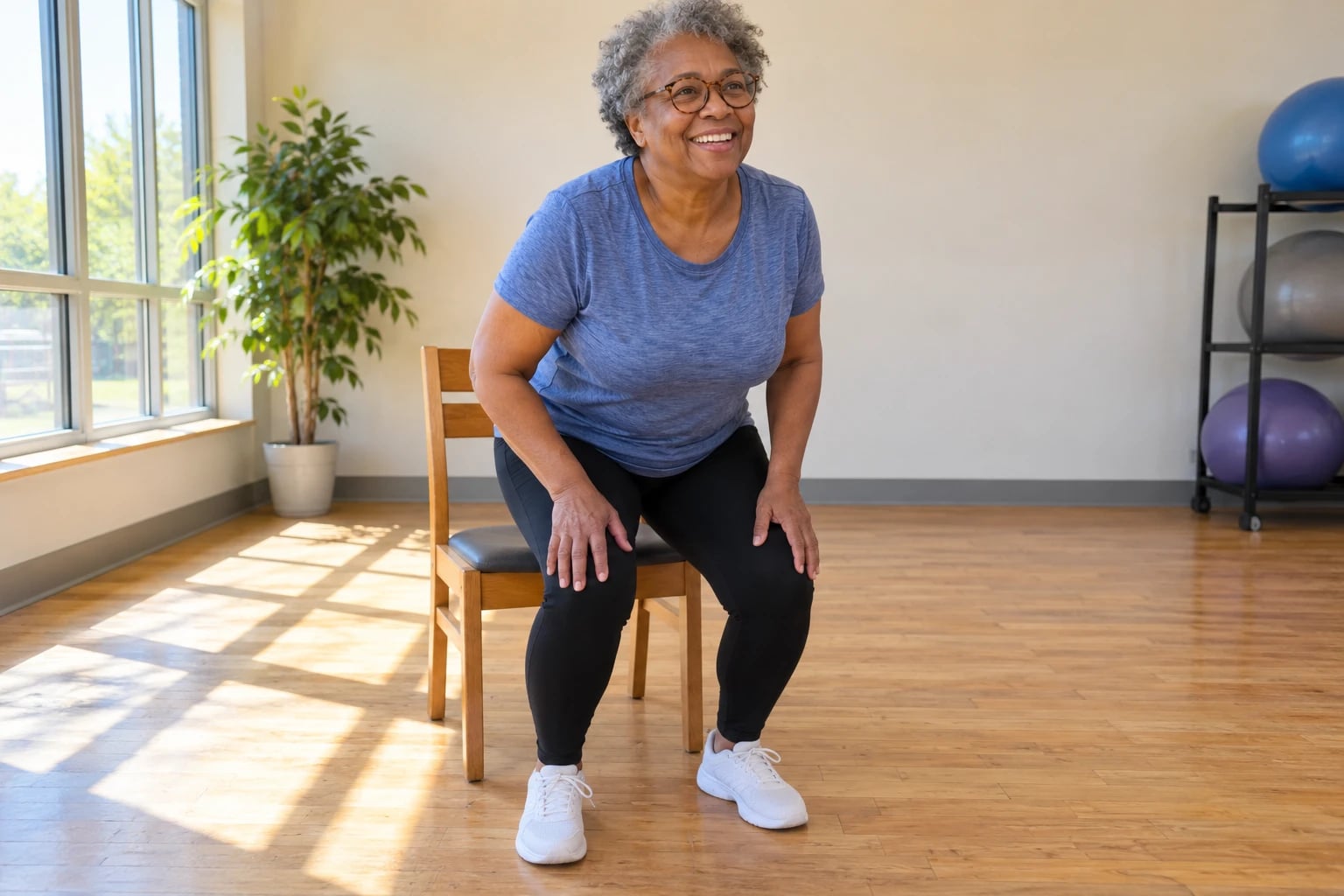
From about age 40, adults lose around 8% of their muscle every decade, and roughly 30% between 50 and 70, according to AARP's guide to fitness with limited mobility. If you haven't exercised in years, that number can land hard.
But it describes muscle that's been left alone. Muscle at your age still answers when you ask something of it, and the asking can start very small.
You don't need a gym, new clothes or a body you feel good about. You need a safe first week, a way to tell ordinary soreness from real trouble, and a plan for the days you'd rather not.
Why it's worth starting now, even after years off
Women lose muscle and strength faster around menopause, and men the same age don't show that drop. One 2021 trial in postmenopausal women also found that their muscles responded somewhat less to strength training.
Here's the part that matters for you. In that same trial, 12 weeks of supervised strength work still built muscle, both in women taking estrogen and in women on a placebo. Slower progress is still progress, and it showed up within one season.
Strength is what gets you out of a low car, up off the floor after you've found the lost earring, and up the stairs with a laundry basket.
It's also what keeps everyday moves from turning into injuries. If you've ever tweaked your back pulling on a pair of pants, building strength and balance may help prevent moments like that.
Balance gets quietly harder after 50. Changes in your eyes, inner-ear trouble, joint pain and neurological problems can all throw it off, and muscles get less flexible and less hydrated, Harvard Health notes. You may have noticed this already as a hand that reaches for the banister without being asked.
Being active cuts falls by 10% to 20%, and people who exercised three or more hours a week cut them by 39%. For a woman whose bones are thinning, fewer falls means fewer fractures.
There are smaller rewards too, the kind you notice by Thursday. Exercise can help with hot flashes, sleep problems and joint pain.
So if you've been thinking the window closed somewhere around your last birthday, it didn't. The muscles you have are trainable today.
Do you need to call your doctor before you start?
For walking, probably not. The CDC says moderate activity is safe for most people. Moderate means a brisk walk, the kind where you're breathing harder but can still talk.
The CDC does say to check with a doctor before *vigorous* exercise if you've been inactive, are overweight, or have heart disease, arthritis or diabetes. After years off, many women tick at least one of those boxes. That doesn't mean you can't walk tomorrow. It means you should make the call before you push hard.
When you do talk to your doctor, these questions get you useful answers instead of a vague "sure, go ahead":
- "Is there any movement I should avoid, given my history?"
- "Am I due for a bone density scan?" The national screening panel recommends one for all women 65 and older, and for younger women past menopause who have risk factors. The test is called a DXA scan, a quick, low-dose X-ray of your hip and spine.
- "Do any of my medicines affect my heart rate, blood pressure or balance?"
- "If I have diabetes, when should I check my blood sugar around exercise?" One endocrinologist's advice: check before and after, and have a small snack about half an hour before you exercise.
One more thing to mention if it's true: if you've lost half an inch or more of height in a year, the Bone Health & Osteoporosis Foundation says that's worth raising with your doctor. It can be a sign of bone loss in the spine, which changes which exercises are safe for you.
Your first week, with a walk and a dining chair
Here is the whole first week. It takes about 15 minutes a day and no equipment you don't already own.
1. Warm up for five minutes. Walk around the house at an easy pace, swing your arms, roll your shoulders. A warm-up is just gentle movement that gets blood to your muscles before you ask more of them.
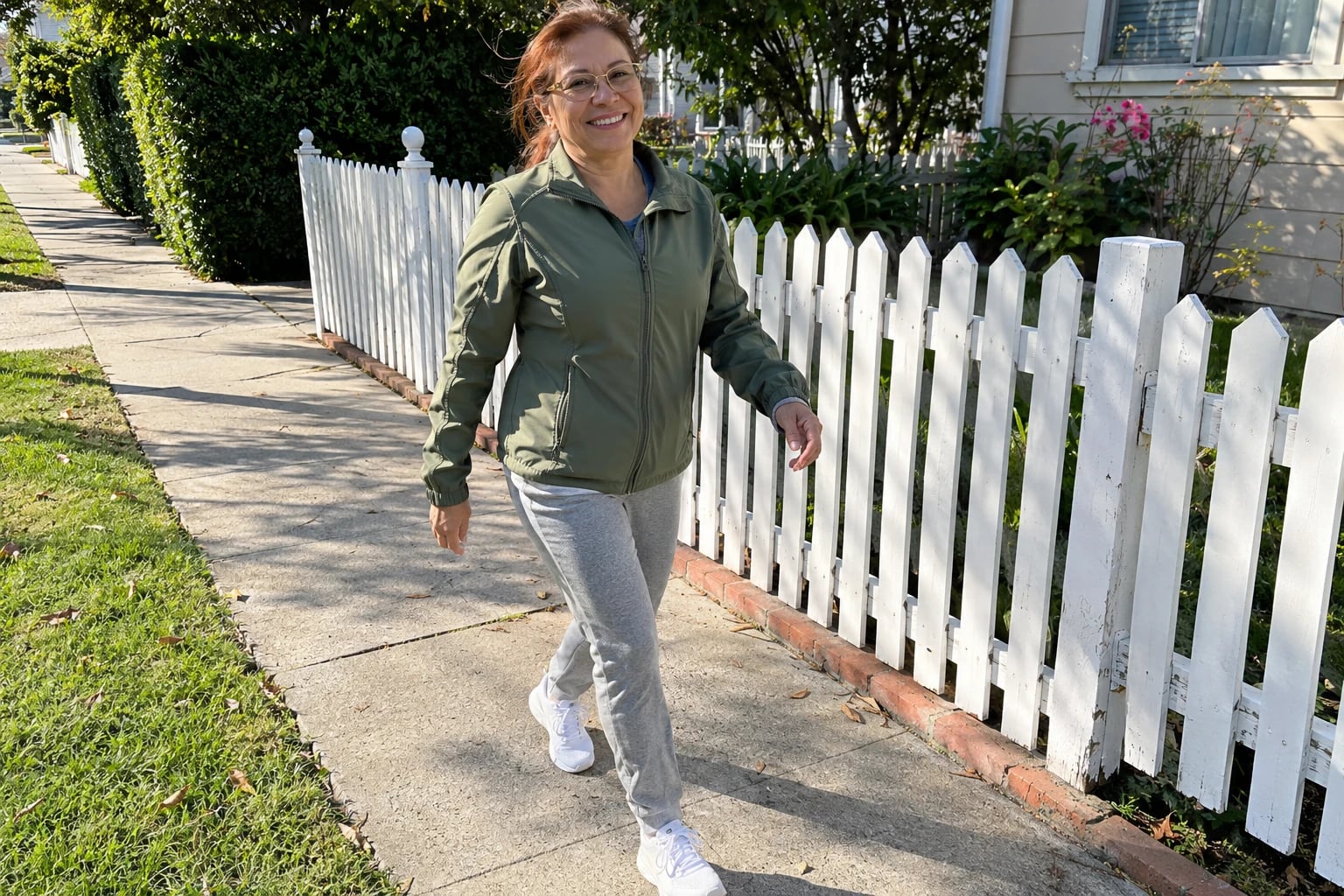
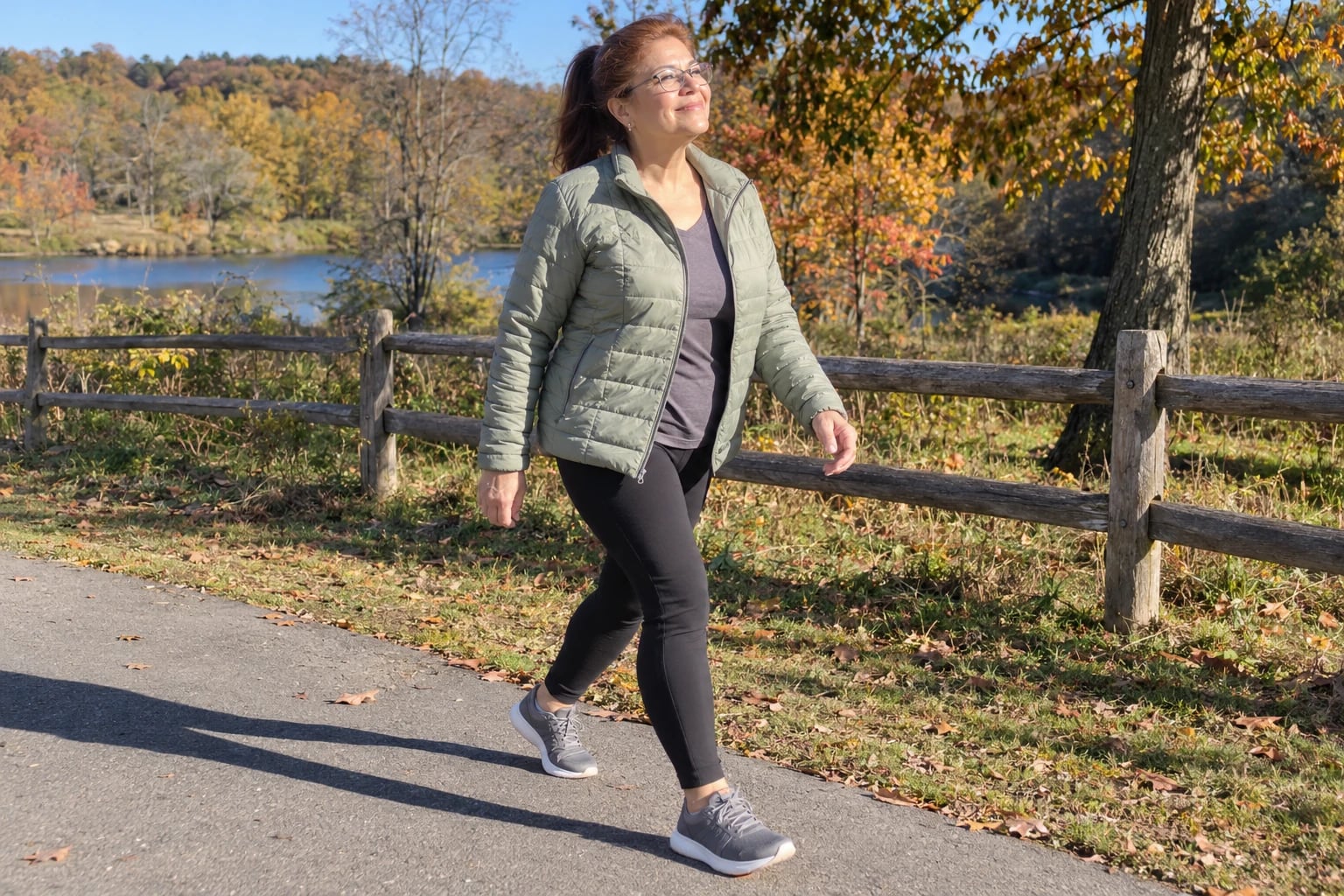
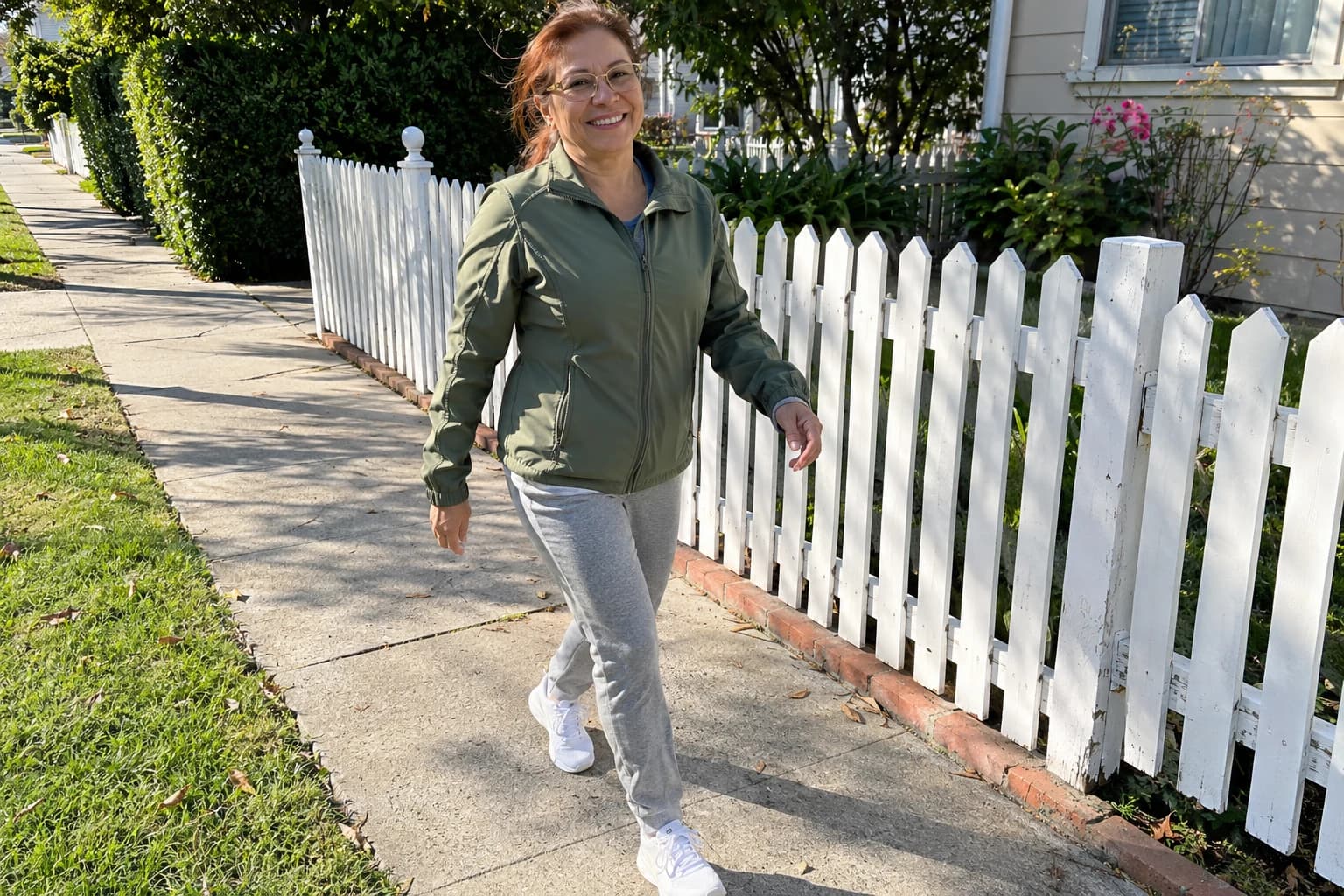
2. Walk for 5 to 10 minutes. Go to the end of the street and back, or loop the block. Keep a pace where you could talk on the phone but couldn't sing along to the radio. That's called the talk test, and it keeps you in the safe, moderate zone.
3. Do chair stands. Push a sturdy dining chair against a wall. Sit near the front edge, feet flat, and stand up without using your hands if you can. Sit back down slowly. Do 10. If 10 is too many, do what you can and use your hands on the seat.
4. Do counter push-ups. Put your hands on the kitchen counter, step your feet back, and lower your chest toward the edge, then push away. Start with 5.
5. Do toe raises. Stand at the counter with your fingertips resting on it. Rise up onto your toes, hold for a breath, lower slowly. Do 10. Once that feels steady, try lifting one foot just off the floor for a few seconds while you hold on. That's balance training.
Do the walk two or three days this week and the chair work on most days. A run of 10 chair stands is called a set, and each single stand is a rep. You'll see those words everywhere once you start looking.
Why these moves? AARP's guide passes on a physical therapist's advice for people with bad knees: chair stands, 10 times, three times a day. That's a gentle enough dose that it suits most beginners, too. Counter push-ups and toe raises count as strength work as well.
As for the walk, a Brigham and Women's Hospital physical therapist suggests beginners aim for 20 to 30 minutes at low intensity, two or three times a week, after a five-minute warm-up. If 20 minutes sounds like a lot right now, start with 5 and work up. Nobody is timing you.
How much to add, and when
The destination is the federal target: 150 minutes a week of moderate activity, plus two days of muscle strengthening. That works out to 30 minutes, five days a week. You don't have to get there this month. For most women starting from nothing, two or three months is a reasonable timeline.
Here's one way to build. Treat it as a guide and slow down if your body asks you to.
Weeks 1 and 2. Walks of 5 to 10 minutes, two or three days a week. Chair stands, counter push-ups and toe raises on most days.
Weeks 3 and 4. Add a few minutes to each walk, so you're doing 10 to 15. Make it three days. Do two sets of chair stands with a short rest between, on two or three days.
Weeks 5 to 8. Walks of 20 to 30 minutes, three or four days. Add light weights for your strength days, two days a week, with a day off in between.
After week 8. Add a fifth walking day, or lengthen the walks, until the week adds up to about 150 minutes.
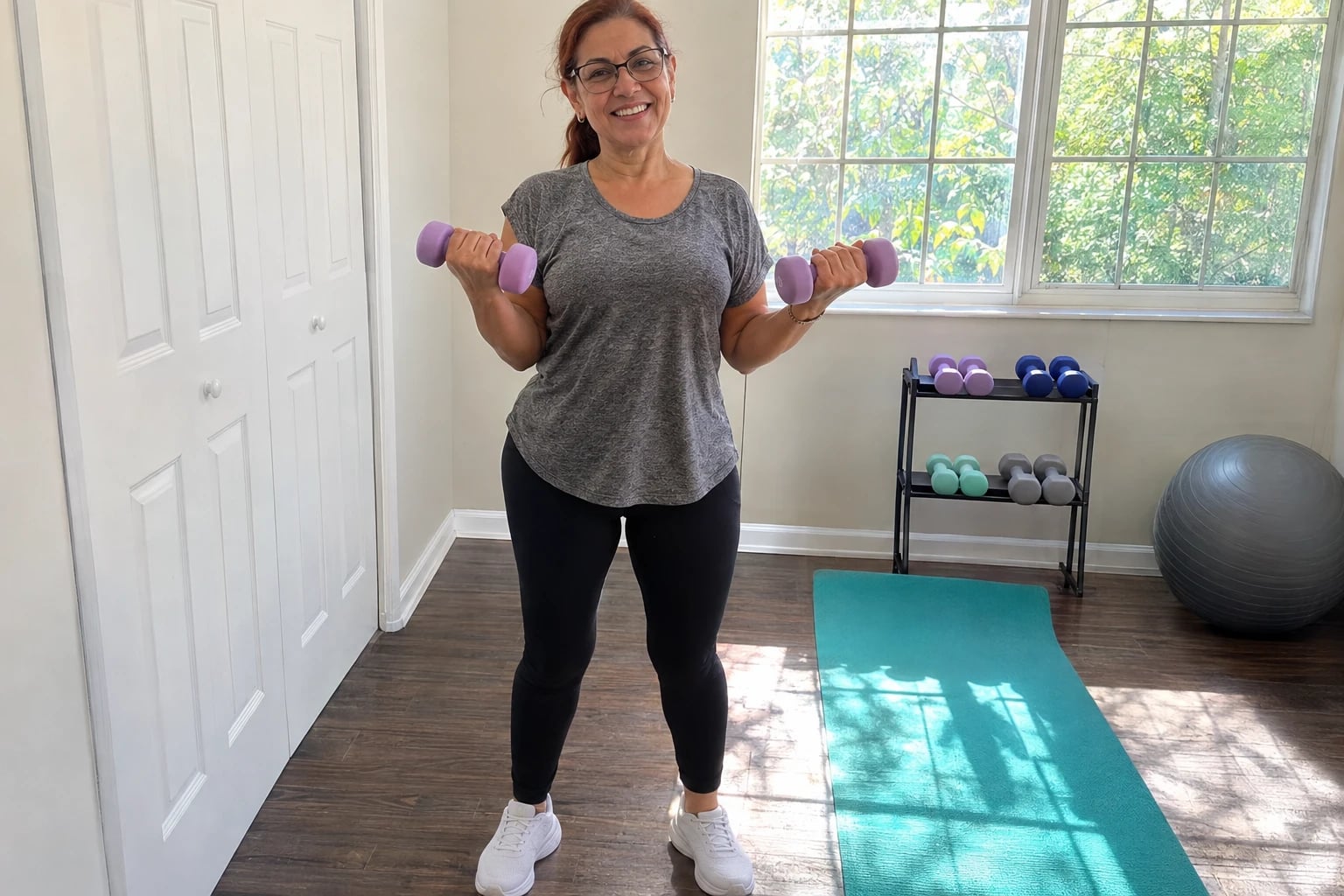
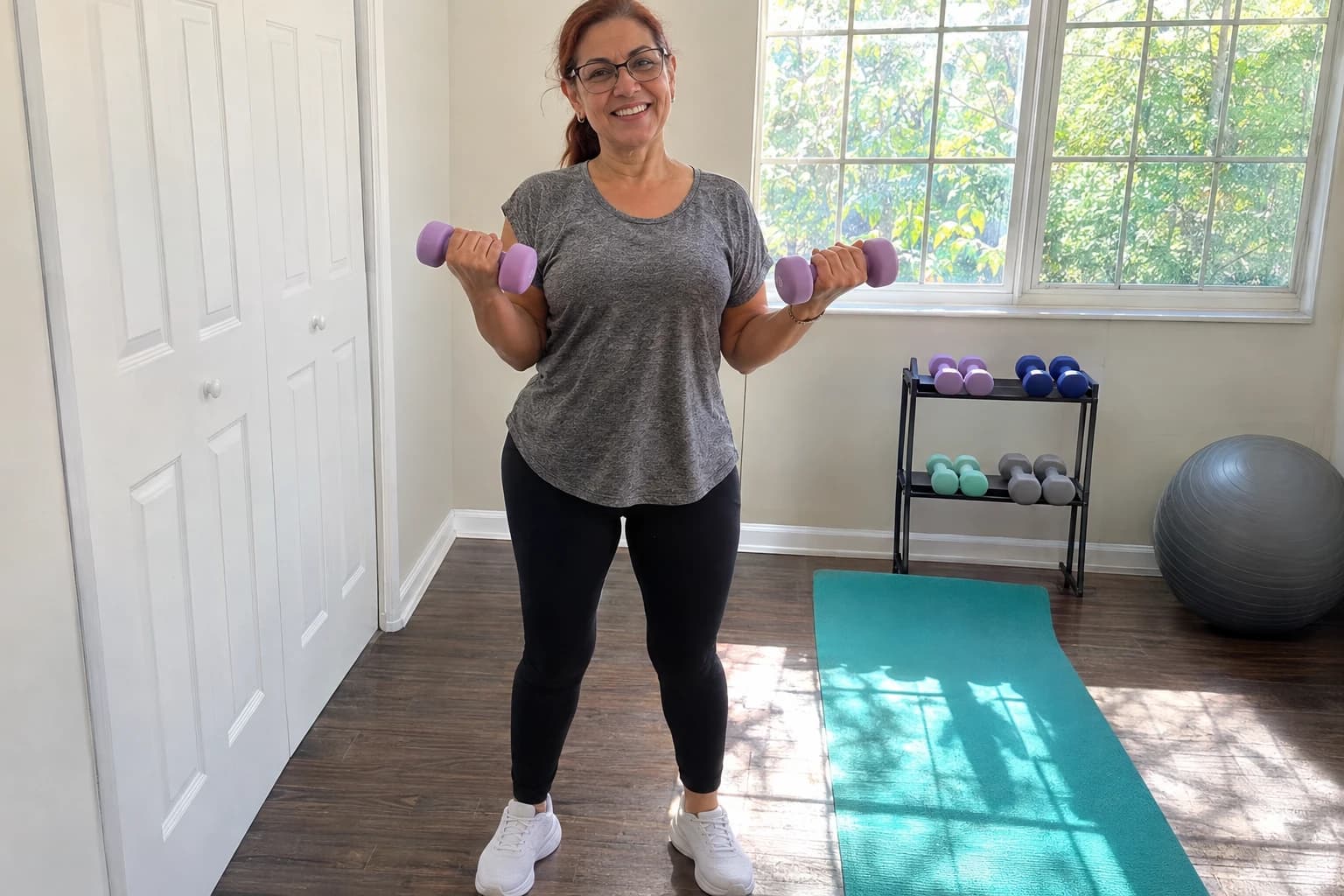
For weights, start light. Light weights still build strength when you're starting out. Begin with slight resistance and add slowly. Two water bottles or soup cans will do for the first weeks.
When you're ready for real weights, pick one you can lift 7 to 10 times, with the last two feeling hard.
That rule comes from the orthopedic practice OrthoCarolina, and it's easy to test in a store aisle. A resistance band, a long stretchy loop of rubber, works the same muscles and folds into a drawer.
Try a farmer's carry, too. Hold a weight in each hand, stand tall, and walk across the room and back. You've done this a thousand times with grocery bags. Doing it on purpose trains your grip, shoulders and balance at once.
Recovery takes longer after 50, so the day off between strength days matters. That rest or recovery day is when your muscles rebuild. And if a walk felt like nothing and you're tempted to double it, stop at the planned time anyway. Most beginner injuries come from the day you felt great.
If you have a heart condition, keep one rule in mind as you speed up. One cardiologist's advice is to keep your heart rate below 120 beats a minute and choose a pace you can sustain for 20 minutes. Ask your doctor what applies to you.
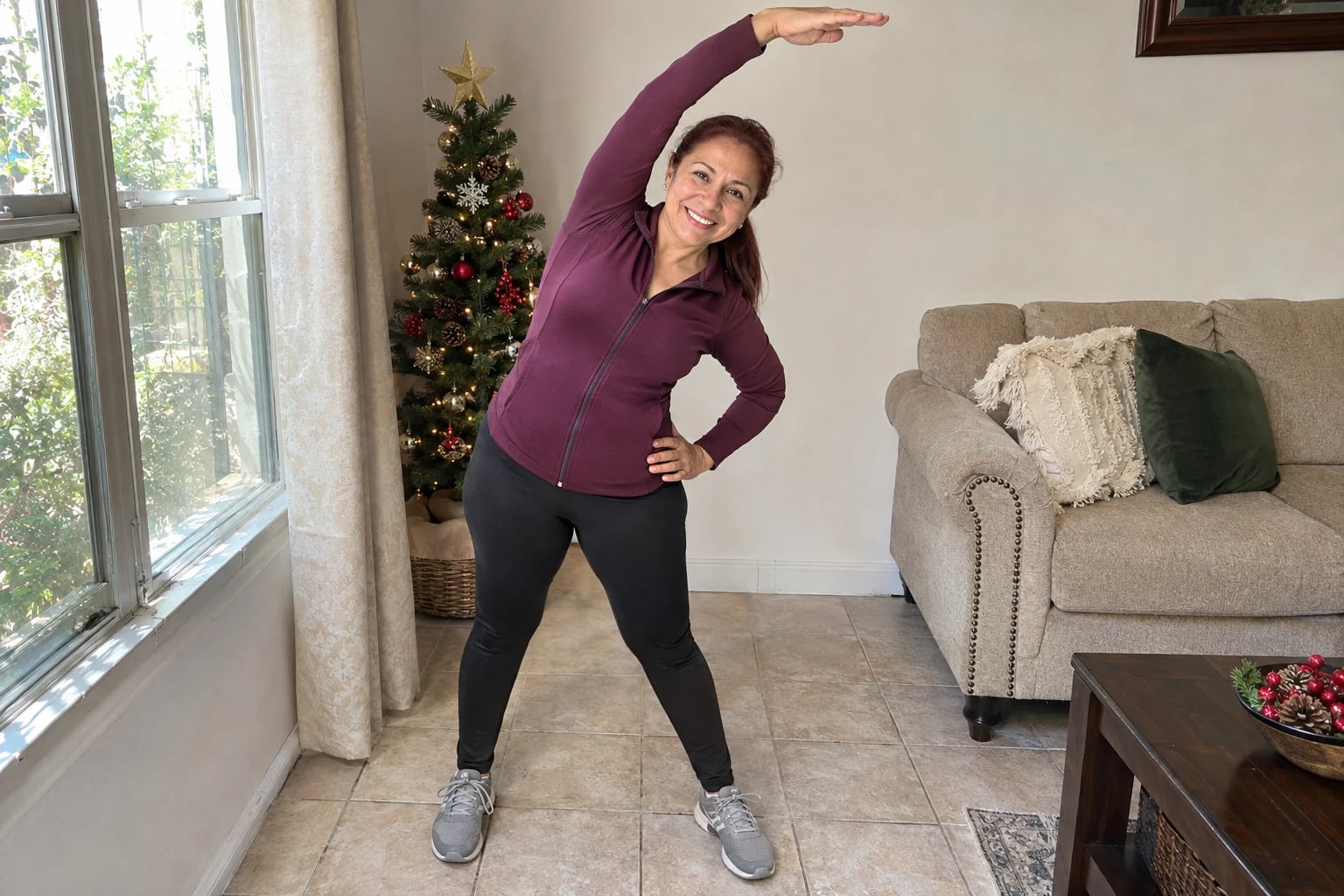
Finish with five to ten minutes of stretching, three to five times a week. Calves against a wall, the front of your thighs while holding the counter, your chest in a doorway. That's your cool-down.
Sore or hurt? How to tell
You wake up the day after your chair stands and your thighs complain on the stairs. That's ordinary muscle soreness. It's dull and spread out, it's on both sides, and it often peaks a day or two after you exercise, then fades. Walking around usually eases it.
Something is sharp, in one spot, or inside a joint. That's different. So is pain that makes you limp, swelling, or pain that gets worse the longer you move. Those mean stop.
The most common mistake is stopping only once it really hurts. Stop the moment something hurts, not after one more rep.
Rest it for a few days, switch to a gentler activity, and if it isn't clearly better within a week or so, call your doctor or a physical therapist. That last step matters: a pushed-through injury can mean physical therapy later.
Some signs have nothing to do with muscles. Chest pain or pressure, pain spreading to your arm, jaw or back, sudden breathlessness that doesn't settle when you slow down, or dizziness: stop right away. If it doesn't ease within a few minutes, call 911.
Aches that were there before you started deserve a mention too. If you've been hurting in your shoulders, neck, hips or knees for a while, it's worth a doctor's look whatever the cause, menopause included. Gentle movement often helps stiffness, but it shouldn't make a joint feel worse the next morning.
Working around a bad knee, stiff joints, extra weight or thin bones
If your knees are bad. Chair stands are your friend. Exercising twice a week for six weeks cut pain by 25% on average in a study of nearly 10,000 people with knee and hip osteoarthritis.
Choose low-impact activities, meaning one foot stays on the ground or your weight is supported, so your joints aren't jarred. Indoor walking, a stationary bike and walking in a pool are all safe starts.
Knees that crunch without pain are common and usually not a reason to stop. If the crunch comes with pain or swelling, get it checked before you add more.
If you're carrying extra weight. Water takes much of your weight off your joints, and a stationary bike lets you sit. Both are good for building stamina before you walk farther. On walks, flat routes and good sneakers make a difference to your hips and feet. Wear what's comfortable: leggings, sweats, an old T-shirt.
If your hips or bottom ache on long walks. Make the walks shorter and more frequent. Two 10-minute walks count toward your week just as well as one 20-minute walk.
If you have osteoporosis or osteopenia (the earlier, milder stage of bone thinning), skip toe touches, sit-ups and crunches, and avoid extreme twisting, bending at the waist and reaching up to high shelves. Those moves load the front of the spine.
When you cough or sneeze, press one or both hands against your chest so you don't fold forward. And bend at the hips and knees, not the waist, when you pick up the dog bowl.
If you're wondering whether yoga is enough. Yoga is good for balance and flexibility. If your class is gentle and mostly stretching, add the chair stands and light weights on two days a week to meet the strength target. With thin bones, ask the teacher to show you options for poses that round your back or twist deeply.
What to tell yourself on the days you'd rather skip it
Many women don't like exercise and find it boring. That's allowed. You don't have to enjoy it to do it, any more than you enjoy flossing. You just have to make it short and easy enough that skipping feels silly. These lines help on the bad days.
"I'll do five minutes." Put your sneakers on and walk to the corner. If you want to turn back, turn back. Most days you won't.
"This is a chair day, not a walk day." When it's raining or you're tired, do ten chair stands while the coffee brews. You've still shown up.
"I can call my sister on the walk." Save a phone call, a podcast or an audiobook for walking only. The walk becomes the time you get to hear the next chapter.
"Nobody is looking at my legs." Mismatched socks, unshaved legs, a T-shirt from a 2009 fun run. On a sidewalk at 7 a.m., nobody notices, and nobody at the Y does either.
"I'll walk before my shower day." If sweat and hair are what keep you home, walk on the morning you were going to wash your hair anyway.
"I've done it four times this week." Put an X on the kitchen calendar each time you go. By week three you'll have a row you won't want to break.
Where to find a beginner class or some company
If you want company or a bit of structure, look for a beginner class at the local YMCA or senior center. Both are good places to start. Senior center classes are usually built for people who haven't moved much in years, so nobody expects you to know anything on day one.
If gyms make you nervous, you're far from alone. Some ways around it:
- Watch a class before you join one. Most places will let you stand at the door or sit in the back for a few minutes.
- Look for a small studio or a gym that calls itself size-friendly. Fewer people, fewer mirrors, more attention.
- Exercise outdoors or at home with a friend. A neighbor with a dog makes a regular walking partner.
- Join a walking group. Parks departments, senior centers and some churches run them. It's a low-stakes way to meet people who are also starting over.
If you do join a gym, ask for an introductory session with a staff member before you use any machines. They'll show you how each one adjusts and how to start it and stop it. You won't break anything, and you won't have to work it out with someone waiting.
A few sessions with a trainer can be worth paying for if you want to learn good form, especially for weights. Ask whether they've worked with women going through menopause or past it. If yours keeps pushing past what you asked for, switch trainers. Plenty of them will gladly go at your pace.
The line to say at the front desk or to a new trainer: "I haven't exercised in years. I want to start slower than you think I need to."
The bottom line
Tomorrow, take a five-minute walk at a pace where you can still talk, then do ten chair stands at the dining table. That's the whole first day.
If you have heart disease or diabetes, or you've been told your bones are thinning, call your doctor first and bring the questions above. Then start the same way.
The federal target is 30 minutes, five days a week, plus two days of strength work. You can reach it one short walk at a time.
Up next
17 Plus-Size Office Outfits Over 50 That Actually Look Polished
Seventeen office outfits for a real plus-size body, each with the one fit detail that makes it work, from where a blazer button lands to what a tailor charges.
Read the list →
Reader quiz
Did you catch the details?
5 questions from this article. Finish them all to unlock the editor's bonus tip.
What is the talk test the article describes for keeping your walking pace in the safe zone?
Did any of these feel familiar?
Know someone who needs this?
Sources cited in this article
This article links to 8 outside sources, listed here so you can read them yourself.
- AARP's guide to fitness with limited mobility www.aarp.org/health/healthy-living/smart-guide-fitness-limited-mobility
- 2021 trial in postmenopausal women pmc.ncbi.nlm.nih.gov/articles/PMC7853242
- Harvard Health notes www.health.harvard.edu/healthy-aging-and-longevity/fitness-over-50-rebooting…
- Cut them by 39% www.aarp.org/health/healthy-living/overcoming-fitness-fears
- Hot flashes, sleep problems and joint pain www.orthocarolina.com/blog/how-women-can-safely-start-an-exercise-program-ov…
- Moderate activity is safe for most people www.cdc.gov/physical-activity-basics/adding-adults/index.html
- Recommends one for all women 65 and older www.uspreventiveservicestaskforce.org/uspstf/recommendation/osteoporosis-scr…
- Bone Health & Osteoporosis Foundation www.bonehealthandosteoporosis.org/patients/treatment/exercisesafe-movement/p…

Peter Byalik
Food & Home Editor
Peter Byalik is a professional chef with more than 20 years of experience, including years running his own business. He came to the United States from Ukraine.
More from Peter Byalik