



18 Belly Fat Workout Moves for Women Over 50 at Home
A bridge held for five seconds, a band pressed out from a doorway, and 16 more home moves that spare your back and knees.

By Peter Byalik, Food & Home Editor
Updated · 18 min read
- Written by our food & home editor
- Cited 6 sources
- How we review
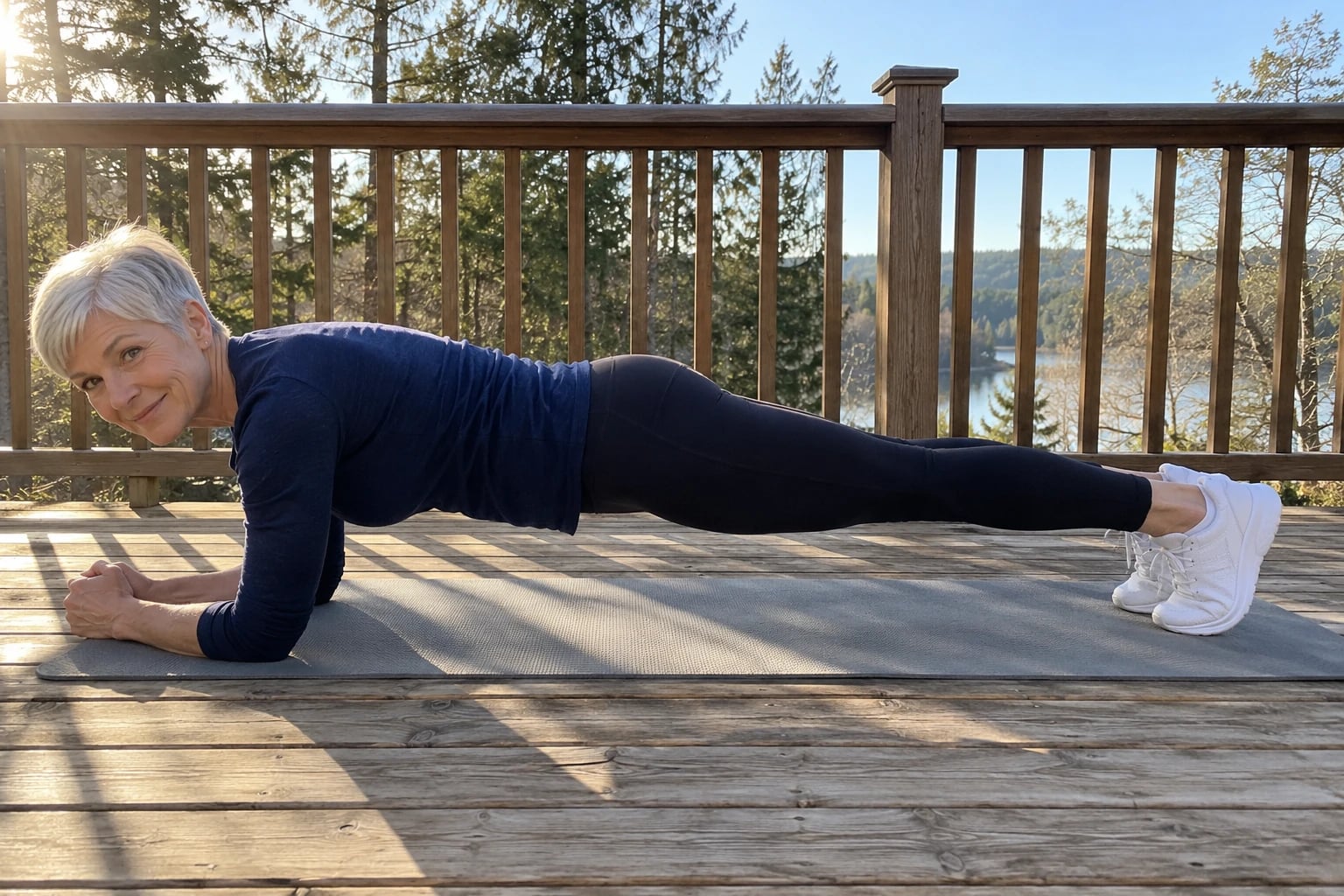
Why would your belly grow when your plate hasn't?
Part of the answer came from a study that followed 1,246 women through menopause. What it found was a quiet swap, muscle for fat.
About two years before the last period, fat started piling on faster, to about 1.7% a year, while muscle began to shrink.
The scale rose at its usual pace, so it hid the swap. And as estrogen drops, Harvard Health explains, more fat settles around the abdomen instead of the hips and thighs.
No exercise burns fat off your stomach alone. Muscle and brisk movement shrink it everywhere, deep belly fat included, and both work at home.
Get your heart rate up
Brisk cardio does half the work on deep belly fat. The CDC's baseline is 150 minutes a week of moderate activity, and short bouts count toward it.
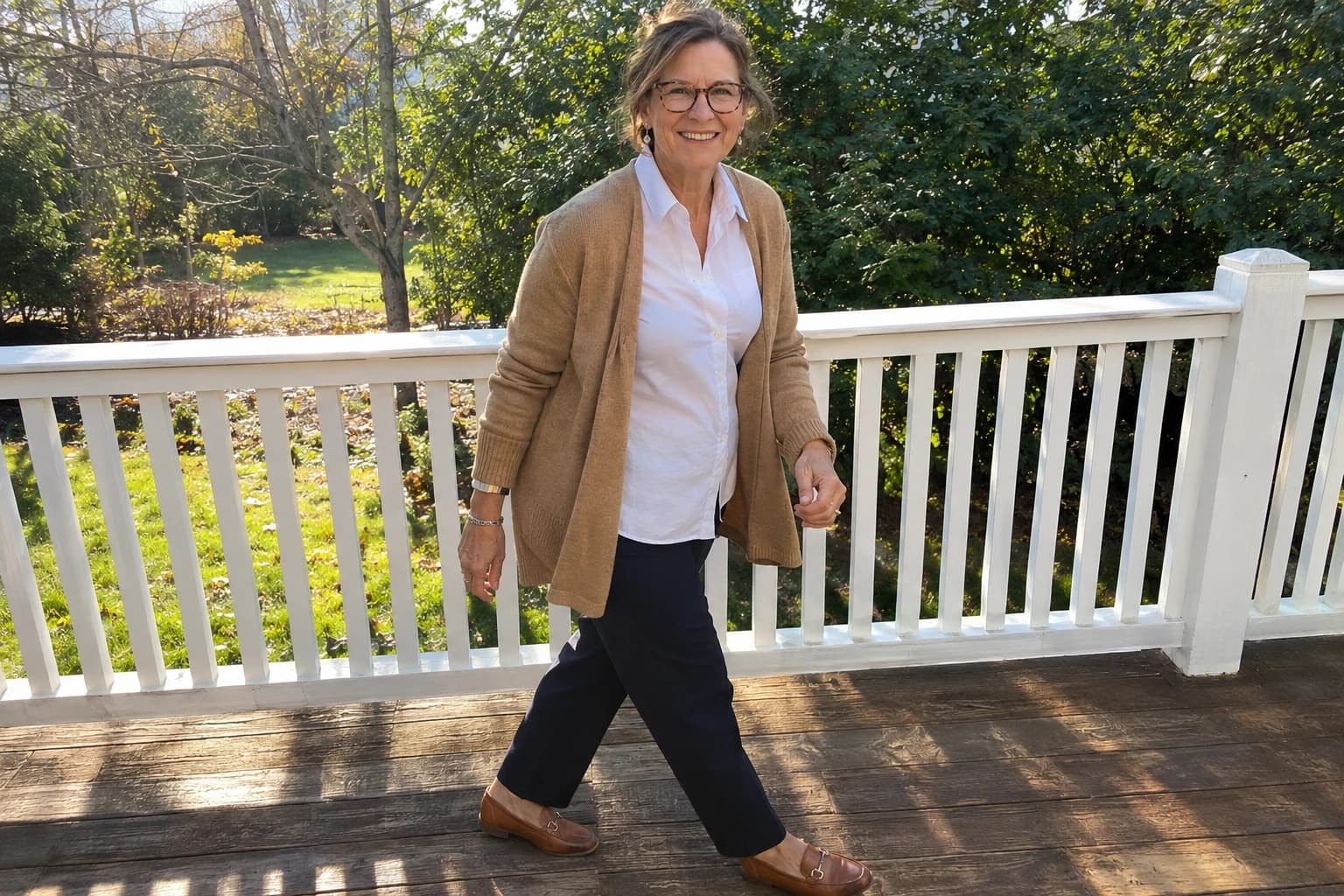
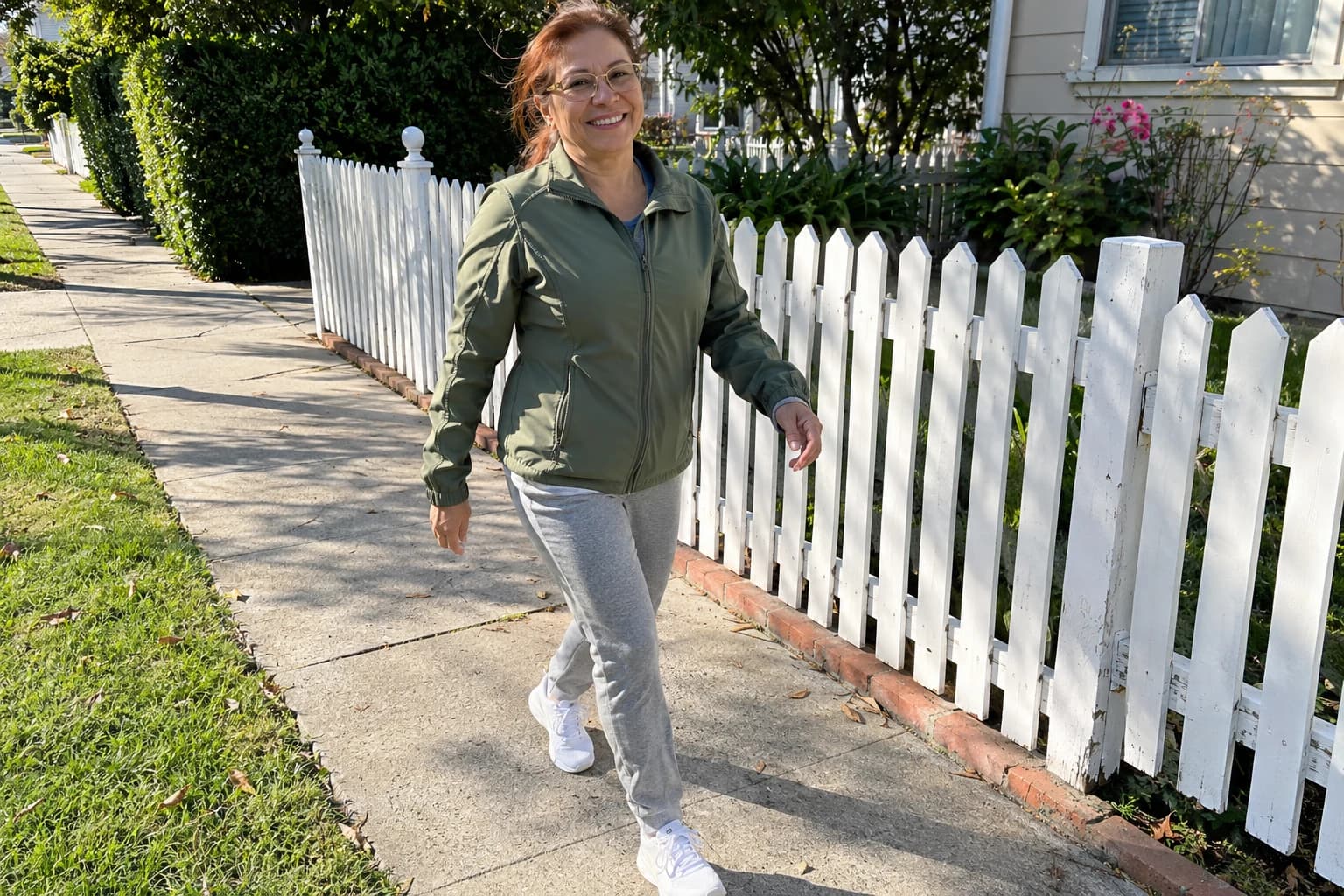
18A Ten-Minute March Around the Living Room
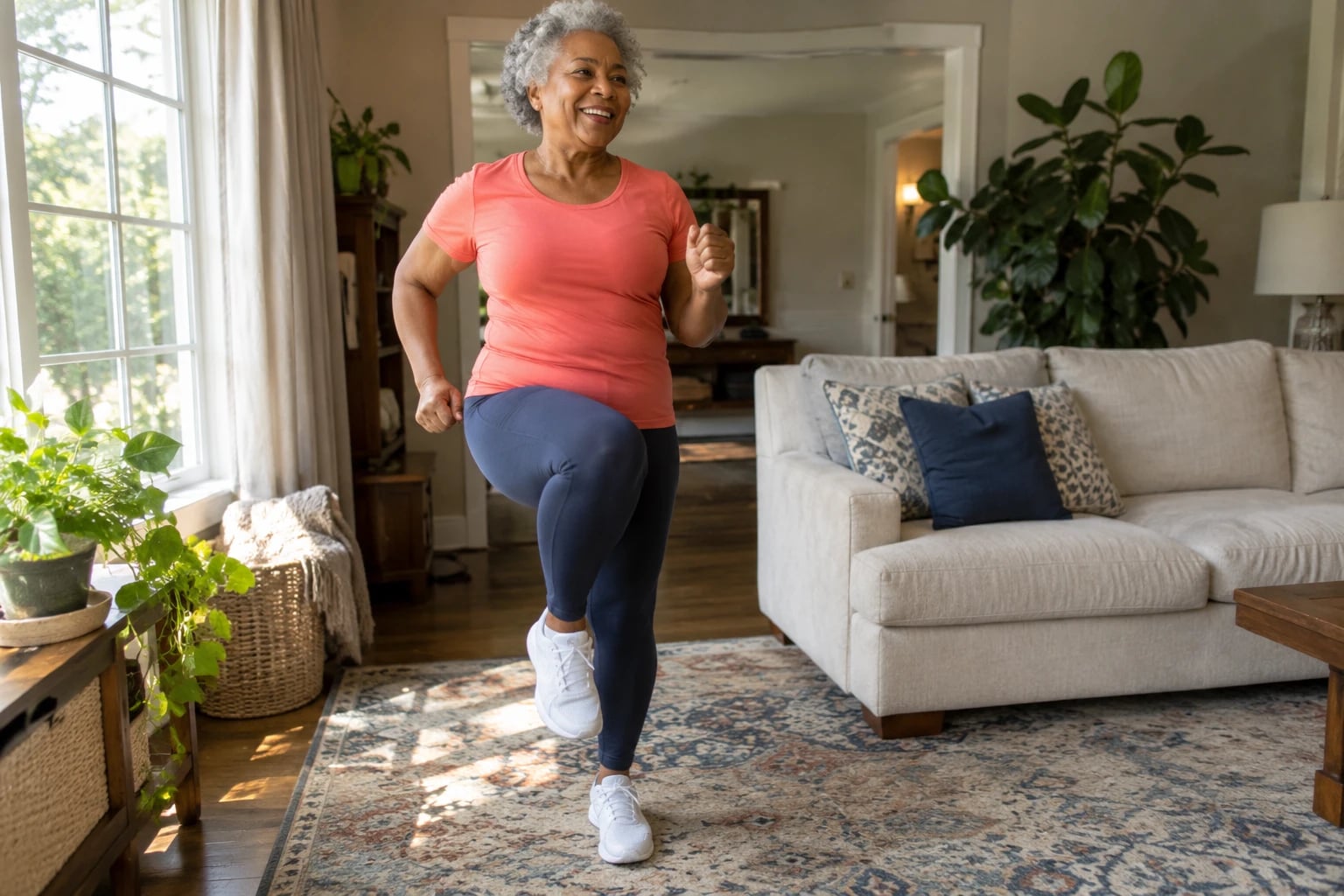
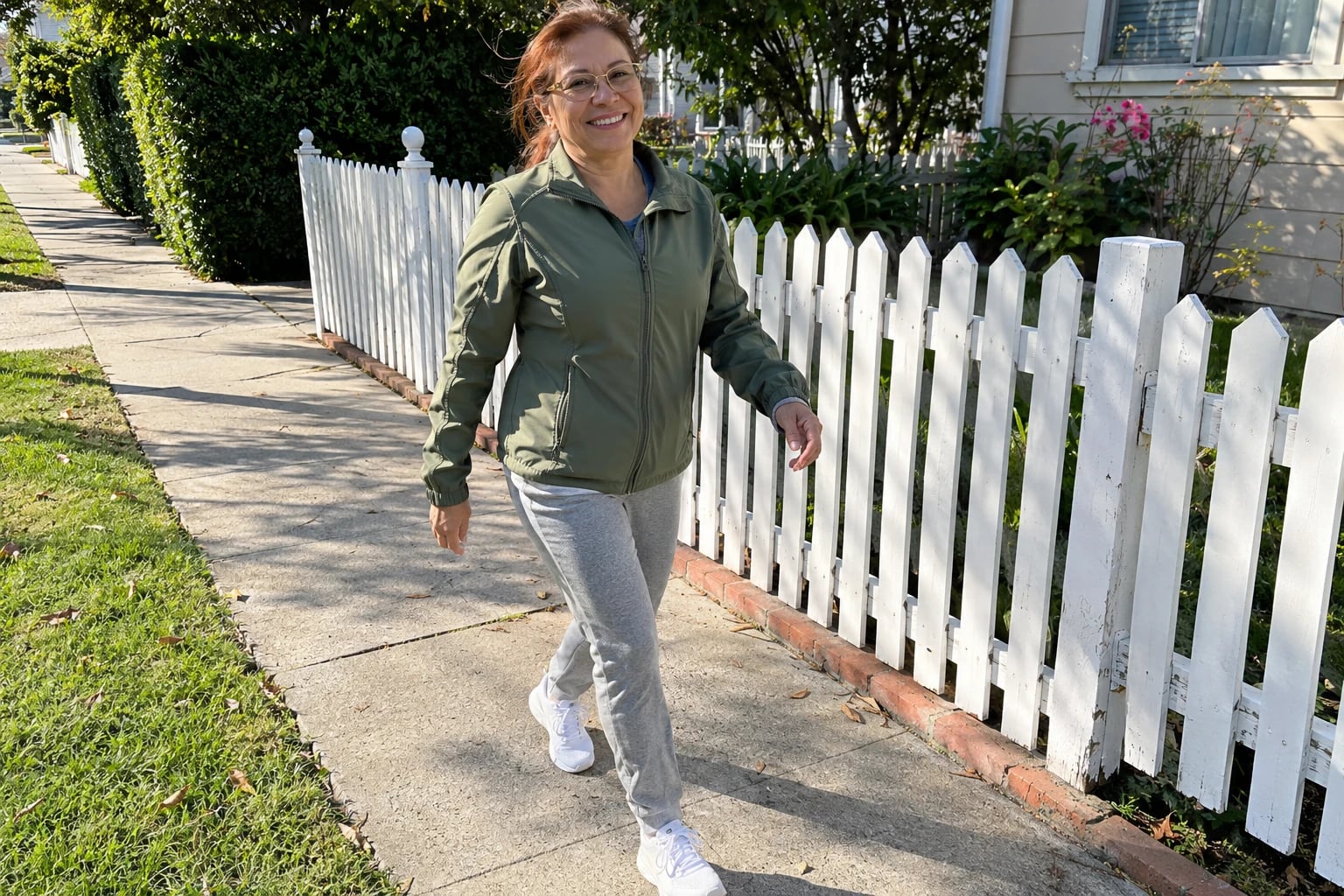
Bend your elbows and swing your fists past your hips while your knees come up toward the height of the sofa cushion. That arm swing is most of what turns marching in place into real exercise.
Wear sneakers and march on a rug or carpet rather than bare tile. Go at a pace where you can talk but couldn't sing a song. That's what moderate means, and it's the kind the CDC counts toward your weekly minutes.
To make it harder, lift your knees higher, add a wide step to the side every 30 seconds, or hold a light hand weight in each hand as you swing.
To make it easier, rest one hand on the back of the sofa and keep the knees low.
This one is worth keeping in your pocket for rainy days and busy ones, because it needs no setup at all. Ten minutes after breakfast, ten before lunch and ten during the evening news add up to half an hour.
17Laps Up and Down Your Own Stairs
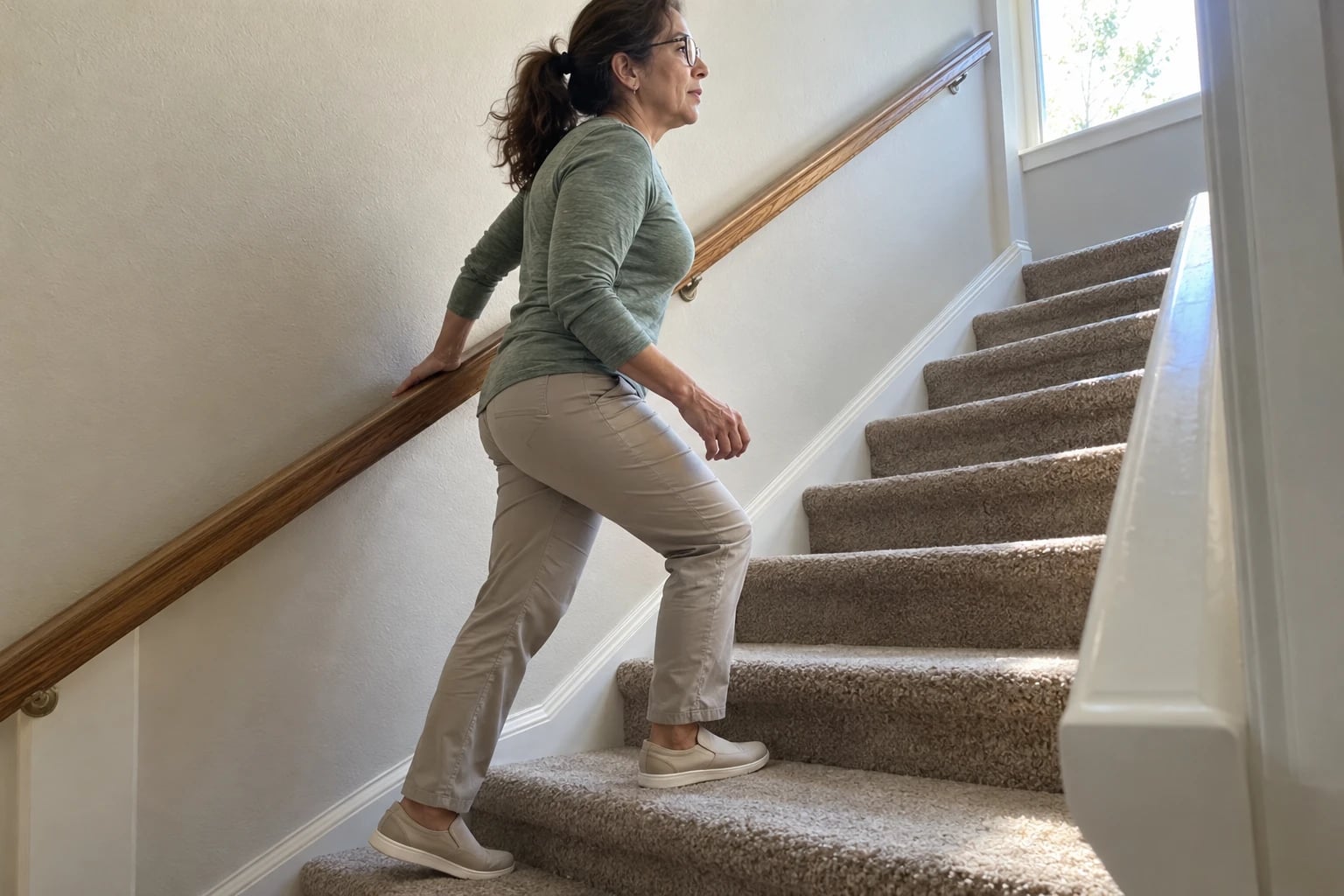
A staircase inside your house is the steepest hill you'll find without leaving it.
Skip this one if your knees ache on the way down a staircase, which is common with knee arthritis. Coming down is the hard part for the joint. The bottom step alone, used for step-ups, is far kinder.
Walk up at a steady, brisk pace, head up and your whole foot landing on each tread. Come down slowly, hand on the rail. Rest at the bottom for 30 seconds, then go again. Start with three laps and add one a week.
Taking the stairs two at a time works the thighs and seat harder, but only if your balance is solid.
Keep the steps clear of shoes, laundry and anything else you could catch a toe on. On the way down, set the whole foot on each tread instead of just the ball of it.
By the eighth or ninth lap, you'll be breathing harder than a stroll around the block ever makes you.
16Thirty-Second Bursts With Minute-Long Rests
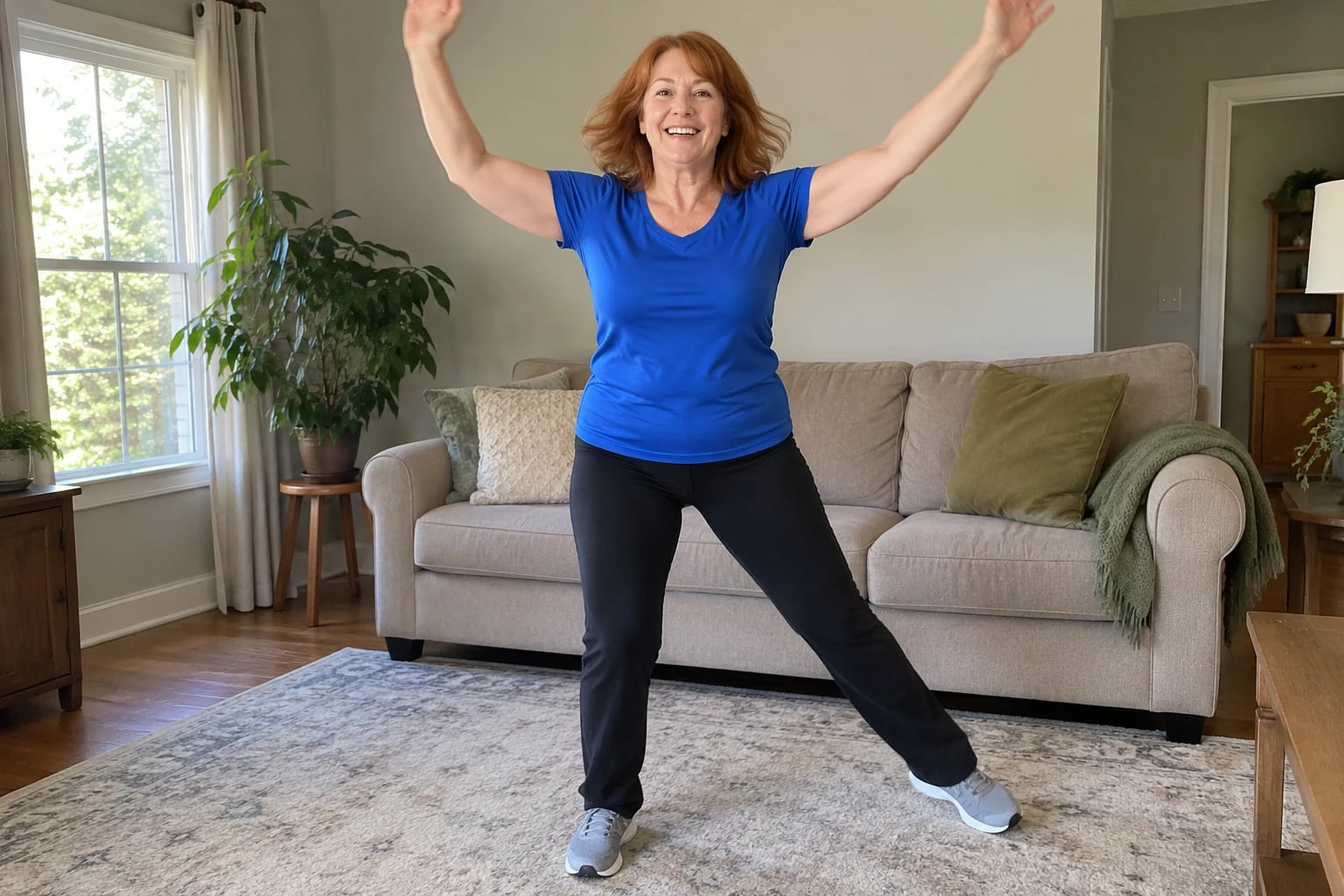
This one is HIIT, short for high-intensity interval training: short bursts of hard effort with rests between them.
In a fast step-jack, your arms reach up and out while one foot always stays on the floor, so there's no jumping.
A small pilot study of 11 postmenopausal women with obesity, covered by AARP, found that those who did 10 minutes of interval training five times a week lost about twice as much weight as women doing steady endurance exercise.
Here's a version for knees that hate impact. Warm up with three minutes of easy marching. Then do 30 seconds of step-jacks, fast marching or punching the air while you march, followed by 60 seconds of slow walking around the room. Repeat six times.
Hard means you couldn't finish a full sentence by the end of the burst. If you have a heart condition, high blood pressure that isn't under control, or you haven't exercised in years, ask your doctor before you push to that level.
Rebuild the deep core
These moves strengthen the deep muscles that hold your middle in and protect your back. Do a few of them on your walking days.
15Heel Slides With a Long, Slow Exhale
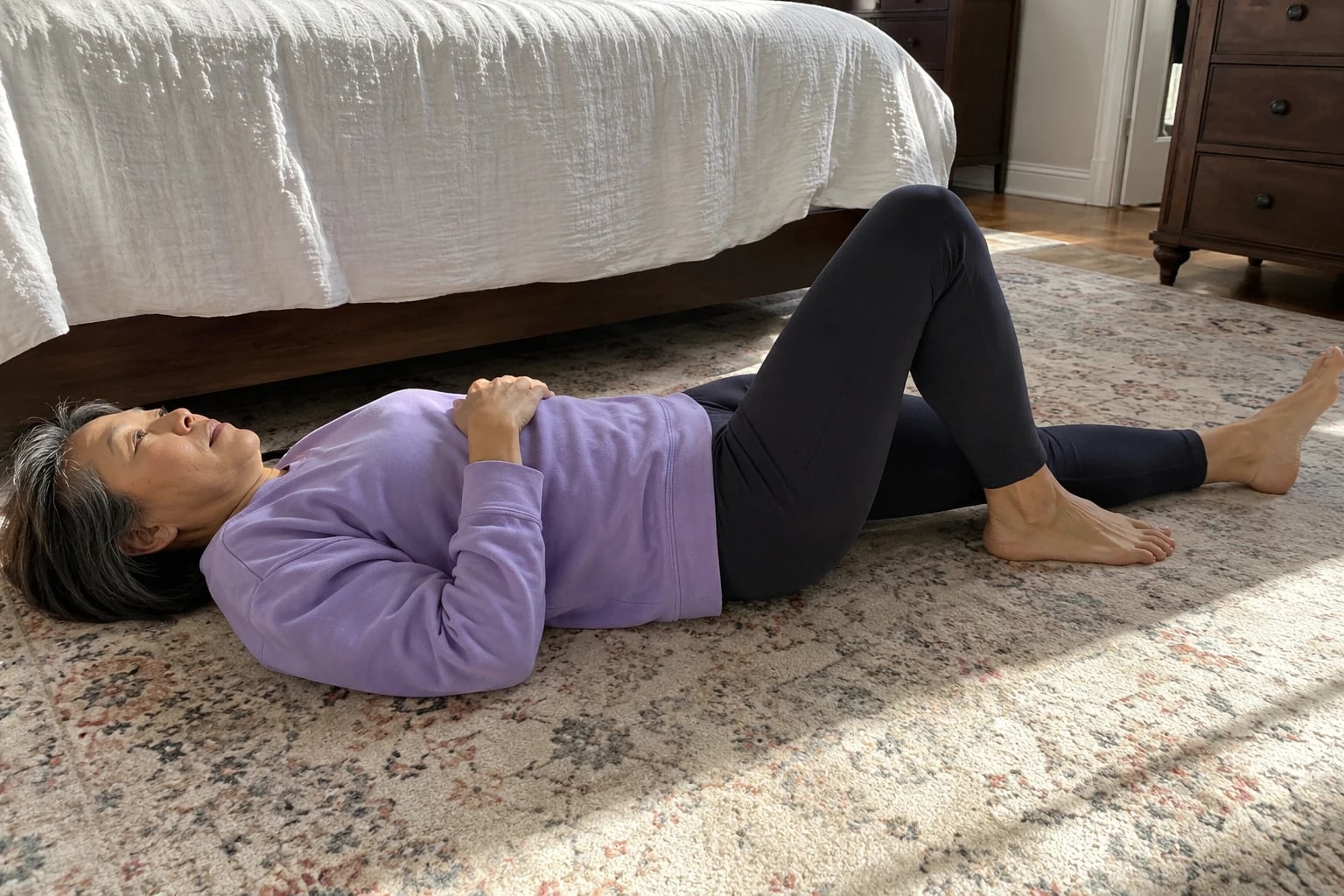
She's lying on her back on a bedroom rug, knees bent. One heel slides out along the floor while the other foot stays planted, and her hand rests on her lower belly. It looks like nothing, which is exactly why women skip it.
This one trains the transverse abdominis, the deep ab muscle that wraps around your middle like a corset. Every other core move leans on it.
Breathe in through your nose. As you breathe out through pursed lips, gently draw your belly button toward your spine and slide one heel out until that leg is nearly straight. Breathe in as you slide it back. Do 10 on each side.
Your lower back should stay softly against the floor, and your belly should stay flat under your hand. If it pushes up into a ridge or a dome down the middle, slide a shorter distance.
If you've had babies and aren't sure whether your ab muscles separated, start your core work here. The advice for women with that separation is slow moves paired with deep breathing, and core work doesn't get much slower than this.
14A Dead Bug on the Bedroom Rug
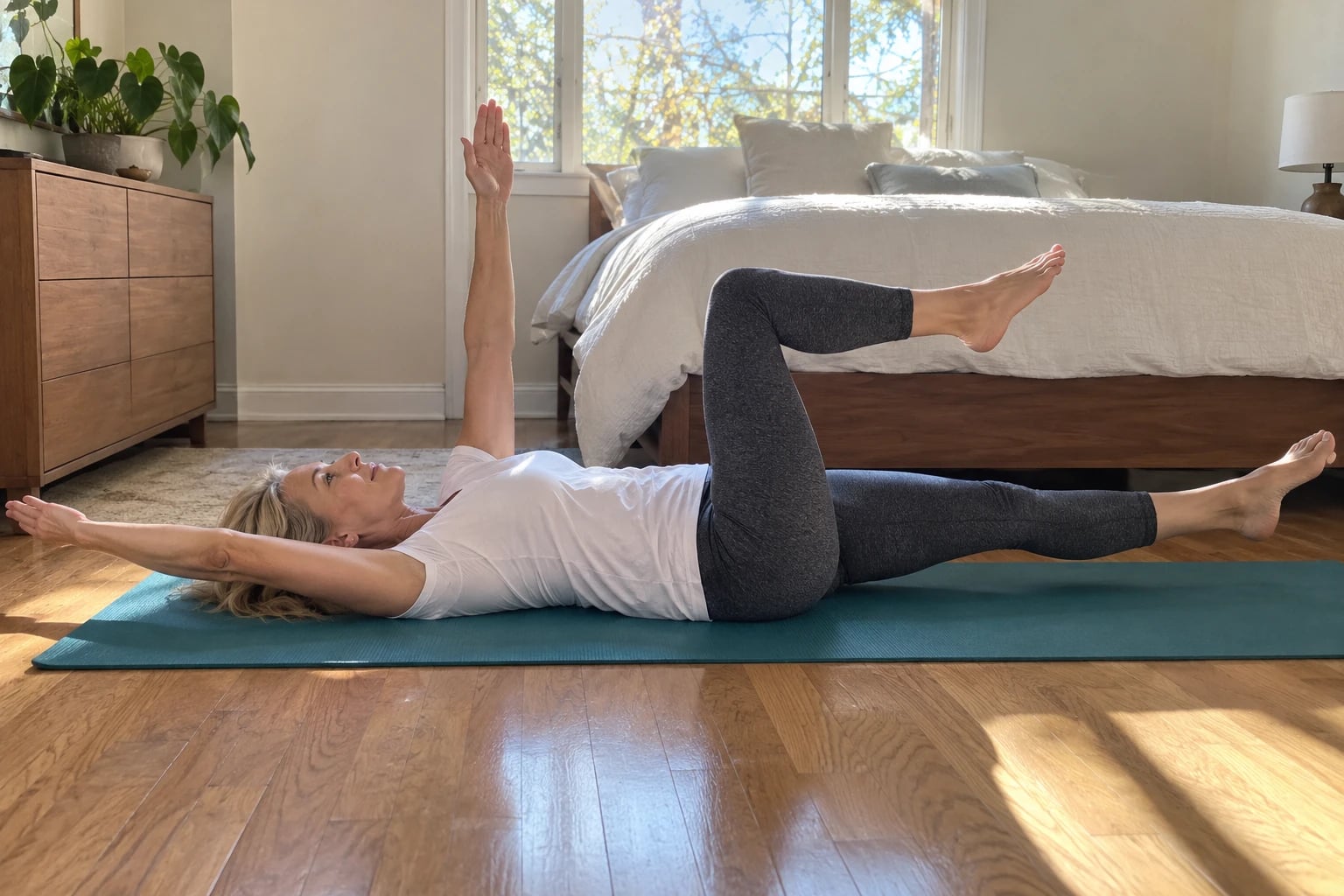
On her back, arms pointing at the ceiling, knees bent at right angles over her hips: yes, it's the shape of a beetle that has tipped over, and that's where the name comes from.
Before you start, slide one hand under the small of your back. You should feel light pressure on it the whole time you move. If the pressure disappears, your back has arched and the work has shifted from your abs to your spine.
Slowly lower your right arm toward the floor behind your head and your left leg toward the floor in front, stopping before your back lifts. Return to the start, then switch sides. Six to eight per side is plenty.
For an easier version, move only the legs, tapping one heel to the floor with the knee still bent. For a harder one, straighten the leg fully as it lowers, or hold a light hand weight in each hand.
13A Bird Dog on Hands and Knees
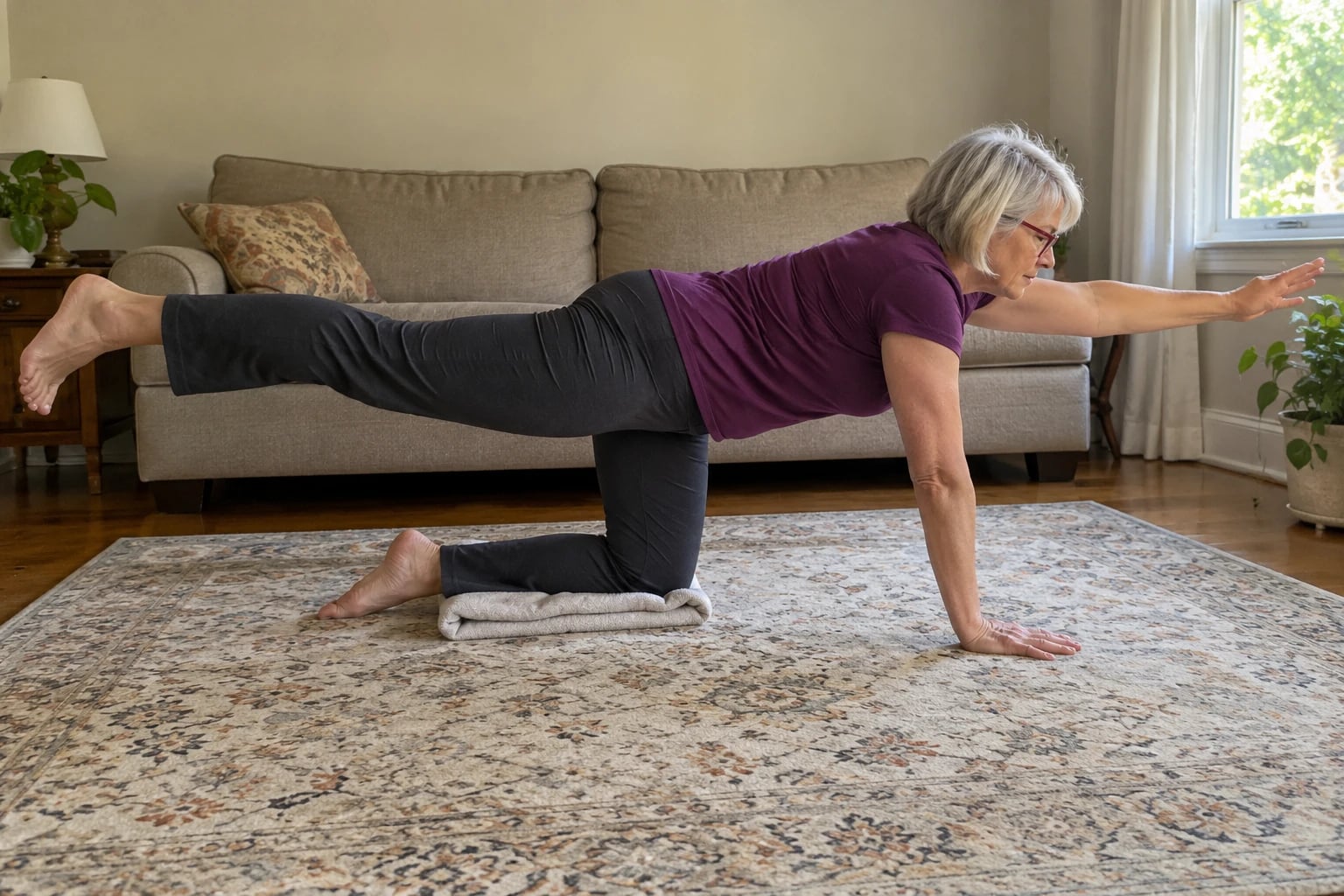
Hands under her shoulders and knees under her hips, she's reaching one arm forward and the opposite leg straight back. Both are level with the floor, as if she had a glass of water balanced on her lower back.
Hold each reach for a slow count of five, then bring the arm and leg back in without letting your hips tip. Do eight per side.
Most women can do this one. If kneeling hurts, fold a thick bath towel under your knees. If your wrists complain, rest on your fists or drop to your forearms.
With a rotator-cuff injury or arthritis in a shoulder, keep both hands down and reach back with the leg only.
Watch the hip on the side of the lifted leg. It will want to roll open toward the ceiling. Keep both hip bones pointing at the floor, and the move gets harder without getting any bigger.
12A Forearm Plank on Your Knees
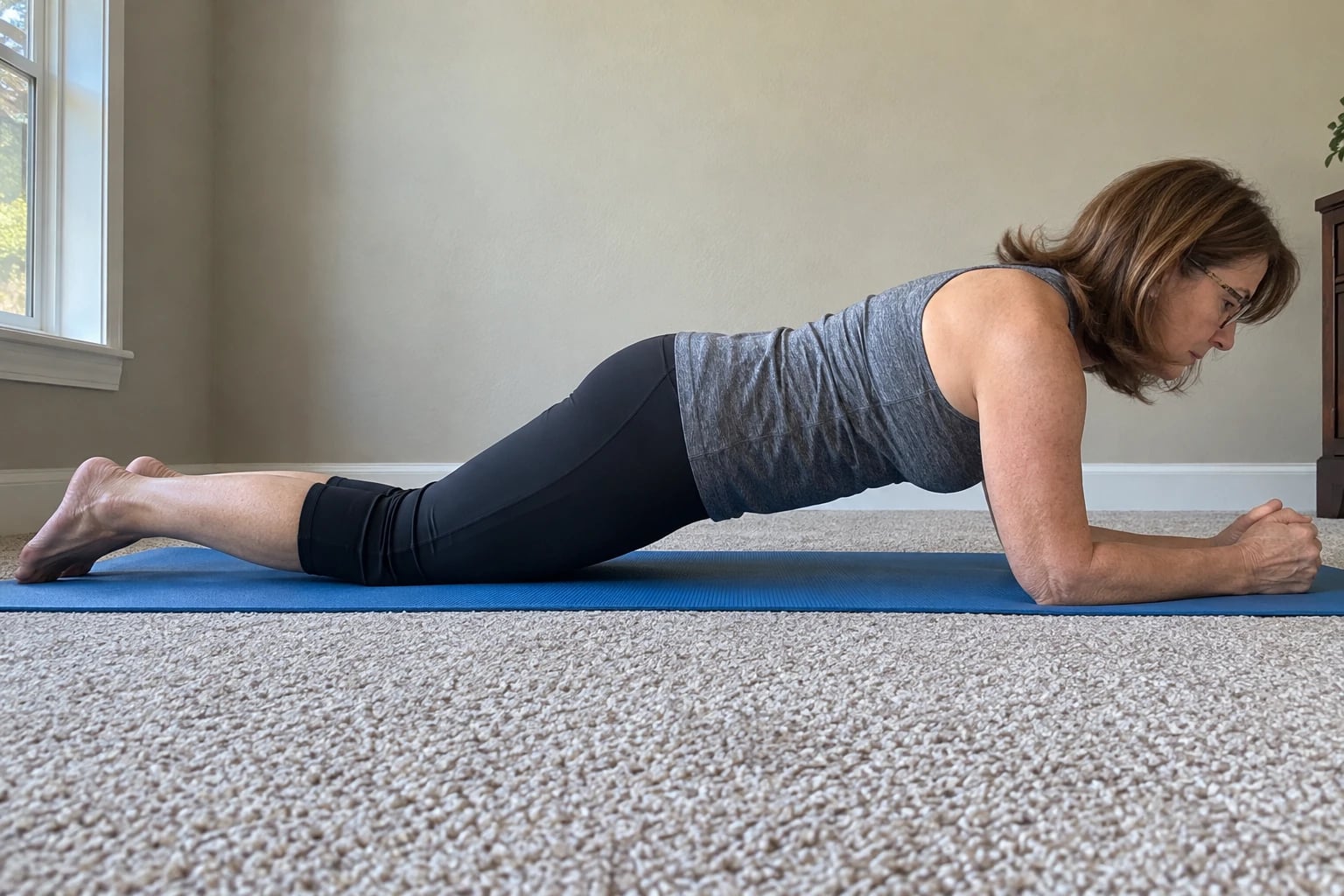
Set your forearms on the mat with your elbows under your shoulders and your knees down. Your body should make one straight line from your knees to the back of your head.
Start with three holds of 15 seconds each, resting between them. Add 5 seconds a week. Once you can hold 45 seconds on your knees with a flat back, try lifting onto your toes for a few seconds at the end.
Keep breathing the whole time. Holding your breath while you brace pushes down on your pelvic floor, which matters if you leak a little when you sneeze.
Hips raised high is the cheat; hips sagging is the strain. A full-length mirror shows you which one you're doing.
11A Band Pressed Out From a Doorway
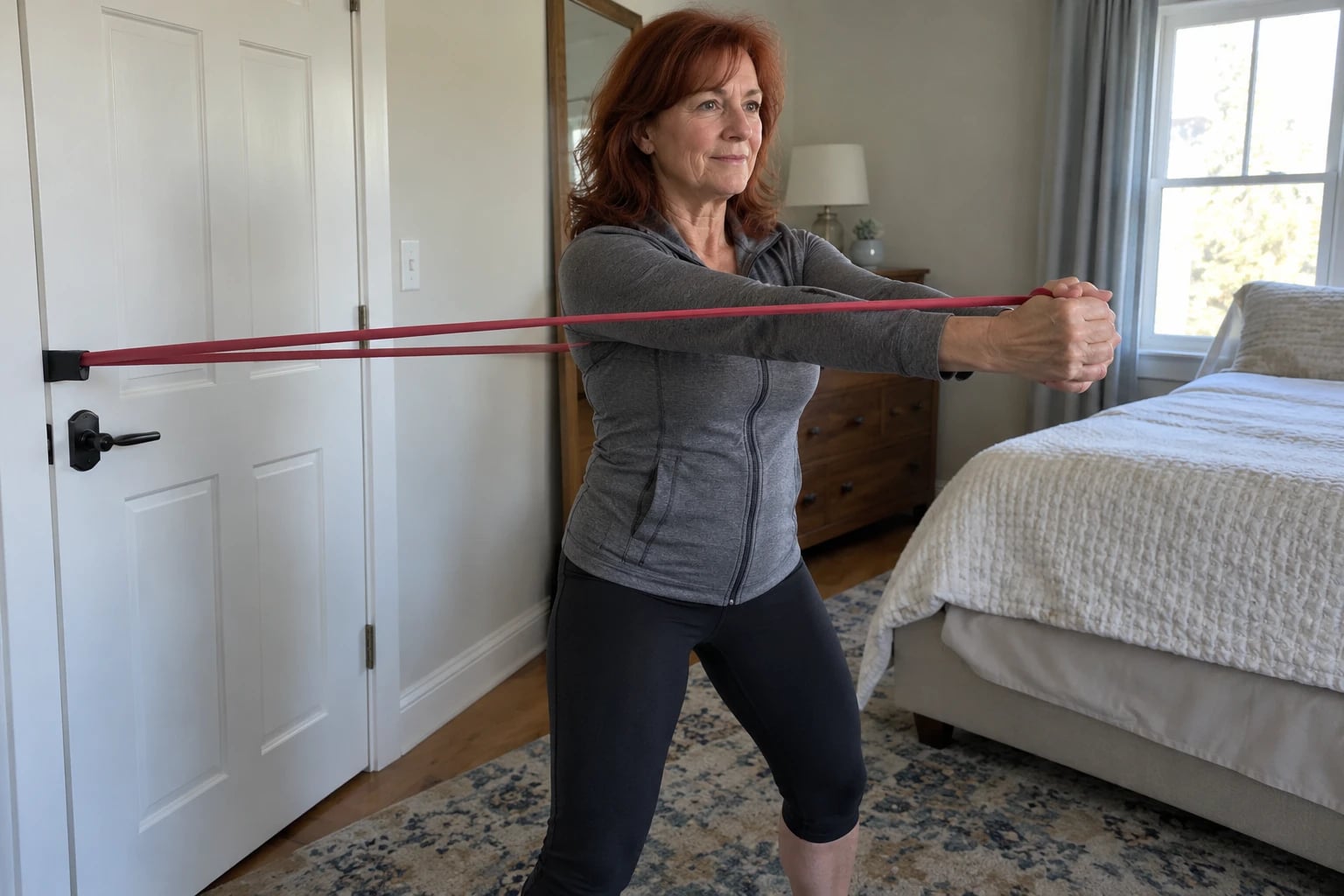
She's standing sideways to a closed bedroom door, with a resistance band anchored at chest height. Her hands start at her breastbone, and then she presses the band straight out in front of her.
For a back that hates bending, this is the core move to learn. You stand, you never twist, and your abs still work hard.
The band tries to turn her toward the door, and she doesn't let it. That resistance is the whole exercise.
A door anchor is a small strap with a foam knob that you shut in the door. Many band sets come with one. Stand on the side where the door opens away from you, so your pull holds it shut.
Press out, hold for three breaths, and bring your hands back in. Do ten, then turn around and face the other way. If you're being pulled around, use a lighter band or step closer to the door.
A set of bands is worth buying even if you never buy a single hand weight.
10Wall Angels With Your Back on the Wall
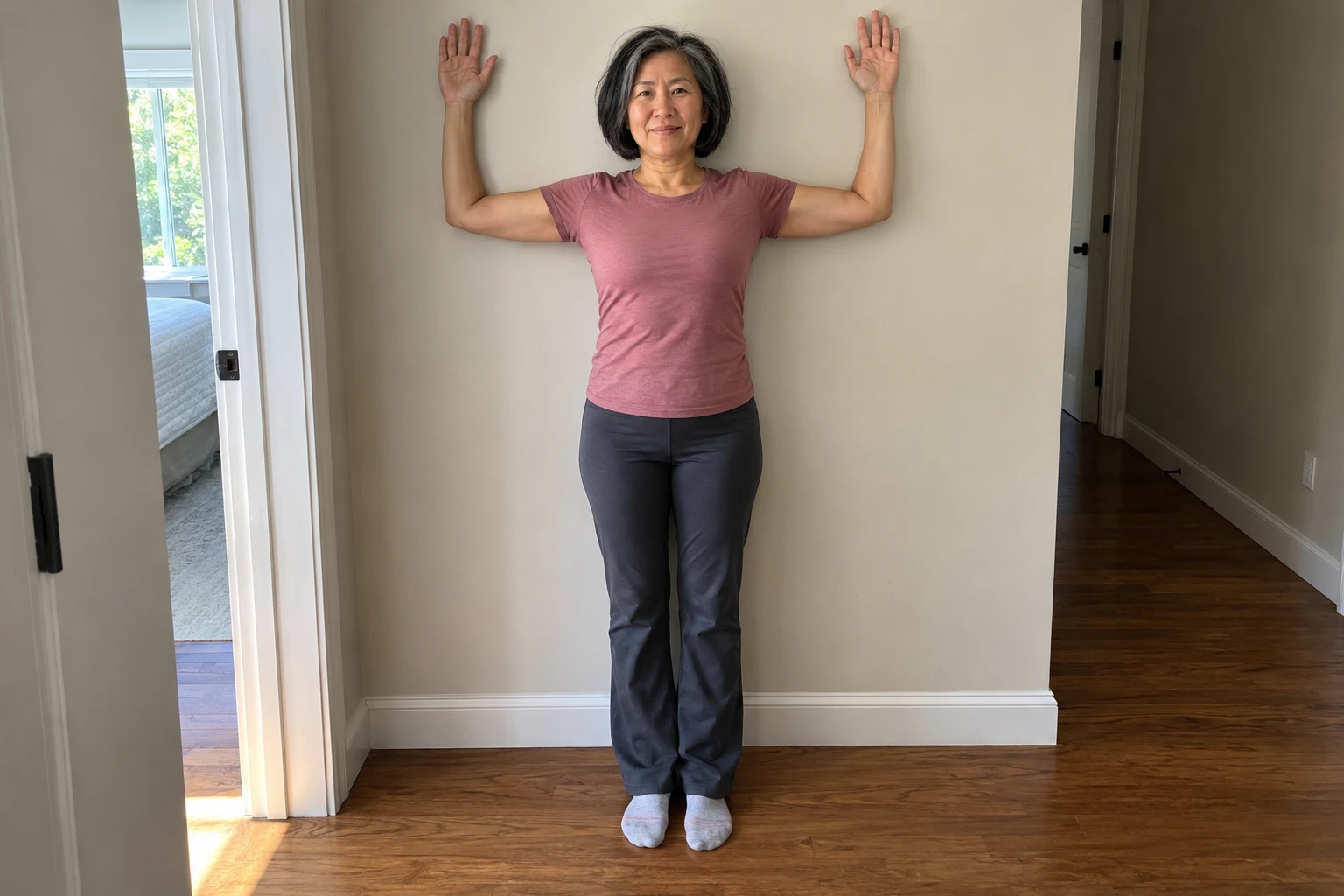
Heels a few inches from the hallway wall, she has her backside, upper back and head all touching it. Her arms are bent like goalposts, and she's sliding them slowly up the wall.
Gynecologist Dr. Becky Brightman has said that poor posture can make the belly stick out. When your upper back rounds, your ribs sink toward your hips, and your stomach has nowhere to go but forward.
The wall tells you where you stand. With your heels about four inches out, let your back settle against it.
If your head won't touch the wall unless you tip your chin up, or your lower back arches far away from it, this move belongs in your week.
Slide your arms up as far as you can while your elbows and wrists stay near the wall, then slide them down. Do 10 slow reps.
With a rotator-cuff injury or a frozen shoulder, keep your arms low, or simply stand against the wall for a minute and breathe.
Build back the muscle
According to Dr. Stephanie Faubion of Mayo Clinic, women lose muscle at about 0.8% a year from midlife, and with less muscle you burn fewer calories at rest. The CDC asks for strength work at least two days a week.
9A Straight-Leg Raise on the Bed
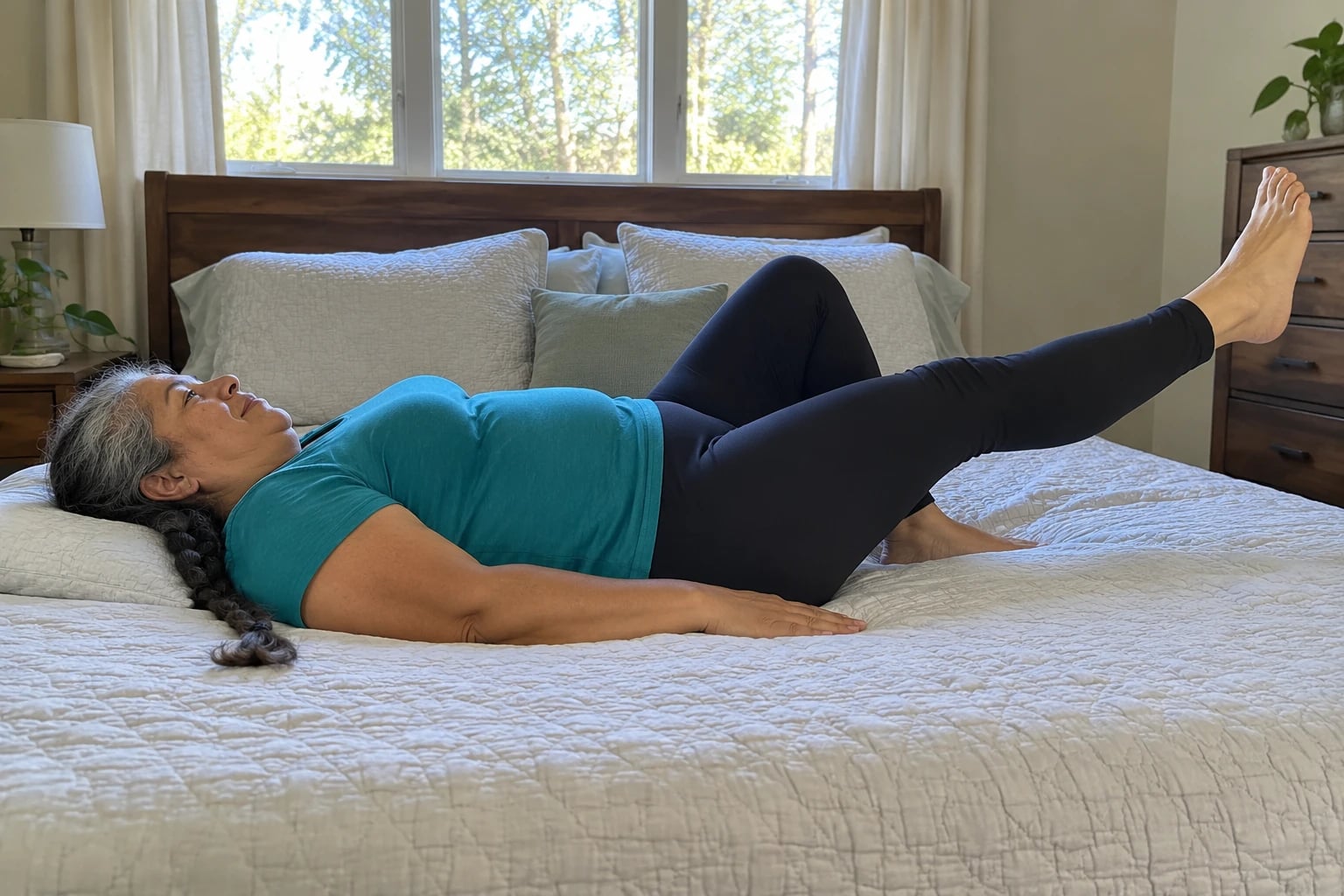
She's lying on top of the bedspread with one knee bent and that foot flat. Her other leg is straight and lifted to the height of the bent knee, toes pointing at the ceiling.
This one is for knees that ache. It's on Cleveland Clinic physical therapist Tim Bungo's list of knee-friendly exercises. It works the front of the thigh while the knee stays straight, so the joint never bends under your weight.
Tighten the front of your thigh first, before the leg leaves the bed. Lift slowly, pause at the top, and lower just as slowly. His dose is two sets of 15 on each leg.
A firm mattress works fine. If yours is soft enough that your hips sink, do it on the floor on a mat instead. When 15 gets easy, strap on a light ankle weight.
Stronger thighs take load off the knee in every squat and on every stair later in the week.
8A Bridge Held for Five Seconds
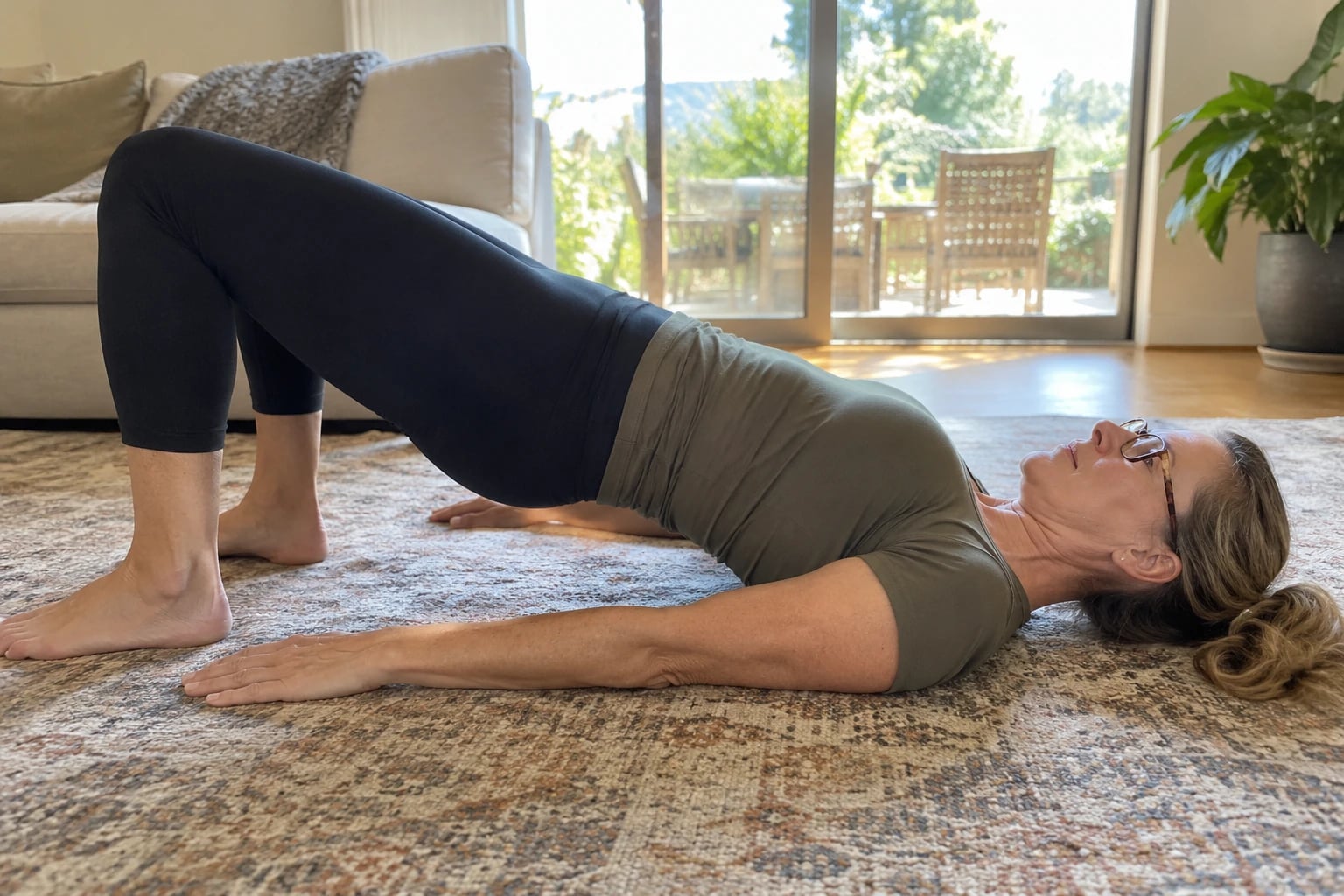
Squeeze your seat first, then lift. That order is the whole trick. Lie with your shoulders on the rug and your feet flat.
Her hips are raised so her body runs in a straight ramp from her knees to her shoulders.
Hold for five seconds at the top, then lower slowly. Two sets of 15 is the same knee-friendly dose as the straight-leg raise, and it suits most other women too.
The common mistake is lifting too high and arching the lower back. If you feel it in your back instead of your seat, drop your hips an inch and walk your feet a little closer to your body.
To make it harder, rest a hand weight across your hip bones and hold it there with both hands, or lift one foot off the floor and hold. To make it easier, lift less and hold for a shorter time.
This one is worth doing for nearly everyone. Your glutes are among the biggest muscles you have, and this move works them while you lie down, with your knees barely involved.
7A Push-Up Against the Hallway Wall
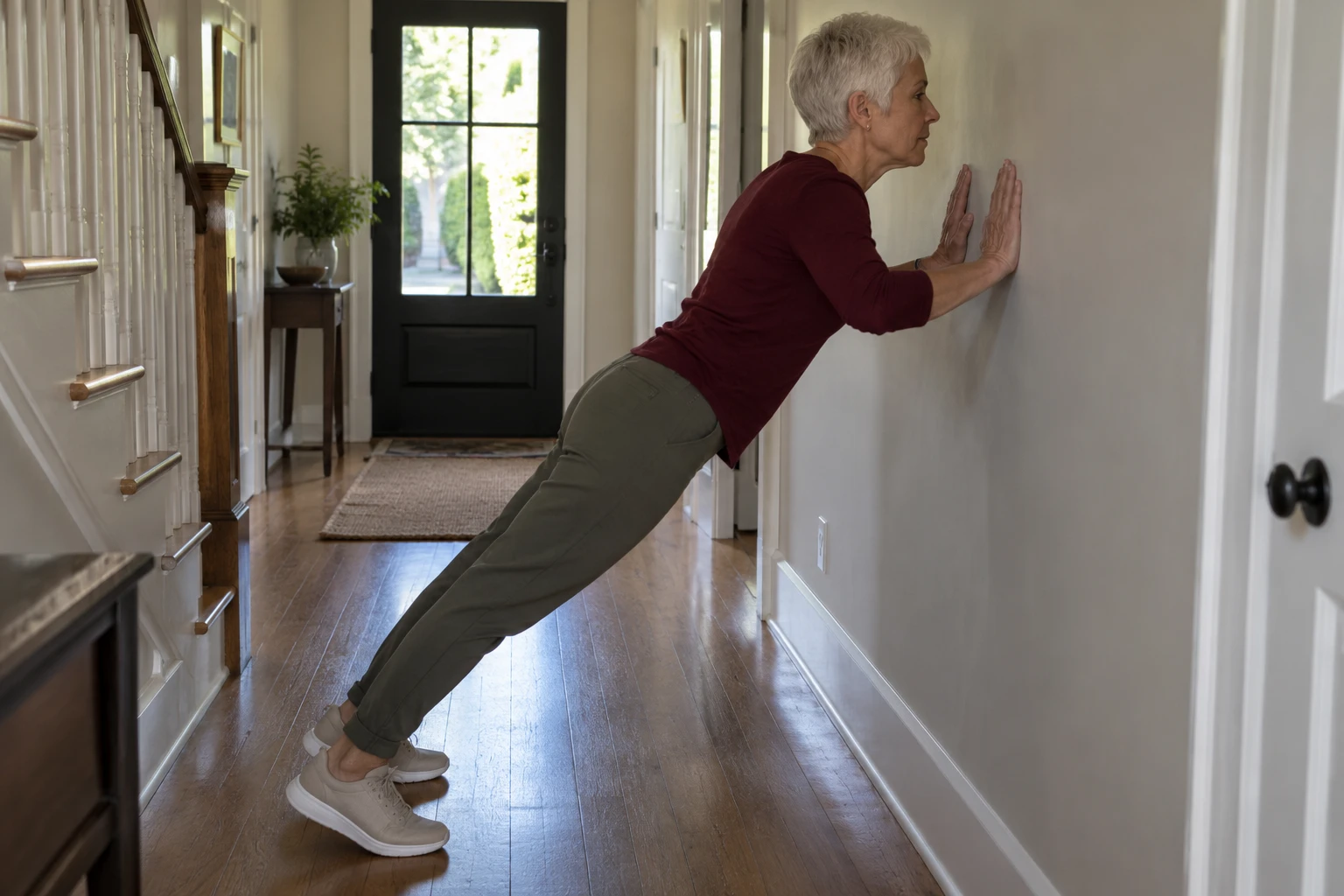
Her hands are flat on the wall at shoulder height and her feet are about an arm's length back. She's leaning in as one straight plank from her heels to her head. That's the whole move.
Full push-ups on the floor are on the skip list if your ab muscles have separated, and they're rough on stiff wrists and shoulders.
The wall version still works your chest, shoulders and the backs of your arms, and you can do it at any age.
Bend your elbows to bring your chest toward the wall, keeping your elbows angled about halfway out from your sides rather than flared wide. Then push back. Do two sets of 10 to 15.
To make it harder, walk your feet farther from the wall. When 15 feels easy, move your hands to the kitchen counter, then to the seat of a sturdy sofa pushed against a wall.
Your belly shouldn't reach the wall before your chest does. If it sags first, step in closer.
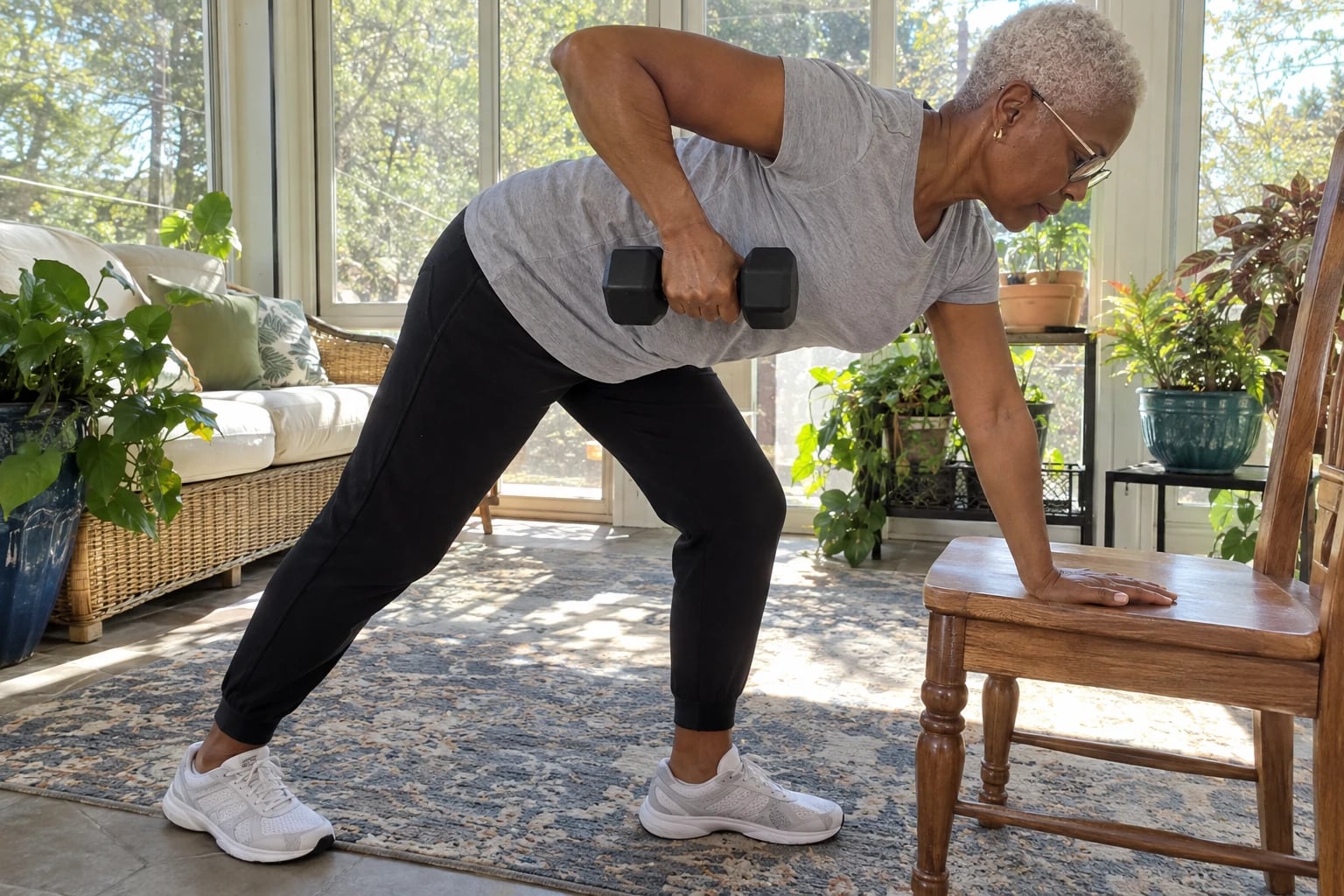
6A One-Arm Row With a Hand on a Chair
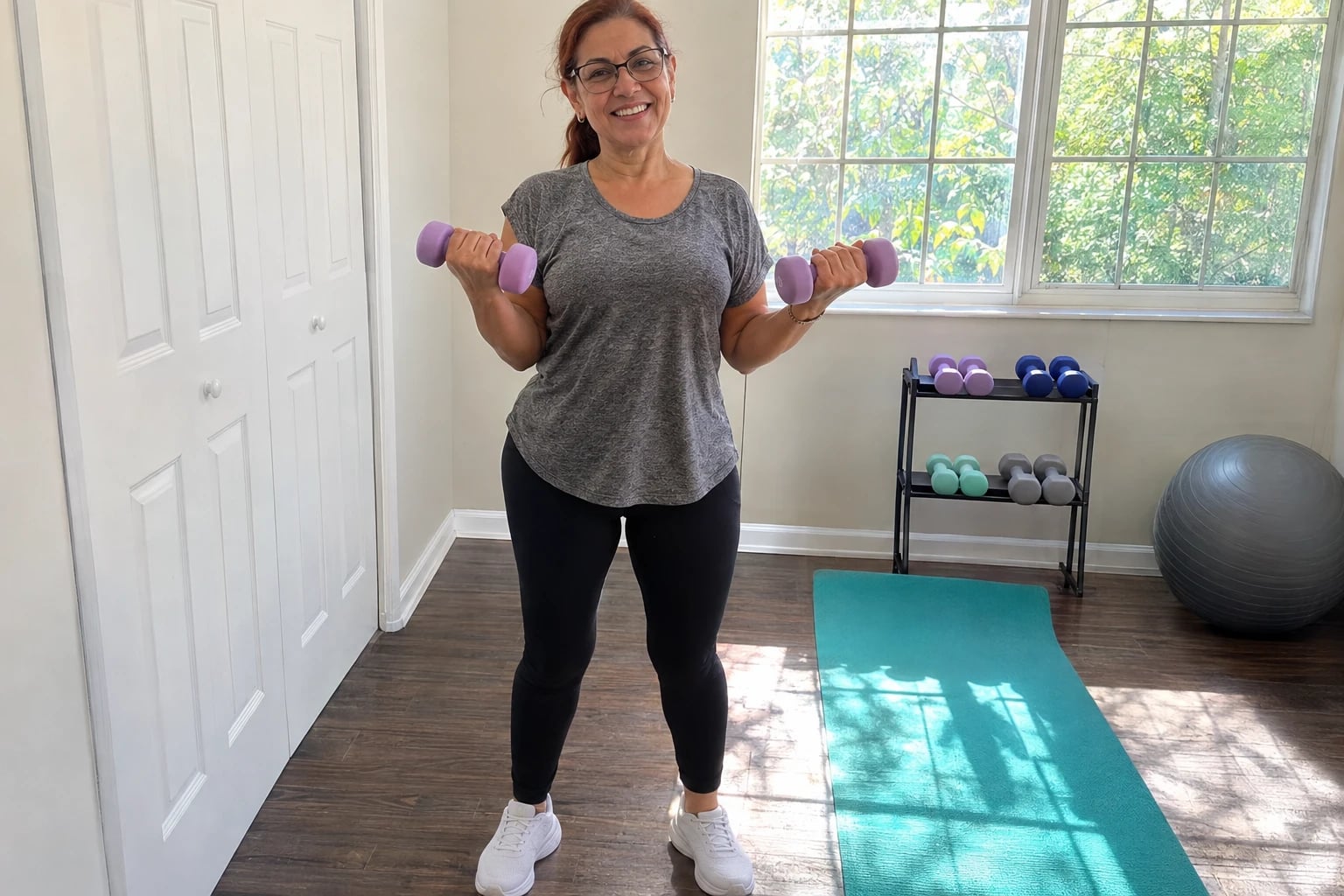
No hand weights yet? A full gallon jug of water weighs a little over 8 pounds and has a built-in handle.
One of her hands is braced on the seat of a sturdy chair and her back is flat as a tabletop. With her other arm she pulls a dumbbell up beside her ribs, elbow pointing at the ceiling.
Imagine a broom handle lying along your spine, touching your head, upper back and tailbone. Keep all three touching it as you pull.
Do two sets of 10 to 12 on each arm. The last two reps of each set should feel hard. If you could easily do five more, the weight is too light.
Many women start with dumbbells too light to change anything, so it's worth owning a heavier pair for this and the carry.
With a rotator-cuff problem, keep the weight light and your elbow close to your side, and stop if you feel a pinch at the top. Rows also pull back rounded shoulders, which helps your posture as well as your back.
5A Hip Hinge With Two Hand Weights
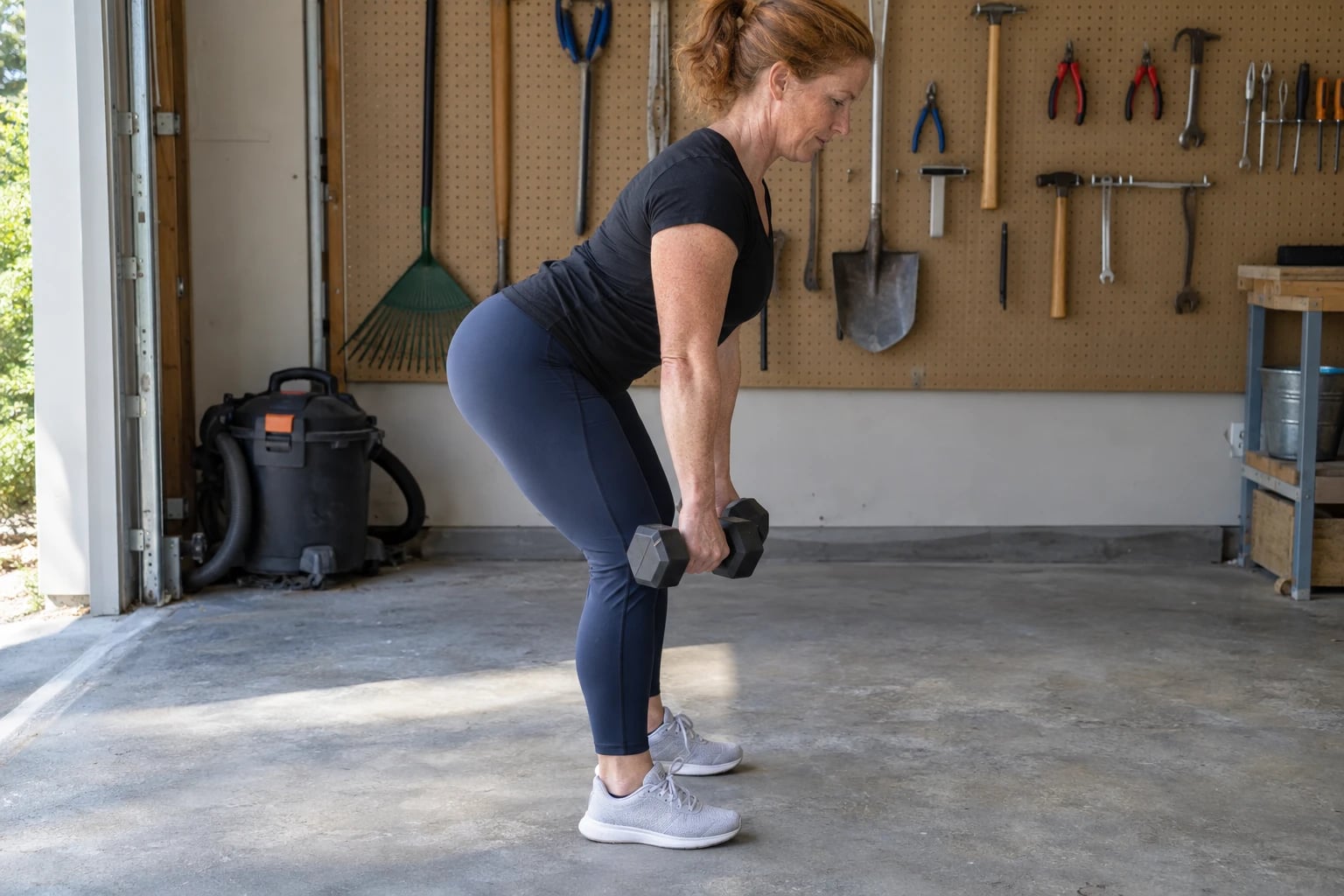
Weights hanging in front of her thighs, knees softly bent, she's pushing her hips back toward the garage wall behind her. Her chest tips forward while her back stays long and flat.
A hip hinge means sitting back from the hips instead of bending at the waist. It's how you should be picking up a laundry basket anyway.
Learn the hinge first without weights. Stand with your back to a wall, about a foot in front of it. Push your backside back until it touches the wall, letting your chest come forward. That motion is the hinge.
If you have osteoporosis, check with your doctor or physical therapist before you add weight to any move that tips you forward.
Then pick up the weights. Slide them down the front of your thighs to just below your knees, and stand back up by squeezing your seat. Do two sets of 10.
If your back starts to round, stop the weights higher on your legs.
4A Step-Up Onto the Bottom Stair
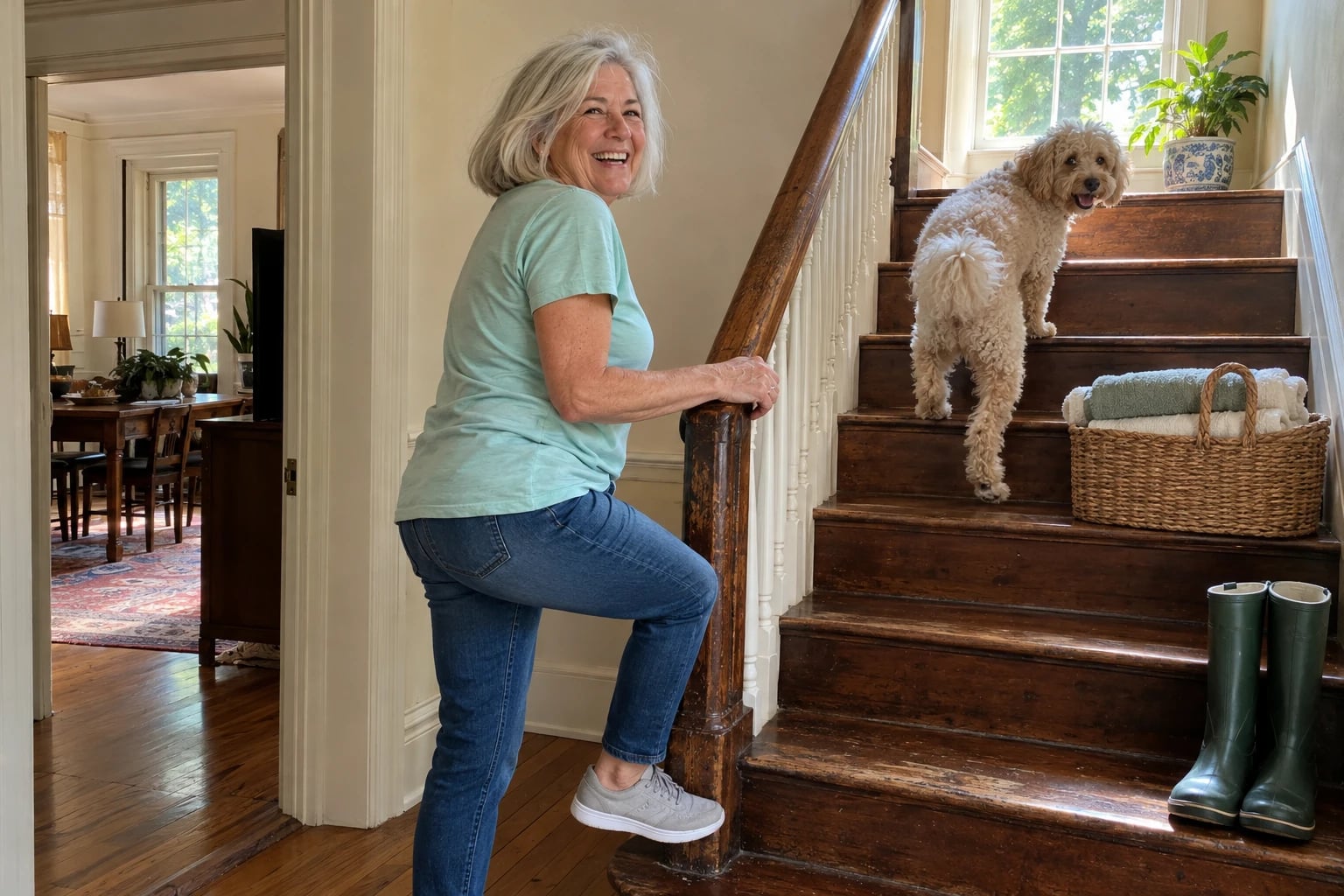
She has one foot planted on the bottom stair and is pressing through that heel to stand up tall on it, with one hand resting on the banister.
Lunges are on the knee-arthritis skip list. A step-up works the same thigh and seat muscles with far less bend in the knee, and you can stop at any point.
Watch the knee of your working leg, in a hall mirror or simply by looking down. It should stay pointed over your second toe instead of caving inward. If it caves, you're stepping up onto something too high.
Step up with your right foot, bring your left foot up beside it, then step down with your left foot first. Do 10 leading with each leg. Push through the top heel, not off the foot that's still on the floor.
If your bottom stair is too tall, use a low, sturdy step platform set beside something you can hold. For a harder version, hold a hand weight on the side away from the rail.
3Sit-to-Stand From a Dining Chair
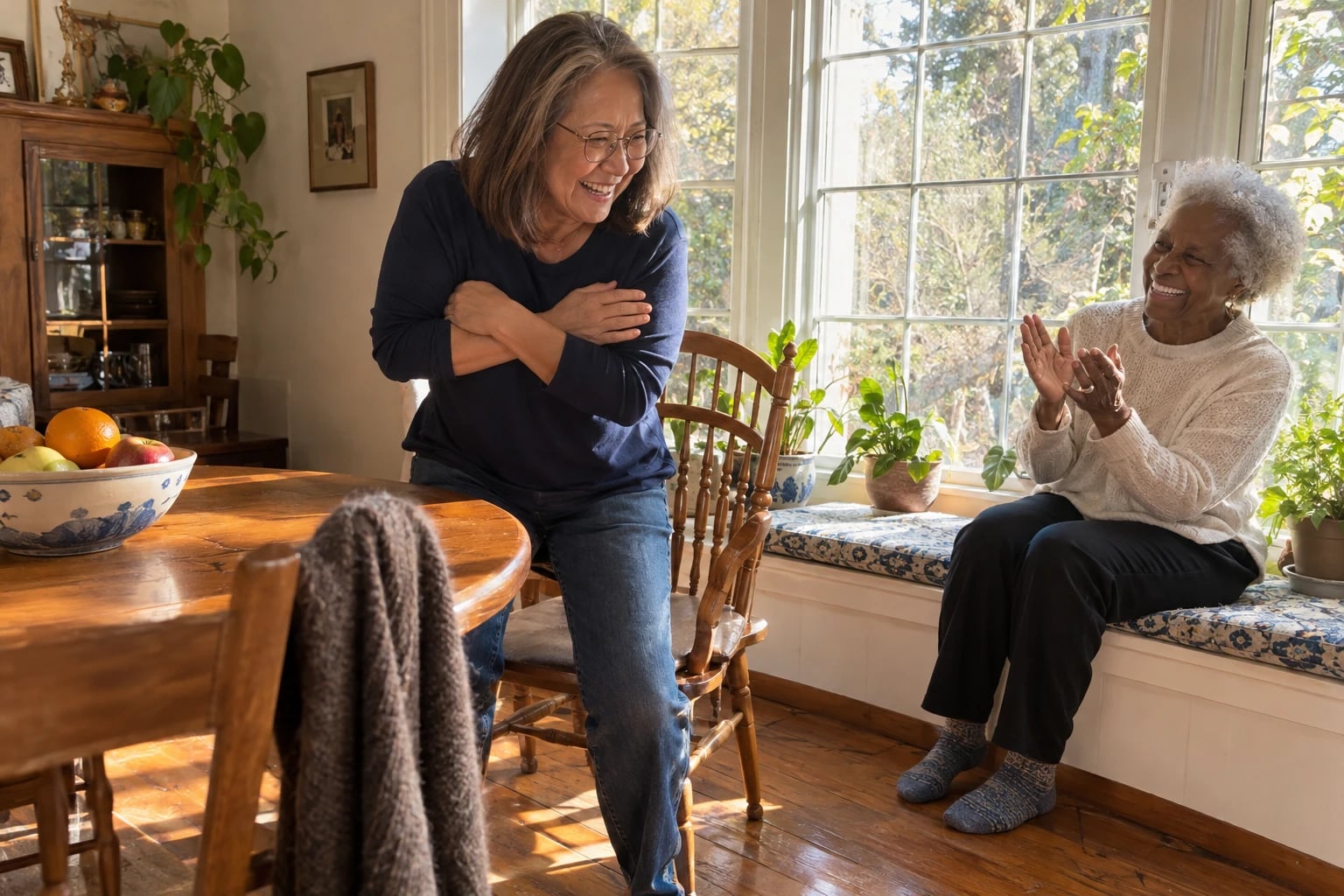
Before you do a single set, count how many times you can stand up and sit down in 30 seconds. Remember the number, and test yourself again in a month.
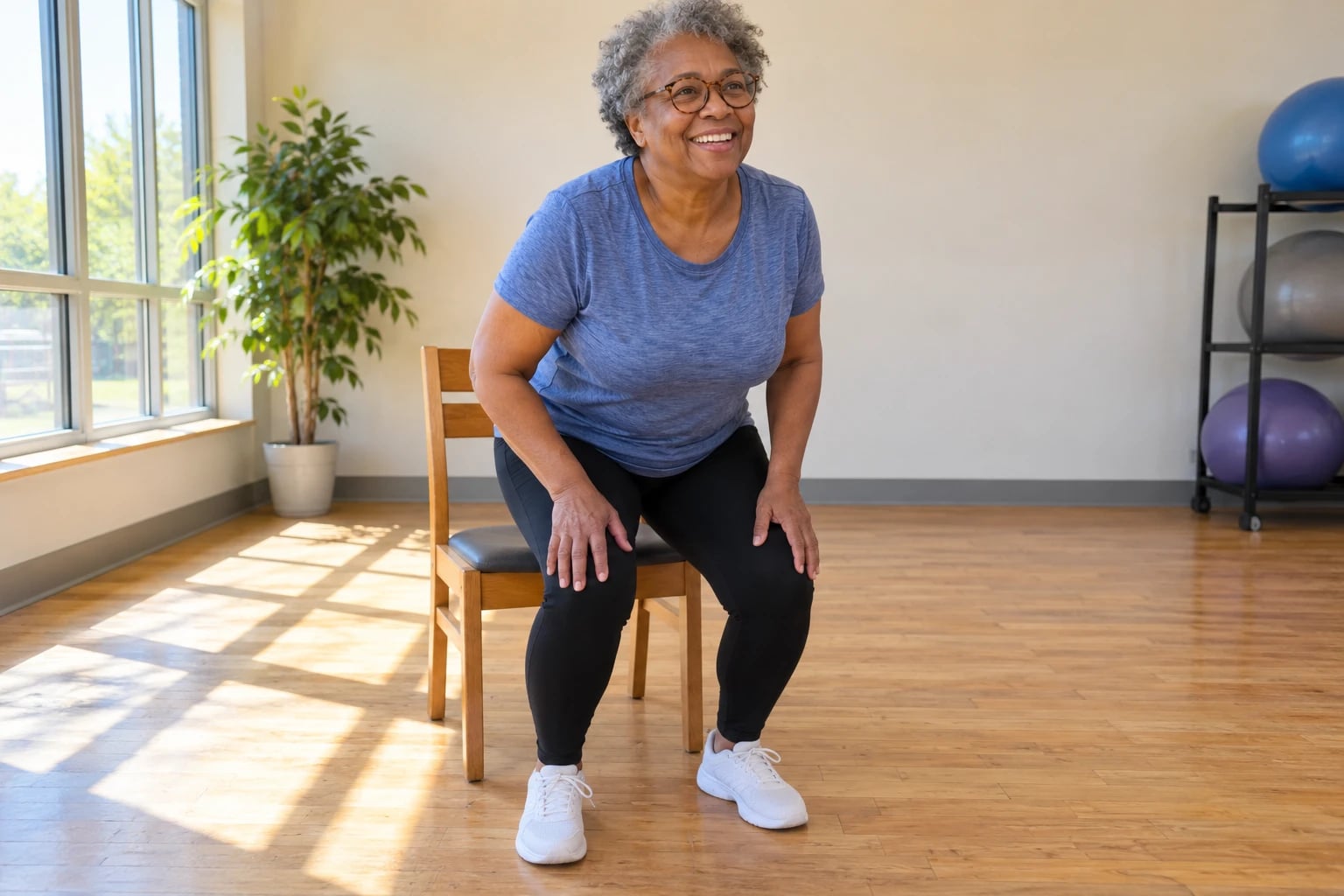
Her arms are crossed over her chest and her feet are hip-width apart. She's rising from a dining chair without rocking or pushing off her knees.
Sit tall near the front edge of the seat and lean forward slightly. Stand up by pressing through your heels. Then lower yourself slowly and touch the seat lightly, without dropping into it. Do two or three sets of 10 to 12.
If your knees protest, start with mini squats at the kitchen counter. Hold on with both hands, bend your knees a little, and straighten them again.
The knee-friendly dose is three sets of five. A higher chair or a firm cushion on the seat helps too.
To make it harder, hug one dumbbell against your chest, or count to four on the way down.
This is a compound move, meaning it works several big muscles at once, so it gives you more back for each minute than almost anything else on the floor.
2Carrying a Heavy Weight in One Hand
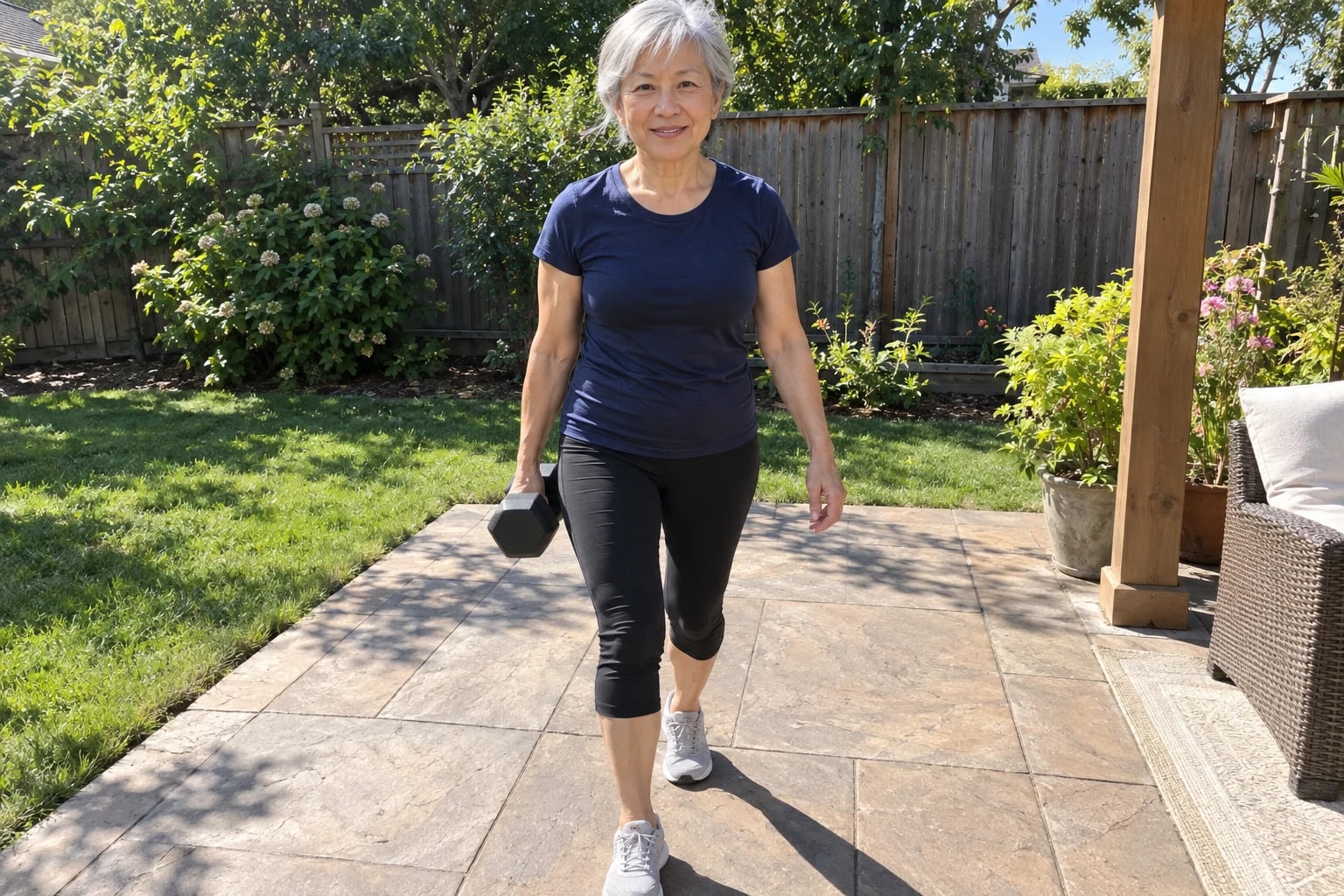
She's walking the length of a backyard patio with one heavy dumbbell in her right hand. Her left arm hangs loose and her shoulders are level, as if she were carrying a full suitcase without leaning toward it.
That's why it's called a suitcase carry. The weight tries to tip you sideways, and the muscles along your side and deep core keep you upright. It's core work you do standing up, with no crunching.
Use a heavy dumbbell, a kettlebell or a full watering can. It should be heavy enough that by 30 steps you feel it in your side and in your grip.
Walk 30 steps, set the weight down, and switch hands. Do three rounds on each side.
Two things give you away: the shoulder on the weight side drops, or you lean your whole body away from the load.
Stand as tall as if someone were measuring your height. Pick the weight up from the ground with a hinge or a squat, never by bending over from the waist.
1A 25-Minute Circuit, Twice a Week
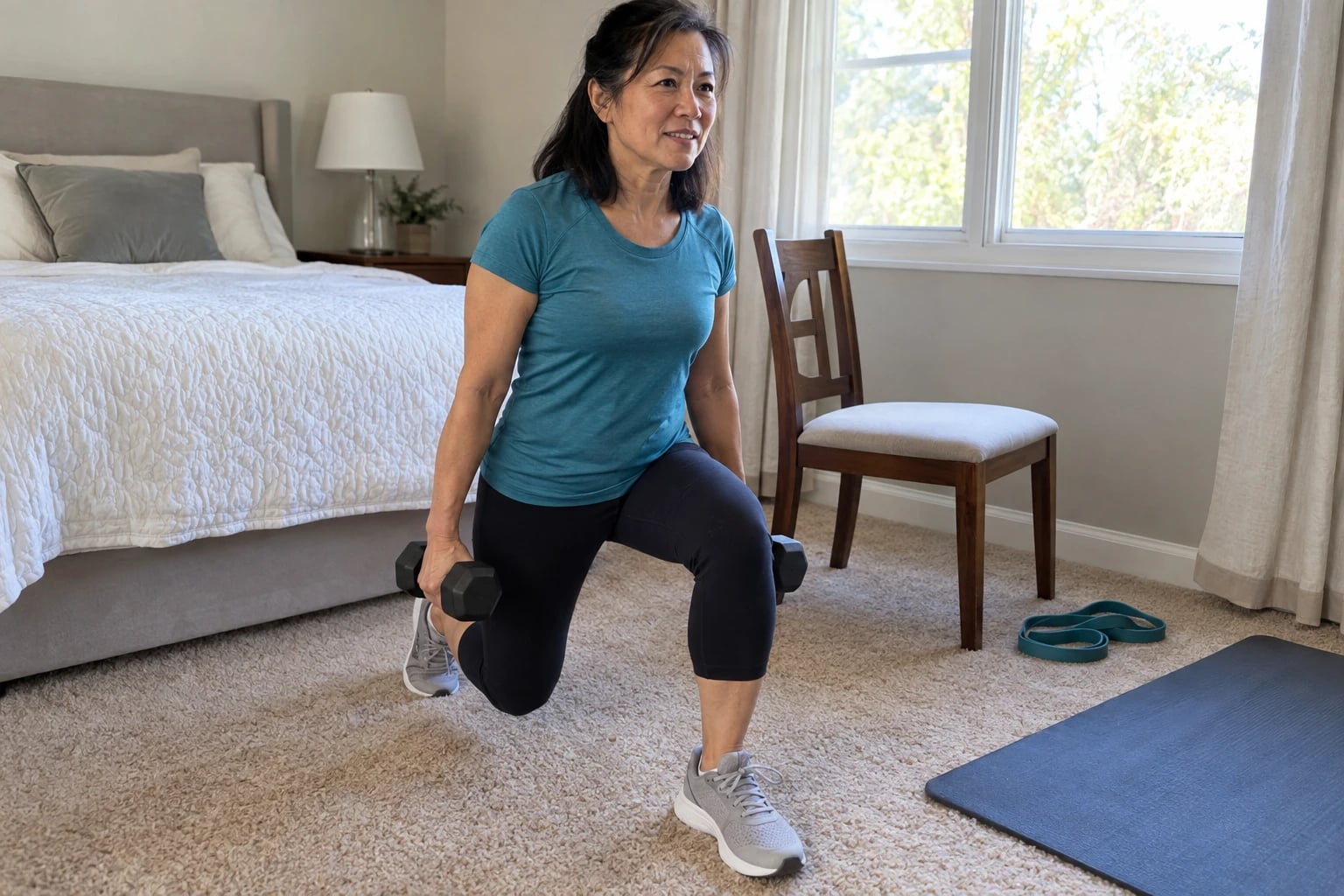
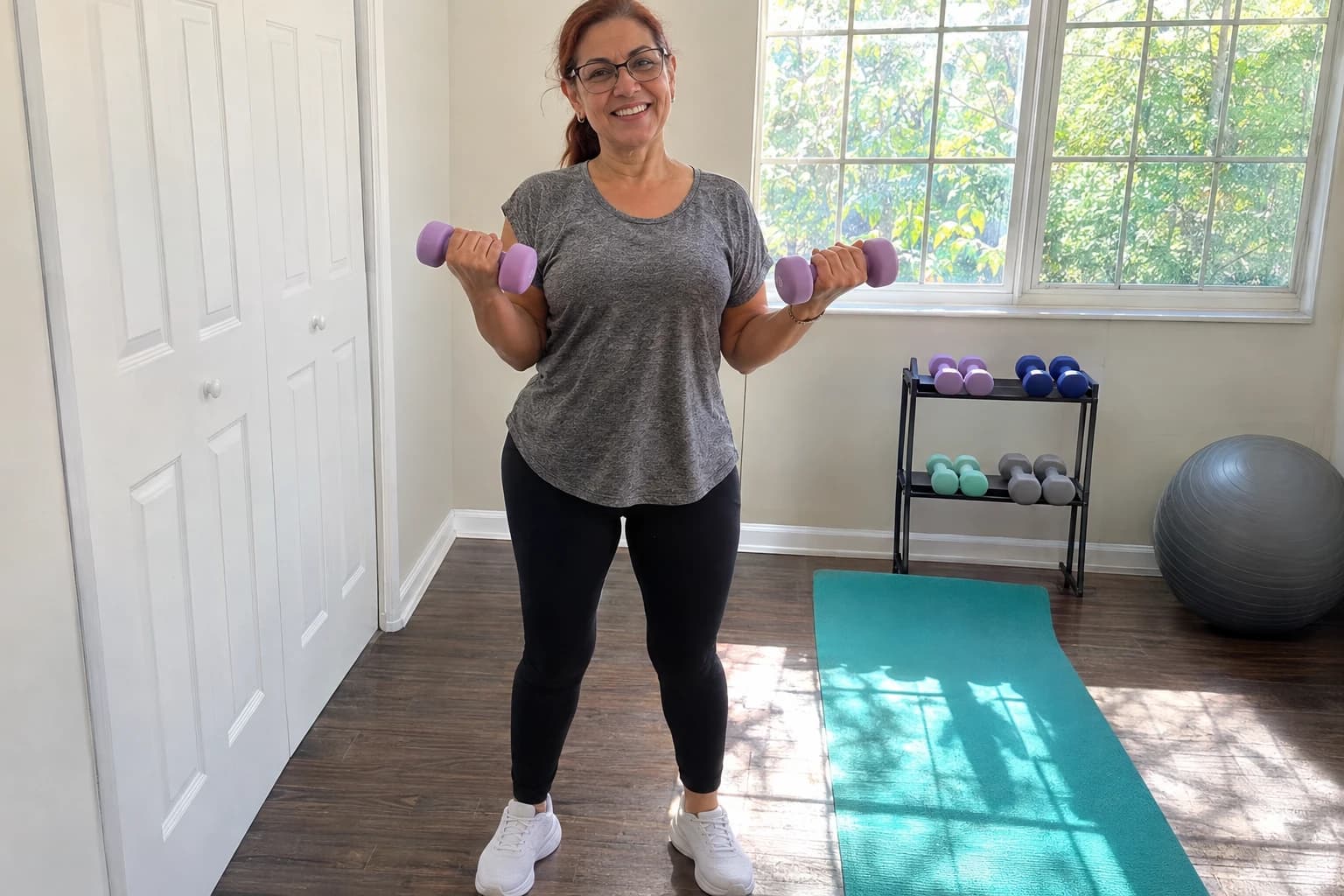
Hand weights, a resistance band and a dining chair are spread around her spare bedroom in a loop, and she's moving from one station to the next with a dumbbell in each hand.
A 2023 review of about 100 trials in postmenopausal women found that exercise trimmed waist size and visceral fat, and that cardio plus strength work did best.
AARP also points to a study in which an hour of strength training twice a week for eight weeks significantly reduced body fat.
Warm up with three minutes of marching. Then do 10 sit-to-stands, 10 rows on each arm, 12 wall push-ups, 10 hip hinges, 15 bridges, a 30-step carry with each hand and a 20-second kneeling plank.
Rest for a minute, then go around again. Three rounds take roughly 25 minutes.
Do the circuit on two days that aren't back to back. Walk briskly or march for 30 minutes on most other days, and add a few minutes of heel slides or dead bugs after.
The bottom line
Start with the sit-to-stand and a brisk ten minutes of marching. They need nothing but a chair and some floor, and between them they cover strength and cardio on day one.
If your knees are your worry, build from the bridge and the straight-leg raise. If it's your back, start with heel slides and the band press-out. If you've had children, do the gap check before any of it.
You may notice the change first in places a tape measure doesn't reach: grocery bags that feel lighter, stairs that stop winding you, a sofa that lets you go without a push from your hands.
Up next
17 Plus-Size Office Outfits Over 50 That Actually Look Polished
Seventeen office outfits for a real plus-size body, each with the one fit detail that makes it work, from where a blazer button lands to what a tailor charges.
Read the list →

Reader quiz
Did you catch the details?
5 questions from this article. Finish them all to unlock the editor's bonus tip.
In the bridge, what does the article say to do first, before you lift your hips?
Did any of these feel familiar?
Know someone who needs this?
Sources cited in this article
This article links to 6 outside sources, listed here so you can read them yourself.
- A study that followed 1,246 women insight.jci.org/articles/view/124865
- Harvard Health explains www.health.harvard.edu/womens-health/why-am-i-gaining-belly-fat-during-menop…
- CDC's baseline www.cdc.gov/physical-activity-basics/guidelines/adults.html
- Knee-friendly exercises health.clevelandclinic.org/knee-arthritis-exercises
- Harvard Health www.health.harvard.edu/staying-healthy/taking-aim-at-belly-fat
- Cleveland Clinic my.clevelandclinic.org/health/diseases/22346-diastasis-recti

Peter Byalik
Food & Home Editor
Peter Byalik is a professional chef with more than 20 years of experience, including years running his own business. He came to the United States from Ukraine.
More from Peter Byalik