









How Much Protein Do Women Over 50 Need
Your own daily number in grams, worked out from your weight in pounds, and a plate for each meal that gets you there without a chicken breast at every sitting.

By Peter Byalik, Food & Home Editor
Updated · 12 min read
- Written by our food & home editor
- Cited 9 sources
- How we review
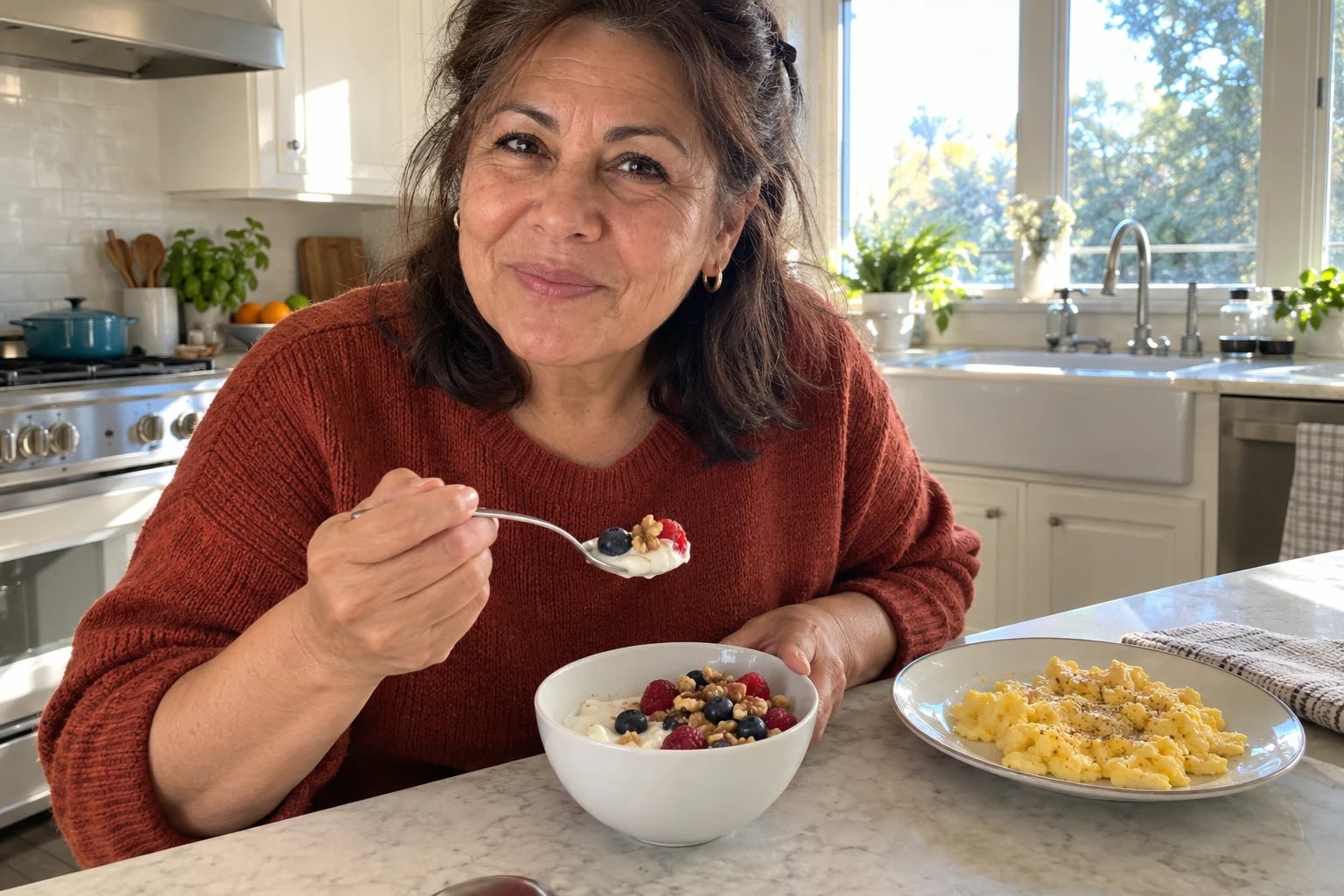
It's 10 in the morning and you're on your second cup of coffee. Breakfast was a slice of buttered toast, eaten standing at the counter while the radio ran through the weather. That's maybe 3 or 4 grams of protein.
Dinner will make up for it, you figure. Grilled chicken, a decent portion.
But as you get older, your muscles take protein in doses, and that toast never came close to one. The day's total matters. So does how you split it. Here's how to find your own number, in pounds, and how to eat it in foods you already buy.
How much protein you actually need now
Plan on about 1 to 1.2 grams of protein for every kilogram you weigh. If you lift weights regularly, you can go up to 1.6. For a 150-pound woman, that's roughly 68 to 82 grams a day, or up to about 109 if she's training hard.
That's more than the number you've probably seen. The Daily Value on food labels assumes 50 grams.
The older figure comes from the RDA, the recommended dietary allowance: 0.8 grams per kilogram, or 0.36 grams per pound. For a sedentary 140-pound woman of 50, that's about 50 to 53 grams a day.
The RDA is a floor. It's the amount that keeps most healthy adults from coming up short. It was never meant as the amount that keeps you strong at 64.
The newest Dietary Guidelines for Americans, for 2025 to 2030, set a goal of 1.2 to 1.6 grams per kilogram for adults. That's 50 to 100 percent above the old minimum. So treat 1 to 1.2 as a sensible everyday floor at your age, and move toward the guidelines' higher range if you're active or lifting.
Why more at your age? Muscle goes fastest during the menopause transition, faster than before it or after it. Much of the overall drop is plain aging, but the slide is real either way, and it's quietly underway in your fifties.
Strength is only half of it. Among active women aged 65 to 70, those eating less than about 1.1 grams per kilogram were more likely to have physical limitations, even with the same amount of muscle. Think of the stairs, the laundry basket, the bag of potting soil from the car.
More isn't endlessly better. Protein beyond what your body uses can be stored as fat, Harvard's nutrition team warns. Past about 1.6 grams per kilogram, there's little reason to push.
So when your tracking app says 112 grams and the label math says 47, both are numbers for different jobs. One is the floor. The app may be aiming at the top of the range, or past it.
Check with your doctor first if this is you
Run down this list before raising your protein:
- You have chronic kidney disease, or a lab result flagged your kidneys. An eGFR, the kidney test on most blood work, below 60 for three months or longer points to it. Many are told to eat less protein, about 0.55 to 0.8 grams per kilogram by stage; on dialysis, usually more, often 1.0 to 1.3.
- You have diabetes or high blood pressure. These are the two most common causes of kidney disease in the US. Find out your eGFR before you change your eating.
- You're recovering from surgery or a serious illness. Needs rise, sometimes sharply; the National Council on Aging lists 1.6 to 3.0 grams per kilogram. Let your care team set the number.
- You're on a GLP-1 medicine. Tell your prescriber you're raising protein, and ask whether a visit with a dietitian is covered.
Here's a line you can say at your next appointment, or type into a patient portal message:
"I'd like to eat about 80 grams of protein a day. Given my last eGFR, is that safe for me?"
You can usually find the number yourself first. Log into your patient portal, open your most recent blood work, and look for eGFR near the creatinine result.
Work out your own number in three steps
1. Divide your weight in pounds by 2.2. That's your weight in kilograms. At 150 pounds, you're about 68.
2. Multiply by 1.0, then by 1.2. Those two answers are your everyday range. If you lift weights regularly, you can multiply by up to 1.6.
3. Divide by three. That's about what each meal should carry.
For a 150-pound woman, that's 68 to 82 grams a day. Split over breakfast, lunch and dinner, it's 23 to 27 grams a meal.
If you'd rather skip kilograms, multiply your weight in pounds by 0.45 for the low end and 0.55 for the high end. If you lift, 0.73 is the ceiling.
If a trainer has handed you 150 grams, ask for the math. On 1,800 calories, 150 grams of protein is 600 calories, a third of everything you eat. No wonder it feels like a second job.
You don't need a food scale forever. Log three ordinary days in a free app, see where you land, then stop. After that, the protein line on the yogurt carton and the size of your palm, about 3 ounces of meat or fish, will tell you most of what you need.
What if you weigh more than you'd like?
Then figure from a lower weight than the one on the scale. Muscle drives your protein needs, and extra body fat doesn't raise them the same way.
Dietitians often use the weight at the top of the healthy range for your height. For most women, that runs roughly from 128 pounds at 5'0" to 164 at 5'8", and around 145 at 5'4".
Say you're 5'4", 250 pounds, and mostly at a desk. Figured from 250, a target of 1.2 grams per kilogram comes to about 136 grams. Figured from 145, it's 66 to 79 grams. You can reach the second number with three normal meals.
Protein matters more, not less, while you're losing weight. When you cut calories, some of what comes off is muscle, and protein plus lifting helps you hold on to it.
That's especially true on the weight-loss shots. Among people taking GLP-1 drugs, mostly women around 49, only 43 percent reached 1.2 grams per kilogram. When the medicine shrinks your appetite, the protein on your plate is the part to protect.
Why breakfast is the meal your muscles hear best
Picture an ordinary Tuesday. Coffee and toast. A salad at lunch with a few chickpeas scattered on top. Then chicken and rice at dinner. The total might reach 60 grams, and most of it arrives after 6 p.m.
In your thirties, that was mostly fine. Younger muscle responds to protein in proportion to whatever shows up.
Older muscle is pickier. The term is anabolic resistance, meaning aging muscle answers protein less readily. In adults over 60, a meal with about 15 grams barely registers. A meal with about 30 grams gets a strong muscle-building response.
The switch is leucine, an amino acid that tells muscle to start building. It takes a few grams of leucine, roughly what 30 grams of protein carries.
The first meal after the overnight fast gets an especially strong response. That makes the light breakfast the most common miss, and the easiest one to fix.
Some clinical guidance for women 50 to 70 suggests at least 20 to 25 grams at each main meal. In practice, aim for 25 to 30 at breakfast and lunch. Dinner usually gets there on its own.
Not hungry? Eat the protein part of the plate first, before the bread or the potatoes. And if you can't face food at 7 a.m., eat at 9 or 10. It's still the first meal after the night.
If food sits heavy in the evening, shift the weight earlier. A bigger breakfast and lunch with a lighter dinner reaches the same total, with fewer sleepless nights.
What 30 grams looks like at each meal
Figures come from Harvard Health and Consumer Reports' nutrition tables; brands and cuts vary a little.
Breakfast
- Two eggs scrambled with ½ cup cottage cheese stirred in: about 26 grams, plus a few more from whole-grain toast.
- A 6-ounce bowl of plain Greek yogurt with berries and ¼ cup walnuts, and one boiled egg on the side: about 27 grams.
- Last night's salmon, 3 ounces, flaked onto toast: about 26 grams.
Lunch
- A 3-ounce can of tuna over greens with ½ cup white beans: about 30 grams.
- Three ounces of rotisserie chicken in a wrap, with a cup of milk: about 32 grams.
- A big bowl of lentil soup made with a full cup of lentils: about 18 grams. Add a spoon of Greek yogurt on top and a slice of cheese toast to close the gap.
Dinner
- Three ounces of salmon with a cup of quinoa: about 31 grams.
- A turkey and bean chili, heavy on the beans: easily 30 grams a bowl.
Snacks that count
Cottage cheese, a hard-boiled egg, a stick of string cheese (about 6 or 7 grams), a small handful of almonds. None is a meal, but each nudges a short day closer.
Without meat, or without dairy
Beans and lentils do more than you'd guess. A cup of lentils brings 18 grams of protein and 15 grams of fiber with almost no saturated fat. A sirloin steak brings more protein, but with several grams of saturated fat.
Tofu and tempeh are soy, which is a complete protein, meaning it carries all the amino acids your body can't make.
Plant foods tend to carry less leucine, so make plant meals a bit bigger to hit the same dose. Beans at lunch and rice at dinner still count; you don't have to pair them on one plate.
Plain Greek yogurt is worth the switch from regular; it carries far more protein per cup. Cereals and bars labeled "high protein" often aren't worth it. Read the sugar and fiber lines before the front of the box.
Is a protein shake worth it?
Sometimes, yes. A shake earns its spot when food keeps falling short: a small appetite, a stretch of illness, a weight-loss medicine that dulls hunger, or mornings when chewing anything feels like too much.
For older adults with small appetites, the National Council on Aging suggests nutrition shakes, the bottled kind sold near the pharmacy counter, along with powders and puddings.
A shake is less worth it as a stand-in for food you'd happily eat. A scoop of powder won't bring the fiber of a bowl of beans or the calcium of yogurt.
If you buy powder, three things on the tub matter:
- Protein per scoop. For a meal's worth, look for about 20 to 30 grams.
- Added sugars. Some tubs read like dessert. Lower is better.
- A testing seal. Supplements aren't approved by the FDA before they're sold. An NSF Certified for Sport or USP Verified mark means an outside lab checked what's inside.
Whey, the protein from milk, is naturally rich in leucine, which makes it a good match for older muscle. If dairy doesn't sit well, soy or pea powders work too.
You can also make a shake without buying one. Blend 6 ounces of plain Greek yogurt with a cup of milk and a handful of frozen berries. That's about 25 grams, for the price of breakfast.
Protein needs a job to do
Protein supplies the raw material. Without the lifting, there's little for it to build.
In a 10-week lifting program, women past menopause, average age 63, gained about 3 pounds of lean mass. It didn't matter whether they ate 1.2 or 0.8 grams per kilogram. The weights did the building.
Hormone therapy doesn't replace either one. In a recent review, estrogen alone didn't build muscle, though estrogen patches combined with strength training added a little.
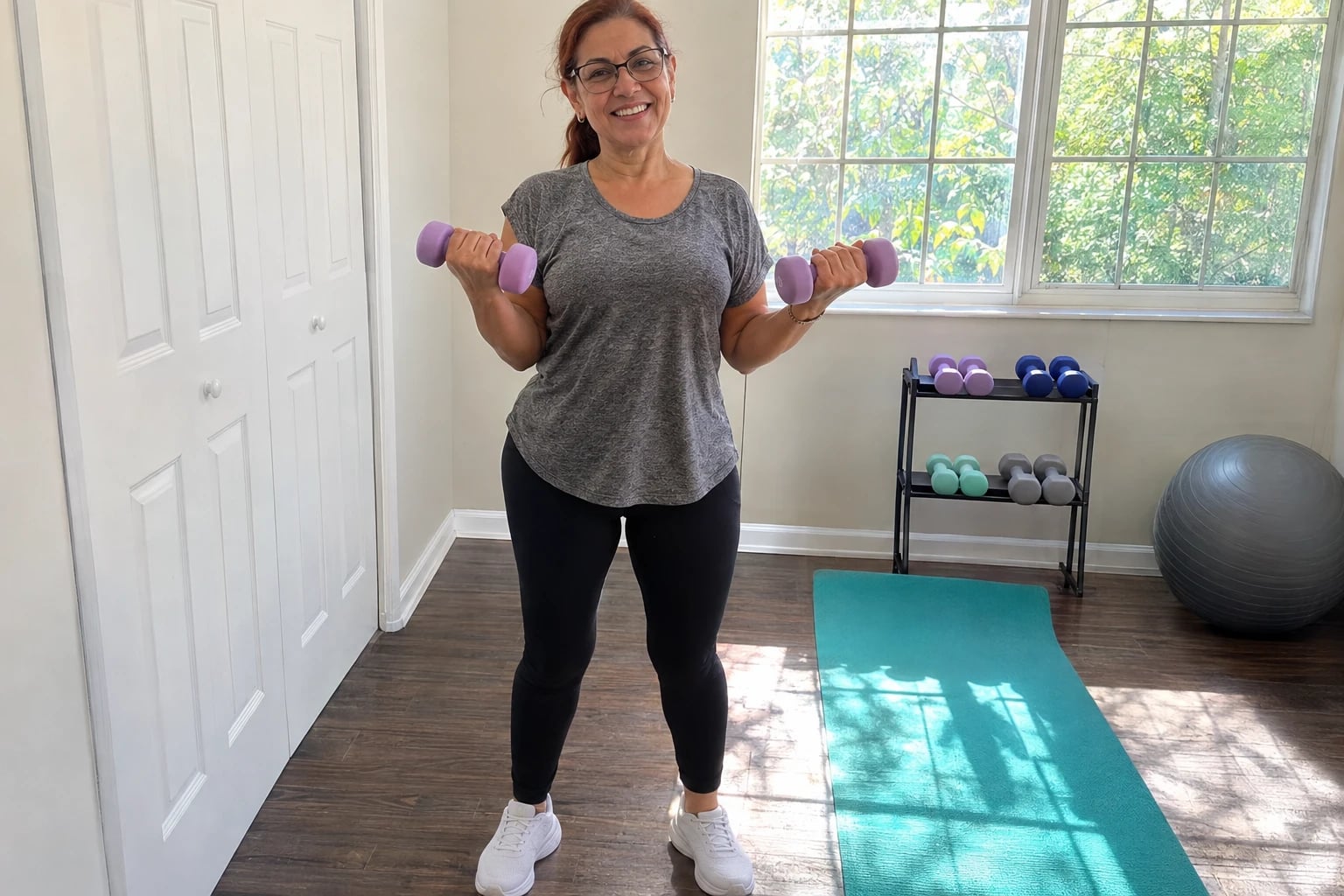
The CDC's activity guidelines call for muscle-strengthening work at least two days a week. That can mean dumbbells, resistance bands, or standing up from a kitchen chair ten times without using your hands.
Time it with a meal. Eating protein close to your workout, before or after, puts it where the muscle can use it.
If you want a trainer, ask how many women past menopause they've worked with, and what they'd have you do in the first week. A good answer starts with your own body weight and gets heavier from there. A bad answer is a number of grams before they've seen you squat.
At home, keep a pair of light dumbbells where you'll walk past them, beside the coffee maker or under the TV stand. Ten curls while the kettle heats adds up.
The bottom line
Start with tomorrow's breakfast. Get it to about 30 grams: two eggs with cottage cheese, or a big bowl of plain Greek yogurt with nuts and an egg on the side.
Then work out your number once, from a weight that fits your height. For most women, it lands between 60 and 100 grams a day, or 20 to 35 grams at each meal.
If you have kidney disease or diabetes, send the portal message before you change anything. Otherwise, add two days a week of lifting, and give it three months.
Up next
17 Plus-Size Office Outfits Over 50 That Actually Look Polished
Seventeen office outfits for a real plus-size body, each with the one fit detail that makes it work, from where a blazer button lands to what a tailor charges.
Read the list →


Reader quiz
Did you catch the details?
5 questions from this article. Finish them all to unlock the editor's bonus tip.
Where does the article suggest you look for your eGFR number before talking to your doctor?
Did any of these feel familiar?
Know someone who needs this?
Sources cited in this article
This article links to 9 outside sources, listed here so you can read them yourself.
- About 50 to 53 grams a day health.harvard.edu/blog/how-much-protein-do-you-need-every-day-201506188096
- 1.2 to 1.6 grams per kilogram medlineplus.gov/ency/article/002093.htm
- 50 to 100 percent above the old minimum nutritionsource.hsph.harvard.edu/2026/01/09/dietary-guidelines-for-americans…
- The menopause transition pmc.ncbi.nlm.nih.gov/articles/PMC12916153
- More likely to have physical limitations pmc.ncbi.nlm.nih.gov/articles/PMC6163522
- 43 percent reached 1.2 grams per kilogram pmc.ncbi.nlm.nih.gov/articles/PMC12419545
- Barely registers www.frontiersin.org/journals/nutrition/articles/10.3389/fnut.2024.1388986/full
- Nutrition shakes www.ncoa.org/article/how-much-protein-do-older-adults-need
- About 3 pounds of lean mass pmc.ncbi.nlm.nih.gov/articles/PMC5622767

Peter Byalik
Food & Home Editor
Peter Byalik is a professional chef with more than 20 years of experience, including years running his own business. He came to the United States from Ukraine.
More from Peter Byalik