27 Things Salespeople Assume About Women Over 50
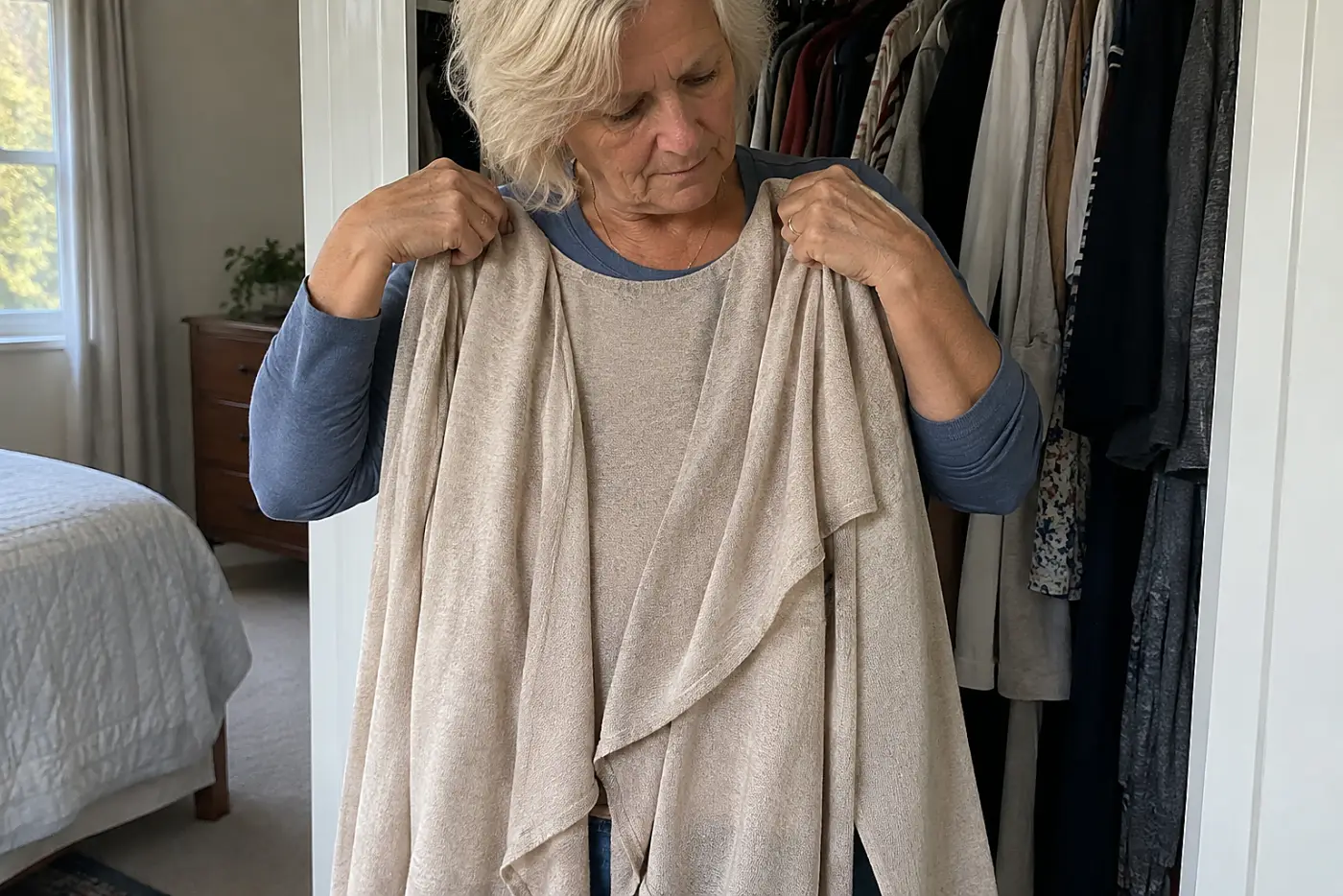
A quick turn toward the back rack makes your age a shopping filter before anyone asks what brought you in.
By Margaret Hale, Travel & Lifestyle Editor
Updated · 19 min read
- Written by our travel & lifestyle editor
- How we review
Read to the end: #1 is a fitting-room request that puts the front rack back in play, and almost nobody makes it.
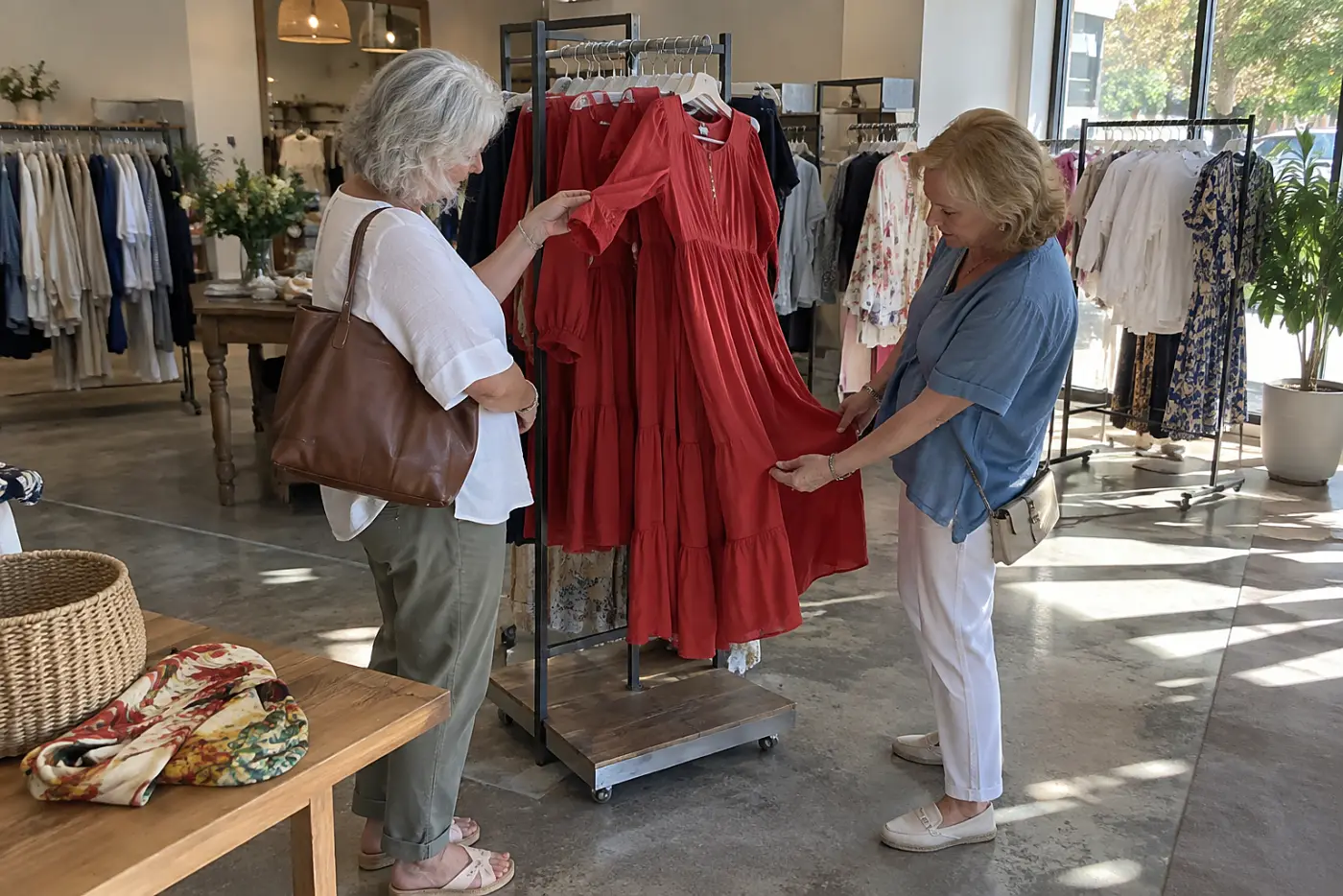
A salesperson points past the bright front display toward a dimmer rack near the fitting rooms. You haven't said your size, your budget, or where you're wearing the dress. Still, the path has been chosen for you, before you've touched a hanger.
The back rack might hold exactly what you want. But the skipped question matters: a guess about your age has replaced your choice, and the front display is still there for you to inspect. You don't need to explain why a red dress caught your eye. You came to shop, and you get to decide what reaches the fitting room.
Here are 27 assumptions to catch before they narrow your choices.
27The back rack before the front display

The first wrong turn happens before you touch a hanger.
A salesperson leads you past the new arrivals without asking what brought you in. Once you've followed, the front display feels like territory you'd have to reclaim. That small detour decides which clothes enter the conversation.
A rack's location tells you nothing about whether its clothes suit you. Skipping a display means you never see its colors, cuts, or fabrics.
Start at the front this week, even if someone points elsewhere. Say, “I want to look through these first.”
Then watch what happens when the assumption moves from place to color.
26The navy dress offered instead of red
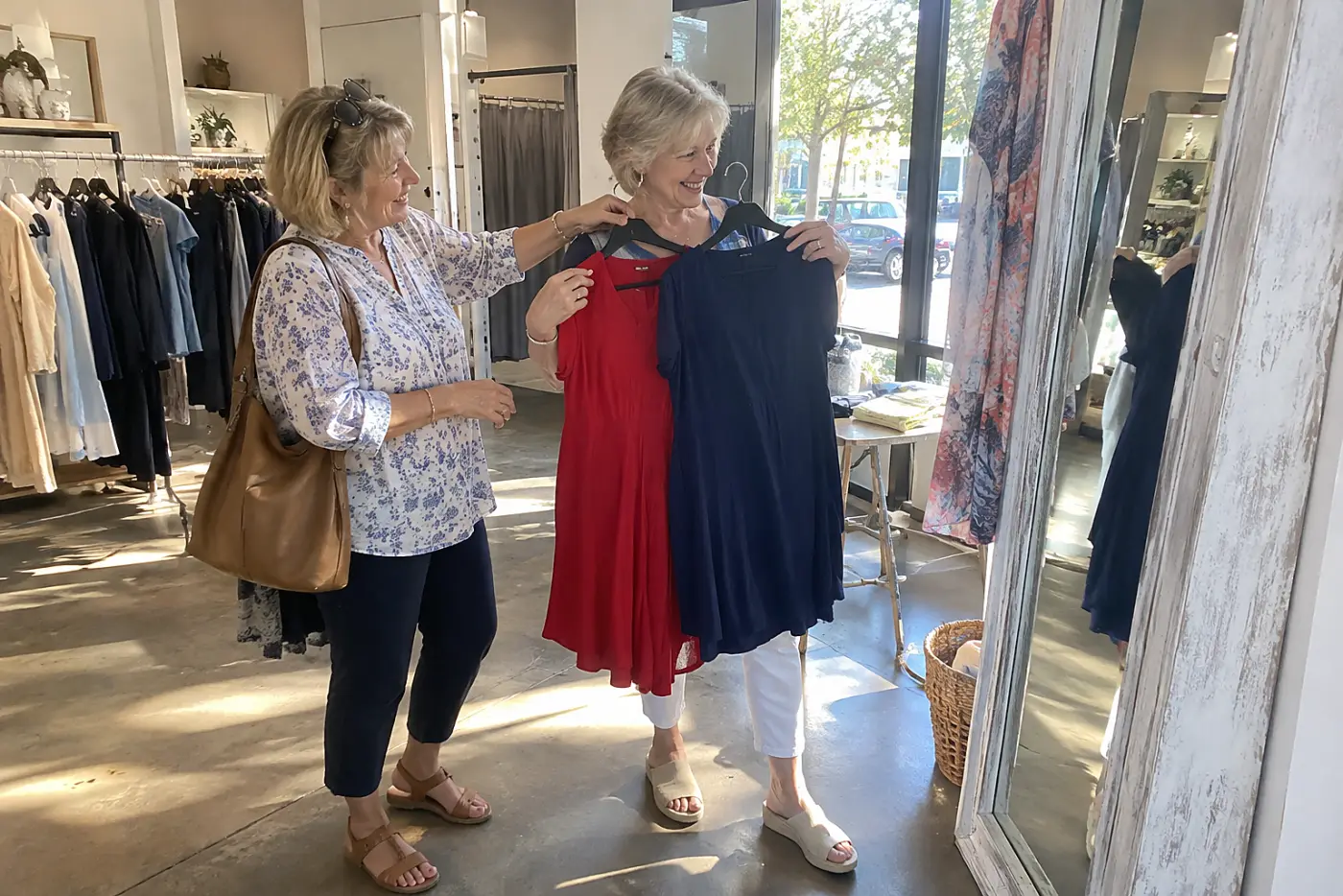
You picked up red. Someone hands you navy instead.
The explanation sounds practical: navy goes with everything. But you came in for red, and the second dress changes the decision before you've tried the first one. A salesperson has answered a question about your taste without asking it.
Colors behave differently beside your face than they do on a hanger. Store lighting changes them again. A color someone labels “flattering” tells you more about their expectation than it does about your reflection.
If you accept the swap without comparing, you leave with the safer choice someone else made. You also miss the chance to see whether the red works with the shoes already in your closet. No color earns a veto without a try-on.
This week, take both dresses to a mirror near the store entrance and stand where daylight reaches you. Say, “I asked for red. Please bring that dress in my size.”
The next guess tends to arrive with a price tag.
25The bargain rack chosen before your budget
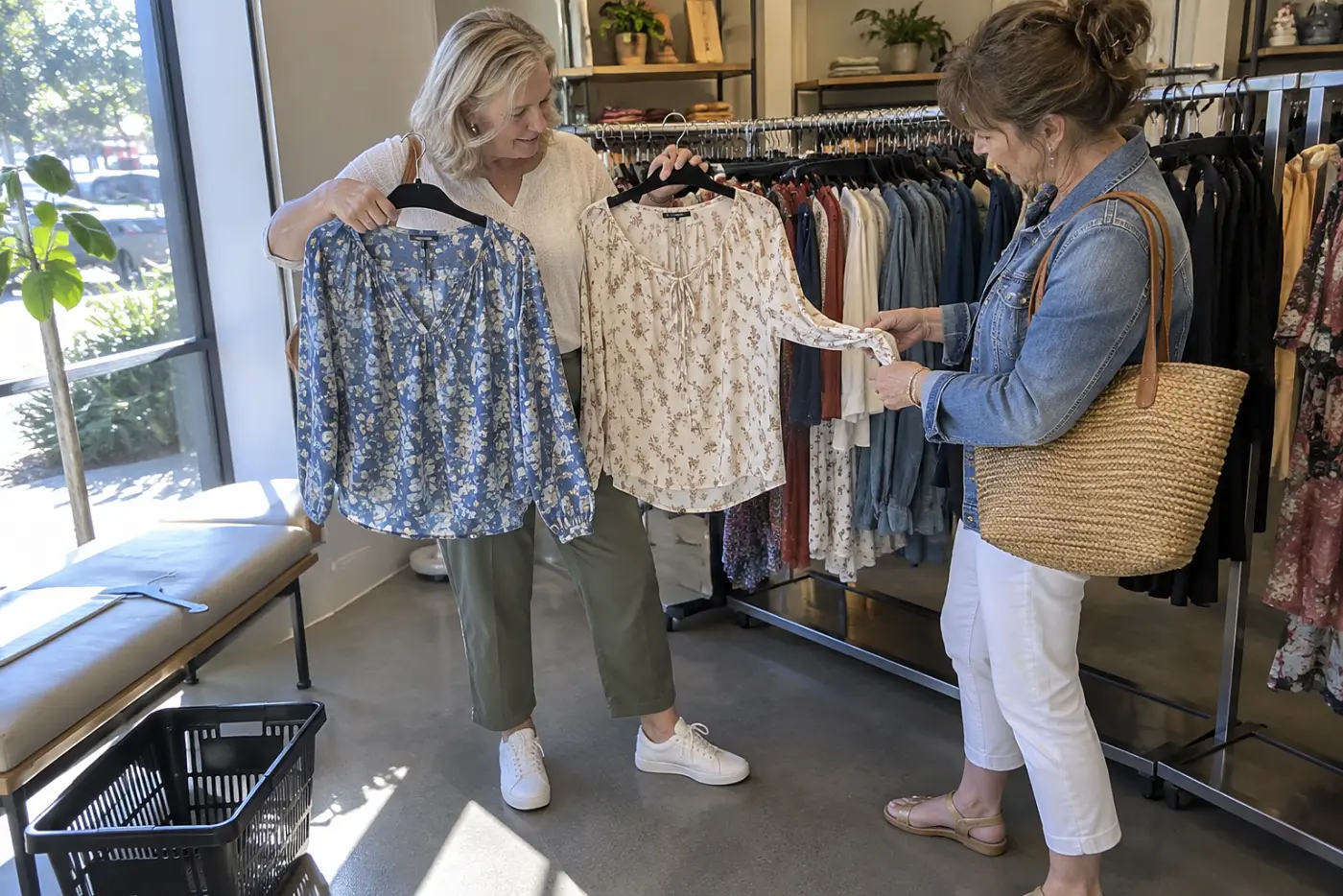
A lower price isn't helpful when nobody asked what you're spending.
Someone steers you toward markdowns before showing you the item you described. Sale stock has fewer sizes and colors because pieces have already sold. The rack narrows your options before you decide what value means to you.
You lose the chance to compare fabric, fit, and care across prices. A bargain that needs costly alterations belongs in a different calculation.
This week, name a range only if you want to share one. Say, “Show me the best match first. I'll decide what to spend.”
Price isn't the only guess hiding in a helpful suggestion.
24The comfort shoe placed in your hands

You ask for dinner shoes. A walking shoe appears.
Comfort matters. So do the outfit, the floor you'll walk on, and the kind of evening you have planned. Handing you a thick sole before showing you the dress shoe makes comfort a verdict about your age.
A shoe's label cannot tell you how its heel sits on your foot. The fit check starts standing up: leave room at the toes, notice any heel slip, and walk on the store's hard floor. A cushioned sole won't fix a heel that lifts with every step.
A shoe bought for an imagined version of your life stays in its box. Worse, pain noticed in the store rarely becomes pleasant after another hour on your feet.
Bring the socks or hosiery you'll wear this week, and try the pair you came for. Say, “I need dinner shoes. Please bring these in my size, too.”
After that, notice whether your size gets treated as a verdict.
23The size tag treated as your limit
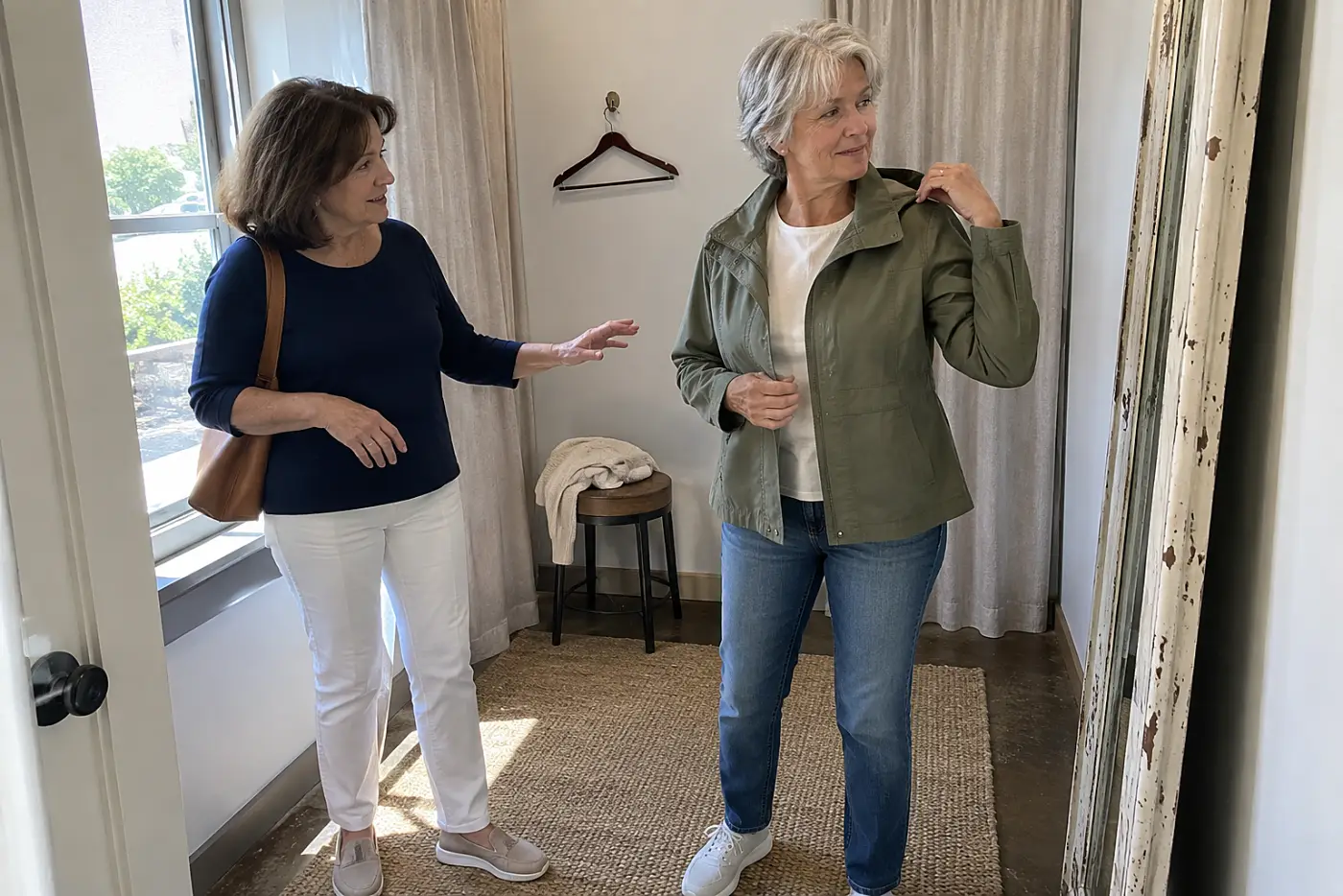
A number on a label can end a search too soon.
Sizing changes between brands and between cuts within a brand. A salesperson who brings one number, then stops, treats the tag as more reliable than the garment on your body.
You lose a jacket that fits because the first size didn't. You also risk buying a poor fit to avoid another conversation.
This week, try the same piece in two nearby sizes and move your arms. Say, “Bring the next size as well. I want to compare the shoulders.”
The tag is only the start; the hanger beside it tells another story.
22The cardigan substituted for a bare arm

The cardigan arrives before you've said a word.
You picked up a sleeveless top. Someone immediately finds a layer to cover it. The pairing serves a purpose if the room is cold, but it changes the outfit before you've seen the top alone.
Stand straight, lift your arms, and look at the armhole from the side. Check whether the fabric gaps and whether your bra shows where you don't want it to. Those are fit questions. Your birth year isn't one.
Adding a cardigan at checkout costs more than the top alone and adds another piece to manage. If you like the top without it, you don't need to buy a layer to justify the purchase.
Try the sleeveless piece alone this week, then add a layer only if you want one. Say, “Let me see this without a cardigan first.”
Next, the covering-up moves from your arms to your knees.
21The longer hem delivered without being asked
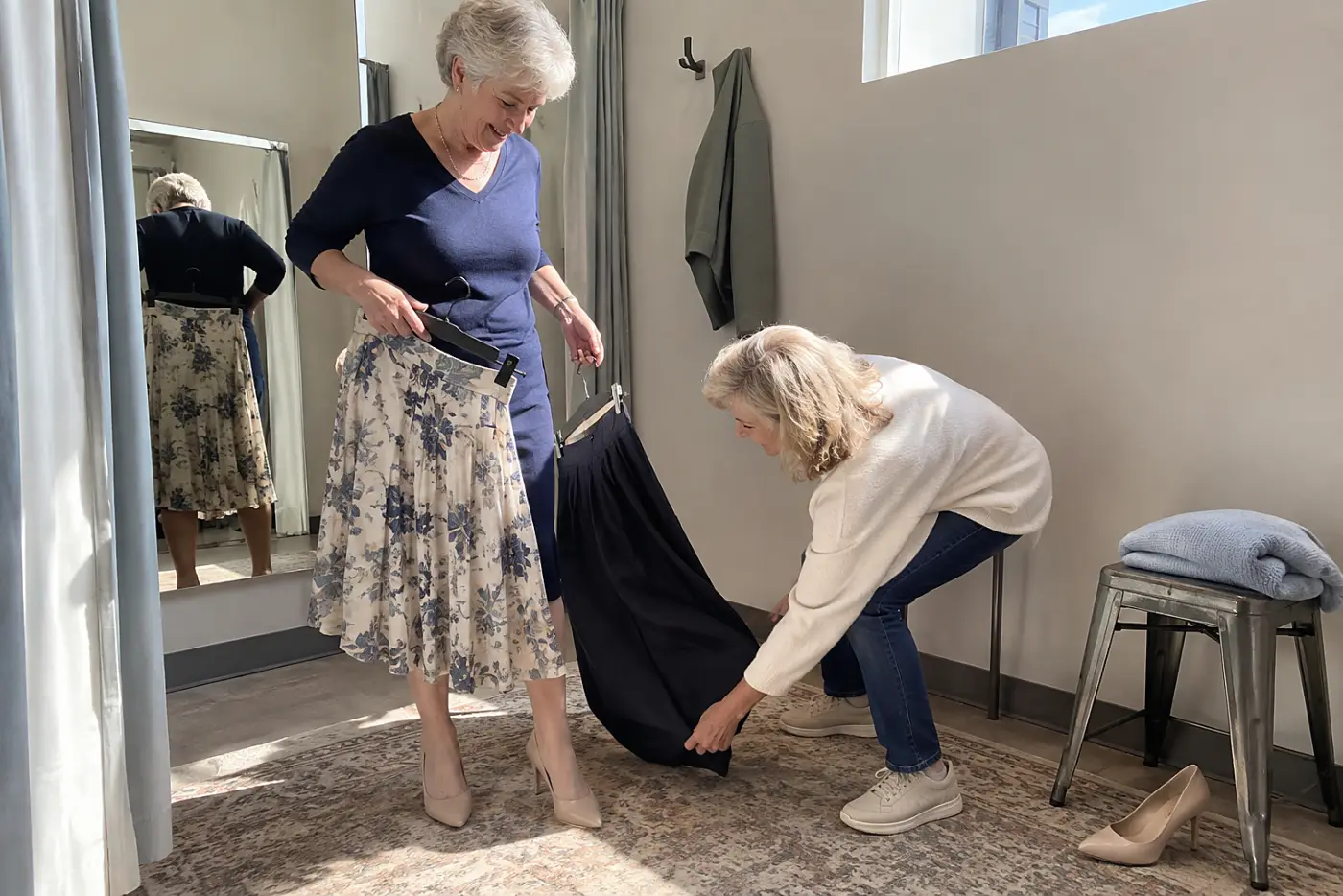
A skirt's length should start with the skirt you chose.
When someone brings a longer version unasked, they replace your decision with theirs. Hem placement changes the outfit's shape, especially with the shoes you intend to wear.
You leave without testing the shorter skirt's actual fit. The mirror, not a stranger's rule, settles where the hem falls on you.
Bring your intended shoes this week, or wear a pair with a similar heel. Say, “Please bring the shorter skirt, too. I want to see both.”
The same shortcut appears when a print comes off the hanger.
20The small print replacing your chosen pattern
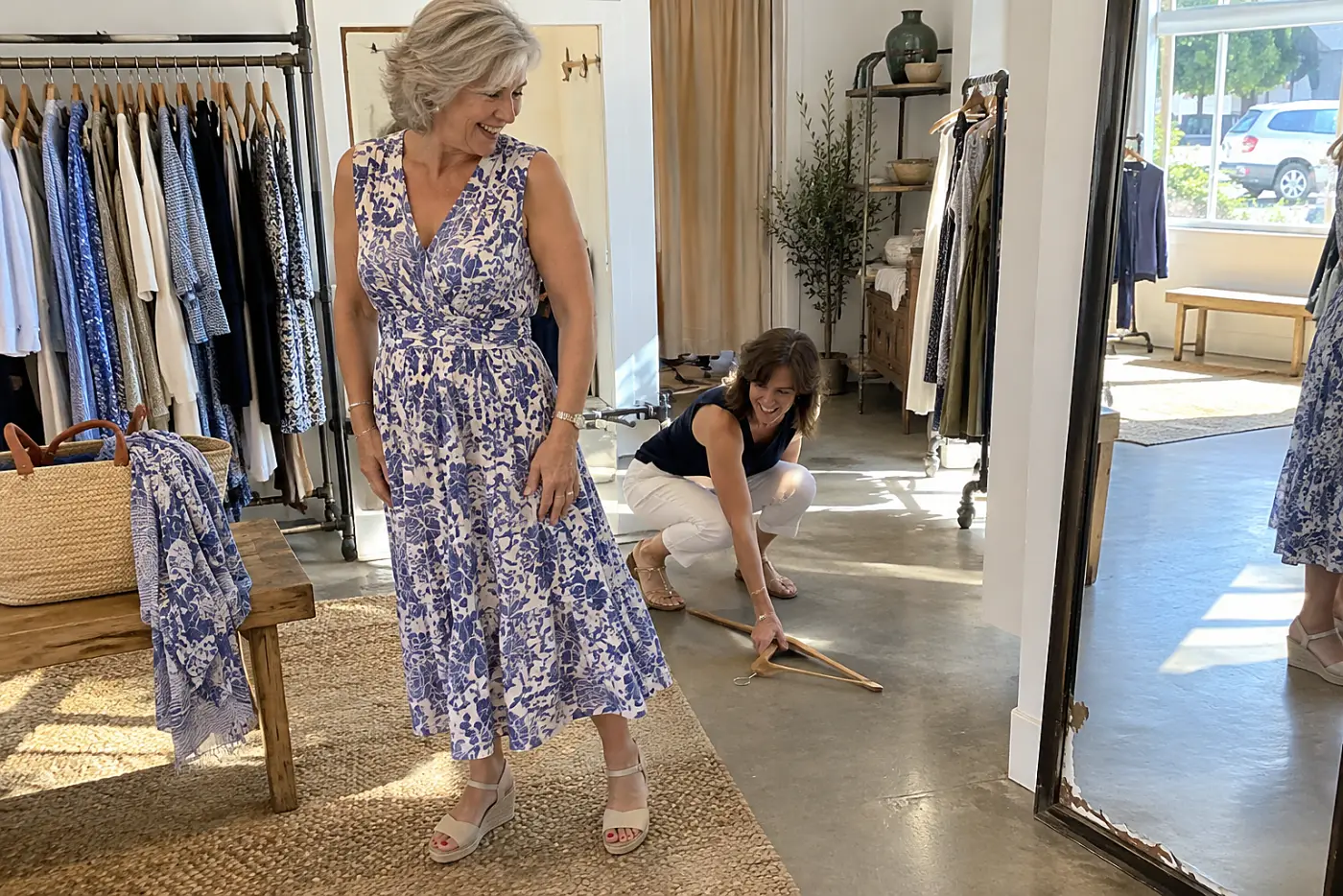
The bold print stays on the rack while a tiny floral arrives.
A salesperson calls the smaller pattern easier to wear. But print size changes when fabric wraps around your body, and a hanger shows only a flat slice. The substitute gets a try-on before the piece that caught your eye.
Step back from the mirror and look at the full garment. Then move close enough to check where the seams cut through the design. Compare the print while you're wearing it, not while someone holds it up.
The substitute costs you a fair look at what drew you into the store. If the bold print works, you shouldn't have to defend wanting to be seen in it.
This week, take the original print into the fitting room before considering alternatives. Say, “I want to try the one I picked up.”
And if the print is right, someone else might still choose its neckline for you.
19The high neckline brought without a request
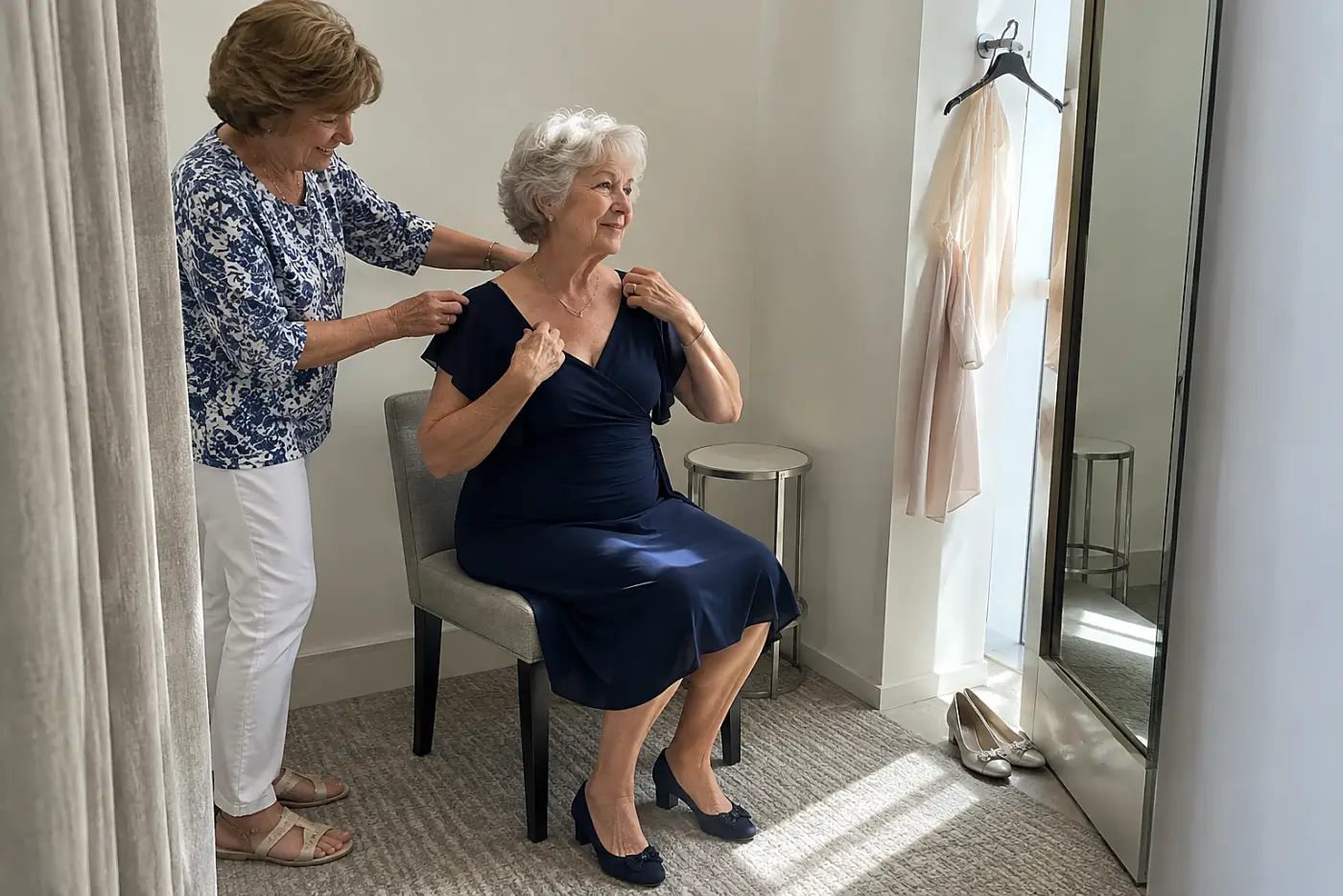
A raised neckline changes how a dress sits on your shoulders.
Someone hands you a higher-cut version after you point to an open neckline. The replacement changes the line of the outfit before you know whether the first dress fits.
You miss the dress you asked to see. Necklines also change which bra works underneath, so test them with the one you'll wear.
Try the original dress this week and check the neckline while sitting and standing. Say, “Please bring the neckline on the display dress.”
A mirror check helps more than another rule about what to hide.
18The fitting-room light used as a verdict
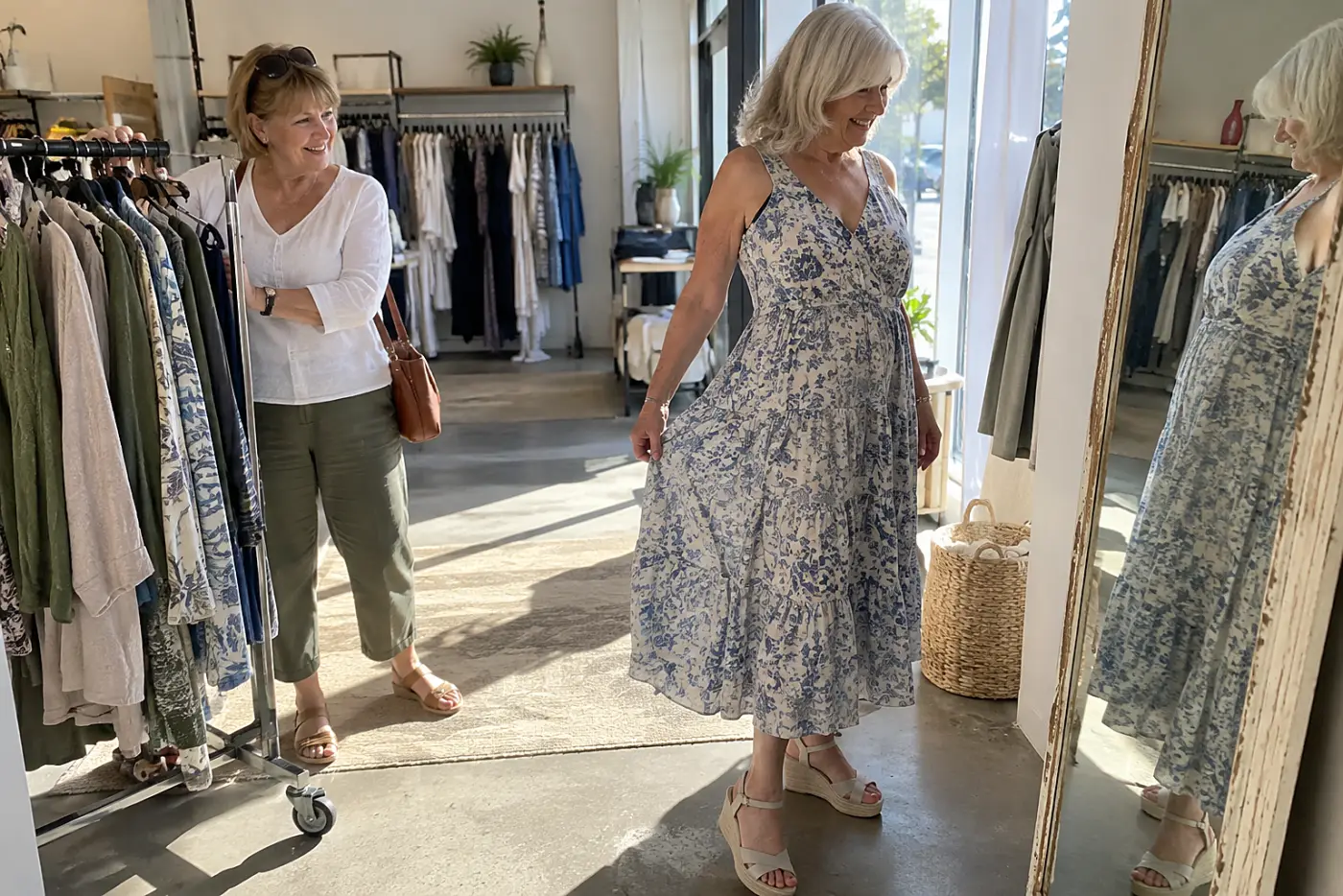
Harsh overhead light puts shadows where the dress has none.
Those shadows cross your face and change how you judge a color. Meanwhile, a salesperson praising a “flattering” shade from the doorway sees the same poor light you do. Separate what the ceiling does from what the garment does.
Look at the fit under the room light, then step toward a brighter mirror if the store has one. Pay attention to pulling, gaps, and how the fabric hangs. Those details travel home with you; the fluorescent ceiling doesn't.
Rejecting an item because of bad light leaves the fit question unanswered. Buying one because the light flatters it creates the opposite problem.
This week, take a second look outside the fitting room before paying. Say, “I'd like to see this by the front mirror.”
Once you're there, check who has been making the comparison for you.
17The matching set assembled before you choose

A coordinated set can solve a problem you never had.
Someone pairs the top you like with matching pants and calls it an outfit. The pairing directs your attention away from the piece you chose and toward a larger purchase.
You risk paying for pants that duplicate a pair at home. Matching in the store doesn't prove both pieces earn closet space.
This week, photograph the top alone and compare it with three things you already own. Say, “I'm deciding on the top first.”
The register has its own way of adding an extra item.
16The shapewear suggested beside the register
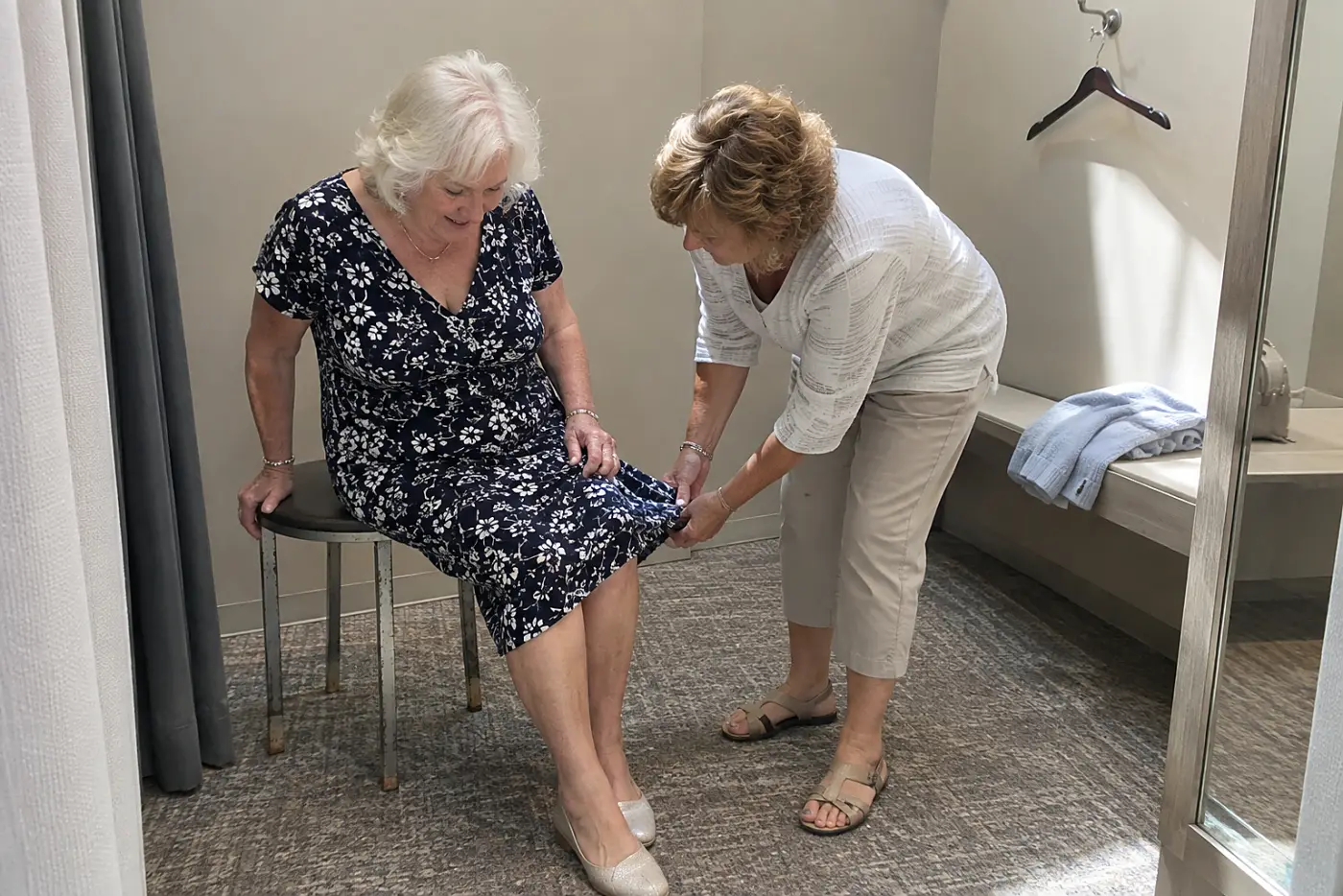
The dress fits until someone offers shapewear to fix it.
An undergarment appears after you've said the dress fits. Suddenly the dress seems incomplete without it. Shapewear changes how fabric lies, but so does the right size or a different cut.
Try a dress with the underwear you plan to wear. Sit down, breathe, and turn sideways before judging the fit. If a sales pitch creates a problem you hadn't noticed, look again.
Buying another garment to rescue a poor fit raises the cost and adds a wash-and-care step. A dress that works only with a layer you dislike won't get much use.
This week, make your decision on the dress before considering anything from the register display. Say, “I want to judge the dress without adding another piece.”
That extra layer leads to a bigger question about the fabric itself.
15The wrinkle-free label offered as a solution
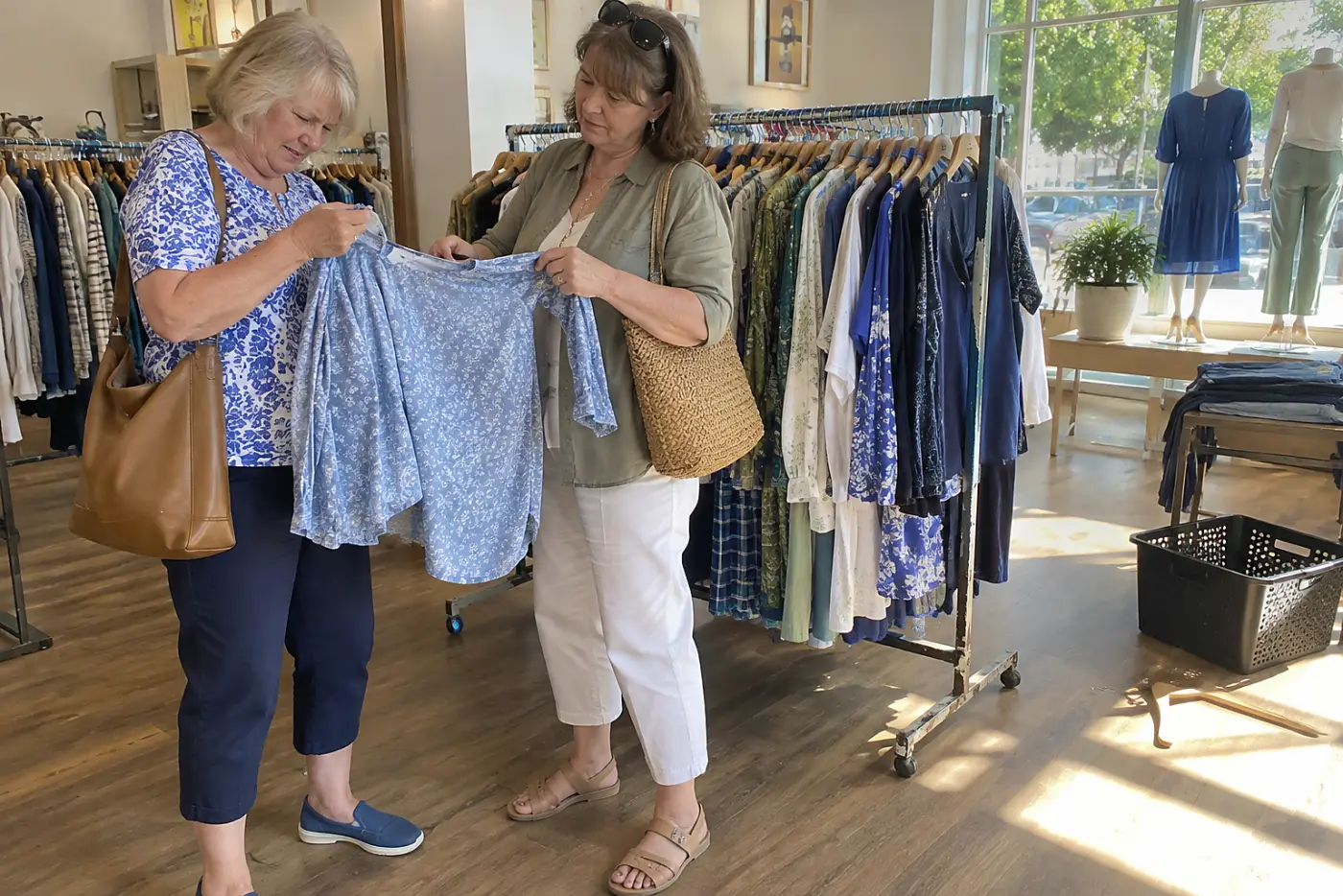
An easy-care label doesn't tell you how the fabric feels.
A salesperson points to a wrinkle-free blouse before asking how you wear or wash clothes. Care instructions matter, but they don't replace the feel of the fabric against your skin.
You bring home a blouse you'll avoid because it feels stiff. The sewn-in care label gives you better information than a sales description.
This week, read that label and rub the fabric between your fingers. Say, “Show me the other fabric in this cut.”
The next assumption concerns how much attention you want from what you wear.
14The statement necklace left behind the counter

The necklace you pointed at stays behind the glass.
A salesperson shows you smaller pieces instead, then waits for you to choose. The case shapes what gets touched, and the smaller pieces now have an advantage you never gave them.
If you can't hold the bright necklace against your top, you can't judge its length, weight, or clasp. Ask to try it before discussing whether it suits an occasion. Your outfit and your neck make that call.
A clasp you cannot manage alone turns a beautiful purchase into a drawer piece. A chain that catches on your collar will annoy you long after the salesperson forgets the sale.
This week, point to the exact necklace you want to see and fasten it yourself. Say, “I'd like to try that one. Please set it on the counter.”
The case isn't the only place where choices stay out of reach.
13The handbag stored on the upper shelf

The bag you noticed stays on a shelf above your reach.
A salesperson offers a smaller bag below it without taking yours down. You cannot judge the strap, weight, or opening from across the aisle.
You leave with no idea whether the bag you wanted fits your daily things. A photo won't answer that question.
This week, ask to hold it, then put your wallet and glasses case inside. Say, “Please take down that bag. I want to try the strap.”
What fits inside matters as much as who the salesperson imagines carrying it.
12The crossbody strap dismissed as too casual
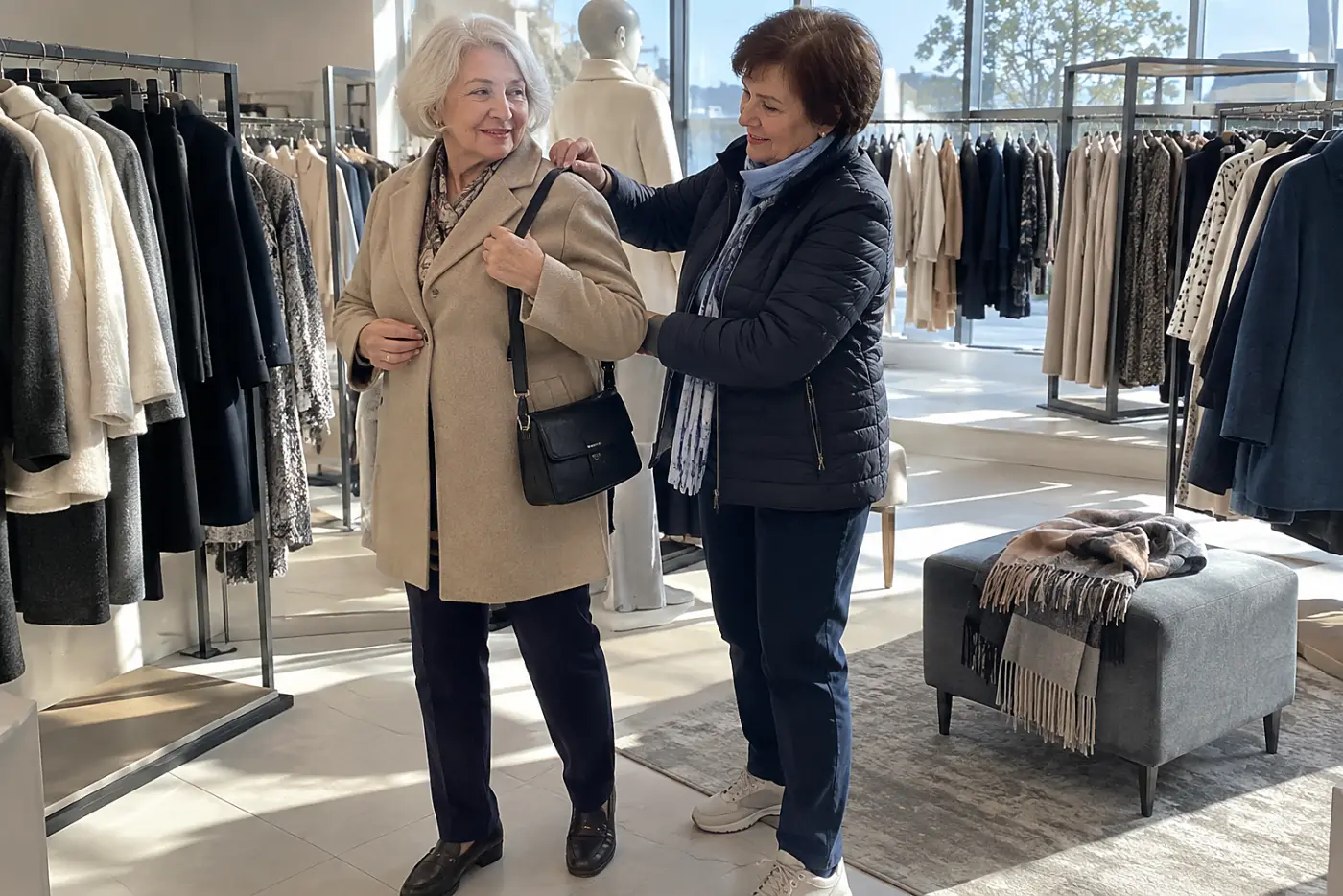
The crossbody you asked for gets replaced by a handbag.
A salesperson offers a short-handled purse for a “dressier” look. That swap changes how you'll carry your keys, phone, and wallet. The label says nothing about where you need your hands during the day.
Strap length is a physical test, not a style ruling. Put the bag across your body with a coat on if you'll wear one. Reach for the zipper with one hand. Check whether the bag swings or rests where you want it.
Buying the wrong strap means carrying a bag you won't reach for. A lovely purse left at home helps no outfit.
Bring your coat this week and test the crossbody you chose. Say, “I need to see how this sits while I'm wearing it.”
The next sales pitch concerns the age of the clothes, not the person wearing them.
11The trend piece passed over for a classic
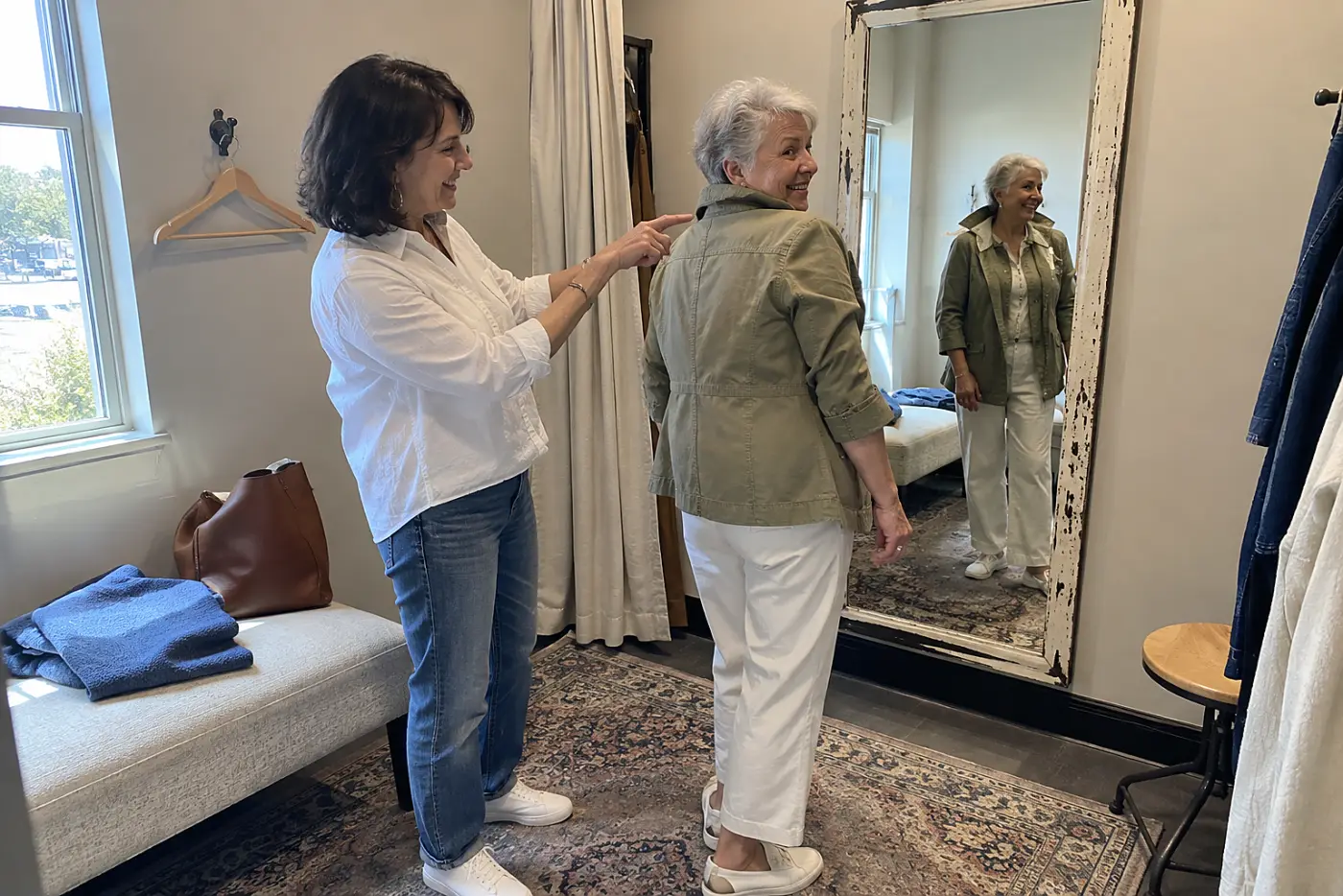
The new cut disappears before you get to try it.
A salesperson pulls a familiar jacket instead of the trend piece you pointed out. “Classic” describes a style; it doesn't describe your taste. The window jacket remains untested while someone else decides which cut belongs in your closet.
You miss a cut that could work with clothes you already own. The hanger cannot settle whether its proportions suit you. Look at the shoulder seam and sleeve length once the jacket is on, then turn to see the back.
This week, try the newer shape with your own jeans or shoes. Say, “Bring the one from the window, please.”
Once it reaches the fitting room, another person might claim the final vote.
10The companion asked for your opinion
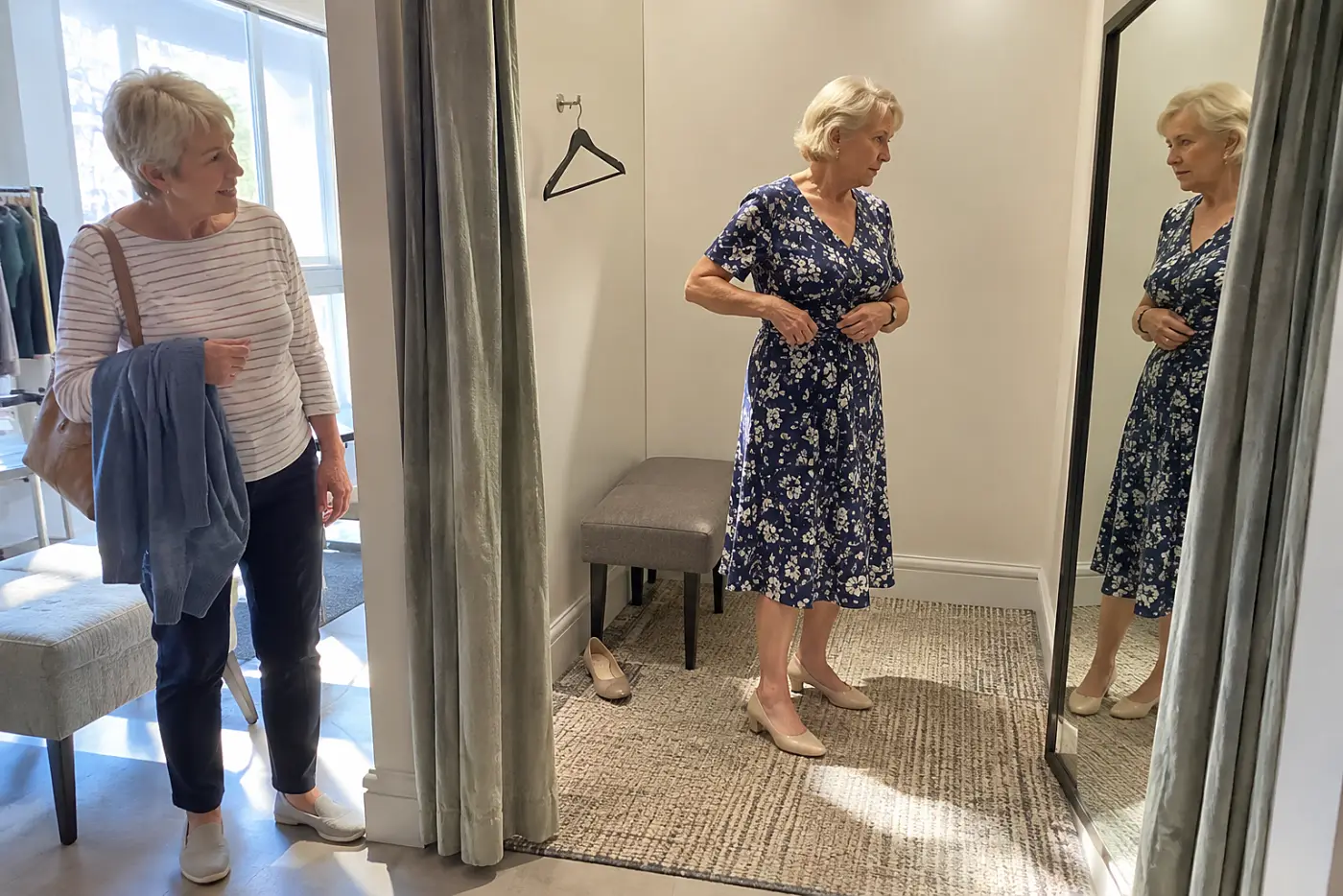
The salesperson asks your friend while you're wearing the dress.
An extra opinion has a place when you invite it. Without that invitation, the conversation moves away from your comfort, taste, and wallet. Your companion sees the outfit from outside, while you know how it feels when you sit or walk.
If you let someone else answer first, their reaction can crowd out your own. Then the dress becomes a vote instead of a choice.
This week, take a moment alone at the mirror before asking anyone. Say, “I'll decide how it feels first, then I'll ask her.”
That matters even more when the shopping trip isn't for you.
9The gift box chosen for your daughter

A salesperson assumes the earrings you're studying are a gift.
That question sounds harmless until it shifts attention to someone else's taste. Now you're discussing wrapping instead of how the earrings feel in your own ears.
You risk passing up a pair because the sale has been framed around another person. Check the backs and weight before deciding.
This week, try the earrings yourself and look in a full-length mirror. Say, “They're for me. I'd like to see them on.”
The next assumption is about where you'll wear what you buy.
8The occasion outfit sized for one dinner
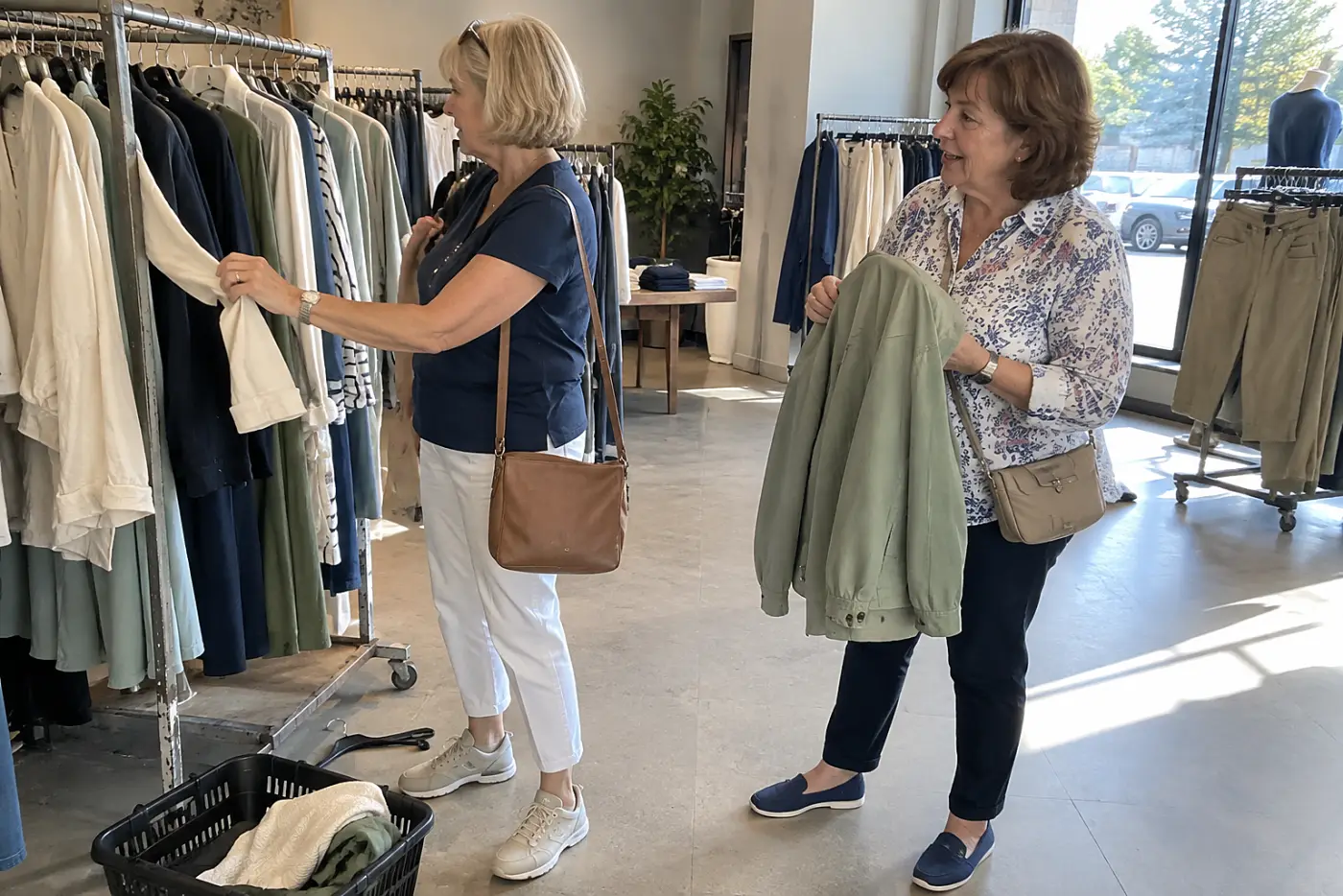
The formalwear rack becomes your whole calendar.
You ask for something to wear to an event. A salesperson treats the outfit as a one-night purchase and heads straight for formalwear. That skips what you already own and what you'll wear afterward.
A jacket you can wear again with trousers earns a different place in your closet than a piece that works with only one dress. Try the outfit as separates, then look at each piece on its own.
One-night thinking turns your budget into a deadline. It also encourages purchases that need shoes, a bag, and a layer you didn't plan to buy.
This week, bring a photo of two things already in your closet. Say, “Show me what works for the event and what I'll wear afterward.”
The same narrow thinking can show up in the accessories.
7The sensible watch offered instead of jewelry

A watch appears when you asked to see bracelets.
Both go on your wrist, but they serve different purposes. A salesperson who replaces one with the other has stopped listening to the request.
You leave without checking the bracelet's clasp or how it stacks with pieces you own. Those details decide whether you'll wear it.
This week, bring the watch or bracelet you already use and compare them at the counter. Say, “I'm looking for a bracelet, not a watch.”
Even when the right piece appears, the label on it deserves a look.
6The leather label taken at face value
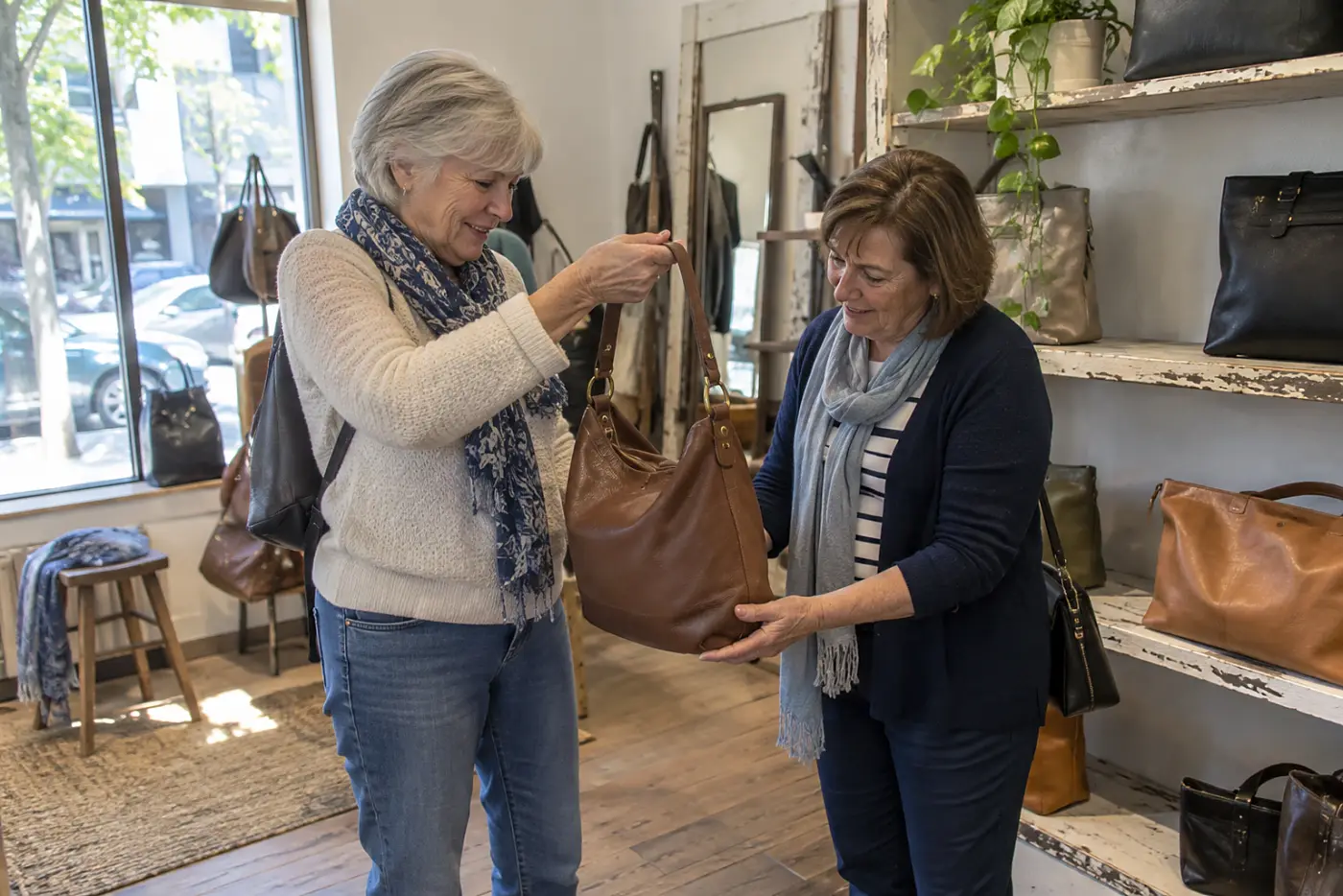
“It's leather” ends the explanation before you've seen the tag.
A salesperson moves straight to the mirror, as though a quick description settles the purchase. But a bag has a body, trim, lining, and strap. Check the product description for each part rather than treating the whole bag as one material.
Look where the strap joins the bag, then run your hand along the seams. A polished display tells you little about construction. The FTC's leather goods guidance is worth a look when a material claim on a tag puzzles you.
If you pay for a material you misunderstood, the disappointment follows you home. The care instructions matter, too: a bag that needs treatment you won't do is the wrong bag.
This week, turn the bag inside enough to find its materials tag. Say, “Which parts are leather, including the strap?”
After materials, the most revealing label is the one on the receipt.
5The return window left off the receipt

A warm “It looks wonderful” doesn't replace a return policy.
The receipt or store policy sets the conditions for a return. Final-sale terms, tags, and proof of purchase matter more than the salesperson's confidence at checkout. Don't assume a recommendation comes with a promise to take the item back.
You lose options when you discover a restriction after trying the item at home. The FTC's shopping and returns guidance is a reminder to check a seller's terms before buying.
This week, read the posted policy and keep the receipt until you've tried everything with your own clothes. Say, “Is this item returnable, and what do I need to keep?”
A good return plan still leaves one question about getting the fit right.
4The alteration pinned without your shoes
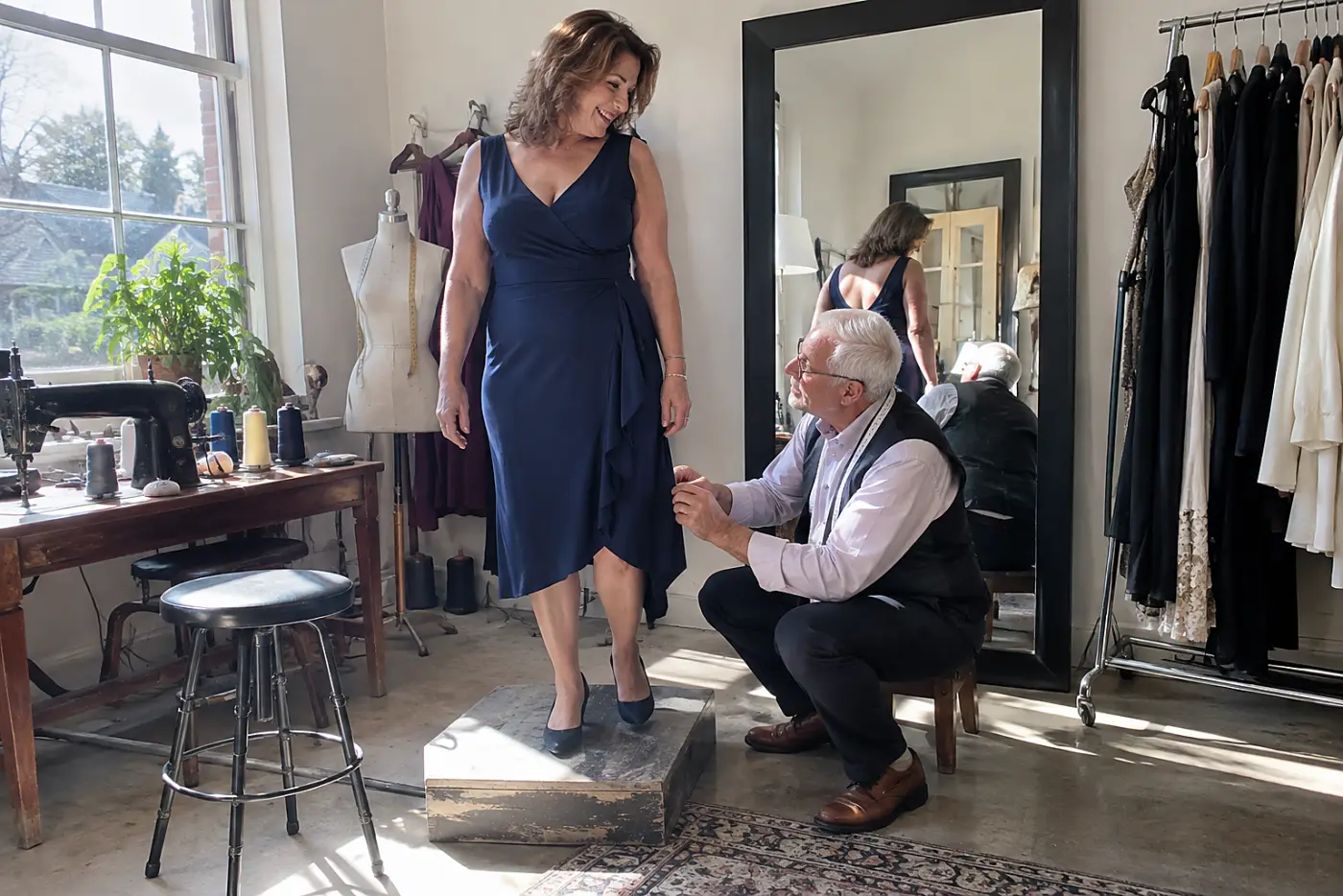
The hem gets pinned while you're wearing the wrong shoes.
You'll wear the outfit with heels, but the fitting-room flats are still on your feet. The distance from fabric to floor changes with your shoes and your posture. Before a tailor pins, put on the pair you intend to wear.
Stand normally, then walk and sit. Decide what length works in all three positions. Don't accept a pin placed for a life you'll never wear the outfit in.
An alteration changes the garment. Once fabric is cut, checking the original length comes too late. Ask about the work and the price before leaving the item.
Bring your event shoes this week if you're having a hem marked. Say, “Please pin this while I'm wearing these shoes.”
A better fit doesn't require you to accept every add-on.
3The loyalty sign-up delaying your purchase
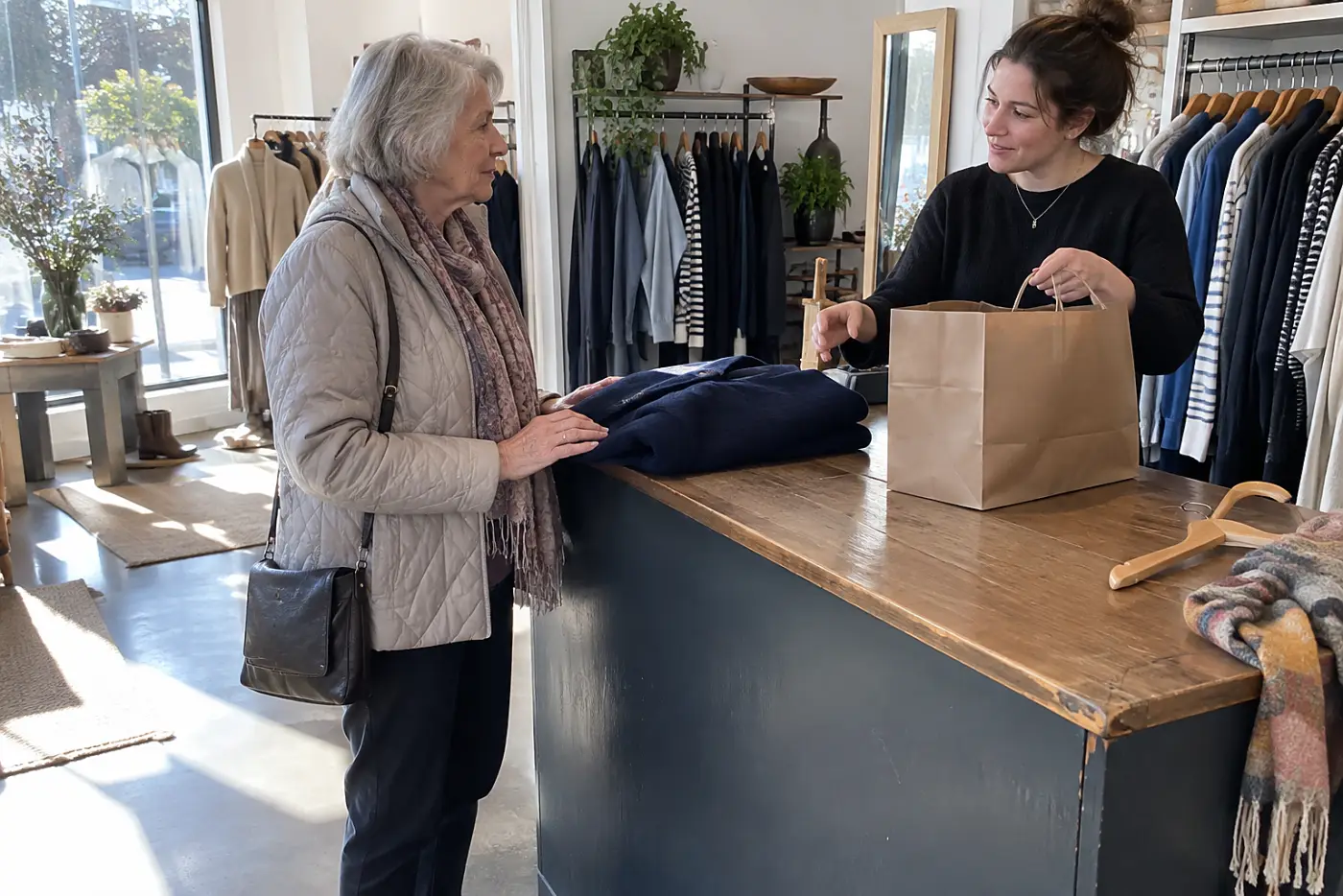
Your phone number becomes a question before the price does.
A cashier treats enrollment as the next step in buying your shirt. Store accounts and marketing lists are separate decisions from the purchase. Hear what you're signing up for before giving your details, especially if the cashier promises a discount.
You lose time sorting messages you never wanted. More importantly, you risk agreeing to terms you didn't read. The FTC's advice on unwanted calls is worth keeping if the marketing follows you home.
This week, pause at the register and ask what enrollment includes. Say, “I'll buy the shirt without signing up.”
Then take that same pause back onto the sales floor.
2The salesperson answering a question you never asked

Your stock question turns into advice about your body.
You ask whether a jacket comes in another color. The answer becomes a speech about slimming cuts. That leap replaces a stock question with a judgment about your shape.
Bring the conversation back to inventory. If the color isn't there, ask whether the store has another location or an online listing for the same jacket. The product name or tag gives both of you something precise to search.
Without a direct answer, you waste a fitting-room trip or abandon the piece you wanted. Neither outcome tells you whether the jacket exists in your color.
This week, repeat the exact product question until it gets an answer. Say, “I mean this jacket in green. Is it available?”
Now use the same directness at the fitting-room door.
1The fitting-room ticket with your first choice
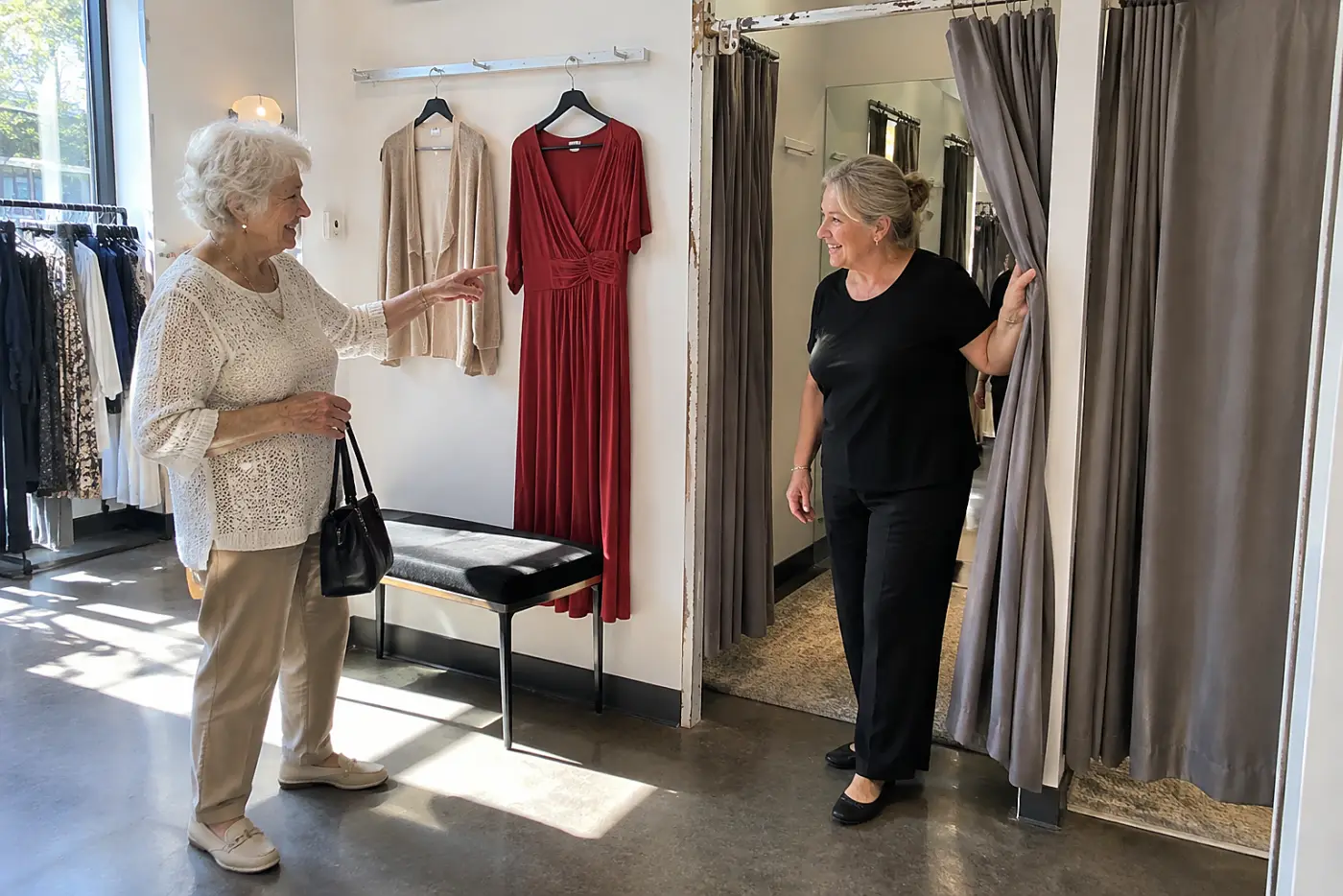
A substitute wins when your first choice never reaches the fitting room.
At the fitting-room door, the attendant sorts garments and counts what goes in. That pause is your chance to name the front-rack dress before anyone fills the room with alternatives. If you left it on the rack, point it out before trying a substitute.
Ask for the dress in your size and have it brought with the pieces already in hand. Check the store's fitting-room limit before adding anything else. An alternative belongs in the comparison only after you've tried the dress that drew you in.
Without that step, you judge a substitute against a memory of a hanger. You never learn how your first choice fits, moves, or looks with your shoes.
This week, name the front-rack item at the fitting-room door. Say, “Please bring that red dress in my size first. I'll try alternatives after it.”
The next store will have a different rack and the same moment at its door.
The bottom line
The pattern is a choice made for you before anyone asks what you want.
You already know what you came to see, try it before accepting substitutes, and check the terms before paying.
When has a salesperson steered you past the item you came for?
Bonus: The fitting-room request that puts the front rack back in play
- Point out the front-rack item at the fitting-room door.
- Say, “Please bring that exact dress in my size first.”
- Check the room's garment limit before adding alternatives.
- Try your first choice with the shoes or layer you brought.
- Only then ask to compare another color, cut, or size.
Margaret Hale
Travel & Lifestyle Editor
Margaret has covered travel for 25 years and has ridden every long-distance train route in the U.S. at least once.
You might also like