26 Fights Siblings Have Over a Parent's Care, and How They End
A pharmacy receipt makes an invisible errand visible; a written deadline keeps the next errand from landing on you by default.
By Margaret Hale, Travel & Lifestyle Editor
Updated · 16 min read
- Written by our travel & lifestyle editor
- How we review

Read to the end: #1 is an unclaimed-task protocol that stops silence from assigning you another job.
The pharmacy bag is still on your passenger seat when your brother texts, “How’s Mom?” You spent the morning sorting her pills, calling the insurer, and finding a ride to Friday’s appointment. His message lands while you’re outside the grocery store with cold food in the trunk.
You assume he sees the work and chooses to leave it to you. He sees the appointment but misses the calls, forms, and hours around it.
These 26 fights begin in that gap.
26The group text after every appointment

A cheerful update can hide an entire workday.
When you send a neat summary, siblings see the result. They miss the ride, waiting room, and calls afterward. Then the next appointment arrives with your name attached by habit. A family thread reports what happened without showing what it took.
The missing hours matter when someone claims the work is already shared. An update alone gives that sibling no reason to check the next date.
This week, add travel and follow-up time to the appointment update. Include who arranged the ride. Say, “I’ll send the appointment details; who’s taking the drive next Tuesday?”
If nobody answers, the distance between seeing a task and doing one gets clearer.
25The sibling who lives across the country

Distance turns into an excuse when nobody assigns remote work.
The sibling in another state cannot drive to the clinic. That sibling still has a phone, an internet connection, and a calendar. Insurance calls, bill tracking, and meal orders don't require a local address.
If you handle every call too, geography has become your second job. This week, send one remote task with a due date: “Please call the insurer about this claim by Thursday and tell us what they say.”
That answer tells you whether the obstacle is distance or willingness.
24The canceled shift you paid for

Time off work disappears from the family accounting.
An appointment moved to Wednesday still costs you the shift you rearranged for Tuesday. A sibling sees one visit. You absorb two schedule changes. That gap fuels the claim that everyone is doing what they can.
The Family and Medical Leave Act provides unpaid, job-protected leave for eligible workers caring for a parent with a serious health condition. Check eligibility with your employer before counting on it.
This week, record missed shifts beside care tasks. “I changed work twice for this visit; who can take the next appointment?” Ask for an answer before changing another shift.
The next dispute starts when someone says they already helped.
23The grocery receipt on your fridge

Small purchases become invisible when you never submit them.
Milk, batteries, and a replacement shower mat come out of your wallet because you're already at the store. A sibling remembers a larger check they wrote. Neither of you sees the other's full list, so both call the spending even.
That disagreement leaves you paying for the next small item. Without receipts, the conversation turns into competing memories instead of a list anyone can check.
This week, keep Dad's receipts separate from your shopping. Total them before the next money conversation. Say, “I paid for these items for Dad; how are we tracking care costs from now on?”
The money argument gets sharper when the payment comes from Dad's account.
22The check written from Dad's account

Access to an account does not settle who controls it.
A joint account, a power of attorney, and permission to use a debit card are different things. Each leaves a different record of who moved money and why. When a sibling questions a payment, “Dad wanted it” won't replace a receipt.
The Consumer Financial Protection Bureau's Managing Someone Else's Money guides describe recordkeeping duties for people handling another person's finances. Keep Dad's money separate from your own.
This week, gather account records and the document giving you authority. Tell the family, “Every care payment will have a receipt and a note about what it bought.”
That record still won't answer whether Dad agreed to the purchase.
21The conversation held outside Mom's room

Leaving Mom out invites siblings to speak for her.
A hallway talk feels efficient when everyone is tired. Then one person reports what Mom “really wants,” and another recalls a different answer. Her preferences disappear beneath arguments about who knows her best.
The National Institute on Aging has guidance for starting advance care planning talks. This week, ask Mom what she wants discussed with everyone present: “Would you rather tell us together, or choose one person to relay it?”
If she names someone, the next question is what authority that person has.
20The health care proxy in a drawer

A document nobody can find won't stop a fight.
When a parent cannot make a medical decision, the care team needs to know who has legal authority. Siblings arguing at the bedside cannot vote a proxy into place. Document names and rules vary by state; check your state's requirements.
A health care proxy concerns medical decisions, not control of a checking account. Confusing the two puts the wrong person in the wrong conversation.
This week, locate the signed document and ask the hospital or clinic how to provide a copy. Say, “Who should receive this form so the care team knows whom to call?”
The name on the form still has to reach the right phone.
19The missed call from the discharge nurse

One unanswered phone call sends the work back to you.
Hospitals need a contact when discharge plans change. If your number is the only one in the chart, you become the person finding a ride. You collect the instructions too. A sibling listed in the family text is invisible to the hospital's contact list.
That gap costs time when discharge moves ahead. You face a pickup with no warning while everyone else waits for your update.
This week, ask your parent to confirm who the hospital should contact, then ask staff which numbers are listed. Say, “Please read back the contact list so we know whose number you have.”
The call list matters most when nobody understands the instructions.
18The discharge papers on the kitchen table

Homecoming begins before anyone has read the instructions.
The papers name medicines, follow-up visits, equipment, and warning signs. A sibling who offers to “help when needed” has no idea which job starts tomorrow. You end up reading the packet and doing the tasks.
For a person with Medicare, the Medicare discharge planning checklist lists questions to ask before leaving the hospital. Use it alongside the actual discharge instructions.
This week, photograph the instruction pages and ask siblings to take specific follow-up jobs. Say, “I'll handle the prescription pickup; who is booking the visit?”
One line in that packet can start a separate money fight.
17The rehab bill nobody expected

A rehab stay doesn't mean every day is covered.
Medicare's skilled nursing facility benefit has conditions. An inpatient hospital stay and skilled care requirements matter. Time spent under observation status does not count as an inpatient stay. A sibling hears “rehab” and assumes the bill is settled.
Check Medicare's skilled nursing facility coverage page before agreeing on a payment plan. This week, ask the facility, “What is the current daily private-pay rate, and what coverage has been confirmed?”
The next bill has nothing to do with rehab.
16The home aide schedule full of gaps

Paying for help doesn't fill every hour.
An agency schedule shows when the aide arrives and leaves. It doesn't assign early breakfast, evening pills, or a missed shift. When siblings say you've hired help, they erase the hours around it.
Ask the agency who handles a missed shift and how it notifies the family. Get its current rates and minimum visit rules in writing before anyone promises to cover the cost.
This week, mark each uncovered hour on a weekly calendar. Tell your siblings, “The aide leaves at four; who is covering dinner on Friday?”
That calendar also shows what happens overnight.
15The overnight call you always answer

A shared phone number still leaves one person awake.
If your parent calls several children, the first one to answer becomes the default. Everyone else wakes to a message saying the matter was handled. The sleep you lost never appears on a care schedule.
By morning, another sibling sees a resolved problem. You start the day tired, with the next call still likely to reach you first.
This week, agree on an overnight call order and write it near the phone. Ask everyone to confirm which nights they will answer. Say, “I'm taking Monday and Tuesday; who has Wednesday if Dad calls?”
A call order won't fix a house that keeps creating emergencies.
14The loose rug beside the bed
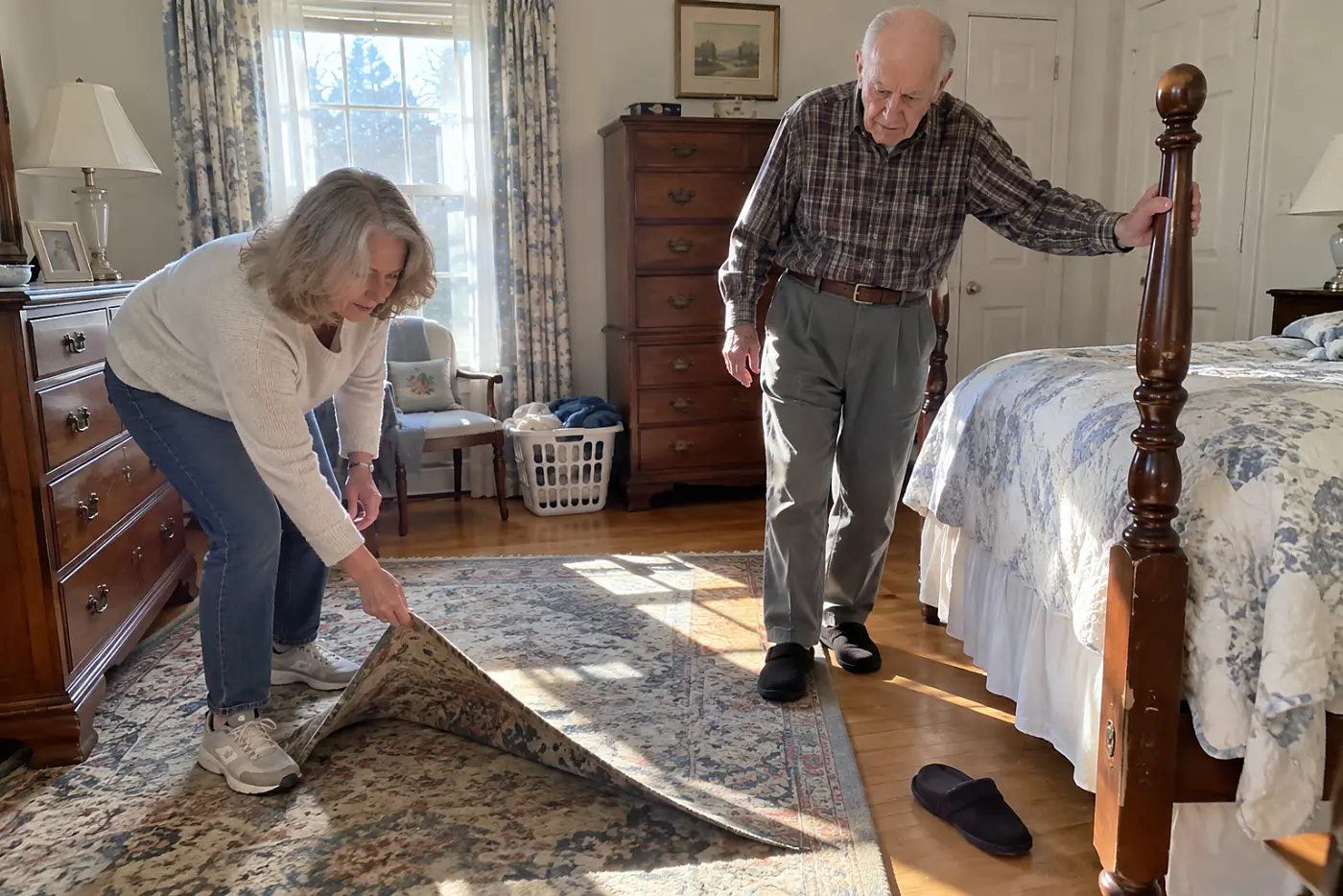
Safety arguments stall when they're framed as insults.
You mention the rug; a sibling hears that you're calling Dad incapable. Dad hears people discussing his bedroom without him. Meanwhile, the rug stays beside the bed, where he gets up at night.
A walk through the house gives everyone something specific to assess. The National Institute on Aging's falls and fractures guidance includes household hazards and prevention steps.
This week, ask Dad to walk his usual path from bed to bathroom with you. Say, “Can we move this rug and see whether the floor feels steadier?”
The harder argument begins when he says no.
13The answer Dad gives to your question

Disagreement with Dad does not prove he lacks capacity.
He has the right to make his own choices while he has decision-making capacity, including choices his children dislike. A sibling who wants to override him needs more than frustration or a frightening anecdote.
If his thinking has changed, the National Institute on Aging's memory and cognition guidance helps frame a conversation with a clinician. This week, record concrete changes, then say, “Dad, would you talk with your doctor about what happened Tuesday?”
A doctor's visit needs observations, not competing verdicts.
12The medication list with three versions

Different lists produce different stories about what happened.
Your sister has an old printout. You have bottles from the kitchen counter. The clinic has prescriptions in its chart, including ones Dad stopped taking. When he feels dizzy, each person points to a different pill.
The National Institute on Aging's medicines guidance recommends a current list of prescriptions, over-the-counter products, and supplements. Include dose and schedule, then have a clinician or pharmacist review changes.
This week, put the bottles and lists together before the next visit. Ask, “Which medicines belong on the current list, and which entries should we remove?”
After that, someone still has to explain what happened between visits.
11The doctor visit you attend alone

The person in the exam room becomes the family interpreter.
You listen, ask questions, and drive home. Then siblings challenge your summary because they didn't hear the doctor's words. Repeating everything from memory turns each call into a fresh argument about what was said.
Your parent decides who attends and what gets shared. That matters before a sibling demands details from an appointment they missed.
This week, ask your parent whom they want present and how they want updates shared. Take brief notes if they agree. Say, “Would you like me to write down the doctor's instructions for everyone, or keep this between us?”
Their answer sets the boundary for the next family demand.
10The portal password your sister requests

Being a sibling does not grant access to medical records.
A patient portal belongs to the patient. Giving out a password lets someone read messages and act through that account. Your parent chooses whom to authorize through the health system's process.
HHS guidance on HIPAA and personal representatives explains when a representative has a right to health information. A sibling's request alone establishes no such role.
This week, ask the clinic how your parent can authorize updates or portal access. Tell your sister, “I'll ask Mom what she wants shared and follow the clinic's process.”
Medical access does not answer who takes the next ride.
9The car keys passed without agreement

A borrowed car key is not a transportation plan.
One sibling drives once and expects thanks. You keep booking the rest because nobody agreed to another trip. Tuesday's ride gets remembered. The empty dates afterward stay on your calendar.
A clinic pickup needs more than a driver's name. Someone has to know the appointment time, travel time, and where your parent will wait.
This week, list upcoming trips with pickup and return times. Send the details to siblings who drive. Say, “Thanks for Tuesday; are you free for the first and third Fridays next month?”
The trip list reveals the errands nobody has mentioned.
8The chores hidden inside a visit

“Checking in” means different things to different siblings.
One person stops by for coffee. You arrive to wash sheets, refill the pillbox, and carry trash to the curb. Both visits get reported as visits, so the work looks equal.
Write chores separately from time spent with Mom. Ask her which ones she wants help with, rather than turning every visit into an inspection.
This week, list recurring jobs and their next due dates. Tell the family, “Coffee with Mom matters; the sheets still need washing. Who will take that job?”
Even a clear request can fail when a sibling says yes too quickly.
7The promised Sunday visit that vanishes

An unkept promise creates more work than an honest no.
You plan errands around the visit. When your brother cancels late, you handle his task and yours. Now you must rearrange your day as well. Next time, his name on the calendar gives you no confidence he'll arrive.
The lost time starts before Sunday. You kept that part of your schedule free because he had said yes.
This week, set a confirmation deadline for his visit. Arrange another option for any task that cannot wait. Say, “If Sunday won't work, tell me by Friday evening so I have time to make other arrangements.”
The next conversation needs to address why you were the automatic replacement.
6The old family roles at the table

Childhood jobs have a way of following you home.
If you were the organizer, siblings still hand you the forms. If your brother was the favorite, his brief appearance receives praise. Neither role says anything useful about who has time, authority, or skill today.
A meeting that starts with past grievances won't fill next week's gaps. Begin with the next four weeks of tasks and ask each person what they will take on, including remote work.
This week, send an agenda with decisions to make, not accusations to settle. Say, “We can talk about the past later; tonight we need to decide who has time for these jobs.”
One person at that table still wants the last word.
5The cousin invited to settle everything

A larger audience rarely makes the facts clearer.
A cousin hears different versions and starts judging who sounds fair. Your parent gains another person discussing private details, while the next prescription still needs pickup. The cousin's view of the argument doesn't get that prescription home.
Adding a relative also changes what your parent is being asked to share. Ask before sending them medical or money details.
This week, ask your parent whom they want included. Invite the cousin to take a specific errand if your parent agrees. Say, “I'd welcome help with Saturday's groceries; I don't want to turn this into a family vote.”
When agreement fails, choose a narrower question.
4The mediator asked to pick a winner

Mediation works on decisions, not a verdict about character.
A mediator helps people set an agenda, hear each other, and put agreements in writing. The process does not make an unwilling sibling loving or available. It gives the family a place to settle a specific dispute without making you referee.
The National Center for State Courts has information on court-connected mediation; private options exist too. Ask about fees, confidentiality, and who must attend before booking anything.
This week, write down one dispute with a decision attached, such as payment for an aide. Tell your siblings, “If we can't agree on this bill, I'm willing to discuss it with a mediator.”
The decision still has to survive the next crisis.
3The care meeting without written decisions

A good conversation evaporates by Monday.
Everyone remembers offering something. Nobody remembers what they agreed to pay, when to call, or where their responsibility ends. You become the person settling those arguments because you held the whole conversation in your head.
The missing detail has a cost. By the next appointment, siblings are disputing the meeting instead of doing the work they discussed.
This week, send a short recap of decisions and open questions soon after the meeting. Include dates and any spending limits discussed. Say, “Please tell me what I've got wrong tonight, before we act on this.”
Then check what the person needing care was told.
2The plan made without your parent

A tidy schedule still fails if Mom rejects it.
Your mother might refuse the aide everyone chose or want a different child at appointments. Siblings then argue over enforcing a plan she never accepted. You carry the fallout because you're there when she objects.
The Administration for Community Living's Eldercare Locator points families toward local aging services when your calendars aren't enough. Start by asking what help your parent wants and will accept.
This week, show your parent the proposed schedule before calling it final. Ask, “Which parts work for you, and what would you change?”
Her answer still leaves one hard question about work nobody accepts.
1The unclaimed-task protocol before the next deadline

Silence turns an unclaimed job into yours again.
After everyone has had a chance to take a task, a blank remains. If you erase it by doing the work, nobody else has to decide whether the family needs paid help or a different arrangement. First, check what your parent wants. Then tell the family which job is still uncovered.
The deadline matters. A Friday pickup cannot wait for another vague promise on Saturday. Neither can a medicine pickup needed tonight. If there's an immediate safety concern, deal with that now; the family dispute comes afterward.
This week, identify the next time-sensitive task nobody has accepted and set an answer deadline. Say, “Thursday's pickup is uncovered. I can't take it. Who will do it, or should we arrange another ride by Wednesday evening?”
Write down the answer, including “no answer.” The steps after the bottom line show what to do with that blank.
The bottom line
These fights grow when visible visits get counted and invisible work stays yours.
The best-prepared version of you has checked your parent's wishes and recorded what others agreed to do. You know which jobs are still open.
Which of these has already happened in your family?
Bonus: The unclaimed-task protocol before the next deadline
- Write down the uncovered task, its deadline, and what your parent wants.
- Tell everyone what you cannot cover. Say, “I can't take Thursday's pickup. Who is available?”
- Set an answer deadline early enough to arrange another option. Ask for a clear yes or no.
- If nobody accepts, tell your parent what remains uncovered. Discuss another ride, paid help, or a changed appointment with them.
- Record the decision where everyone involved can see it. Don't turn silence into your name.
Margaret Hale
Travel & Lifestyle Editor
Margaret has covered travel for 25 years and has ridden every long-distance train route in the U.S. at least once.
You might also like